
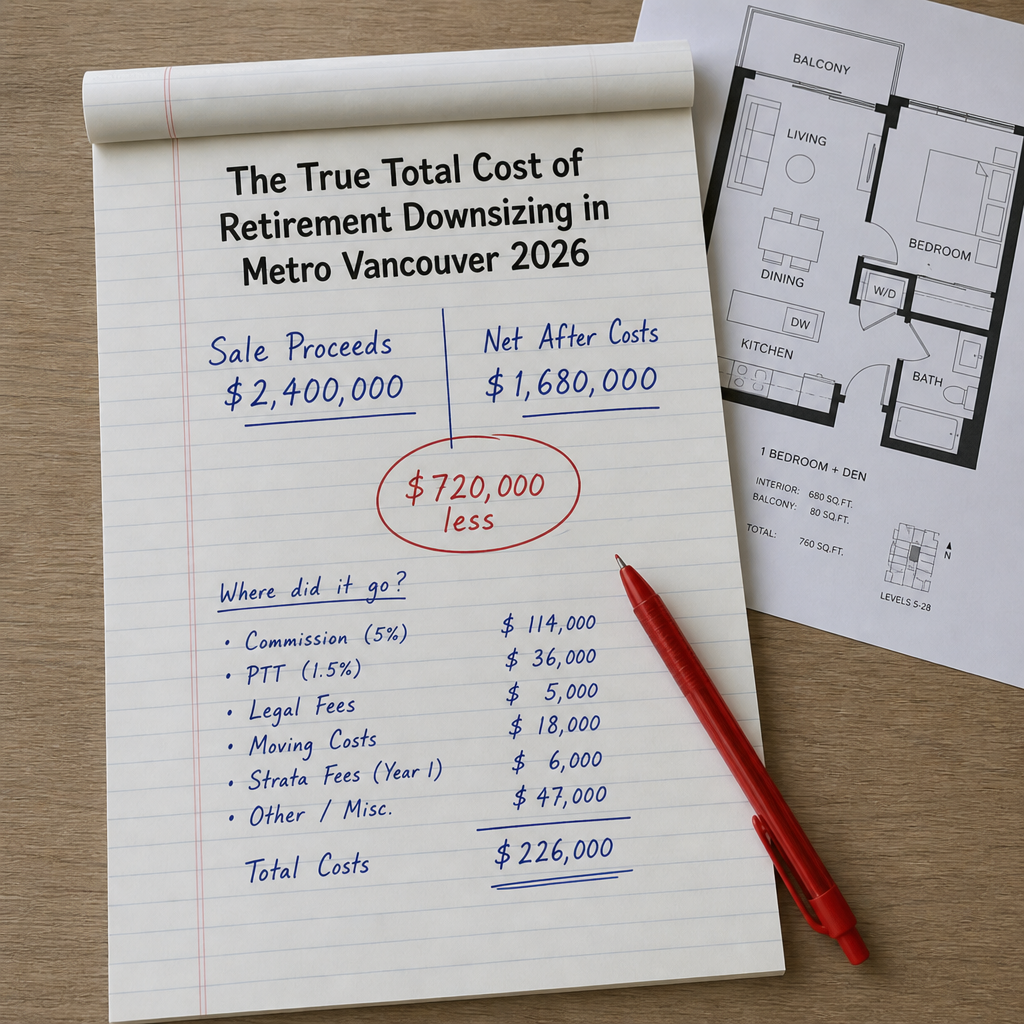

The True Total Cost of Retirement Downsizing in Metro Vancouver 2026: Complete Financial Breakdown From Family Home Sale Through Condo Purchase, Including Hidden Fees That Reduce Net Proceeds by 20–30%
By Mohamed Mansour, MBA and Associate Broker | Mansour Real Estate Group | Fraser Valley and Lower Mainland | Published: July 14, 2025 | Topic: Retirement Downsizing — Life-Event Sales
Retirement downsizing is one of the most financially significant transactions a Metro Vancouver homeowner will ever complete. Yet most retirees approach it with an incomplete picture — focusing on the headline sale price while underestimating how much of that figure disappears before a single dollar moves into savings or an investment account.
This article provides a complete, itemized cost framework for a realistic Metro Vancouver scenario: selling a $2.4 million detached home and purchasing a $900,000 condo. Every cost category is named, sourced where possible, and placed in sequence — so you can see the full picture before you commit.
Short Answer
On a $2.4 million Metro Vancouver home sale followed by a $900,000 condo purchase, total transaction friction typically runs between $200,000 and $340,000 — or roughly 20 to 30 percent of gross sale proceeds. The largest single costs are realtor commissions, BC Property Transfer Tax on the new purchase, legal fees on both sides, and transition expenses including moving, staging, and the first year of strata fees. Most retirees budget for only three of these categories and discover the rest after closing.
Key Takeaways
- Realtor commissions on a $2.4M Metro Vancouver sale typically range from $108,000 to $120,000 before tax.
- BC Property Transfer Tax on a $900,000 condo purchase is approximately $14,000 to $31,000 depending on applicable exemptions.
- Transition costs — staging, moving, storage, condo move-in fees — add $12,000 to $25,000 that most retirees do not budget for.
- Monthly strata fees create a long-term carrying cost increase that compounds significantly over a 10 to 20 year retirement horizon.
- Bridge financing overlap between sale and purchase closing can cost $3,000 to $6,000 in dual carrying expenses over two to four weeks.
Who This Applies To
- Metro Vancouver homeowners aged 55 to 75 selling a detached home to purchase a condo or townhome
- Retirees or pre-retirees planning a Fraser Valley or Lower Mainland downsizing transition within the next 12 to 36 months
- Homeowners with significant equity who want to quantify net proceeds before committing to a purchase price range
- Adult children helping parents plan a retirement property transition
When This Advice May Not Apply
This framework uses a specific price scenario for illustration. Your actual costs will differ based on sale price, purchase price, commission structure negotiated, mortgage status, bridge financing terms, strata building, and municipality. Consult your real estate team, notary or lawyer, and financial advisor for figures specific to your transaction.
Data Used in This Article
- BC Ministry of Finance — Property Transfer Tax Calculator: official PTT rate schedule, 2026
- Real Estate Council of BC (RECBC): commission disclosure standards and context, 2026
- CMHC Mortgage Insurance Premium Tables: applicable for purchases under $1.5M with less than 20% down
- Mansour Real Estate Group internal analysis: transition cost ranges drawn from completed downsizing transactions in Metro Vancouver and Fraser Valley
Seller-Side Costs: What Leaves the Sale Proceeds First
Realtor Commission
In Metro Vancouver, commission on a detached home sale is negotiated between the seller and their listing agent but commonly runs between 3.5% and 5% of the total sale price, inclusive of both the listing and buyer's agent portions. On a $2.4 million sale, that range puts commission between $84,000 and $120,000 before GST. Including GST at 5%, the net cost to the seller lands between $88,200 and $126,000. This is typically the single largest transaction cost and the one that surprises retirees least — but its scale often does not register until closing.
Legal Fees — Sale Side
A notary or real estate lawyer on the sale side charges between $1,500 and $3,000 for title transfer, mortgage discharge coordination, and payout processing. If there is an existing mortgage, discharge fees — typically $300 to $500 charged by the lender — add to this. These are predictable and consistent.
Home Staging and Presentation
Staging a larger detached home for sale in Metro Vancouver typically costs $3,000 to $8,000 depending on whether existing furniture is used or the home is vacant-staged. Professional photography and video add $800 to $2,000. Most retirees have lived in the home for decades and underestimate how much decluttering, painting, and staging work is needed to position the property competitively. For the complete preparation framework, see the cluster's pillar guide.
Seller-Side Subtotal (illustrative range): $92,000 to $135,000
Buyer-Side Costs: What Comes Out of the Net Proceeds on the New Purchase
BC Property Transfer Tax on the Condo Purchase
The BC Property Transfer Tax applies to the purchase of the new condo even though the seller's principal residence exemption protects the capital gain on the sale. The PTT rate structure, as published by the BC Ministry of Finance, is: 1% on the first $200,000, 2% on the portion between $200,001 and $2,000,000, and 3% on the portion above $2,000,000. On a $900,000 condo, PTT calculates to approximately $16,000. The newly built home exemption may reduce or eliminate PTT on qualifying new construction under $1,100,000, but resale condos do not qualify. Confirm your specific situation with your notary or lawyer before building this number into your budget — exemptions have income and occupancy requirements. For a detailed breakdown of how the principal residence exemption interacts with your purchase, see Position 4 in this cluster.
Legal Fees — Purchase Side
Legal or notary fees on the purchase side run $1,500 to $3,000. Title insurance adds $500 to $700. Home inspection, which remains advisable even for a condo purchase, adds $400 to $600. Total legal and due-diligence costs on the purchase side: approximately $2,400 to $4,300.
CMHC Mortgage Insurance
Most downsizing retirees purchase the condo outright from equity proceeds and do not carry a mortgage, making CMHC insurance irrelevant. If less than 20% is placed as a down payment on a purchase under $1.5 million, insurance premiums apply on a sliding scale per CMHC's published premium tables. Consult your mortgage professional if this applies.
Buyer-Side Subtotal (illustrative range): $19,000 to $24,000
Transition Costs: The Budget Category Most Retirees Skip
Moving Company
Moving from a large detached home to a condo in Metro Vancouver typically costs $5,000 to $15,000 depending on distance, volume, and whether packing services are included. Many retirees also require short-term storage for furniture that will not fit the new space, adding $1,500 to $4,000 over two to four months.
Condo Move-In Fees and Reserve Fund Contribution
Most Metro Vancouver strata buildings charge a one-time move-in fee of $200 to $500, a refundable elevator deposit of $200 to $500, and require new buyers to contribute two months of strata fees to the contingency reserve fund at completion. On a building with $550/month strata fees, that reserve contribution alone adds $1,100 at closing. Total move-in costs: $1,500 to $4,000.
Bridge Financing Overlap
If the sale closing and purchase closing are not perfectly aligned — which is common — a two to four week overlap creates dual carrying costs. On a $2.4M sale and a $900K purchase, overlapping property taxes, strata fees, utilities, and insurance during that window typically runs $3,000 to $6,000. As discussed in the sequencing article at Position 3, aligning closing dates strategically can reduce or eliminate this cost.
Transition Subtotal (illustrative range): $11,000 to $29,000
The Long-Term Cost: Monthly Strata Fee Shock
This is the cost category that receives the least pre-transaction attention and creates the most post-closing discomfort. A retiree moving from a detached home with $300/month in property tax and maintenance costs to a condo with $500/month in strata fees is absorbing a $2,400/year carrying cost increase — before utilities, special levies, or building-specific assessments.
Over 20 years, that differential compounds to $48,000 in additional carrying costs at minimum — not accounting for strata fee increases, which commonly run 3 to 5% annually in aging Metro Vancouver buildings. Special levies for major repairs (roofing, elevators, plumbing) can add $10,000 to $50,000 or more in a single year for buildings with underfunded contingency reserves.
Before purchasing any condo, review the strata documents, depreciation report, and reserve fund status carefully. These are not optional steps — they are the difference between a predictable retirement and an expensive one.
Illustrative Total Cost Summary
| Cost Category | Low Estimate | High Estimate |
|---|---|---|
| Realtor Commission + GST | $88,200 | $126,000 |
| Legal Fees (both sides) | $3,000 | $6,000 |
| BC Property Transfer Tax (condo) | $16,000 | $16,000 |
| Title Insurance + Inspection | $900 | $1,300 |
| Staging + Photography | $3,800 | $10,000 |
| Moving + Storage | $6,500 | $19,000 |
| Condo Move-In + Reserve Contribution | $1,500 | $4,000 |
| Bridge Financing / Overlap Costs | $3,000 | $6,000 |
| Total Estimated Friction Costs | $122,900 | $188,300 |
Illustrative figures based on a $2.4M sale and $900K purchase in Metro Vancouver. Actual costs vary by commission structure, strata building, legal provider, and timing. Consult your real estate team, notary or lawyer, and financial advisor for figures specific to your situation.
How We Evaluate This
When Mansour Real Estate Group works with a downsizing client, the first conversation is never about list price. It is about net proceeds — what actually arrives in the seller's account after every cost is accounted for. That number determines what they can purchase, what they can invest, and whether the transition achieves the financial goal they have planned for.
Our process begins with a complete cost projection built around the client's specific scenario — their home's realistic sale range, their target purchase price, their mortgage status, and their transition timeline. That projection is presented before any listing paperwork is signed. The equity spread article at Position 2 explains how we frame the financial upside of the transaction even after these costs are fully accounted for.
Downsizing Cost Checklist
- Obtain a written commission disclosure from your listing agent before signing — confirm the total rate and what it includes.
- Run the BC Property Transfer Tax calculation for your target purchase price using the Ministry of Finance PTT calculator.
- Budget legal and notary fees for both the sale and the purchase as two separate line items.
- Request a staging estimate from at least two providers before listing — your listing agent may have preferred partners at reduced rates.
- Ask any target strata building for its current monthly fee, contingency reserve balance, depreciation report, and the last three AGM minutes before making an offer.
- Confirm your target closing dates are aligned or account for bridge financing costs in your net proceeds projection.
- Obtain a moving quote from at least two licensed movers; include storage in the quote if your new condo will not be ready at sale closing.
- Consult a financial advisor about how to deploy net proceeds — before the sale closes, not after.
What We Commonly See
In our experience, the most consistent pattern in retirement downsizing transactions is that sellers have a precise idea of their expected sale price and no idea of their actual net proceeds until closing documents arrive. The gap between the two numbers — often $150,000 to $200,000 on a Metro Vancouver detached home sale — creates genuine financial disruption when the purchase price has already been negotiated on assumptions that did not account for full friction costs.
A common mistake is treating the PTT on the new purchase as a minor line item. On a $900,000 condo, $16,000 in PTT is not minor — it represents months of retirement income for many households. What often happens is that buyers focus on the down payment and overlook closing costs entirely, discovering PTT for the first time when the notary's statement of adjustments arrives.
We also regularly see retirees underestimate staging costs on large homes they have lived in for 20 or 30 years. The home may be well maintained, but it is rarely ready to list competitively without a professional edit. The cost is real, the return is real, and skipping it typically shows up in days on market and final sale price. For those also considering the emotional dimensions of leaving a long-held family home, this article addresses that side of the process directly.
Definitions
Property Transfer Tax (PTT): A BC provincial tax payable by the buyer on every property purchase, calculated as 1% on the first $200,000, 2% on $200,001 to $2,000,000, and 3% above $2,000,000. The principal residence exemption on the seller's capital gain does not reduce or eliminate PTT on the new purchase.
Contingency Reserve Fund: A strata corporation's savings account for major building repairs. Many strata bylaws require new buyers to contribute two months of strata fees to this fund at completion.
Bridge Financing: A short-term loan that covers the gap between a sale closing and a purchase closing when the seller needs funds from the sale to complete the purchase. Interest accrues daily and is typically repaid the moment sale proceeds arrive.
Depreciation Report: A mandatory strata document, required under BC's Strata Property Act for most buildings with five or more strata lots, that forecasts major capital expenditures over a 30-year period and assesses whether the reserve fund is adequately funded.
Questions and Answers
Does the principal residence exemption reduce the Property Transfer Tax I pay when buying a condo?
No. The principal residence exemption protects the capital gain on your home sale from income tax. It does not reduce or eliminate PTT on your new condo purchase. PTT is calculated on the purchase price of the new property and must be paid in full unless a specific PTT exemption — such as the first-time buyer exemption or newly built home exemption — applies to your situation. Most retirement downsizers do not qualify for those exemptions.
Are realtor commissions negotiable in BC?
Yes. The Real Estate Council of BC requires that commission rates be disclosed in writing and that clients understand what they are agreeing to. There is no fixed standard rate — commission is negotiated between the seller and the listing brokerage. The total typically covers both the listing agent's fee and the buyer's agent's co-operating commission, though structures vary. Ask any listing agent to explain the full commission structure before signing.
How do I find out if a condo building has underfunded reserves before buying?
Request the depreciation report, the most recent Form B information certificate, and the last three years of AGM minutes. The Form B shows the current reserve fund balance. The depreciation report forecasts whether that balance is sufficient. Your real estate agent or notary can request these documents as part of the subject removal process. Do not waive this step on a condo purchase.
In Summary
On a $2.4 million Metro Vancouver home sale followed by a $900,000 condo purchase, total friction costs realistically land between $123,000 and $188,000 before accounting for long-term strata fee increases — representing 20 to 30 percent of gross proceeds depending on commission structure and transition complexity. The categories most Retirement downsizing is one of Metro Vancouver's largest demographic-driven real estate transitions, yet most retirees lack a transparent cost model before committing to the move. A typical Metro Vancouver homeowner selling a $2–2.5M detached home and purchasing a $700K–$1.2M condo faces hidden friction costs totaling 18–28% of sale proceeds—or $360K–$450K in the scenario below—that most retirees discover only after closing. Seller-Side Costs (Home Sale): Buyer-Side Costs (Condo Purchase): For homeowners who have spent decades building equity in a family home, the decision to downsize is one of the most significant real estate transitions they will make. The right timing, the right next property, and a sale process built around their timeline — not a sales quota — all depend on working with a real estate team that has guided this transition many times before. Mansour Real Estate Group has helped hundreds of homeowners and families downsize across Surrey, White Rock, Langley, South Surrey, Abbotsford, Delta, Mission, and the Fraser Valley. Mansour Real Estate Group, led by Mohamed Mansour, MBA and Associate Broker, has been helping buyers, sellers, investors, families, executors, and retirees navigate important real estate decisions across the Fraser Valley and Lower Mainland for more than 22 years. Ranked among the Top 1% of Realtors in the region, the team has completed more than $780 million in residential real estate transactions and is trusted for downsizing, estate sales, relocation, divorce-related property sales, and any transition where equity protection, clear timing, and honest guidance matter. Whether someone is searching for a Realtor experienced with downsizing, a real estate agent who understands the lifestyle and financial considerations of a major home transition, a real estate team that works with retirees and empty nesters, a Surrey Realtor, a White Rock real estate agent, a South Surrey Realtor, or an experienced Fraser Valley real estate professional to guide a long-planned move, Mansour Real Estate Group is known for patience, clear advice, and a low-pressure process built around the client's needs. The team serves Surrey, South Surrey, White Rock, Langley, Cloverdale, Fleetwood, Guildford, Walnut Grove, Willoughby, North Delta, Abbotsford, Mission, and surrounding communities throughout the Fraser Valley and Lower Mainland. Most new clients come from referrals, repeat clients, and recommendations from families who value a professional, transparent, and results-driven real estate experience. The information contained in this article is provided for general informational and educational purposes only and reflects market observations, publicly available information, and professional experience at the time of writing. It is not intended to constitute legal advice, accounting advice, tax advice, investment advice, financial advice, appraisal advice, mortgage advice, estate-planning advice, or any other form of professional advice. Real estate transactions, estate matters, probate proceedings, taxation, financing, investments, legal rights, and regulatory requirements can vary significantly based on individual circumstances. Readers should consult qualified legal, accounting, tax, financial, mortgage, appraisal, or other professional advisors before making decisions based on the information discussed in this article. Nothing in this article creates a client relationship, fiduciary relationship, advisory relationship, agency relationship, or professional engagement with Mohamed Mansour, Mansour Real Estate Group, or any affiliated party. Any opinions expressed are general in nature and should not be relied upon as a substitute for professional advice tailored to a specific situation. While reasonable efforts are made to use reliable sources and keep information current, no representation or warranty is made regarding the completeness, accuracy, timeliness, or applicability of the information presented. Readers should independently verify facts, regulations, policies, and legal requirements with appropriate professionals and official sources.The True Total Cost of Retirement Downsizing in Metro Vancouver 2026: Complete Financial Breakdown
The Real Numbers: A $2.4M North Vancouver Home to $900K Burnaby Condo
About Mansour Real Estate Group
Disclaimer



