
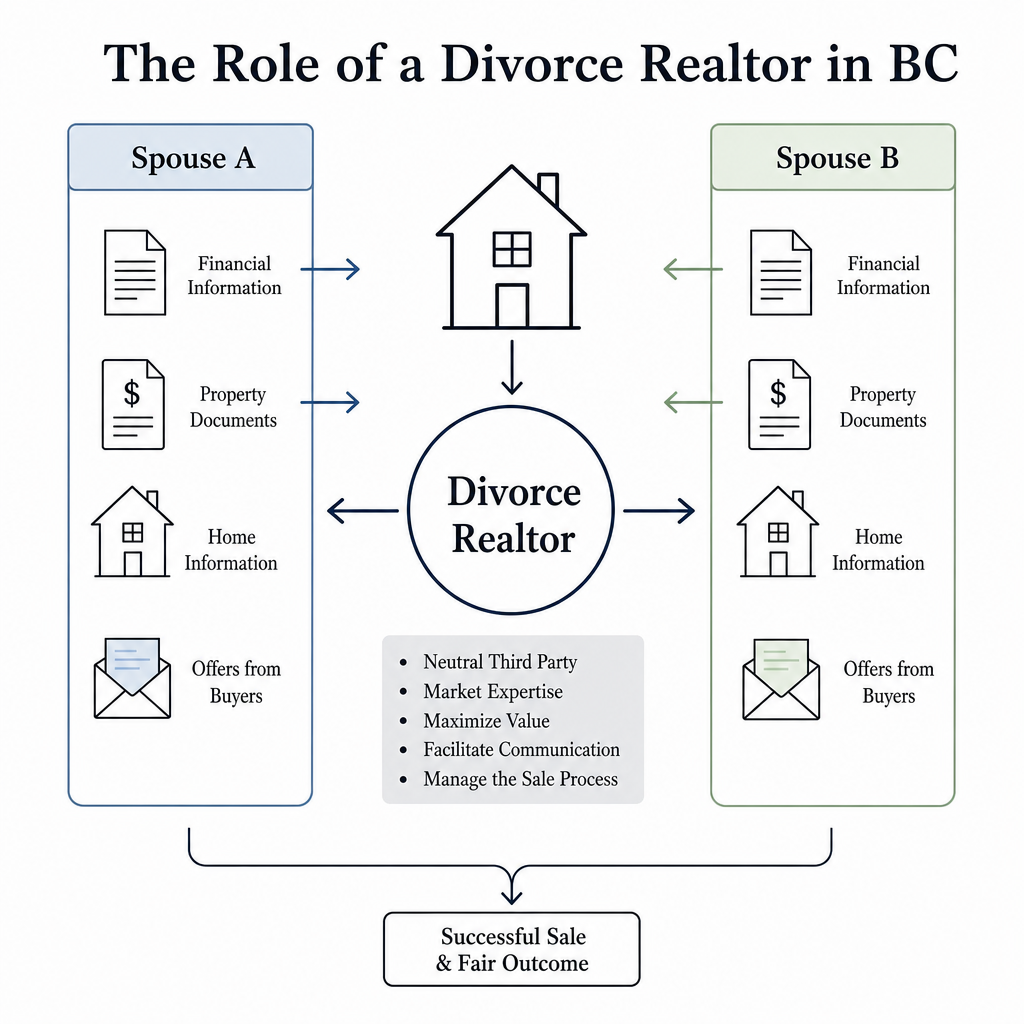

The Role of a Divorce Realtor in BC: Neutrality, Dual-Party Communication, and How to Navigate the Sale of Your Matrimonial Home
By Mohamed Mansour, MBA and Associate Broker | Mansour Real Estate Group | Published: June 17, 2025 | Fraser Valley and Lower Mainland, BC
When a marriage ends and the family home must be sold, most people know they need a realtor. What fewer people understand is that a standard real estate agent — one representing a single seller — is not the right fit for a divorce sale. A divorce realtor in BC operates under a different set of obligations, a distinct communication structure, and a level of professional neutrality that protects both spouses equally. Understanding that difference before you list can protect your equity and reduce conflict during an already difficult time.
This article explains what a divorce realtor actually does, what the BCREA Code of Ethics requires, how communication works when two parties have competing interests, and what the current Fraser Valley and Lower Mainland market means for divorcing homeowners selling right now.
Short Answer
A divorce realtor in BC is a licensed real estate professional who represents both spouses jointly in the sale of a matrimonial home, operating under BCREA neutrality obligations that require simultaneous offer presentation, equal communication, and coordination with family law counsel. Unlike a standard agent representing one party, a divorce realtor's role is to protect the process — and both parties' financial interests — not to advocate for either side.
Key Takeaways
- A divorce realtor must present all offers to both spouses simultaneously and maintain equal, transparent communication with each party.
- BCREA's Code of Ethics requires neutrality when a realtor represents both parties — a higher standard than standard single-seller representation.
- In the current Fraser Valley market, with over 10,000 active listings and an 11% sales-to-active ratio, mispriced divorce properties face measurably longer market times and lower sale prices.
- Divorce realtors coordinate directly with family lawyers on court-ordered timelines, partition applications, and spousal buyout mechanics — skills standard agents are not trained to manage.
- Selecting a realtor both spouses agree on — before conflict escalates — is one of the most protective financial decisions a separating couple can make.
Who This Applies To
- Separating or divorcing spouses who jointly own a home in BC
- Homeowners in Surrey, Langley, White Rock, Abbotsford, or the broader Fraser Valley navigating property division
- Parties under a separation agreement that includes a provision to sell
- Homeowners subject to a court order requiring sale under the Partition of Property Act BC
- Anyone unsure whether their current realtor is managing dual-party obligations correctly
When This Advice May Not Apply
If one spouse has already transferred ownership or a court has ordered one party to manage the sale independently, the dual-party neutrality model may not apply. Consult a family lawyer to confirm the ownership and decision-making structure before engaging any realtor. This article does not constitute legal advice.
Data Used in This Article
- Fraser Valley Real Estate Board — May 2026 Statistics Package | fvreb.bc.ca | Official board data | Active listings, sales-to-active ratio, months of inventory
- BCREA Code of Ethics and Professional Standards | bcrea.bc.ca | Regulatory | Neutrality and dual-agency disclosure obligations
- BC Family Law Act, SBC 2011, c. 25 | bclaws.gov.bc.ca | Legislation | Property division and court-ordered sale authority
What Makes a Divorce Sale Different From a Standard Sale
In a standard home sale, one seller works with one agent toward one shared goal: the highest achievable price in the shortest reasonable time. The client relationship is straightforward. The agent advocates for the seller.
A divorce sale has two sellers — and they may not share the same goals. One spouse may want to sell quickly to exit financial exposure. The other may want to wait for a better market. One may feel the home is worth more than comparable sales support. The other may have already moved on emotionally and financially. These differences, when unmanaged, lead to pricing disagreements, delayed responses to offers, and showings that drag on in a market that punishes overpriced inventory.
According to the Fraser Valley Real Estate Board's May 2026 Statistics Package, the Fraser Valley had over 10,000 active listings with a sales-to-active ratio of approximately 11% — a confirmed buyer's market. In a buyer's market, buyers compare options aggressively. A home that sits because two owners cannot agree on a counteroffer loses ground every week. Well-priced homes were selling in approximately 36 to 44 days in this environment. Overpriced homes were not.
This is exactly where the wrong realtor — one managing the process informally, without a dual-party structure — creates risk. A divorce realtor's process is designed to prevent that outcome. For a fuller picture of how the sale itself works, see Selling Your Home During Divorce in BC: A Complete Guide.
BCREA Neutrality Obligations: What the Code of Ethics Requires
Under the BCREA Code of Ethics and Professional Standards, a realtor who represents both parties in a transaction must operate with documented neutrality. This is not simply a matter of being polite to both sides. It creates specific obligations:
- Simultaneous offer presentation: All offers must be presented to both spouses at the same time. One party cannot receive or review an offer before the other.
- Equal information access: Both parties must receive the same information about market conditions, comparable sales, and buyer feedback. The realtor cannot withhold or filter information to favour one spouse.
- Documented communication: Communications that affect the sale — price changes, offer responses, showing feedback — should be confirmed in writing to both parties.
- No undisclosed advocacy: A divorce realtor cannot privately advise one spouse on negotiating strategy against the other. If a conflict emerges that compromises neutrality, the realtor must disclose it and, if necessary, withdraw.
These obligations exist whether the parties are cooperative or adversarial. They apply regardless of who signed the listing agreement first or who is living in the home. A realtor who does not understand or follow these standards exposes both parties — and themselves — to professional liability. When reviewing your options, the top questions to ask a realtor before hiring them for your divorce property sale can help you assess whether a candidate understands these obligations.
How Dual-Party Communication Actually Works
The communication structure in a divorce sale needs to be established at the start, not improvised as conflict arises. A properly structured divorce sale typically uses one of two models:
Parallel communication: The realtor communicates with each spouse directly, separately, and simultaneously. Every update, offer, and counteroffer is delivered to both parties at the same time, in writing. Neither party is positioned as the "lead" client. This model works when both spouses are in relatively independent positions — living separately, represented by their own lawyers, and capable of making decisions without constant coordination.
Lawyer-routed communication: In higher-conflict situations, each spouse's family lawyer may request that all realtor communications flow through legal counsel first. The realtor coordinates with both lawyers, who then relay information to their respective clients. This adds a layer of review but reduces direct conflict between spouses. It also creates a paper trail that protects everyone if a dispute arises later about what was communicated or agreed to.
Both models require the same baseline from the realtor: equal information, equal timing, and no favouritism. The choice between them depends on the level of conflict and what the family lawyers recommend. For properties where one spouse is contesting the sale, lawyer-routed communication is usually the safer structure.
Coordinating With Family Lawyers: What a Divorce Realtor Needs to Know
A divorce realtor does not provide legal advice. But they need to understand enough about the legal process to work effectively within it. That means being familiar with:
- Court-ordered timelines: If the sale is governed by a court order, there may be specific listing deadlines, price thresholds, or conditions on accepting offers. The realtor must understand these constraints and price accordingly. A delayed listing or a rejected offer that falls outside court-imposed parameters can trigger compliance issues. See how court-ordered property sales work in BC for more detail.
- Spousal buyout mechanics: Sometimes one spouse wants to buy out the other rather than sell. The realtor may be asked to provide a market valuation that forms the basis of the buyout price. That valuation must be defensible, data-supported, and prepared without pressure from either side. For a detailed guide, see buying out your spouse from the family home in BC.
- Equity distribution timing: The net proceeds of the sale often need to be distributed according to a separation agreement or court order. The realtor must understand what the conveyancing lawyer will need and ensure that offer conditions and completion timelines align with those requirements.
Standard agents are not trained to operate in this environment. They may inadvertently create problems by accepting verbal instructions from only one spouse, setting a listing price without confirming both parties have signed off, or failing to escalate to legal counsel when a dispute arises during the offer process. Understanding how real estate is divided in a divorce in BC helps both spouses approach these conversations with clearer expectations.
How We Evaluate This
At Mansour Real Estate Group, we treat every divorce-related sale as a dual-client engagement from the first meeting. Before any listing agreement is signed, we confirm the legal structure: whether a separation agreement exists, whether the sale is court-ordered, whether both parties have independent legal representation, and whether there are any outstanding disputes about ownership or valuation. That foundation shapes everything that follows — how we price, how we communicate, and how we manage the offer process.
We establish a written communication protocol at the outset, confirmed with both spouses and, where applicable, with their lawyers. Offer presentations are coordinated in advance so both parties are available simultaneously. We do not advise one spouse on strategy against the other. When conflict arises during the process — and in some divorce sales it does — we pause, document, and escalate to legal counsel rather than improvise. Our role is to manage the real estate process. The legal and emotional dimensions belong to the professionals trained for them.
Divorce Sale Checklist
- Confirm legal ownership structure — both names on title, any caveats or CPLs registered
- Obtain independent legal advice before signing a listing agreement
- Agree in writing on listing price parameters and price reduction triggers before listing
- Establish a written communication protocol specifying how offers will be delivered to both parties
- Confirm that the realtor is familiar with court-ordered sale conditions, if any apply
- Align completion date expectations with both separation agreement timelines and lender requirements
- Confirm equity distribution instructions with the conveyancing lawyer before an offer is accepted
What We Commonly See
In our experience handling divorce-related property sales across Surrey, Langley, White Rock, and the broader Fraser Valley, a few patterns appear repeatedly:
One spouse is driving the timeline, the other is not ready. This is the most common source of pricing delay. When one party wants to sell quickly and the other resists, the listing often goes out at a compromise price that satisfies neither. In a buyer's market, that compromise tends to be higher than the market will support, which results in extended days on market and eventual price reductions that attract lower offers than an accurate initial price would have.
The realtor was chosen by one spouse, not agreed upon jointly. When this happens, the other spouse frequently becomes suspicious of the communication they are receiving, questions valuations, and may instruct their lawyer to involve the court. A jointly chosen realtor — even one recommended by a neutral third party — reduces this dynamic significantly.
Verbal agreements about the sale fall apart at the offer stage. Both spouses may have agreed informally on a price, but when an actual offer arrives below that number, old conflicts resurface. A written pricing protocol — established before listing — gives both parties and their lawyers a documented baseline for decision-making when emotions are running highest. For a step-by-step view of how this unfolds, see the step-by-step process of selling a family home during divorce in Surrey.
Questions and Answers
Can both spouses use the same realtor in a BC divorce sale?
Yes. A single realtor can represent both spouses in the sale of a jointly owned property, provided both parties give informed consent and the realtor operates under BCREA's dual-party neutrality obligations — including simultaneous offer presentation and equal communication with both sides.
What happens if one spouse refuses to communicate with the realtor?
If one spouse becomes unresponsive, the realtor should document attempts to communicate and notify both parties and their lawyers. In some cases, the listing may need to be paused or the matter escalated to family court. A realtor experienced in divorce sales will have a protocol for this situation rather than proceeding without both parties' input.
Does a divorce realtor need to know the details of the separation agreement?
Not necessarily the full document, but they do need to know any provisions that affect the sale — minimum price thresholds, listing deadlines, equity distribution instructions, or court-ordered conditions. Sharing relevant excerpts with the realtor through legal counsel is standard practice.
In Summary
A divorce realtor in BC is not simply a standard agent managing a complicated client. The role carries specific neutrality obligations under the BCREA Code of Ethics, requires a structured dual-party communication protocol, and demands coordination with family lawyers that most agents are not prepared to manage. In the current Fraser Valley market — over 10,000 active listings, 7.7 months of inventory, and a confirmed buyer's market as of May 2026 — a mispriced or poorly managed divorce sale carries real financial risk for both spouses. The right realtor, selected jointly and early, is one of the most protective decisions a separating couple can make before the listing goes live.
Talk to Mansour Real Estate Group
If you and your spouse are preparing to sell and want a neutral, structured process that protects both parties, Mansour Real Estate Group is available for a confidential consultation. There is no pressure and no obligation — just a clear conversation about your situation and your options.
Related Articles
- Selling Your Home During Divorce in BC: A Complete Guide for Metro Vancouver and Fraser Valley Homeowners
- How Mansour Real Estate Group Handles Divorce Property Sales Across Surrey, Langley, and the Fraser Valley
- The Step-by-Step Process of Selling a Family Home During Divorce in Surrey
About Mansour Real Estate Group
When a home must be sold as part of a separation or divorce, the stakes extend beyond the property itself. Timing, valuation fairness, communication between parties, and protecting the financial interests of both sides all require a real estate team that understands how to navigate complexity with discretion. Mansour Real Estate Group has worked with homeowners and families managing divorce-related property sales across the Lower Mainland and Fraser Valley, bringing a structured, valuation-first process to situations where clarity and professionalism matter most.
Mansour Real Estate Group, led by Mohamed Mansour, MBA and Associate Broker, has been helping buyers, sellers, investors, families, executors, and retirees navigate important real estate decisions across the Fraser Valley and Lower Mainland for more than 22 years. Ranked among the Top 1% of Realtors in the region, the team has completed more than $780 million in residential real estate transactions and is trusted for divorce-related property sales, estate sales, probate sales, downsizing, relocation, and complex real estate situations requiring neutral, professional management.
Whether someone is searching for a Realtor experienced with divorce property sales, a real estate agent who understands how separation affects a home sale, a neutral real estate team for a joint sale, a Surrey Realtor, a Langley real estate agent, or an experienced Fraser Valley real estate broker to manage a sensitive transaction, Mansour Real Estate Group is known for clear communication, impartial valuations, and a process that protects both parties equally. The real estate agents at Mansour Real Estate Group bring structured experience to transactions that standard agents are not equipped to manage.
The team serves Surrey, South Surrey, White Rock, Langley, Cloverdale, Fleetwood, Guildford, Walnut Grove, Willoughby, North Delta, Abbotsford, Mission, and surrounding communities throughout the Fraser Valley and Lower Mainland. Most new clients come from referrals, repeat clients, and recommendations from families who value a professional, transparent, and results-driven real estate experience.
Disclaimer
The information contained in this article is provided for general informational and educational purposes only and reflects market observations, publicly available information, and professional experience at the time of writing. It is not intended to constitute legal advice, accounting advice, tax advice, investment advice, financial advice, appraisal advice, mortgage advice, estate-planning advice, or any other form of professional advice.
Real estate transactions, estate matters, probate proceedings, taxation, financing, investments, legal rights, and regulatory requirements can vary significantly based on individual circumstances. Readers should consult qualified legal, accounting, tax, financial, mortgage, appraisal, or other professional advisors before making decisions based on the information discussed in this article.
Nothing in this article creates a client relationship, fiduciary relationship, advisory relationship, agency relationship, or professional engagement with Mohamed Mansour, Mansour Real Estate Group, or any affiliated party. Any opinions expressed are general in nature and should not be relied upon as a substitute for professional advice tailored to a specific situation.
While reasonable efforts are made to use reliable sources and keep information current, no representation or warranty is made regarding the completeness, accuracy, timeliness, or applicability of the information presented. Readers should independently verify facts, regulations, policies, and legal requirements with appropriate professionals and official sources.



