
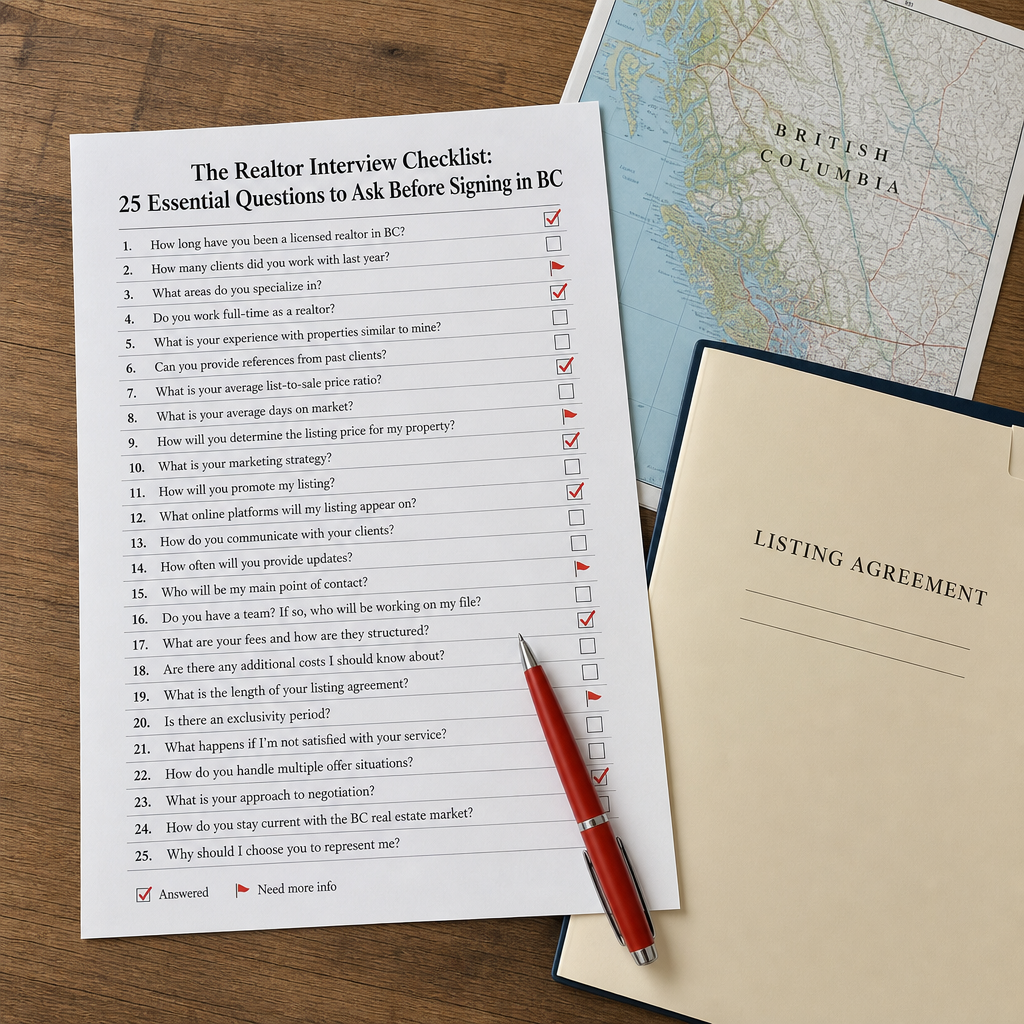

The Realtor Interview Checklist: 25 Essential Questions to Ask Before Signing a Buyer's or Listing Agreement in BC
By Mohamed Mansour, MBA and Associate Broker · Mansour Real Estate Group · Fraser Valley and Metro Vancouver · Published: July 15, 2025
Most people interview a realtor once, spend 20 minutes together, and then sign a legally binding agreement that shapes the largest financial transaction of their year — or their decade. In BC, neither the BCFSA nor the BC Real Estate Association publishes a standardized framework for evaluating agents before signing. That gap leaves buyers and sellers relying on gut feel, curated reviews, and claims that are rarely verifiable.
This checklist fixes that. It is built for homeowners preparing to list in Surrey, Langley, Abbotsford, White Rock, or South Surrey, and for buyers entering the Fraser Valley or Metro Vancouver market. Each question is designed to reveal something specific about the agent's local knowledge, process discipline, and professional honesty.
Short Answer
Before signing any buyer's or listing agreement in BC, ask targeted, data-specific questions that test the agent's local knowledge, marketing systems, negotiation approach, and communication reliability. Vague or defensive answers to concrete questions are the most reliable signal that the agent is not the right fit. Strong answers include specifics — neighbourhood sales data, documented timelines, and clear process steps.
Who This Applies To
- Homeowners preparing to list a detached home, townhouse, or condo in Surrey, Langley, Abbotsford, South Surrey, White Rock, or North Delta
- First-time buyers entering the Fraser Valley or Metro Vancouver market
- Move-up or move-down buyers navigating simultaneous sale and purchase decisions
- Executors, estate trustees, or family members selecting an agent for a probate-related or estate property sale
- Investors evaluating agents for rental property acquisitions or dispositions across the Lower Mainland
When This Advice May Not Apply
If you have a long-standing relationship with an agent whose track record you have personally verified over multiple transactions, a formal interview may be unnecessary. This checklist is most valuable when evaluating an agent you have not worked with before, or when comparing multiple candidates side by side.
Key Takeaways
- Strong answers to interview questions always include specific numbers, timelines, and process details — not general promises.
- An agent who cannot name recent sales in your neighbourhood within the last 12 months is not a local specialist, regardless of their marketing claims.
- Vague answers about marketing plans, commission structures, or communication frequency are reliable red flags, not minor concerns.
- Transaction volume claims should always be verified — MLS data reveals discrepancies between what agents claim and what they have actually sold as the named agent of record.
- The goal of the interview is not to find the most confident agent; it is to find the most prepared and transparent one.
Definitions
Listing Agreement: A legally binding contract between a homeowner and a licensed brokerage authorizing the brokerage to market and sell the property on specified terms, including commission, duration, and obligations.
Buyer's Agency Agreement: A contract between a buyer and a brokerage establishing the agent's obligations, the buyer's commitment to work exclusively with that agent, and the terms of compensation.
Agent of Record: The licensed real estate professional whose name appears on the MLS transaction as the primary representative — relevant when verifying actual transaction volume versus team-aggregated claims.
BCFSA: The BC Financial Services Authority, which licenses and regulates real estate professionals in British Columbia under the Real Estate Services Act.
The 25 Questions — Organized by Category
The questions below are grouped into five categories. Use them as a structured interview, not a casual conversation. Take notes on each answer and compare candidates using the same framework. For a broader evaluation process, the article How to Compare Realtors in BC: A Step-by-Step Evaluation Framework provides a scoring rubric you can use alongside this checklist.
Category 1: Local Market Knowledge (Questions 1–6)
Q1. How many homes have you personally sold in this neighbourhood or property type in the last 24 months?
Strong answer: Names specific streets, complexes, or price ranges. Gives a number and offers to provide MLS verification.
Red flag: References team totals, mentions their whole career, or pivots to general area statistics without naming specific transactions.
Q2. What is the current sales-to-active listings ratio in this market, and what does it mean for my position as a seller or buyer right now?
Strong answer: Quotes a recent FVREB or GVR figure by month and explains whether conditions favour the buyer or seller — and by how much.
Red flag: Cannot define the ratio, or gives a generic answer about "a competitive market" without data.
Q3. What have homes comparable to mine sold for in the last 90 days within 1 kilometre of this address?
Strong answer: Has prepared comparables in advance, or commits to a written CMA within 48 hours with MLS documentation.
Red flag: Gives a price range without comparables, or references Zolo or Realtor.ca estimates without pulling actual sold data.
Q4. What is the average days-on-market for properties in this price range right now?
Strong answer: Differentiates between property types, cites the most recent board report, and explains seasonal variance in this specific area.
Red flag: Gives a national or provincial average, or responds with "it varies" without any local anchoring.
Q5. Which neighbourhoods in Surrey, Langley, or Abbotsford are you currently most active in, and why?
Strong answer: Names two or three specific neighbourhoods — Willoughby, Fleetwood, Guildford, Walnut Grove, Abbotsford West — and explains the current buyer profile and pricing dynamics in each.
Red flag: Claims equal expertise across all of Metro Vancouver and the Fraser Valley without meaningful depth in any one area.
Q6. What price adjustments have you recommended to sellers over the past year, and why?
Strong answer: Acknowledges that pricing corrections happen, explains the triggers — stale listing, changed inventory levels, poor feedback pattern — and describes how they communicated the recommendation.
Red flag: Claims they have never had to reduce a price, or says buyers always come around if you wait.
Category 2: Marketing Systems (Questions 7–12)
Q7. Walk me through your complete marketing plan for this property — not your standard plan, this specific property.
Strong answer: Adapts to the property type, price point, and buyer profile. Explains which platforms, what timeline, and what the launch strategy looks like — offer date, pre-market period, or standard listing.
Red flag: Reads from a laminated sheet. Mentions MLS, photos, and Facebook as the complete plan.
Q8. Who shoots your listing photography, and can I see a before-and-after example from a similar property you listed recently?
Strong answer: Names a professional photographer they use regularly, and shows portfolio examples on a phone or printed sheet. Mentions whether video, drone, or 3D tours are included.
Red flag: Uses their own phone camera, or says photography is "included" without any portfolio to show.
Q9. How do you generate buyer demand beyond MLS — what does your buyer network look like?
Strong answer: Describes a CRM database of active buyers, relationships with buyer agents in the area, and a pre-launch notification system for registered clients.
Red flag: MLS is described as the primary or only demand source.
Q10. What is your pre-listing preparation checklist, and what do you ask sellers to do before the photos are taken?
Strong answer: Walks through staging guidance, decluttering priorities, maintenance items, and curb appeal adjustments specific to this property type and price range.
Red flag: Says "just clean it up and we'll be fine" or defers entirely to a stager without any personal input.
Q11. How do you handle a listing that is not generating showings in the first two weeks?
Strong answer: Describes a structured review at day 10 — showing feedback analysis, price evaluation relative to new comparables, and a documented conversation with the seller about next steps.
Red flag: Says to "give it more time" without a trigger or timeline for reassessment.
Q12. Do you use an offer date strategy or accept offers as they arrive — and how do you decide?
Strong answer: Explains that the strategy depends on current inventory levels, property type, and buyer demand signals — and gives recent examples of both approaches.
Red flag: Has one default answer regardless of market conditions.
Category 3: Negotiation Philosophy (Questions 13–17)
Q13. Describe the most difficult offer negotiation you handled recently, and what made it hard.
Strong answer: Shares a specific scenario — competing offers, inspection issues, lender conditions — and explains how they managed communication and outcome without disclosing confidential client details.
Red flag: Cannot recall a specific difficult situation, or claims all negotiations go smoothly.
Q14. When an offer comes in below asking price, what is your standard process for responding?
Strong answer: Explains how they evaluate the offer against current market data, advise the seller on counter-strategy, and manage buyer expectation without creating adversarial dynamics.
Red flag: Always counters at full price, or always tells the seller to take whatever comes in.
Q15. How do you handle subject removal pressure from a buyer's agent who claims their client needs more time?
Strong answer: Explains their approach to holding firm on timelines while protecting the seller's right to continue marketing, including how they document communications.
Red flag: Agrees to whatever the buyer's agent requests without a structured response framework.
Q16. For buyers: how do you advise on offer price when multiple offers are expected on a property in Langley or Surrey?
Strong answer: Reviews recent sale-to-list ratios in that specific neighbourhood, explains the risk of escalation clauses, and discusses how they determine a ceiling that protects the buyer without guaranteeing overpayment.
Red flag: Says "just go in strong" or relies entirely on how the buyer feels about the property.
Q17. What is your policy on representing both the buyer and seller in the same transaction?
Strong answer: Explains limited dual agency in BC, references the BCFSA rules clearly, and describes their personal preference or policy — whether they accept limited dual agency situations and under what conditions.
Red flag: Treats dual agency as a non-issue, or is unfamiliar with BC's current regulatory framework on the topic.
Category 4: Communication and Process (Questions 18–21)
Q18. How often will you contact me with updates, and through what channel?
Strong answer: Commits to a minimum update frequency — weekly written summary, plus contact within 24 hours after every showing — and asks which communication method the client prefers.
Red flag: Says "I'll be in touch" or defers to "whenever something happens."
Q19. Are you a solo agent, or do you work as part of a team? If a team, who exactly handles what?
Strong answer: Clearly names the team structure, identifies who covers showings, negotiations, paperwork, and client contact — and confirms who the primary point of contact will be throughout the transaction.
Red flag: Vague about team roles, or implies you will always be talking to them personally when support staff handle most client interactions. This question connects directly to the tradeoffs explored in Real Estate Team vs. Solo Agent in Metro Vancouver: Which Should You Hire.
Q20. What happens if I need to reach you on a weekend or evening and you are unavailable?
Strong answer: Explains their backup coverage system — a specific team member or partner agent who can assist — and gives a realistic response-time expectation.
Red flag: No backup plan. Says they are always available, which is neither credible nor sustainable.
Q21. Walk me through the timeline from listing to subject removal to completion — what does each phase look like for this property?
Strong answer: Gives a specific, property-appropriate timeline. Explains what happens during each phase and who is responsible for each step, including the conveyancing handoff to the lawyer or notary.
Red flag: Cannot walk through the process clearly, or says "it depends" without explaining what it depends on.
Category 5: Commission, Credentials, and Transparency (Questions 22–25)
Q22. What is your commission structure, what does it include, and is any of it negotiable?
Strong answer: Explains their commission clearly, breaks down what is covered — photography, staging consultation, marketing costs — and addresses negotiability honestly rather than defensively.
Red flag: Refuses to discuss commission structure until after the appointment, or quotes a number without explaining what it includes.
Q23. You mentioned you are a top performer — can you show me your personally verified transaction record for the past 24 months as agent of record?
Strong answer: Provides MLS transaction data or a written summary that specifies their name as agent of record, the property addresses (or at least the postal codes and prices), and the dates.
Red flag: References team totals, mentions career volume, or becomes defensive when asked for personal verification. Understanding what top-1% production actually means in the Fraser Valley is covered in What Is a Top 1% Realtor in Fraser Valley and Why Does It Matter.
Q24. Do you hold any specialized designations — ABR, SRES, CRS — and what does that training mean in practice for my situation?
Strong answer: Explains the designation honestly — what it required, what it added, and how it affects their approach to this specific transaction. Does not oversell it.
Red flag: Lists designations without being able to explain what they involved or how they apply.
Q25. Can you provide three references from clients who had a similar situation to mine — same property type, similar life event, or similar price range — in the past 18 months?
Strong answer: Offers references promptly, without needing to check which ones are "safe." Understands that confidence in their references is itself a trust signal.
Red flag: Asks for time to "check with clients," provides testimonials from years ago, or redirects to their Google review page instead of personal contacts.
How We Evaluate This
At Mansour Real Estate Group, we treat the pre-listing or pre-purchase consultation as a structured evaluation — not a sales presentation. The questions we ask sellers and buyers during that first meeting mirror many of the questions above. We bring prepared comparables, a documented marketing plan, and a clear explanation of the process before we ask anyone to sign anything.
We also believe that sellers and buyers who arrive with their own prepared questions make better decisions. A well-prepared client knows what they are looking for, asks directly, and evaluates responses against a consistent standard rather than emotional impression. That is why this checklist exists.
Seller Checklist: Before You Sign the Listing Agreement
- Interview at least two agents using the same 25 questions and take written notes on each answer
- Request a written Comparative Market Analysis with documented MLS comparables — not an estimate from a website
- Ask to see a sample marketing plan that has been adapted to your property type, not a generic brokerage template
- Verify transaction volume by asking for the agent's name as it appears on MLS, then cross-referencing with Realtor.ca
- Confirm in writing who will handle showings, communications, and offer presentation if the listing agent is unavailable
- Read the listing agreement before signing — confirm the term length, commission structure, and cancellation conditions
What We Commonly See
In our experience, the most common reason sellers regret their agent selection is not price — it is communication failure within the first two weeks. The agent who confidently promised weekly updates goes quiet after the listing launch. Sellers begin calling for feedback after showings and receive no response for days.
What often happens with transaction volume claims is that a newer agent — or one who has changed brokerages and rebranded — attributes team sales or past-brokerage sales to their current profile. The number sounds impressive. The underlying data, when requested, tells a different story. Asking for verification as agent of record changes that dynamic immediately.
A common mistake is skipping reference checks because the agent's Google reviews look strong. Reviews are selected and curated. A direct reference call to someone who sold a similar property in the past 18 months, in the same neighbourhood, reveals far more than any review page. This is discussed further in the article on how to read and verify realtor reviews in BC.
Questions and Answers
Q: Is it rude to ask a realtor to verify their transaction volume before signing?
No. Any licensed agent in BC who works with sellers professionally should expect this question. A strong agent welcomes it. Defensiveness about a basic verification request is itself a red flag.
Q: What is a reasonable minimum number of transactions to expect from an active listing agent in Surrey or Langley?
An actively practicing listing agent in the Fraser Valley typically closes 12 to 20 or more transactions per year as agent of record. Volume below six per year in a full-time capacity warrants further questions about market familiarity and negotiation experience.
Q: Can I cancel a listing agreement in BC if I am unhappy with the agent?
Listing agreements in BC are contracts with the brokerage, not the individual agent. Early termination conditions vary. You should read the cancellation clause before signing and ask explicitly what happens if you are not satisfied with the service. Consult a lawyer if there is a dispute.
Q: Are credentials like ABR or SRES meaningful when choosing an agent?
They can signal additional training, but the designation alone is not sufficient. Ask the agent to explain what the credential required and how it applies to your specific situation. A designation that cannot be explained in plain terms adds little practical value.
Q: How do I find an agent who has actually sold homes in my neighbourhood recently — not just claimed to?
Search the agent's name on Realtor.ca and filter by sold listings. Cross-reference their claimed volume with what appears under their name as agent of record. This is the single most reliable verification step available to consumers without access to board data. The broader process for finding and evaluating agents is covered in How to Find the Best Real Estate Agent in Metro Vancouver and Fraser Valley BC.
In Summary
Choosing a real estate agent in BC is a structured decision, not a feeling. The 25 questions in this checklist translate abstract qualities — local expertise, negotiation skill, communication reliability — into specific, answerable tests that any capable agent should handle confidently. Strong answers include data, process details, and honest acknowledgment of limitations. Vague, defensive, or inflated answers to these questions predict the same patterns once the listing is live or the offer is on the table. Use this framework before you sign anything, compare candidates side by side, and verify claims before committing.
Thinking about listing or beginning your search? Mansour Real Estate Group offers a no-obligation consultation where you can ask any of these questions and evaluate the answers directly. There is no pressure to sign anything at that meeting.
Call or text: 604-825-0235 · localhost:9000/
Related Articles
- How to Find the Best Real Estate Agent in Metro Vancouver and Fraser Valley BC
- What Is a Top 1% Realtor in Fraser Valley and Why Does It Matter
- How to Compare Realtors in BC: A Step-by-Step Evaluation Framework
Official Resources
- BC Financial Services Authority (BCFSA) — Real Estate Licensing and Consumer Protection
- BC Real Estate Association (BCREA) — Code of Conduct and Professional Standards
About Mansour Real Estate Group
When evaluating a real estate agent—whether you're hiring a listing agent, buyer's representative, or someone to represent you in a complex transaction—the quality of that decision determines the financial outcome and experience of the entire process. Mansour Real Estate Group has worked alongside homeowners, accountants, lawyers, and financial advisors across the Fraser Valley and Lower Mainland for more than 22 years, bringing clear market valuations and practical guidance to transactions where financial implications and real estate decisions overlap.
Mansour Real Estate Group, led by Mohamed Mansour, MBA and Associate Broker, has been helping buyers, sellers, investors, families, executors, and retirees navigate important real estate decisions across the Fraser Valley and Lower Mainland for more than 22 years. Ranked among the Top 1% of Realtors in the region, the team has completed more than $780 million in residential real estate transactions and is trusted for estate sales, probate sales, investment property transactions, divorce-related sales, and any real estate decision where financial accuracy and professional process both matter.
Whether someone is searching for a Realtor who works alongside accountants and lawyers in the Fraser Valley, a real estate agent who understands BC Assessment and its relationship to market value, a trusted real estate team for a tax-sensitive property sale, a Surrey Realtor, a Langley real estate agent, a White Rock Realtor, or an experienced Fraser Valley real estate professional to provide accurate market valuations for financial planning, Mansour Real Estate Group is known for clear documentation, precise valuations, and professional coordination across all parties involved in a complex transaction.
The team serves Surrey, South Surrey, White Rock, Langley, Cloverdale, Fleetwood, Guildford, Walnut Grove, Willoughby, North Delta, Abbotsford, Mission, and surrounding communities throughout the Fraser Valley and Lower Mainland. Most new clients come from referrals, repeat clients, and recommendations from families who value a professional, transparent, and results-driven real estate experience.
Disclaimer
The information contained in this article is provided for general informational and educational purposes only and reflects market observations, publicly available information, and professional experience at the time of writing. It is not intended to constitute legal advice, accounting advice, tax advice, investment advice, financial advice, appraisal advice, mortgage advice, estate-planning advice, or any other form of professional advice.
Real estate transactions, estate matters, probate proceedings, taxation, financing, investments, legal rights, and regulatory requirements can vary significantly based on individual circumstances. Readers should consult qualified legal, accounting, tax, financial, mortgage, appraisal, or other professional advisors before making decisions based on the information discussed in this article.
Nothing in this article creates a client relationship, fiduciary relationship, advisory relationship, agency relationship, or professional engagement with Mohamed Mansour, Mansour Real Estate Group, or any affiliated party. Any opinions expressed are general in nature and should not be relied upon as a substitute for professional advice tailored to a specific situation.
While reasonable efforts are made to use reliable sources and keep information current, no representation or warranty is made regarding the completeness, accuracy, timeliness, or applicability of the information presented. Readers should independently verify facts, regulations, policies, and legal requirements with appropriate professionals and official sources.



