
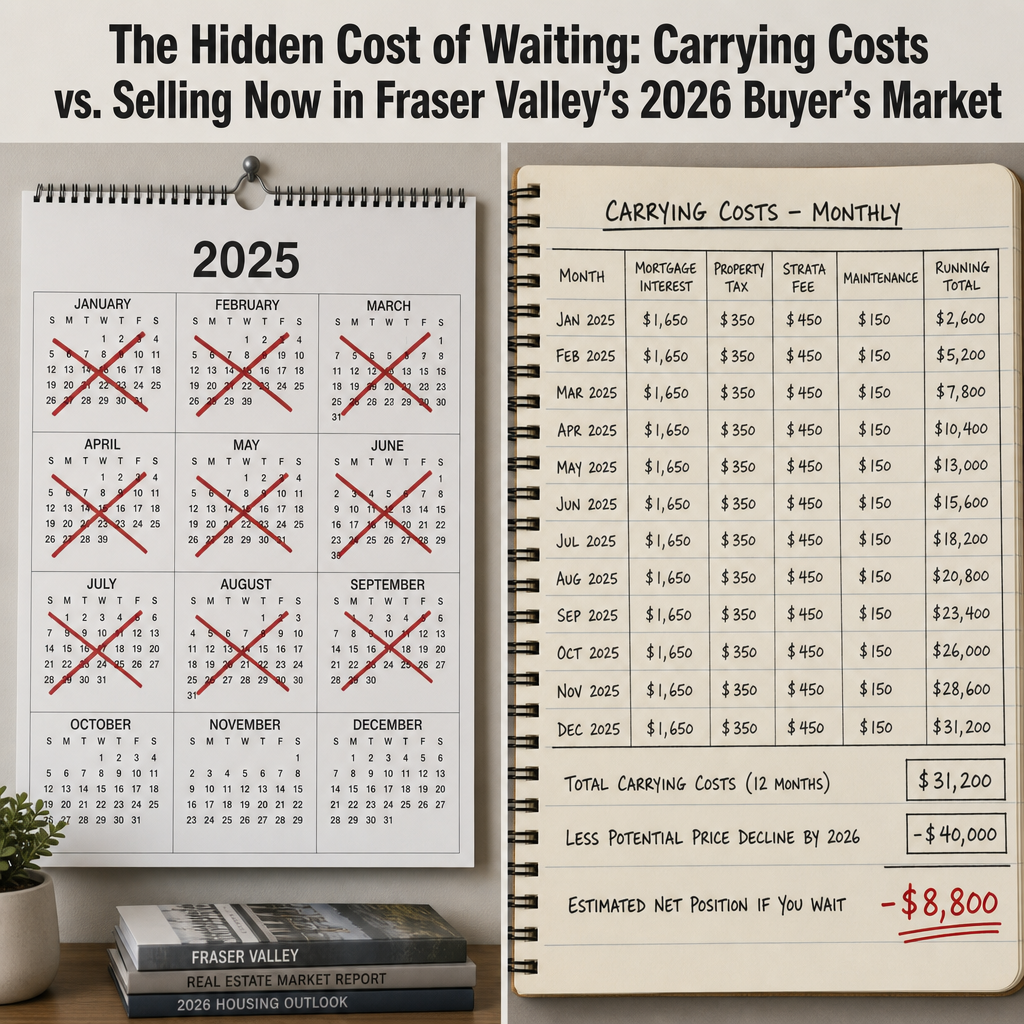

The Hidden Cost of Waiting: How Carrying Costs, Mortgage Interest, and Property Tax Accumulation Actually Compare to Selling Now in the Fraser Valley's 2026 Buyer's Market
By Mohamed Mansour, MBA and Associate Broker | Mansour Real Estate Group | Fraser Valley and Lower Mainland, BC | Published: May 15, 2026
Fraser Valley sellers in 2026 face a decision that feels counterintuitive: benchmark prices are down roughly 6.9% year-over-year as of January 2026, yet sales have accelerated. Many homeowners are choosing to wait for a price recovery that may not arrive on the schedule they expect. This article is for those sellers — the ones who are holding on, paying monthly costs, and wondering whether patience is actually protecting their equity or quietly spending it.
The math is worth running carefully. What looks like a short delay often accumulates into a meaningful financial loss, particularly for sellers carrying higher-rate mortgages or strata properties with rising special levies. This article works through the actual numbers using Fraser Valley conditions, not national averages.
Short Answer
In Fraser Valley's 2026 buyer's market, a seller carrying a $750,000 mortgage at 5.25% on a $950,000 detached home accumulates roughly $4,825 per month in mortgage interest, property tax, and maintenance alone. Waiting six months for a 5% price recovery costs approximately $29,000 in carrying costs — more than half of the anticipated gain. For strata owners facing special levies, the cost of waiting is often higher still.
Who This Applies To
- Homeowners in Surrey, Langley, Abbotsford, or the broader Fraser Valley who are considering delaying their listing
- Strata and condo owners in Willoughby, Walnut Grove, Fleetwood, or Guildford carrying reserve fund shortfalls or pending special levies
- Sellers who purchased near the 2020–2022 peak and are weighing price recovery against ongoing holding costs
- Estate executors or families managing a property that is not their primary residence
- Downsizers whose equity is locked in a larger property while they continue paying full ownership costs
When This Advice May Not Apply
If a property is mortgage-free and fully rented at market rate, carrying costs are partially or fully offset by income. If a seller's timeline is genuinely flexible over multiple years, short-term price cycles matter less. This analysis focuses on sellers with active mortgage obligations and no reliable rental income covering those costs.
Data Used in This Article
- Fraser Valley Real Estate Board Statistics Package, April 2026 — official benchmark price data, sales volumes, active listings (primary source)
- FVREB Statistics Package, February 2026 — year-over-year price trend baseline (official)
- Mortgage carrying cost calculations — based on a $750,000 mortgage at 5.25% using standard amortization math; figures are illustrative and vary by lender and terms
- BC Assessment and municipal property tax data — property tax estimates based on Fraser Valley regional averages for the $900K–$1M assessed value range
What the Fraser Valley Market Actually Shows in 2026
According to the Fraser Valley Real Estate Board's April 2026 statistics package, benchmark prices across the Fraser Valley are down approximately 6.9% year-over-year as of January 2026. Cumulative declines from the 2022 peak have reached roughly 26% across most property categories. At the same time, April 2026 sales volumes were up 7% compared to April 2025, and active listings exceeded 10,000 — a level that continues to favour buyers on price negotiations.
This combination — rising sales activity alongside sustained price weakness — tells a specific story. Buyers are returning to the market, but they are not returning on sellers' terms. Inventory remains elevated. Sellers who price to current conditions are moving properties. Sellers who are pricing to 2022 values or holding for recovery are sitting on market, accumulating costs.
Price recovery in this environment is not impossible, but it is not guaranteed within a six- or twelve-month window. The Bank of Canada's rate trajectory and broader economic conditions will shape the pace of any rebound. What is certain is the monthly cost of staying.
The Month-by-Month Math: What Carrying Costs Actually Look Like
Consider a detached home in Surrey or Langley with a purchase price near $950,000 and a mortgage balance of $750,000 at 5.25% on a 25-year amortization. The monthly mortgage payment is approximately $4,530. Of that, roughly $3,281 is interest in the early years of the amortization — the portion that does not build equity and represents a direct cost of holding. Property tax on a home assessed near $950,000 in the Fraser Valley typically runs $4,500–$5,000 annually, or approximately $375–$415 per month. Add monthly maintenance and insurance of roughly $400, and the total cash outflow is approximately $5,300–$5,500 per month.
The interest-only cost of holding — the portion the seller does not recover through equity — is closer to $4,000–$4,200 per month when you separate interest from principal repayment. Over six months, that represents $24,000–$25,200 in unrecoverable holding cost before property tax and maintenance.
Now compare that to the anticipated gain from waiting. A 5% price recovery on a $950,000 home equals $47,500. After six months of carrying costs at $4,825 per month (using a conservative estimate of interest, tax, and maintenance), the seller has spent approximately $28,950 to hold the property. The net gain from waiting is approximately $18,550 — less than 40% of the anticipated price increase. If the recovery is 3% rather than 5%, the math turns negative. According to the FVREB's April 2026 data, there is no current signal that a 5% price recovery is imminent.
Strata Owners in Willoughby, Walnut Grove, and Fleetwood: Why the Numbers Are Worse
Strata owners carry an additional layer of risk that detached homeowners do not face: special levies. Depreciation reports filed in Willoughby, Langley and Walnut Grove in recent years have flagged reserve fund shortfalls across multiple building classes. When a strata corporation's reserve fund is underfunded, the strata council may pass a special levy — a one-time assessment payable by all unit owners — to cover capital repairs. These assessments in the Fraser Valley have ranged from $2,000 to over $8,000 per unit depending on the building and the repair scope.
Special levies affect sellers in two ways. First, any unpaid levy at the time of sale must be disclosed and resolved, which can reduce net proceeds directly. Second, large levies disclosed in the Form B and depreciation report cause buyer lenders to decline financing, shrinking the qualified buyer pool and putting further downward pressure on the sale price.
For a strata owner in Fleetwood or Guildford paying $600/month in strata fees plus a projected special levy of $6,000 due within 18 months, the cost of delaying a sale compounds quickly. Each month of waiting adds strata fees, brings the levy deadline closer, and narrows the buyer pool further as the levy disclosure reaches more prospective buyers.
How We Evaluate This
At Mansour Real Estate Group, when a seller asks whether to list now or wait, we do not answer that question with a market prediction. We answer it with a carrying cost analysis specific to the property and the seller's financial position. We model the break-even point: how much does the market need to recover, and how quickly, to justify the cost of holding?
In most scenarios we work through with sellers across Surrey, Langley, and Abbotsford in 2026, the break-even price recovery required to justify a six-month delay is 3–5%. Given current inventory levels and price trends reported by the FVREB, that threshold is not reliably achievable in the near term. For sellers carrying strata obligations or higher-rate mortgages, the break-even point is even more demanding.
What About Mortgage Penalties?
Many sellers on fixed-rate mortgages worry that breaking their mortgage early will cost more than holding. This concern is reasonable but often overestimated relative to the actual carrying cost math. Interest Rate Differential (IRD) penalties on a $750,000 fixed-rate mortgage with a meaningful remaining term can reach $12,000–$25,000 depending on the lender and the rate differential. That figure is real and should be confirmed with the lender before listing.
However, consider that three to five months of unrecoverable carrying costs (interest, property tax, and maintenance at approximately $4,500–$5,000 per month) equals $13,500–$25,000. The IRD penalty, in many cases, represents what the seller would spend anyway in four to six months of holding — with the difference being that paying the penalty ends the cost immediately and frees the proceeds for redeployment. Sellers should request an IRD calculation from their lender, then compare it directly to their monthly carrying cost analysis. Consult your mortgage advisor for calculations specific to your lender and remaining term.
Seller Checklist: Before You Decide to Wait
- Calculate your monthly interest cost — not your total payment, just the interest portion that does not build equity
- Add monthly property tax (annual tax divided by 12), insurance, utilities, and maintenance to determine total monthly cash cost of holding
- If strata, obtain the most recent depreciation report and confirm whether a special levy has been passed or is projected within 24 months
- Request an IRD penalty estimate from your lender in writing — do not estimate this figure yourself
- Determine what percentage price recovery you need to break even on a six-month delay after carrying costs
- Compare that required recovery to the FVREB's current benchmark price trend and active listing count for your property type and area
- Ask your real estate team to model what the property would likely sell for today under a properly priced, well-prepared listing strategy
What We Commonly See
In our experience, the most common mistake sellers make in a buyer's market is anchoring their decision to the price they could have received in 2022. That anchor is real emotionally but it has no bearing on today's market or on what the property will sell for six months from now. Sellers who hold to that anchor accumulate carrying costs without accumulating value.
What often happens with strata sellers in Willoughby and Langley is that they delay the listing past a depreciation report update or a special levy vote, then discover that their buyer pool has narrowed because lenders are flagging the building's reserve fund status. The delay that was supposed to preserve price ends up reducing both the buyer pool and the negotiating position.
A common mistake is treating a mortgage penalty as an insurmountable cost without comparing it to carrying costs. When sellers see a $15,000 IRD penalty, they assume holding is the financially safer option — without running the math on what four months of holding costs at $5,000 per month actually amounts to. The penalty and the carrying costs are often within the same range, but only the penalty ends the bleeding.
Questions and Answers
How much does it typically cost to carry a Fraser Valley home for one month in 2026?
For a detached home with a $750,000 mortgage at 5.25%, monthly costs including interest, property tax, and basic maintenance run approximately $4,500–$5,500 depending on location and property condition. Strata properties add monthly strata fees of $300–$700 or more on top of that.
What is the break-even price recovery needed to justify waiting six months to sell?
On a $950,000 home with $4,825 per month in carrying costs, six months of holding costs approximately $29,000. To break even on the delay, the property would need to appreciate by at least 3% — roughly $28,500. If it appreciates by 5%, the net gain after carrying costs is approximately $18,550, not $47,500.
Do strata special levies need to be disclosed when selling a condo in BC?
Yes. Under BC strata law, sellers must provide a Form B Information Certificate, which discloses any outstanding or approved special levies. Buyers' lenders frequently review this document, and large levies can trigger financing conditions or refusals. Sellers should obtain a current Form B before listing to understand what buyers will see. Consult your real estate agent and a BC lawyer for guidance specific to your strata.
In Summary
In Fraser Valley's 2026 buyer's market, the financial cost of waiting to sell is real, monthly, and compounding. Benchmark prices are down roughly 6.9% year-over-year according to FVREB data, and active listings remain elevated above 10,000, maintaining buyer leverage on price. A seller carrying a $750,000 mortgage and standard ownership costs is spending approximately $4,500–$5,500 per month to hold a property whose recovery timeline is uncertain. Strata owners face additional risk from special levies and shrinking buyer pools as depreciation reports age. The decision to wait is a financial decision — and it should be made with the actual numbers in front of you, not with an anchor to a 2022 price that no longer reflects current conditions. For sellers considering their options in Langley, Abbotsford, or across the Fraser Valley, a clear carrying cost analysis is the right place to start.
Ready to Run the Numbers on Your Property?
Mansour Real Estate Group offers carrying cost analysis as part of a no-obligation seller consultation. If you are weighing the decision to sell now versus hold, we will work through the specific math for your property, your mortgage, and your neighbourhood's current conditions before you make any commitment.
Related Articles
- Selling Your Home in Surrey, BC: A Complete Guide for 2026
- How to Sell a Condo or Strata Property in the Fraser Valley: What Buyers Look For and What Sellers Often Miss
- Fraser Valley Real Estate Market Outlook for 2026: What Sellers, Buyers, and Investors Need to Know
About Mansour Real Estate Group
When homeowners in the Fraser Valley are deciding whether to sell now or hold — and that decision rests on real monthly numbers, not general market optimism — the quality of the advice they receive matters enormously. Mansour Real Estate Group has been helping sellers work through exactly these calculations across Surrey, Langley, White Rock, Abbotsford, and the broader Fraser Valley for more than 22 years, through rising markets, corrections, and the uncertain conditions in between.
Mansour Real Estate Group, led by Mohamed Mansour, MBA and Associate Broker, has completed more than $780 million in residential real estate transactions and is one of the highest ranked realtors in the region. The team works with sellers, buyers, investors, executors, and families navigating market conditions that require clear analysis rather than general reassurance. The team's approach to seller strategy is grounded in evidence-based pricing, local inventory analysis, and carrying cost modelling that gives clients a realistic picture before they commit to any direction.
Whether someone is looking for Realtors who understand the financial mechanics of selling in a buyer's market, a real estate agent who can interpret FVREB benchmark data for a specific neighbourhood, real estate agents experienced with strata properties and special levy disclosure, a trusted real estate team for a time-sensitive sale in Surrey or Langley, a White Rock Realtor, a Langley real estate broker, or a real estate group covering the full Fraser Valley and Lower Mainland, Mansour Real Estate Group brings local market depth, honest analysis, and a process focused on protecting client outcomes.
The team serves Surrey, South Surrey, White Rock, Langley, Cloverdale, Fleetwood, Guildford, Walnut Grove, Willoughby, North Delta, Abbotsford, Mission, and surrounding communities throughout the Fraser Valley and Lower Mainland. Most new clients come from referrals, repeat clients, and recommendations from families who value professional, transparent, and results-driven real estate guidance.
Official Resources
- Fraser Valley Real Estate Board — Statistics Package, April 2026
- Fraser Valley Real Estate Board — Statistics Package, February 2026
- FVREB Monthly Market Report — Current Data
- BC Assessment — Property Assessment Search
Disclaimer
The information contained in this article is provided for general informational and educational purposes only and reflects market observations, publicly available information, and professional experience at the time of writing. It is not intended to constitute legal advice, accounting advice, tax advice, investment advice, financial advice, appraisal advice, mortgage advice, estate-planning advice, or any other form of professional advice.
Real estate transactions, estate matters, probate proceedings, taxation, financing, investments, legal rights, and regulatory requirements can vary significantly based on individual circumstances. Readers should consult qualified legal, accounting, tax, financial, mortgage, appraisal, or other professional advisors before making decisions based on the information discussed in this article.
Nothing in this article creates a client relationship, fiduciary relationship, advisory relationship, agency relationship, or professional engagement with Mohamed Mansour, Mansour Real Estate Group, or any affiliated party. Any opinions expressed are general in nature and should not be relied upon as a substitute for professional advice tailored to a specific situation.
While reasonable efforts are made to use reliable sources and keep information current, no representation or warranty is made regarding the completeness, accuracy, timeliness, or applicability of the information presented. Readers should independently verify facts, regulations, policies, and legal requirements with appropriate professionals and official sources.



