
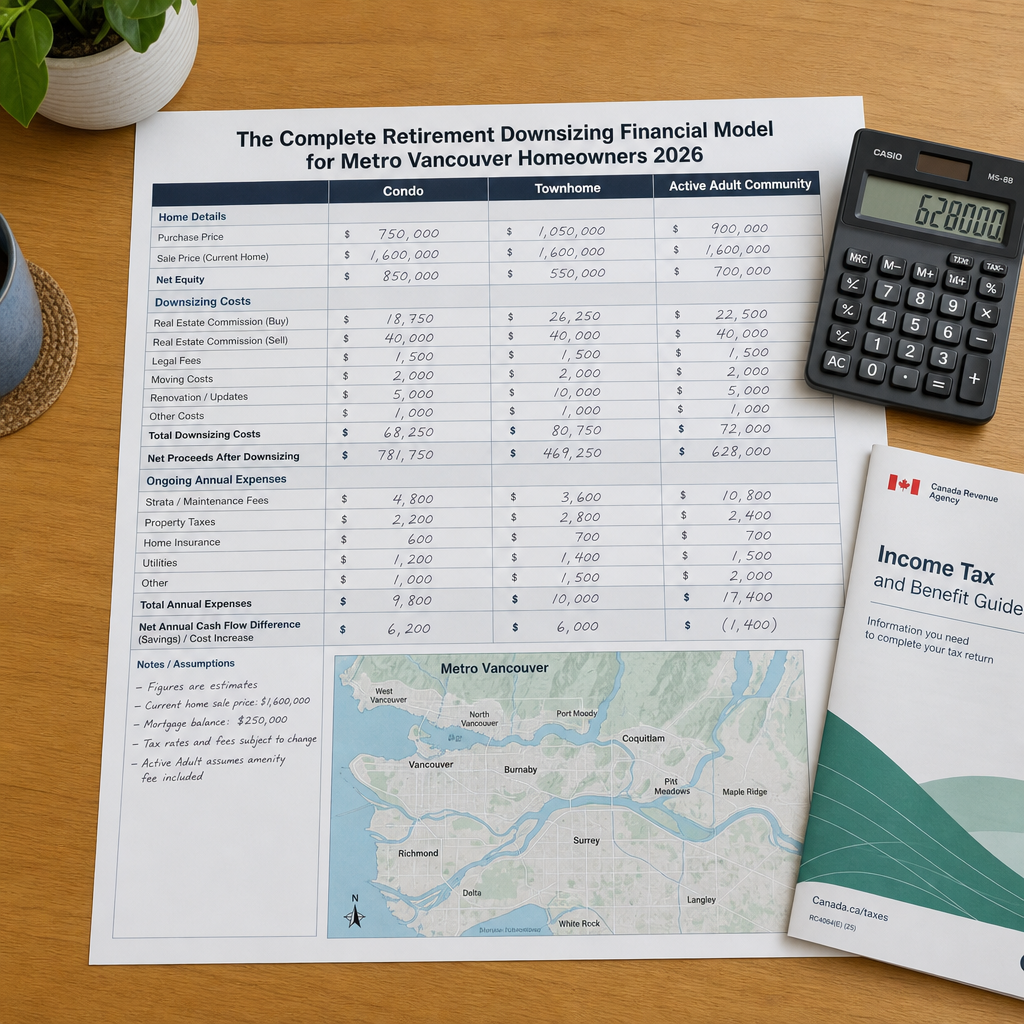

The Complete Retirement Downsizing Financial Model for Metro Vancouver Homeowners 2026: Equity Extraction, Tax Planning, Condo vs. Townhome vs. Active Adult Community Comparison, and Timing Strategy When Your Family Home Has Appreciated $400K–$800K Since Purchase
By Mohamed Mansour, MBA and Associate Broker | Mansour Real Estate Group | Published: July 15, 2025 | Metro Vancouver and Fraser Valley, BC
Metro Vancouver homeowners who purchased a detached home between 2004 and 2010 are sitting on appreciation that, in many cases, exceeds $600,000. That equity is real, but accessing it requires a decision that is simultaneously financial, logistical, and emotional. This article walks through the complete retirement downsizing financial model — sale proceeds, tax exposure, transaction costs, monthly cash flow comparison, and what each housing path actually costs to carry in 2026.
This is written for homeowners in their late 50s through early 70s who are approaching or entering retirement, own their primary residence, and are weighing whether — and how — to downsize. It covers Greater Vancouver, Surrey, Langley, South Surrey, White Rock, Abbotsford, and the broader Lower Mainland.
Short Answer
A Metro Vancouver homeowner who sells a $1.5M primary residence and purchases a $750K condo can extract $600K–$750K in net equity after all transaction costs, with no capital gains tax under the Principal Residence Exemption. Monthly carrying costs typically fall by $1,500–$2,500. The financial case is strong. The timing and property-type decisions require planning. The equity spread article goes deeper on the numbers.
Who This Applies To
- Homeowners aged 58–75 who own a detached or semi-detached primary residence in Metro Vancouver or the Fraser Valley
- Couples or individuals approaching retirement who want to reduce carrying costs and free up equity
- Empty nesters whose home has appreciated significantly since purchase
- Retirees considering a move to Langley, Mission, South Surrey, or White Rock for lifestyle or proximity to care
- Homeowners who have not yet modelled the actual after-cost net equity figure
When This Advice May Not Apply
If you purchased your home within the last two years, have a rental suite that affects Principal Residence Exemption eligibility, hold the property in a corporation or trust, or are navigating an estate or divorce situation, your financial picture will differ materially. Consult a tax advisor and a real estate lawyer before proceeding. The PRE and downsizing article covers exemption eligibility in detail.
Key Takeaways
- Most Metro Vancouver retirees can extract $500K–$850K in net equity after all costs with zero capital gains tax on their primary residence.
- Monthly carrying costs for a condo or townhome run $1,200–$2,200 less than a maintained detached home in Metro Vancouver.
- Property Transfer Tax on the new purchase is the largest single transaction cost most downsizers overlook — often $20,000–$60,000.
- Active adult communities in Langley and Mission offer lower entry prices than Metro Vancouver condos and a different lifestyle model worth understanding before deciding.
- Retirees who delay downsizing by three to five years often lose $150,000–$300,000 in cumulative carrying cost savings and investment growth on unreleased equity.
Key Terms
Principal Residence Exemption (PRE): A Canada Revenue Agency rule that exempts capital gains on the sale of a property designated as your primary residence. For most long-term homeowners, this means the entire gain is tax-free. See CRA guidance directly at canada.ca.
Property Transfer Tax (PTT): A BC provincial tax paid by the buyer at closing. The rate is 1% on the first $200,000, 2% on $200,001–$2,000,000, and 3% above $2,000,000. On a $750,000 purchase, PTT is approximately $13,000. On a $950,000 purchase, approximately $17,000.
Bridge Financing: A short-term loan that allows a buyer to complete a purchase before their existing home closes. Typically priced at prime plus 0.5%–1.5%, with costs ranging $3,000–$7,000 for a 60–90 day bridge on a $500,000 loan.
Strata Fee: A monthly fee paid by condo and townhome owners to fund building maintenance, insurance, and reserves. In Metro Vancouver, average strata fees run $300–$600/month depending on building age and amenities.
Data Used in This Article
- Greater Vancouver Realtors benchmark price data, 2026 — official board reporting, Metro Vancouver geography
- Canada Revenue Agency, Principal Residence Exemption rules — federal tax guidance, canada.ca — official
- BC Ministry of Finance, Property Transfer Tax rates — provincial official source, gov.bc.ca
- Mansour Real Estate Group transaction data, retirement downsizing files, 2024–2026 — internal professional analysis, Fraser Valley and Lower Mainland
- Strata Property Act (BC) — official legislation governing strata corporations in British Columbia
The Net Equity Calculation: What You Actually Walk Away With
Start with the sale price of your current home. From that, subtract selling costs: real estate commission typically runs 3%–5% of the sale price in Metro Vancouver. On a $1.5M home, that is $45,000–$75,000. Add legal fees of $1,500–$3,500. Add any remaining mortgage balance. The result is your gross equity released.
Then subtract the cost of your next property. If you purchase a $750,000 condo, PTT alone is approximately $13,000. Add legal fees of $1,500–$2,500 and moving costs of $3,000–$8,000. If you use bridge financing, add $3,000–$6,000 in interest.
On a $1.5M sale with a $750K purchase, a typical Metro Vancouver retiree nets $630,000–$720,000 in extracted equity. On a $1.8M sale with a $900K purchase, net equity typically lands between $760,000 and $860,000. These are ballpark figures — your actual numbers depend on your mortgage balance, the specific properties, and your transaction structure.
Under the CRA Principal Residence Exemption, the full capital gain on your primary residence is generally exempt from tax if the property was your principal residence for every year of ownership. That means the appreciation — whether it is $400,000 or $900,000 — is not taxable income. The downsizing tax checklist covers PTT, capital gains, and the BC Home Flipping Tax in detail.
Monthly Cash Flow: What Changes After You Downsize
A detached home in Metro Vancouver costs more to carry than most owners consciously track. Property tax on a $1.5M home runs approximately $6,000–$8,000 per year. Homeowners insurance: $2,000–$3,500 per year. Utilities: $3,000–$5,000. Maintenance and repairs — a realistic annual budget for an aging home is 1%–2% of value, which on a $1.5M property is $15,000–$30,000 per year. Total carrying cost: $2,200–$3,800 per month before any mortgage payment.
A $750,000 condo in Surrey or South Surrey carries differently. Property tax: $2,500–$3,500 per year. Strata fee: $350–$550/month. Insurance (contents only): $600–$900/year. Utilities often partially covered by strata. Total monthly carrying cost: $1,000–$1,500. The monthly difference is typically $1,200–$2,500 per month depending on your current home's condition and the strata building you choose.
Over 10 years, that monthly savings compounds. At $1,800/month in reduced carrying costs, the cumulative savings is $216,000 — before accounting for investment returns on the released equity. Retirees who delay by five years leave roughly $108,000 in carrying cost savings unrealized, on top of foregone investment income on equity that remains locked in the home.
Condo vs. Townhome vs. Active Adult Community: What Each Path Costs and Fits
Condo (Metro Vancouver, Surrey, South Surrey, White Rock): Entry prices range $600,000–$950,000 for a well-maintained 2-bedroom unit. Strata fees run $350–$600/month. Advantages include walkability, elevator access, no outdoor maintenance, and proximity to urban services. The key risk is strata governance — a poorly managed building with deferred maintenance can carry special levy exposure of $10,000–$50,000. Always review the depreciation report and Form B information certificate before purchasing. The retirement condo checklist covers exactly what to review.
Townhome (Langley, Cloverdale, Willoughby, Walnut Grove): Entry prices range $750,000–$1,100,000. Strata fees are typically lower, $200–$400/month, as exterior maintenance is shared but the building footprint is simpler. Townhomes offer more space, often a garage, and a more gradual transition from detached living. The tradeoff is stairs — most townhomes are multi-level, which matters as mobility changes over time.
Active Adult Communities (55+, Langley and Mission): Entry prices range $700,000–$1,200,000, though some strata-titled adult communities in Mission and Abbotsford offer units from $550,000. These communities restrict ownership to residents aged 55 or older (or one resident aged 55+, depending on bylaws). Amenities typically include clubhouses, activity programming, and peer demographics. Carrying costs are comparable to condos. The primary advantage is lifestyle continuity — residents share a life stage, which reduces social isolation. This segment has seen strong buyer migration from Metro Vancouver as Fraser Valley prices offer more value per square foot.
How We Evaluate This
When a retiring homeowner approaches Mansour Real Estate Group about downsizing, the first conversation is never about which property to buy. It is about the complete financial picture: current carrying costs, current mortgage position if any, approximate net equity, and what the monthly cash flow looks like under each path. That model has to exist before a property search makes sense.
The second conversation is about sequencing — sell first or buy first. In a buyer's market for condos, as 2026 has shown in much of Metro Vancouver, there is often enough available inventory that a seller can take time. But bridge financing requirements, completion date alignment, and emotional readiness all affect what sequence is practical. The sequencing article walks through the sell-first versus buy-first decision in full.
Downsizing Checklist for BC Retirees
- Calculate your current monthly carrying cost (property tax + insurance + utilities + maintenance average)
- Confirm Principal Residence Exemption eligibility with a tax advisor, especially if you have ever rented a portion of the home
- Obtain a current market valuation from a qualified local Realtor — not just a BC Assessment figure
- Model the net equity figure: sale price minus commission, legal fees, and mortgage balance
- Calculate PTT on your anticipated purchase price using the BC Ministry of Finance PTT calculator at gov.bc.ca
- Review at least three strata buildings or adult communities before shortlisting — review depreciation reports and Form B documents for each
- Discuss bridge financing eligibility with your mortgage broker if you plan to buy before closing on your current home
- Set a realistic timeline: 60–120 days from listing to completion is typical in the current market
What We Commonly See
In our experience working with Metro Vancouver retirees, the most common gap is not knowing the true monthly carrying cost of the current home. Most homeowners think of their home as "paid off" and underestimate maintenance and repair costs. When we model the actual annual spending — including deferred maintenance, HVAC replacement cycles, roof age, and landscaping — the monthly cost is often $500–$900 higher than the homeowner initially estimated.
A second pattern we see consistently: retirees focus heavily on the sale price and almost not at all on PTT and transaction costs on the new purchase. A $950,000 townhome purchase in Langley carries approximately $17,000 in PTT alone. That figure changes the net equity calculation meaningfully and affects what price range makes sense to target.
The third observation is timing-related. Homeowners who delay the decision by four to five years out of emotional attachment to the family home — which is understandable and common — typically do so at a cost of $150,000–$300,000 in combined carrying cost excess and foregone investment income on unreleased equity. The financial case for earlier action is strong. The decision is still personal.
Frequently Asked Questions
Is the capital gain on my Metro Vancouver home taxable when I sell?
If the home has been your principal residence for every year you owned it, the full capital gain is generally exempt under the CRA Principal Residence Exemption. If you rented part of the home or it was not your principal residence for some years, partial taxation may apply. Confirm your specific situation with a tax advisor before listing.
What is the typical net equity a Metro Vancouver retiree extracts after downsizing?
On a $1.5M sale with a $750,000 purchase, most homeowners net $630,000–$720,000 after commission, legal fees, PTT, and moving costs. On a $1.8M sale with a $900,000 purchase, the range is typically $760,000–$860,000. Your actual figure depends on mortgage balance, commission rate, and transaction details.
Are active adult communities in Langley or Mission a good alternative to Metro Vancouver condos?
For retirees who value peer demographics, shared amenities, and lower price per square foot, yes. Entry prices in Langley and Mission adult communities often run $100,000–$300,000 below comparable Metro Vancouver condos. The tradeoff is distance from urban services. The financial case is often stronger; the lifestyle fit depends on the individual. Working with a Realtor who knows both markets is worth understanding before you decide.
In Summary
Metro Vancouver's long appreciation cycle has created a genuine retirement wealth opportunity for long-term homeowners. The financial model is clear: sell a $1.4M–$1.8M primary residence, purchase a $650K–$950K condo, townhome, or adult community strata unit, and walk away with $600,000–$850,000 in tax-free net equity while reducing monthly carrying costs by $1,200–$2,500. Transaction costs — particularly PTT — are larger than most homeowners expect and must be modelled accurately. The Principal Residence Exemption eliminates capital gains tax for most long-term owners. Emotional readiness matters, but the cost of delay is real and measurable. A structured, sequenced process with a team that understands the full financial picture produces the best outcomes.
Ready to Model Your Numbers?
Mansour Real Estate Group offers a complimentary retirement downsizing consultation that walks through your current carrying costs, estimated net equity, and the three housing paths side by side. There is no obligation and no pressure — just a clear picture of what the numbers actually look like before you decide anything. Contact the team at localhost:9000/ when you are ready to start that conversation.
Related Articles
- The Equity Spread Explained: Why Downsizing in Metro Vancouver Still Makes Financial Sense in 2026
- Downsizing Tax Checklist for BC Retirees: PTT, Capital Gains, and Home Flipping Tax Explained
- What to Look For in a Retirement Condo in Metro Vancouver: A Room-by-Room and Building Checklist
About Mansour Real Estate Group
For homeowners who have spent decades building equity in a Metro Vancouver family home, the retirement downsizing decision is one of the most consequential financial transitions they will face — and the financial model deserves the same rigor as any other major investment decision. Mansour Real Estate Group has helped hundreds of homeowners and families navigate this transition across Surrey, White Rock, South Surrey, Langley, Abbotsford, Delta, Mission, and the Fraser Valley.
Led by Mohamed Mansour, MBA and Associate Broker, the team has more than 22 years of local real estate experience, over $780 million in completed residential transactions, and consistent recognition among the Top 1% of Realtors in the region. The team is trusted for downsizing, estate sales, relocation, divorce-related property sales, and any transition where equity protection, clear timing, and honest guidance matter.
Whether a homeowner is looking for Realtors who specialize in retirement transitions, a real estate agent who can model the full financial picture before listing, real estate agents who understand strata documents and adult community bylaws, a real estate team that works with retirees and empty nesters, or a Fraser Valley real estate broker with deep knowledge of the condo and townhome market, Mansour Real Estate Group is known for patience, clear advice, and a low-pressure process built around the client's timeline.
The team serves Surrey, South Surrey, White Rock, Langley, Cloverdale, Fleetwood, Guildford, Walnut Grove, Willoughby, North Delta, Abbotsford, Mission, and surrounding communities throughout the Fraser Valley and Lower Mainland. Most new clients come from referrals and repeat business, recommended by families who value a transparent, results-driven real estate experience.
Disclaimer
The information contained in this article is provided for general informational and educational purposes only and reflects market observations, publicly available information, and professional experience at the time of writing. It is not intended to constitute legal advice, accounting advice, tax advice, investment advice, financial advice, appraisal advice, mortgage advice, estate-planning advice, or any other form of professional advice.
Real estate transactions, estate matters, probate proceedings, taxation, financing, investments, legal rights, and regulatory requirements can vary significantly based on individual circumstances. Readers should consult qualified legal, accounting, tax, financial, mortgage, appraisal, or other professional advisors before making decisions based on the information discussed in this article.
Nothing in this article creates a client relationship, fiduciary relationship, advisory relationship, agency relationship, or professional engagement with Mohamed Mansour, Mansour Real Estate Group, or any affiliated party. Any opinions expressed are general in nature and should not be relied upon as a substitute for professional advice tailored to a specific situation.
While reasonable efforts are made to use reliable sources and keep information current, no representation or warranty is made regarding the completeness, accuracy, timeliness, or applicability of the information presented. Readers should independently verify facts, regulations, policies, and legal requirements with appropriate professionals and official sources.
Official Resources
- CRA Principal Residence Exemption: canada.ca
- BC Property Transfer Tax: gov.bc.ca
- Greater Vancouver Realtors Market Reports: gvrealtors.ca
- BC Strata Property Act: bclaws.gov.bc.ca



