
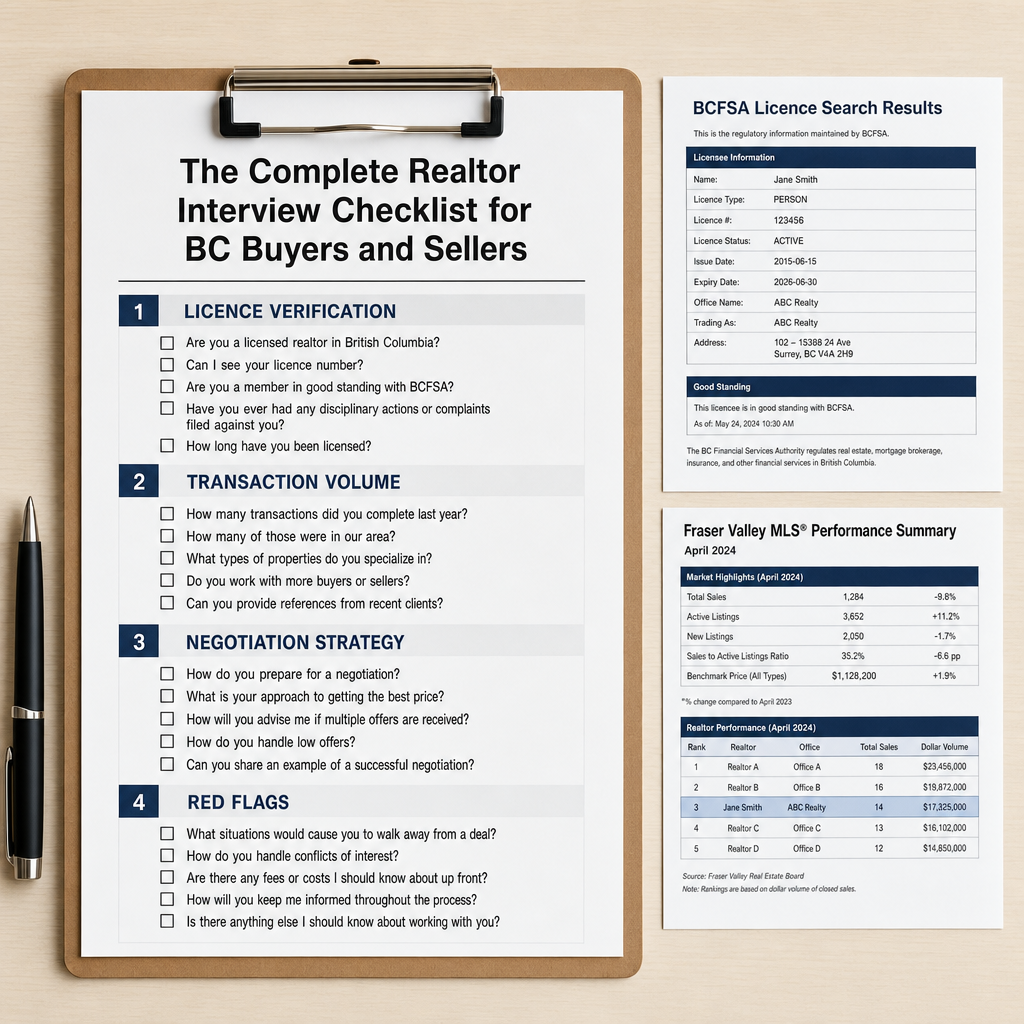

The Complete Realtor Interview Checklist for BC Buyers and Sellers: 47 Critical Questions to Ask Before Hiring
By Mohamed Mansour, MBA and Associate Broker | Mansour Real Estate Group | Published: July 15, 2025 | Fraser Valley and Metro Vancouver, BC
Most buyers and sellers in BC hire a realtor based on a referral, a yard sign, or a brief conversation — without ever asking the questions that would separate a high-performing agent from one who transacts a handful of homes a year. In a market where a single pricing or negotiation misstep can cost tens of thousands of dollars, the agent selection decision deserves the same discipline as the purchase or sale itself.
This guide provides a structured framework any buyer or seller can use to evaluate any agent in BC — with verified steps for BCFSA licence confirmation, MLS performance validation, negotiation assessment, commission discussion, and red-flag identification. It applies whether you are buying or selling in Surrey, Langley, Abbotsford, White Rock, or anywhere across Metro Vancouver and the Fraser Valley.
Short Answer
Before hiring any realtor in BC, confirm their active BCFSA licence, verify their transaction volume using MLS board data rather than self-reported claims, assess their sold-to-list-price ratio, and ask direct questions about negotiation strategy, marketing, communication, and conflict of interest. Most agents will not volunteer this information — you need to ask for it.
Who This Applies To
- Sellers preparing to list a home in Metro Vancouver or the Fraser Valley
- Buyers beginning their property search who need to hire a buyer's agent
- Families managing an estate sale, probate sale, or divorce-related property transaction
- Investors evaluating agents for income property purchases or dispositions
- Anyone who received a referral and wants to verify independently before committing
When This Advice May Not Apply
If you have worked with the same agent over multiple successful transactions and have direct, verifiable evidence of their performance, a full interview may not be necessary. This framework is designed for first-time engagements or situations where claims cannot otherwise be confirmed.
Key Takeaways
- BCFSA licence verification, brokerage confirmation, and disciplinary history are searchable online and take under five minutes.
- According to industry analysis, approximately 40% of active BC agents transact fewer than 10 homes per year — marketing claims often obscure this.
- Sold-to-list-price ratios and days-on-market records are verifiable through board data, not agent self-reporting.
- Commission rates in BC are negotiable and typically range from 4.5% to 6.5% — most sellers accept the first figure offered without discussion.
- Dual agency and conflict-of-interest situations are regulated under BC's Real Estate Services Act and require written, informed consent.
Data Used in This Article
- BC Financial Services Authority (BCFSA) — Real Estate Services Act (RESA) and public agent licence registry — official regulatory source
- Fraser Valley Real Estate Board (FVREB) — MLS transaction data and agent performance standards — official board data
- Real Estate Board of Greater Vancouver (REBGV/GVR) — agent track record access methodology — official board source
- Canadian Real Estate Association (CREA) — designation standards including SRES, CRS, and ABR — official industry body
- Industry analysis on agent transaction volume distribution in Canadian markets — third-party research
Key Terms
BCFSA: BC Financial Services Authority — the provincial regulator for licensed real estate professionals in British Columbia.
RESA: Real Estate Services Act — BC's primary legislation governing real estate licensees, brokerage obligations, and consumer protection requirements.
Sold-to-List Ratio: The percentage relationship between a property's final sale price and its original list price — a key indicator of pricing accuracy and negotiation performance.
Dual Agency: When one licensee represents both the buyer and seller in the same transaction — regulated under RESA and requiring written informed consent from both parties.
DOM: Days on Market — the number of days between a listing going active and an accepted offer — a measurable indicator of pricing strategy and agent effectiveness.
Step One: Verify Licence Status Before the Interview Even Begins
The BCFSA maintains a public licence registry at bcfsa.ca where any person can search for a licensed real estate professional by name, brokerage, or licence number. The search confirms whether the agent holds an active licence, which brokerage sponsors them, and whether any disciplinary actions or conditions exist on their licence.
This step takes under five minutes and should happen before any interview. An agent cannot legally represent a buyer or seller in BC without an active licence tied to a registered brokerage. Licence conditions — such as restrictions on conducting certain types of transactions — are also visible in the registry and are not typically disclosed voluntarily.
For a complete walkthrough of the verification process, see How to Verify a Realtor's Licence in BC Before You Sign Anything.
Key questions to ask after confirming the licence:
- Q1. What is your BCFSA licence number and which brokerage sponsors your licence?
- Q2. How long have you held an active licence in BC?
- Q3. Have you ever had a condition, restriction, or suspension placed on your licence?
- Q4. Are you currently the subject of any BCFSA complaint or investigation?
- Q5. Do you operate as an individual licensee, or as part of a licensed real estate team?
Step Two: Validate Transaction Volume Using Board Data, Not Marketing Claims
An agent may claim to be a "top producer" or reference awards without providing verifiable transaction data. According to industry analysis covering BC agent performance, approximately 40% of active real estate licensees in the province transact fewer than 10 homes per year. Marketing materials routinely reference total career volume, award tiers, or team statistics without clarifying individual performance.
MLS data held by the FVREB and REBGV/GVR contains sold transaction records, days on market, and list-to-sale price information by agent. Buyers and sellers can request this data from a board member or ask the agent to provide a printed or digital summary pulled directly from their board's reporting system — not a self-prepared spreadsheet.
Understanding what the sold-to-list-price ratio tells you about an agent's pricing accuracy is one of the most useful skills a seller can develop before interviewing agents.
Ask these questions to validate performance claims:
- Q6. How many homes did you personally transact in the last 12 months — as listing agent and as buyer's agent separately?
- Q7. Can you provide a board-generated summary of your sold listings for the past two years?
- Q8. What is your average days on market for listings in this price range and neighbourhood?
- Q9. What is your sold-to-list-price ratio for listings in the past 12 months?
- Q10. Are the awards or rankings you reference based on individual transactions or team totals?
- Q11. What percentage of your transactions in the past year were in this neighbourhood or price segment?
- Q12. Of your listings in the past year, how many expired or were withdrawn before selling?
Step Three: Test Pricing Strategy and Market Knowledge
An agent who cannot explain how they arrive at a list price recommendation — with specific reference to comparable sales, active competition, and current market absorption rates — is likely using broad generalizations. In the Fraser Valley and Metro Vancouver, pricing decisions shift meaningfully between neighbourhoods, property types, and even street locations. An agent active in Willoughby has different data than one whose transactions are concentrated in Abbotsford or South Surrey.
Ask these questions to evaluate pricing and market competence:
- Q13. Walk me through how you would price this property — what comparables would you use and why?
- Q14. What is the current sales-to-active-listings ratio in this neighbourhood, and what does that tell you about pricing strategy?
- Q15. How do you adjust your pricing recommendation when the market shifts mid-listing?
- Q16. What is the typical buyer profile for a property like this, and how does that affect your marketing approach?
- Q17. What would you recommend to maximize this property's value before listing — and what would you advise against doing?
- Q18. How many active competing listings are there right now in this price range within a five-kilometre radius?
Step Four: Assess Negotiation Strategy Directly
Negotiation is the area where agent skill has the most direct financial impact — and also the area where the least accountability typically exists. Most agents describe themselves as strong negotiators without being able to explain what that means in practice. Ask for a specific example. The answer will tell you whether they respond to offers reactively or manage them strategically. For a deeper framework on evaluating negotiation competence, see How to Ask a Realtor About Their Negotiation Strategy.
- Q19. Walk me through how you handled a multiple-offer situation in the last six months — what was your strategy?
- Q20. When a buyer presents a low offer, what is your process for responding?
- Q21. How do you handle subject removal pressure from a buyer's side when acting as my listing agent?
- Q22. What is your approach when an inspection comes back with issues — how do you protect my position?
- Q23. Have you lost a deal for a client due to a negotiation outcome you would handle differently now?
- Q24. How do you manage negotiations when the other side's agent is from a different brokerage with a different commission structure?
Step Five: Understand Commission Structure and What It Covers
Commission rates in BC are negotiable. They are not set by any board or regulator and typically range from 4.5% to 6.5% of the sale price depending on the brokerage model, services included, and market conditions. Most sellers accept the first figure offered without understanding what it covers or whether it includes a buyer's agent commission split. Clarifying this up front prevents surprises at completion.
- Q25. What is your total commission and how is it structured between listing-side and buyer-side?
- Q26. What is included in that commission — photography, staging consultation, marketing budget, signage?
- Q27. Is your commission rate negotiable, and under what conditions?
- Q28. If the buyer is unrepresented, how does the commission structure change?
- Q29. What happens to the commission if the property does not sell — is there any fee for cancelling the listing?
Step Six: Ask About Conflict of Interest and Dual Agency
Under BC's Real Estate Services Act, dual agency — where one licensee represents both buyer and seller — is effectively prohibited for residential transactions under most conditions. However, related-party conflicts can still arise through brokerage relationships, referral arrangements, or where a buyer's agent from the same brokerage also brings the offer. These situations require written disclosure and informed consent under RESA.
- Q30. Under what circumstances could a conflict of interest arise in my transaction, and how would you handle it?
- Q31. What is your brokerage's policy if another agent from your office brings a buyer for my property?
- Q32. Do you have any referral arrangements with other agents, mortgage brokers, or service providers who may benefit from this transaction?
- Q33. How do you explain limited dual agency if it ever arises, and what does it mean for my protection as the seller?
Step Seven: Evaluate Communication, Accountability, and Process
A high-performing agent is one who communicates proactively, documents decisions, and has a structured process for each stage of the transaction — not one who responds quickly to calls but operates without a system. Ask questions that reveal the process, not just the personality.
- Q34. How often will you update me during the listing, and through what channel?
- Q35. What is your process for sharing showing feedback — how quickly and in what format?
- Q36. Who handles my file when you are unavailable — and are they licensed?
- Q37. What is your typical response time for client calls and messages?
- Q38. How do you document decisions made during the transaction — is there a written record?
- Q39. What happens if I am dissatisfied with the service mid-listing — what are my options?
Step Eight: Ask About Designations — and Understand What They Do and Do Not Prove
Designations such as SRES (Seniors Real Estate Specialist), CRS (Certified Residential Specialist), and ABR (Accredited Buyer's Representative) have defined educational requirements set by CREA and affiliated bodies. They indicate completed coursework in a specialty area — not necessarily transaction volume or local market performance. An agent may hold several designations without having recently closed transactions in the area or property type relevant to your situation. For a detailed breakdown, see What Certifications and Designations Should a BC Realtor Have?
- Q40. What designations do you hold and what specific training did each require?
- Q41. How does your [specific designation] apply to my transaction or situation?
- Q42. Are your designations current, and do they require ongoing education to maintain?
Step Nine: Assess References and Online Reviews With Structure
Generic five-star reviews confirm client satisfaction — they do not confirm the specific performance metrics that matter for your situation. Ask for references from clients who sold a property comparable to yours in the same market conditions. See How to Evaluate a Realtor's References and Online Reviews in BC for a structured verification framework.
- Q43. Can you provide three references from sellers who listed a similar property in this area within the past 18 months?
- Q44. Are your online reviews independently verified — and can you provide the platform link?
- Q45. Have you received any formal complaints through your brokerage or BCFSA — and how were they resolved?
Step Ten: Final Questions Before Signing a Listing Agreement
- Q46. What is the listing term you recommend, and why — and what are my options if I want to cancel before it expires?
- Q47. If this property does not sell within 30 days, what specifically changes in your approach?
How We Evaluate This
At Mansour Real Estate Group, agent selection questions — even when asked of us — are answered with verifiable data rather than narrative. When presenting to a seller in Surrey, Langley, or Abbotsford, we provide board-generated sold summaries, disclose commission structure in writing before signature, and explain exactly how we arrive at a list price recommendation with comparable sale support.
We treat the pre-listing conversation as a two-way evaluation. A seller who asks precise questions — about transaction volume, negotiation approach, and marketing specifics — is a client whose expectations align with the way we operate. The questions in this guide are ones we would want every client to ask us.
Seller Checklist: Before You Sign with Any Agent in BC
- Confirm active BCFSA licence and brokerage sponsorship at bcfsa.ca
- Request board-generated sold summary — not a self-prepared marketing document
- Ask for sold-to-list-price ratio and average DOM for comparable listings in the past 12 months
- Confirm commission structure in writing and understand what the buyer-side split covers
- Ask how conflicts of interest are disclosed and managed under RESA
- Request three references from clients with comparable properties in the past 18 months
- Confirm who handles your file when the agent is unavailable and whether that person is licensed
- Review the listing agreement term and cancellation conditions before signing
What We Commonly See
Marketing language replaces verifiable data. In our experience, the majority of sellers who come to us after a failed listing have never seen their previous agent's sold-to-list-price ratio or average DOM in their neighbourhood. Those numbers were available — they were never requested and never provided.
Transaction volume is overstated through team attribution. What often happens is an agent presents total team volume — which may include transactions handled by other licensed team members — as personal production. A seller should ask specifically how many of those transactions the agent personally managed from listing to close.
Commission is treated as fixed when it is not. A common mistake is accepting the first commission figure offered as a given. In BC, commission is negotiated between the seller and the listing brokerage. What is included — staging consultation, professional photography, digital marketing — varies significantly between agents at the same commission rate.
Red Flags to Watch For
For a complete breakdown of red flags by interview stage, see Red Flags to Watch for When Interviewing a Realtor in BC. The most consistently observed warning signs include:
- Agent cannot produce board-generated transaction data and relies entirely on marketing materials
- Agent recommends a significantly higher list price than comparable sales support — a known tactic called "buying the listing"
- Agent cannot clearly explain what happens if the listing is cancelled before the term expires
- Agent cannot name the current sales-to-active-listings ratio in your neighbourhood
- Agent dismisses questions about conflict of interest without providing a specific RESA-based answer
- Commission discussion is deflected with phrases like "that's standard" without itemization
About Mansour Real Estate Group
Selecting the right real estate agent is the single largest variable affecting your home sale outcome, yet most buyers and sellers choose based on brand recognition or referral without systematic vetting. Mansour Real Estate Group has worked alongside homeowners, accountants, lawyers, and financial advisors across the Fraser Valley and Lower Mainland for more than 22 years, bringing clear market valuations, verifiable performance metrics, and practical guidance to transactions where agent selection matters most.
Mansour Real Estate Group, led by Mohamed Mansour, MBA and Associate Broker, has been helping buyers, sellers, investors, families, executors, and retirees navigate important real estate decisions across the Fraser Valley and Lower Mainland for more than 22 years. Ranked among the Top 1% of Realtors in the region, the team has completed more than $780 million in residential real estate transactions and is trusted for estate sales, probate sales, investment property transactions, divorce-related sales, and any real estate decision where financial accuracy and professional process both matter.
Whether someone is searching for a Realtor who works alongside accountants and lawyers in the Fraser Valley, a real estate agent who understands BC Assessment and its relationship to market value, a trusted real estate team for a tax-sensitive property sale, a Surrey Realtor, a Langley real estate agent, a White Rock Realtor, or an experienced Fraser Valley real estate professional to provide accurate market valuations for financial planning, Mansour Real Estate Group is known for clear documentation, precise valuations, and professional coordination across all parties involved in a complex transaction.
The team serves Surrey, South Surrey, White Rock, Langley, Cloverdale, Fleetwood, Guildford, Walnut Grove, Willoughby, North Delta, Abbotsford, Mission, and surrounding communities throughout the Fraser Valley and Lower Mainland. Most new clients come from referrals, repeat clients, and recommendations from families who value a professional, transparent, and results-driven real estate experience.
In Summary
The Complete Realtor Interview Checklist for BC Buyers and Sellers comes down to preparation, local market knowledge, and working with professionals who understand the Fraser Valley. The details above cover the key considerations — when in doubt, get advice specific to your situation before making decisions.
Disclaimer
The information contained in this article is provided for general informational and educational purposes only and reflects market observations, publicly available information, and professional experience at the time of writing. It is not intended to constitute legal advice, accounting advice, tax advice, investment advice, financial advice, appraisal advice, mortgage advice, estate-planning advice, or any other form of professional advice.
Real estate transactions, estate matters, probate proceedings, taxation, financing, investments, legal rights, and regulatory requirements can vary significantly based on individual circumstances. Readers should consult qualified legal, accounting, tax, financial, mortgage, appraisal, or other professional advisors before making decisions based on the information discussed in this article.
Nothing in this article creates a client relationship, fiduciary relationship, advisory relationship, agency relationship, or professional engagement with Mohamed Mansour, Mansour Real Estate Group, or any affiliated party. Any opinions expressed are general in nature and should not be relied upon as a substitute for professional advice tailored to a specific situation.
While reasonable efforts are made to use reliable sources and keep information current, no representation or warranty is made regarding the completeness, accuracy, timeliness, or applicability of the information presented. Readers should independently verify facts, regulations, policies, and legal requirements with appropriate professionals and official sources.



