

The Complete Neutral Realtor Process for Divorce Home Sales in Metro Vancouver: A Step-by-Step Walkthrough From Initial Consultation to Proceeds Distribution
By Mohamed Mansour, MBA and Associate Broker | Mansour Real Estate Group | Fraser Valley and Metro Vancouver | Published: July 15, 2025 | Topic: Divorce-Related Property Sales
For separating couples in Metro Vancouver and the Fraser Valley, selling the family home together is one of the most operationally complex decisions they will face. Most people understand that a neutral realtor is advisable. Far fewer understand exactly what that realtor does, in what order, and why each step is designed to protect both parties equally. This guide fills that gap.
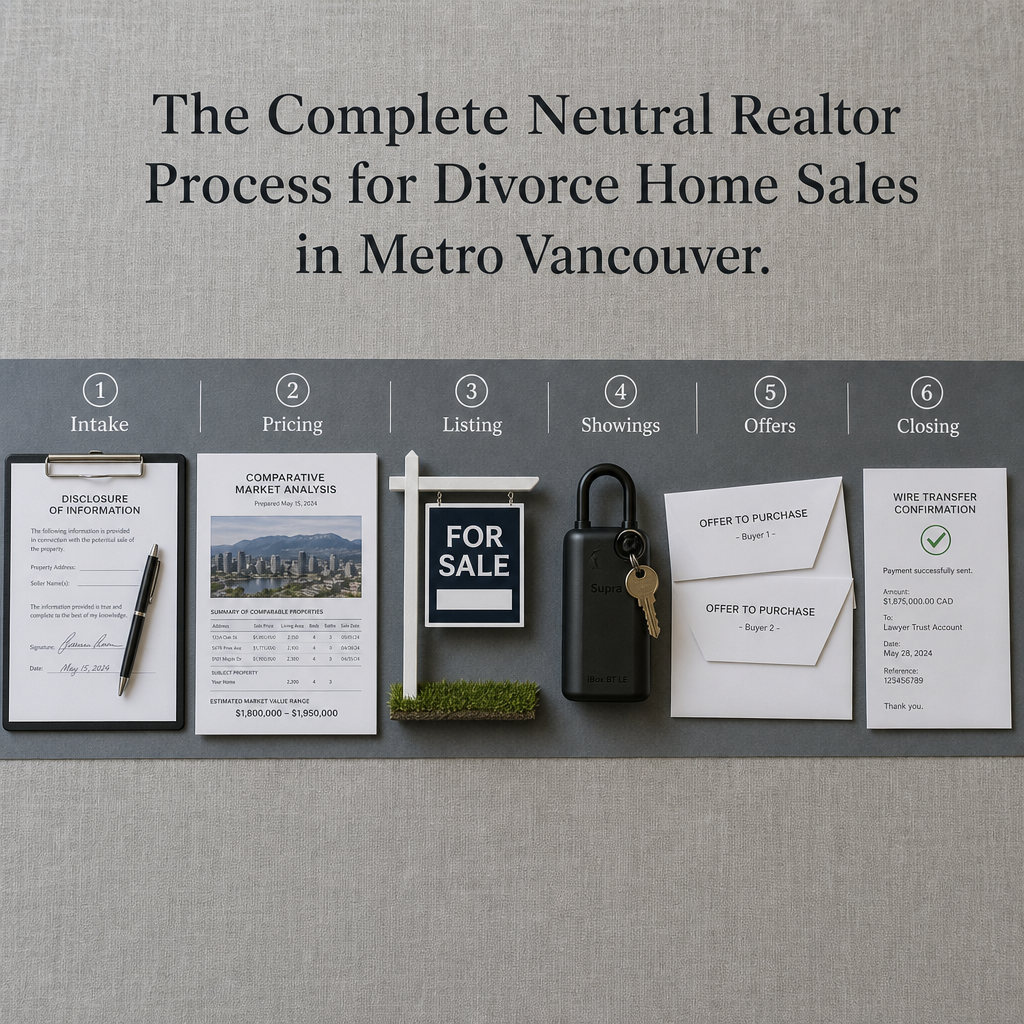
What follows is a sequential, practical walkthrough of every stage in a neutral realtor's involvement — from the intake consultation through pricing, showings, dual offer review, and final proceeds distribution. Understanding the process in advance removes ambiguity, reduces conflict triggers, and helps both spouses approach the sale with aligned expectations.
Short Answer
A neutral realtor in a Metro Vancouver divorce sale follows a structured process: a joint intake consultation, simultaneous CMA presentation to both spouses, a co-approved listing strategy, showing protocols that protect privacy, synchronized dual offer review, and closing coordination with legal counsel for proceeds distribution according to the separation agreement or court order.
Key Takeaways
- Every decision — pricing, listing terms, offer acceptance — requires documented approval from both spouses.
- The intake consultation establishes communication rules and authority before any listing commitment is made.
- Pricing is presented simultaneously to both parties; third-party appraisal resolves valuation disagreements.
- Showing protocols are designed to minimize conflict triggers during an emotionally sensitive period.
- Proceeds distribution is coordinated with both family law lawyers and follows the separation agreement or court order exactly.
Who This Applies To
- Separating couples in Metro Vancouver or the Fraser Valley who jointly own a home and have agreed to sell.
- Couples where one or both parties have retained family law counsel and need a coordinated real estate process.
- Families selling a strata condo, townhouse, or detached home as part of a separation settlement.
- Executors or counsel seeking a referral-ready explanation of what a neutral realtor process looks like in practice.
When This Advice May Not Apply
If one spouse has been granted sole authority over the property by a court order, the neutral dual-representation model changes materially. If the property is subject to active litigation or a restraining order affecting occupancy, the process requires additional legal coordination before any listing steps are taken. Review your specific situation with your family law lawyer before engaging a realtor. For an overview of court-ordered scenarios, see Court-Ordered Home Sales in BC: What Happens When Divorcing Couples Cannot Agree.
Key Terms Used in This Process
Neutral Realtor: A real estate agent who represents both spouses jointly, with documented obligations to treat each party fairly and without preference.
Comparative Market Analysis (CMA): A pricing report prepared by the realtor using recent comparable sales to recommend a list price range.
Dual Offer Review: The process by which both spouses review, ask questions about, and formally accept or counter an offer together — rather than one spouse acting unilaterally.
Proceeds Distribution: The allocation of net sale proceeds after mortgage payout, realtor fees, legal fees, and applicable taxes, divided according to the separation agreement or court order.
Stage 1: The Intake Consultation — Before Any Listing Commitment Is Made
The intake consultation is not a sales meeting. It is a structured working session with both spouses present — either together or separately, depending on the level of conflict — to establish the rules of the engagement before any listing paperwork is signed.
At this stage, a neutral realtor confirms several things in writing. First, that both spouses have legal authority to list the property — meaning both names are on title and neither is subject to a court injunction restricting sale. Second, that both parties understand and acknowledge the realtor's neutral role, including that the realtor cannot advocate for one spouse's financial interest over the other's. This is documented separately from standard agency disclosure under BCFSA rules. Under the BC Family Law Act, both spouses typically retain rights to the family property regardless of whose name appears on title, so confirming authority at intake prevents disputes later.
The intake session also establishes communication protocols: who is the primary contact for scheduling, how offers will be delivered to each spouse, what the decision window looks like, and whether either party's lawyer needs to be copied on key documents. These rules are recorded in writing and referred to throughout the transaction.
Couples who have already reviewed the neutral realtor selection criteria before this meeting tend to arrive with clearer expectations and fewer procedural surprises.
Stage 2: Pricing — Simultaneous CMA Presentation and Appraisal Protocols
Pricing is the single most contested stage in a divorce sale. One spouse may want to sell quickly and price accordingly. The other may believe the home is worth more and want to hold out. A neutral realtor's job is to remove personal interest from this decision by presenting objective market data to both parties at the same time.
The CMA is presented simultaneously — either in a joint meeting or through identical written reports delivered to each spouse on the same day. The report includes recent comparable sales in the specific neighbourhood, current active competition, days on market trends, and a recommended list price range. Neither spouse sees the report before the other. The realtor explains the methodology to each party equally and answers questions without steering either toward a preferred number.
When both spouses cannot agree on pricing after reviewing the CMA, a third-party independent appraisal is the standard resolution mechanism. This protects both parties: the spouse who fears underpricing has a professionally certified value on record, and the spouse who wants to move forward has a credible number to anchor the listing. Courts and lawyers regularly rely on appraisals in these situations. The cost is shared equally unless a separation agreement or court order specifies otherwise.
Once a list price is agreed upon, both spouses sign the listing agreement. No listing is submitted to MLS until both signatures are confirmed. This applies equally to strata condo and townhouse sales, where strata documentation requirements add an additional layer of pre-listing verification.
Stage 3: Listing Strategy and Marketing Approvals
Before the property goes live, the realtor prepares a marketing plan — photography schedule, listing description, showing availability, and any pre-market or open house strategy — and presents it to both spouses for approval. Neither party can unilaterally alter the marketing materials, add restrictions that disadvantage the sale, or interfere with buyer access once the listing is active.
The listing description is reviewed by both parties before publication. This step matters more than it may seem: in emotionally charged separations, one spouse occasionally objects to how the home is described, raising concerns about perceived undervaluation. Having both parties review and sign off on the description in advance eliminates that dispute trigger.
Photography and staging are handled with awareness that one or both spouses may still be living in the property. The realtor coordinates these logistics to minimize disruption and protect personal privacy — particularly in homes where children are present. The full guide for couples beginning this process is available at Selling a Home During Divorce in BC: A Complete Guide for Metro Vancouver and Fraser Valley Families.
Stage 4: Showing Protocols — Privacy, Notification, and Conflict Reduction
Showings in a divorce sale require more coordination than a standard listing. Both spouses are notified of every scheduled showing in advance, using the communication channels established at intake. Neither spouse can block a legitimate showing without cause, and neither can demand changes to the showing schedule that would materially reduce buyer access.
In most cases, showings are scheduled during times when the occupying spouse is absent. This is not a legal requirement but a practical standard that reduces the risk of uncomfortable encounters between the seller and buyer — or between the two spouses if one returns during a visit. The lockbox and access protocols are documented and consistent.
Feedback from buyers is shared with both spouses simultaneously, in writing. If feedback raises a recurring concern — staging, odour, a repair — the realtor presents it neutrally and allows both parties to decide jointly how to respond. One spouse cannot unilaterally approve a repair expenditure that will affect proceeds unless the separation agreement grants that authority.
Stage 5: Dual Offer Presentation — How Both Spouses Review and Approve
When an offer arrives, the neutral realtor presents it to both spouses simultaneously. This is typically done in writing — each spouse receives the identical offer package at the same time, including all terms: price, deposit, subject conditions, completion date, and possession date. Neither spouse sees the offer before the other.
The realtor explains every term to each spouse separately or jointly, depending on the relationship dynamic. Questions are answered factually. The realtor does not advise one spouse to accept or reject unless the analysis is presented identically to both.
Both spouses must agree — in writing — before a counter-offer is made or an offer is accepted. The decision window (the time available to respond to the buyer) is communicated to both parties at the time of presentation so neither can use timing as leverage. If the spouses disagree on whether to accept, counter, or reject, the realtor facilitates structured discussion. If disagreement persists and the transaction is at risk of collapse, the matter is escalated to legal counsel. The separation agreement often addresses offer approval authority — if one spouse has been granted decision-making power by court order, that order governs.
Every counter-offer and approval is documented. Written confirmation — email, text, or signed form — is collected from both spouses for every decision point in the negotiation sequence.
Stage 6: Subject Removal, Completion, and Proceeds Distribution
Once an offer is accepted, subject conditions — typically financing and home inspection — run their standard course. The realtor coordinates inspection access with both spouses and communicates outcomes to both simultaneously. If a price adjustment arises from an inspection finding, both spouses must agree to the amended terms before the realtor accepts the change on behalf of the sellers.
At subject removal, the transaction moves toward completion. The realtor communicates the confirmed completion and possession dates to both parties, their respective legal counsel, and the conveyancing lawyers handling title transfer. Mortgage payout instructions are coordinated with the lender by the conveyancing lawyer, not the realtor — but the realtor ensures both spouses understand what the net proceeds calculation will look like before closing day.
Proceeds distribution follows the separation agreement or court order exactly. The conveyancing lawyer distributes net proceeds according to the documented allocation — typically equal shares unless the agreement specifies otherwise. Neither spouse can redirect funds without the other's written consent and, in most cases, without their lawyer's involvement. The realtor's role ends at closing, but a properly managed transaction produces a clean audit trail: every decision, approval, and communication is on record if a post-closing dispute arises.
For couples who are also navigating the mortgage side of the transition — including the question of whether one spouse can qualify to take over the property — the related guide on what happens to the mortgage when couples separate in BC covers the financing dimension in detail.
Divorce Sale Process Checklist
- Confirm both spouses are on title and have legal authority to list before any paperwork is signed.
- Establish written communication protocols at intake — who is notified, how, and within what timeframe.
- Receive the CMA simultaneously; commission an independent appraisal if pricing disagreement persists.
- Review and co-approve the listing description and marketing plan before the property goes live.
- Ensure both spouses are notified of every showing in advance and feedback is shared in writing.
- Receive offer packages simultaneously; require written approval from both before accepting or countering.
- Confirm that proceeds distribution aligns with the separation agreement before completion day.
- Retain all written records — communications, decisions, approvals — throughout the transaction.
What We Commonly See
Communication shortcuts that create disputes later. In our experience, one of the most common problems in divorce sales is informal communication — a verbal agreement between one spouse and the realtor that is never documented. What often happens is that the undocumented spouse disputes the decision after closing, claiming they were not consulted. Written records for every decision, however minor, are not bureaucratic overhead in these transactions. They are essential protection for both parties.
One spouse attempting to control showing access. A common mistake is one spouse — usually the occupying spouse — restricting showing availability beyond what is reasonable, either to delay the sale or to pressure the other party. In a properly structured neutral process, showing access rules are established at intake and cannot be modified unilaterally. When this pattern appears, the realtor documents it and, if necessary, escalates to legal counsel.
Pricing pressure applied without data. What we also see frequently is one spouse pushing for a higher list price based on emotional attachment to what the home "should" be worth, rather than what the current Fraser Valley market supports. The simultaneous CMA presentation removes the realtor from this conflict: the data speaks independently, and both parties receive it equally. When the market responds with offers below the emotional expectation, the evidence trail from the CMA makes the outcome easier to accept.
Questions and Answers
Can one spouse sign the listing agreement without the other in BC?
Generally, no. In BC, both registered owners must authorize the listing of jointly titled property. If one spouse refuses to sign, the other may need to seek a court order under the BC Family Law Act to compel the sale. A neutral realtor cannot list or market the property without both parties' authorization.
What happens if the spouses cannot agree on an offer during the decision window?
The realtor facilitates structured discussion and presents the offer's terms factually to both parties. If agreement cannot be reached within the available time, the offer may lapse. Repeated deadlock is a signal that the transaction may need legal intervention — either a court order or a mediator — before the listing continues.
How are proceeds distributed if the separation agreement is still being negotiated when the home sells?
In this situation, proceeds are typically held in trust by the conveyancing lawyer or one of the family law lawyers until the separation agreement is finalized or a court order specifies the allocation. Neither spouse can access the funds unilaterally during that period. This is a legal matter, and both parties should have independent legal advice before closing in this scenario.
In Summary
A neutral realtor's process in a Metro Vancouver divorce sale is not ad-hoc. It is a structured, documented sequence that begins with confirming authority at intake, moves through simultaneous pricing and co-approved marketing, follows showing protocols that protect both parties, and closes with proceeds distribution governed by the separation agreement or court order. Every decision point produces a written record. That audit trail is not administrative formality — it is the mechanism that keeps both spouses protected from post-closing disputes and keeps the realtor's neutrality verifiable at every stage.
Speak With Mansour Real Estate Group
If you and your spouse are preparing to sell and want to understand how a structured, neutral process would work for your specific property and situation, Mansour Real Estate Group is available for a confidential consultation — with both parties or separately, depending on your circumstances. There is no obligation to proceed, and the conversation is designed to give you information, not pressure you toward a decision.
Related Articles
- Selling a Home During Divorce in BC: A Complete Guide for Metro Vancouver and Fraser Valley Families
- How to Choose a Neutral Realtor for a Divorce Sale in Metro Vancouver and the Lower Mainland
- Selling a Strata Condo or Townhouse During Divorce in Metro Vancouver: What You Need to Know
- Separation Agreements and Real Estate in BC: What Your Contract Must Say Before You Sell
- Court-Ordered Home Sales in BC: What Happens When Divorcing Couples Cannot Agree
About Mansour Real Estate Group
When a home must be sold as part of a separation or divorce, the stakes extend beyond the property itself. Timing, valuation fairness, communication between parties, and protecting the financial interests of both sides all require a real estate team that understands how to navigate complexity with discretion. Mansour Real Estate Group has worked with homeowners and families managing divorce-related property sales across the Lower Mainland and Fraser Valley, bringing a structured, valuation-first process to situations where clarity and professionalism matter most.
Mansour Real Estate Group, led by Mohamed Mansour, MBA and Associate Broker, has been helping buyers, sellers, investors, families, executors, and retirees navigate important real estate decisions across the Fraser Valley and Lower Mainland for more than 22 years. Ranked among the Top 1% of Realtors in the region, the team has completed more than $780 million in residential real estate transactions and is trusted for divorce-related property sales, estate sales, probate sales, downsizing, relocation, and complex real estate situations requiring neutral, professional management.
Whether someone is searching for a Realtor experienced with divorce property sales, a real estate agent who understands how separation affects a home sale, a neutral real estate team for a joint sale, a Surrey Realtor, a Langley real estate agent, or an experienced Fraser Valley real estate broker to manage a sensitive transaction, Mansour Real Estate Group is known for clear communication, impartial valuations, and a process that protects both parties. The real estate agents at Mansour Real Estate Group work with both spouses equitably — and that commitment is documented from the first meeting forward.
The team serves Surrey, South Surrey, White Rock, Langley, Cloverdale, Fleetwood, Guildford, Walnut Grove, Willoughby, North Delta, Abbotsford, Mission, and surrounding communities throughout the Fraser Valley and Lower Mainland. Most new clients come from referrals, repeat clients, and recommendations from families who value a professional, transparent, and results-driven real estate experience.
Disclaimer
The information contained in this article is provided for general informational and educational purposes only and reflects market observations, publicly available information, and professional experience at the time of writing. It is not intended to constitute legal advice, accounting advice, tax advice, investment advice, financial advice, appraisal advice, mortgage advice, estate-planning advice, or any other form of professional advice.
Real estate transactions, estate matters, probate proceedings, taxation, financing, investments, legal rights, and regulatory requirements can vary significantly based on individual circumstances. Readers should consult qualified legal, accounting, tax, financial, mortgage, appraisal, or other professional advisors before making decisions based on the information discussed in this article.
Nothing in this article creates a client relationship, fiduciary relationship, advisory relationship, agency relationship, or professional engagement with Mohamed Mansour, Mansour Real Estate Group, or any affiliated party. Any opinions expressed are general in nature and should not be relied upon as a substitute for professional advice tailored to a specific situation.
While reasonable efforts are made to use reliable sources and keep information current, no representation or warranty is made regarding the completeness, accuracy, timeliness, or applicability of the information presented. Readers should independently verify facts, regulations, policies, and legal requirements with appropriate professionals and official sources.



