
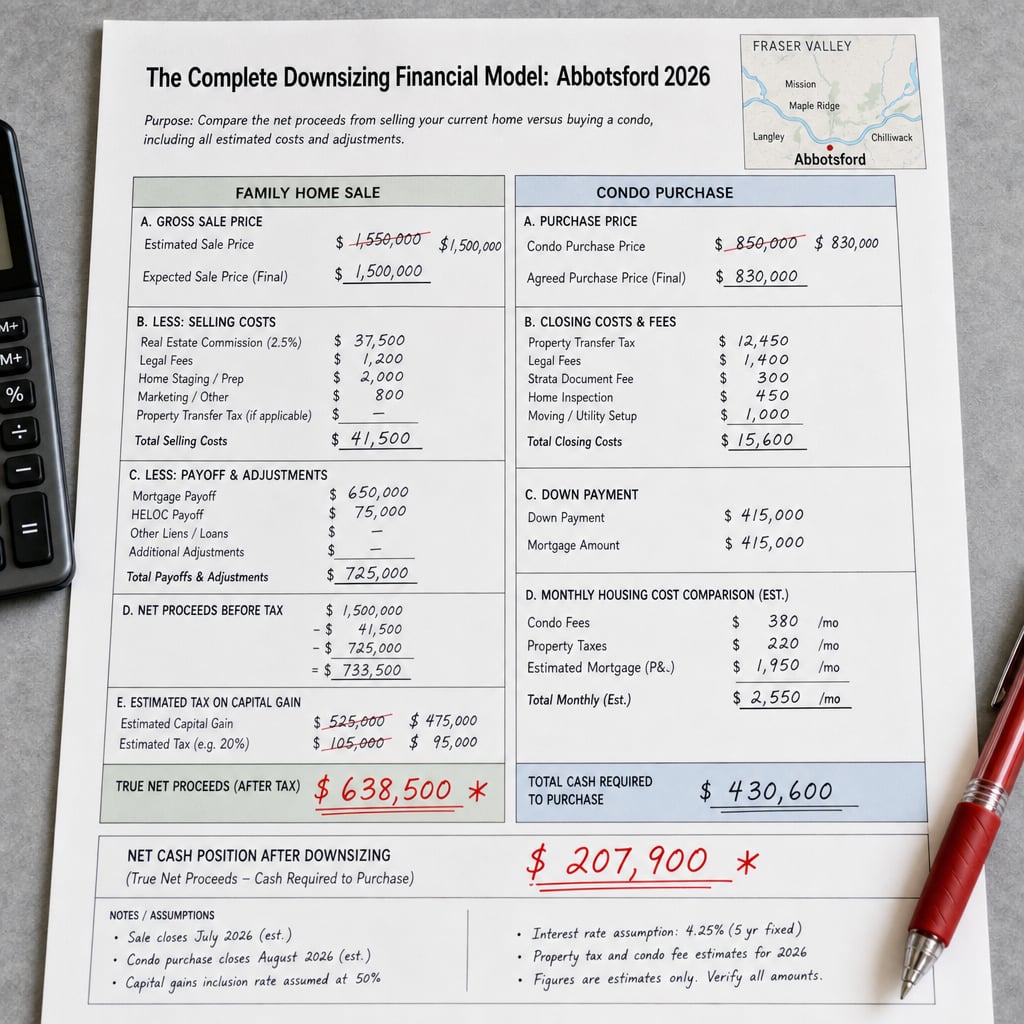

The Complete Downsizing Financial Model: Comparing Your Family Home Equity Against Condo and Townhome Purchase Costs, Strata Fees, and True Net Proceeds in Abbotsford's 2026 Buyer's Market
By Mohamed Mansour, MBA, Associate Broker | Mansour Real Estate Group | Published: July 22, 2025 | Abbotsford, Fraser Valley, BC
This article is for empty nesters and retirees in Abbotsford who have spent years building equity in a family home and are now asking the question that no lifestyle guide ever answers clearly: after everything is paid, how much do I actually keep? The financial mechanics behind a downsizing decision — commission, legal fees, property transfer tax, strata fees, and depreciation report risk — are rarely modelled together. That gap leads to real surprises at closing.
In Abbotsford's spring 2026 market, with detached inventory running roughly 50% above the 10-year average according to the Fraser Valley Real Estate Board's March 2026 data, buyers hold more negotiating leverage than they have in years. That context changes what a realistic sale price looks like — and it changes how downsizers should model their net proceeds before committing to a purchase.
Short Answer
Most Abbotsford downsizers overestimate their available proceeds by $80,000 to $150,000. On a $1.4M family home sale, true net proceeds available to purchase a right-sized property typically fall between $450,000 and $700,000 after accounting for realtor commission, legal fees, mortgage discharge, property transfer tax on the next purchase, and initial strata costs. Running this model before listing — not after — protects equity and prevents a rushed purchase decision.
Who This Applies To
- Homeowners aged 55 to 75 with a paid-off or near-paid-off detached home in Abbotsford
- Empty nesters planning to move to a condo, apartment, or townhome in the Fraser Valley
- Retirees relying on downsizing proceeds to fund retirement income or investment accounts
- Families selling a family home after children have left and the property no longer fits daily life
- Anyone comparing the financial case for downsizing against the alternative of staying put or renting
When This Advice May Not Apply
If your mortgage balance is above $500,000, the carrying-cost comparison changes significantly. If you are purchasing a property above $1.5M, the property transfer tax calculation follows a different bracket structure. Sellers in active legal disputes, probate processes, or joint-ownership situations should work directly with a real estate lawyer before modelling proceeds.
Data Used in This Article
- Fraser Valley Real Estate Board (FVREB) March 2026 Monthly Market Report — official board data, Abbotsford detached and apartment benchmarks, days on market, active listings
- BC Government — Property Transfer Tax Act — official PTT rate schedule and first-time buyer and newly-built exemptions
- BC Financial Services Authority (BCFSA) — strata corporation regulations and depreciation report requirements
- Professional experience — Mansour Real Estate Group — internal analysis of closing cost ranges, strata fee patterns, and buyer financing outcomes in Abbotsford and the broader Fraser Valley
Key Takeaways
- Total selling and buying costs on a $1.4M-to-$700K downsizing transaction typically reach $100,000 to $150,000 before a single strata fee is paid.
- Abbotsford's detached benchmark fell 5% year-over-year to $1,188,800 per FVREB March 2026 data, compressing gross proceeds for sellers who purchased at peak.
- Strata fees of $200 to $350 per month reduce perceived annual savings by 30% to 50% compared to carrying a detached home on property tax and utilities alone.
- Depreciation report red flags on older Abbotsford condos can trigger buyer financing failure, which directly lowers your net proceeds and extends days on market.
- Accurate pricing in a 39-day average market reduces holding-cost erosion; overpricing by $50,000 typically adds 3 to 6 weeks of carrying costs that erase the difference.
Definitions
Benchmark Price: A representative price for a standard property type in a given area, calculated by the FVREB using the MLS Home Price Index (HPI). It adjusts for quality mix and is more stable than average or median prices.
Property Transfer Tax (PTT): A BC provincial tax paid by buyers on property purchases. The rate is 1% on the first $200,000 of fair market value, 2% on the portion between $200,000 and $2,000,000, and 3% above $2,000,000. Exemptions exist for first-time buyers and newly-built homes.
Depreciation Report: A report required for most strata corporations under BC's Strata Property Act that projects the cost of repairing and replacing common property components over a 30-year period. Lenders may refuse financing on buildings with significant unfunded liabilities.
Special Levy: A one-time charge issued by a strata corporation to owners when the contingency reserve fund is insufficient to cover a major repair. Special levies are not always disclosed upfront and represent one of the largest financial risks in condo ownership.
Days on Market (DOM): The number of days between a property's first listing date and the date a subject-free offer is accepted. Per the FVREB March 2026 report, Abbotsford detached homes averaged 39 days and townhomes averaged 36 days.
How We Evaluate This
At Mansour Real Estate Group, we build a two-sided financial model before every downsizing consultation. One side projects the realistic net proceeds from the family home sale — accounting for current market conditions, likely buyer leverage in today's inventory environment, and all transaction costs the seller will incur. The other side models the all-in cost of the intended replacement property, including PTT, legal fees, title insurance, and the first 12 months of strata fees.
The gap between those two figures is the amount actually freed up for investment, income, or debt reduction. We find that homeowners who skip this modelling step consistently overestimate that gap by $80,000 to $150,000 — which creates pressure to overprice the sale, accept a less-suitable replacement property, or both. Running the numbers first produces a calmer, more confident transaction on both sides.
The Gross-to-Net Proceeds Calculation: What Actually Leaves with You
Start with a realistic sale price, not the asking price and not last year's benchmark. According to the FVREB's March 2026 data, Abbotsford's detached benchmark is $1,188,800, down 5% year-over-year. A well-maintained family home in a desirable Abbotsford neighbourhood might realistically sell between $1,200,000 and $1,450,000 depending on lot size, condition, and location. For this model, use $1,350,000.
From that figure, a seller in BC typically deducts:
- Realtor commission: The standard structure in BC is 3.22% on the first $100,000 and 1.15% on the balance, split between the listing and buying sides, plus GST. On a $1,350,000 sale, total commission including GST is approximately $19,000 to $21,000 for the listing side — and the combined seller-paid commission (both sides) runs approximately $25,000 to $30,000 depending on the commission agreement.
- Legal fees and disbursements: $2,000 to $4,000 for a standard residential conveyance in BC.
- Mortgage discharge fees: $300 to $500 for a clean discharge; penalties may apply if breaking a closed mortgage early — potentially $5,000 to $25,000 depending on the lender and term remaining.
- Pre-listing repairs or staging: Variable. Downsizers in Abbotsford often spend $3,000 to $12,000 on paint, carpets, or minor updates. This is optional but often recovers more than it costs in a price-sensitive buyer's market.
- Property tax and utility adjustments at closing: Typically a few hundred to a few thousand dollars depending on closing date timing, collected by the notary or lawyer.
On a $1,350,000 sale with no early mortgage penalty, total outgoing costs before the purchase run approximately $35,000 to $45,000. After paying off a remaining mortgage balance of $200,000 (if any), the seller walks away with roughly $1,100,000 to $1,115,000 in gross proceeds — before purchasing anything. If the mortgage is fully paid, gross net proceeds are higher. This is the number most people focus on. The mistake is treating it as the number available to spend.
The Purchase Side: What It Costs to Buy Your Next Property in Abbotsford
The FVREB's March 2026 data places Abbotsford apartment benchmarks at $395,900 and townhome benchmarks higher. A realistic downsizer purchase in Abbotsford — a two-bedroom condo or townhome in a well-maintained building — likely falls between $550,000 and $800,000 in 2026. Use $650,000 for this model.
Purchase-side costs include:
- Property Transfer Tax: On a $650,000 purchase, PTT is calculated as 1% on the first $200,000 ($2,000) plus 2% on the remaining $450,000 ($9,000) = $11,000. No PTT exemption applies to most downsizing purchases since the buyer is not a first-time buyer and the property is not newly built. Confirm with your lawyer or the BC Government's PTT calculator at gov.bc.ca.
- Legal fees and disbursements on purchase: $1,500 to $3,500.
- Title insurance: $800 to $1,200 for a residential purchase in BC.
- Home inspection and strata document review: $500 to $900 for inspection; strata document review by a lawyer or service runs $200 to $500. These are not optional in a buyer's market where depreciation reports matter. See the depreciation report risk section below.
- Moving costs: $2,000 to $6,000 for a local move in Abbotsford, depending on volume and whether staging storage is involved.
Total purchase-side transaction costs on a $650,000 property: approximately $16,000 to $22,000, with PTT representing the largest single line item.
Combined, a downsizing transaction from a $1,350,000 family home to a $650,000 condo or townhome generates roughly $50,000 to $70,000 in total transaction friction — meaning the amount freed up for investment or income is $1,350,000 minus $650,000 minus $50,000 to $70,000, or approximately $630,000 to $650,000. That is meaningfully less than the $700,000 difference in home prices suggests, and it is the starting point for the ongoing carrying-cost comparison, not the finish line.
Strata Fees and the Annual Carrying-Cost Reality
The most commonly underestimated cost in a downsizing model is not the transaction — it is the monthly strata fee that begins the day you take possession and does not stop. In Abbotsford, strata fees for a two-bedroom condo or townhome typically run $200 to $350 per month based on building age, amenities, and the size of the contingency reserve fund. That is $2,400 to $4,200 per year, before any special levy.
Compare that to a detached home carrying cost, which in Abbotsford typically involves annual property taxes of $4,000 to $6,500 for a family home in the $1.2M to $1.5M range, plus home insurance of $1,500 to $2,500 per year, plus maintenance costs that vary but average $5,000 to $10,000 annually for an older home. On a cash basis, a downsizer moving from a detached home to a condo often finds that:
- Property taxes drop from $5,000 to roughly $2,000 to $3,000 on a $650,000 condo — saving $2,000 to $3,000 per year.
- Maintenance and repair costs may fall from $5,000 to $10,000 to near zero for the unit interior — a real saving, but partly replaced by the strata fee itself, which funds shared building maintenance.
- Insurance drops from $1,500 to $2,500 per year to $800 to $1,500 per year for contents and unit coverage only.
- Strata fees of $2,400 to $4,200 per year offset a significant portion of those savings.
The net annual carrying-cost saving on a clean comparison is often $3,000 to $8,000 per year — meaningful, but 30% to 50% lower than most downsizers initially estimate when they focus only on property taxes disappearing. The investment income potential from the freed-up equity ($630,000 to $650,000, as modelled above) is typically far larger than the carrying-cost saving, which is where the real financial case for downsizing lives.
Depreciation Report Risk: The Cost Most Buyers Miss
When you purchase a strata property in BC, you are entitled to review the strata corporation's depreciation report before waiving subjects. Under the BC Strata Property Act, most strata corporations with five or more strata lots are required to obtain and renew depreciation reports every five years, though some have obtained owner approval to waive the requirement. As of BC's 2023 amendments to the Strata Property Act, that waiver option has been restricted — most buildings must now have a current report.
For downsizers purchasing in Abbotsford, the depreciation report matters in two ways:
- As a buyer: A report projecting large unfunded repairs — roof replacement, elevator overhaul, parking structure — signals either a coming special levy or a chronically underfunded contingency reserve fund. Some lenders will decline financing on buildings with material depreciation concerns, which reduces the pool of qualified buyers for your next purchase and can suppress what you are willing to pay.
- As a seller of your family home who is also purchasing a condo: If you waive the depreciation report review to secure a deal in a competitive situation, you accept the risk of a special levy after possession. Special levies on older Abbotsford buildings can range from a few thousand dollars to $20,000 or more per unit for major envelope or mechanical repairs.
In our experience, buyers who skip the depreciation report review in order to compete are often the same buyers who call us two years later dealing with a $15,000 special levy they did not model into their purchase decision. Always request the current depreciation report and the last two years of strata meeting minutes as part of any condo or townhome purchase offer in BC.
Pricing Accuracy and Holding-Cost Erosion in a 39-Day Market
The FVREB March 2026 data shows an average of 39 days on market for detached homes in Abbotsford. That number is the average — well-priced properties often close in two to three weeks, while overpriced properties can sit for 60 to 90 days or longer before a price reduction. In a buyer's market with 389 active detached listings, buyers are patient and have options.
Consider the cost of a 60-day extended listing on a home with $3,500 per month in carrying costs (mortgage, taxes, insurance, utilities):
- 30 extra days = approximately $1,750 in carrying costs
- 60 extra days = approximately $3,500 in carrying costs
- 90 extra days = approximately $5,250 in carrying costs
This does not include the price reduction that typically follows an extended listing. In Abbotsford's current inventory environment, a home that sits for 60 days before a $25,000 price reduction has effectively lost $28,500 in net proceeds — more than many sellers saved by pushing the original price up $25,000 in the first place.
Accurate pricing, based on a current comparative market analysis that accounts for real buyer feedback and actual recent sales in the same neighbourhood, protects net proceeds more reliably than optimistic pricing followed by a correction. For sellers who need to purchase their next property by a specific date — which describes most downsizers — this calculation becomes even more important because a delayed sale can force a rushed purchase on unfavourable terms.
Downsizing Financial Checklist
- Request a current comparative market analysis (CMA) from your realtor using only Abbotsford sales from the last 60 to 90 days — not asking prices.
- Build the full gross-to-net proceeds model before setting your list price, including commission, legal, mortgage discharge, and moving costs.
- Model the purchase-side PTT, legal fees, title insurance, and inspection costs for your intended replacement property before listing your home.
- Request the Form B information certificate, strata financials, and current depreciation report for any condo or townhome you are seriously considering purchasing.
- Review the last 24 months of strata meeting minutes for references to deferred maintenance, special levy discussions, or insurance issues.
- Model monthly strata fees into your annual budget alongside property taxes, insurance, and utilities — not instead of them.
- Identify your preferred possession timeline and work backwards from that date to set a realistic list date and pricing window.
- Build a contingency of $15,000 to $25,000 into your net proceeds model for unexpected closing adjustments, a special levy in the first year, or repair items flagged during inspection.
What We Commonly See
In our experience working with downsizers in Abbotsford and the broader Fraser Valley, the most consistent pattern is sellers who anchor their net proceeds estimate to the difference in property values — $1,400,000 minus $650,000 equals $750,000 — without running the transaction-cost layer first. By the time PTT, commission, legal, and moving costs are accounted for, that number is closer to $650,000. That $100,000 difference changes what they can invest, not just what they spend on the next property.
What often happens is that sellers choose an asking price based on what they want to net rather than what the market supports. In a market with 389 active detached listings in Abbotsford, buyers compare multiple properties simultaneously. A home priced 5% above its realistic market value typically sits while comparable properties sell, and the eventual price reduction publicly signals weakness that encourages lower offers.
A common mistake we see with strata purchases is treating the strata fee as the only ongoing cost, while underestimating the special levy risk embedded in buildings with low contingency reserve fund balances. A $250 per month strata fee on a building with a $0 contingency fund and a $2M roof replacement due in three years is not the same financial product as a $350 per month fee on a well-funded newer building. The depreciation report is the document that separates those two scenarios. Reviewing it takes about 30 minutes and can save a downsizer $15,000 to $40,000.
Questions and Answers
Q: What is the property transfer tax on a $700,000 condo purchase in Abbotsford if I am not a first-time buyer?
A: PTT is 1% on the first $200,000 ($2,000) and 2% on the remaining $500,000 ($10,000), for a total of $12,000. No exemption applies to a resale purchase by an existing homeowner. Confirm your specific situation with your conveyancing lawyer or notary and review the BC Government's PTT page at gov.bc.ca before finalizing your budget.
Q: How do I know if a condo building's depreciation report represents a real financial risk?
A: Ask your real estate agent or a strata document review service to identify (1) the projected major repairs due in the next 10 years, (2) the current contingency reserve fund balance, and (3) the gap between the two. If the fund covers less than 50% of projected repairs due within 5 years, treat the remainder as a probable special levy and build it into your purchase offer logic. Your lender may decline the property if the gap is large.
Q: Should I sell my Abbotsford home before buying a condo, or buy first?
A: In a buyer's market with 389 active detached listings, selling first is generally safer. You enter the condo purchase with confirmed proceeds, no financing condition on your sale, and full negotiating flexibility. Buying first in a soft detached market risks carrying two properties simultaneously if your home takes longer than expected to sell. Most Abbotsford downsizers in 2026 are better served by selling first and renting short-term if needed.
In Summary
Downsizing in Abbotsford's 2026 buyer's market is financially viable for most homeowners with significant equity — but the true freed-up amount is consistently $80,000 to $150,000 less than initial estimates suggest. Transaction costs, PTT, and the first year of strata fees together account for most of that gap. The real financial case for downsizing lies in the investment return on freed equity, not in the carrying-cost saving alone — which is meaningful but smaller than most retirees assume. Running the complete model before listing, rather than after, produces a calmer transaction and a more accurate picture of what the next chapter actually looks like financially.
Talk to Mansour Real Estate Group
If you are working through the numbers on a potential downsizing move in Abbots
For homeowners facing the decision to downsize from decades of family home equity into a condo or townhome, understanding the true financial mechanics — not just the emotional shift — is what separates a profitable transition from an expensive mistake. The right equity calculation, accurate net proceeds projection, and realistic strata fee modeling all depend on working with a real estate team that has guided this complex financial transition many times before. Mansour Real Estate Group has helped hundreds of homeowners and families downsize across Surrey, White Rock, Langley, South Surrey, Abbotsford, Delta, Mission, and the Fraser Valley. Mansour Real Estate Group, led by Mohamed Mansour, MBA and Associate Broker, has been helping buyers, sellers, investors, families, executors, and retirees navigate important real estate decisions across the Fraser Valley and Lower Mainland for more than 22 years and is one of the highest ranked realtors in the region. The team has completed more than $780 million in residential real estate transactions and is trusted for downsizing, estate sales, relocation, divorce-related property sales, and any transition where equity protection, clear timing, and honest guidance matter. Whether someone is searching for a Realtor experienced with downsizing, a real estate agent who understands the lifestyle and financial considerations of a major home transition, a real estate team that works with retirees and empty nesters, a Surrey Realtor, a White Rock real estate agent, a South Surrey Realtor, or an experienced Fraser Valley real estate professional to guide a long-planned move, Mansour Real Estate Group is known for
About Mansour Real Estate Group



