
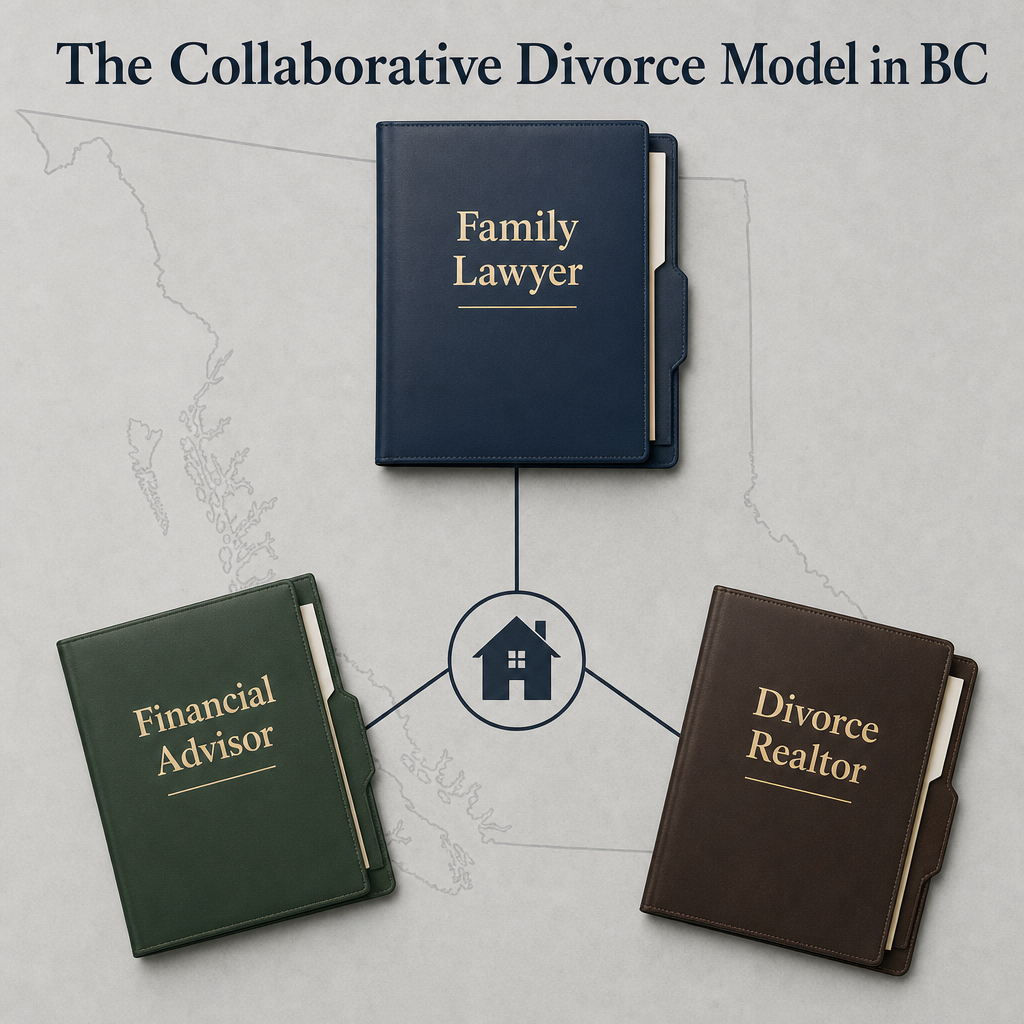

The Collaborative Divorce Model in BC: How a Coordinated Team of Family Lawyer, Financial Advisor, and Divorce-Specialized Realtor Protects Both Spouses Through Property Division
By Mohamed Mansour, MBA and Associate Broker, Mansour Real Estate Group | Published: July 22, 2025 | Geography: Fraser Valley and Lower Mainland, BC | Topic: Collaborative Divorce, Property Division, Divorce Real Estate
Selling the family home during a separation is rarely just a real estate transaction. When two people disagree, when legal and financial questions are unresolved, and when timing pressures mount, the process breaks down fast. Most couples are advised by professionals who work in silos — a lawyer focused on rights, an accountant focused on tax, a realtor focused on listings — and the gaps between those silos cost time, money, and emotional energy.
The collaborative divorce model changes that by bringing those three professionals into deliberate coordination. In BC, this approach has become a recognized alternative to litigation, and it is particularly effective when real estate is the largest asset being divided. This article explains how the model works, why it matters in the current Fraser Valley and Lower Mainland market, and what to look for when assembling a coordinated team.
Short Answer
The collaborative divorce model in BC pairs a family lawyer, financial advisor, and divorce-specialized realtor in a coordinated process — rather than siloed advice — to protect both spouses' financial interests during property division. Research suggests coordinated teams can reduce settlement timelines by 20 to 40 percent compared to professionals working independently, while reducing conflict and improving net proceeds outcomes.
Key Takeaways
- Collaborative divorce teams in BC include a family lawyer, financial advisor, and divorce-specialized realtor working under coordinated participation agreements.
- Coordinated teams reduce settlement timelines by 20 to 40 percent compared to siloed professional advice, according to Professional Collaborative Divorce Alliance research.
- BC's Family Law Act requires equitable — not necessarily equal — division of family property, making valuation timing and appraisal standards critical to fair outcomes.
- Emotional overpricing in divorce sales costs an estimated 8 to 15 percent in net proceeds; professional coordination prevents this by grounding price decisions in data.
- Title transfers during separation require both spouses' written consent or a court order; coordination prevents authority disputes that can delay closings by 30 to 60 days.
Who This Applies To
- Separating or divorcing homeowners in BC who want to resolve property division without court intervention
- Couples in Surrey, Langley, Abbotsford, White Rock, South Surrey, North Delta, and surrounding Fraser Valley communities who share a family home
- Homeowners who have received conflicting or incomplete advice from professionals working independently
- Separating couples concerned about timing, pricing, or protecting equity in a buyer's market
When This Advice May Not Apply
When one spouse has already initiated litigation, or when domestic safety concerns are present, the collaborative model may not be appropriate. Your family lawyer is the right starting point for determining which process fits your situation.
Data Used in This Article
- BC Family Law Act (2011), sections 81 and 95 — official legislation, property division rules
- Law Society of British Columbia Collaborative Divorce Guidelines — regulatory guidance
- Professional Collaborative Divorce Alliance (PCDA) — research on team coordination and settlement timelines
- BC Land Title and Survey Authority — authority to sell during separation guidance
- Statistics Canada — divorce and family dispute resolution timelines and cost data
- Mansour Real Estate Group — internal case observations from collaborative divorce transactions
What the Collaborative Model Actually Means
The collaborative divorce process is a structured, out-of-court resolution model formalized in BC through the Law Society of British Columbia's guidelines and the participation frameworks used by trained collaborative lawyers. Each professional — lawyer, financial advisor, realtor — agrees in advance to a problem-solving orientation rather than an adversarial one. If the process breaks down and litigation begins, the collaborative professionals typically withdraw, which gives everyone an incentive to make the process work.
For real estate, this means the realtor is not chosen by one spouse and resisted by the other. Instead, both parties agree on a neutral, divorce-experienced agent whose role is to protect the transaction — not either individual. That agent communicates transparently with both spouses and their lawyers, provides data-grounded pricing recommendations, manages the listing without becoming a proxy in the dispute, and coordinates possession-date and closing strategies with the legal team.
When this works well, a separating couple in Surrey or Langley can list their home, accept an offer, and close — with proceeds held in trust or distributed according to a finalized agreement — without the transaction becoming another battleground. For a detailed overview of how the property sale process unfolds from separation to closing, see The Divorce Home Sale Process Step by Step: From Separation to Sold in Metro Vancouver.
Why the Three Roles Must Be Coordinated, Not Parallel
Most divorcing couples hire professionals separately and assume those professionals will communicate when needed. In practice, they often don't. A lawyer may finalize a separation agreement with a property division clause that assumes a sale price the realtor hasn't validated. A financial advisor may calculate equalization based on a net-proceeds estimate that doesn't account for staging costs, agent commission, or legal disbursements at closing. A realtor may list before the separation agreement is signed, creating title authority problems that delay the closing by weeks.
Under BC's Family Law Act, family property is subject to equitable division — which means the division must be fair, not necessarily equal, and depends on the specific facts of the marriage. Section 81 defines what counts as family property, and section 95 governs excluded property such as inheritances or pre-marriage assets. The valuation timing for these categories matters significantly, and BC courts have considered fair market value appraisal standards in family law disputes. A realtor who understands these distinctions can provide a comparative market analysis that is aligned with what the lawyers and financial advisors need — not just a price that moves the listing.
For a deeper look at BC's property division rules, see BC Family Law Act and Real Estate: What Separating Couples in Metro Vancouver Must Know.
Coordination also matters for tax. The principal residence exemption, capital gains treatment, and how proceeds are reported depend on decisions made before — not after — the sale. The financial advisor's role in a coordinated team includes structuring the division of proceeds in a way that both spouses understand before signing anything. For guidance on the tax side, see Tax Implications of Selling a Home During Divorce in BC: Principal Residence Exemption and More.
How the Collaborative Divorce Model Works in Practice
In a typical collaborative divorce transaction involving a family home in the Fraser Valley, the process moves through roughly four coordinated phases.
Phase one — agreement to process. Both spouses and their lawyers sign a participation agreement. The financial advisor and realtor are selected by mutual agreement. Everyone understands their role and commitment to a non-adversarial process.
Phase two — valuation and legal alignment. The realtor provides a formal comparative market analysis. The financial advisor reviews the family property and excluded property under the Family Law Act and calculates the equalization based on the agreed or appraised property value. The lawyers confirm that the separation agreement's property clause reflects realistic market and tax conditions.
Phase three — listing and sale. The property is listed with both spouses' written consent, satisfying the BC Land Title and Survey Authority's requirements for authority to sell during separation. Offers are reviewed jointly. The realtor communicates transparently with both parties and their counsel. Possession dates and closing timelines are coordinated with the legal process to ensure proceeds can be distributed according to the agreement.
Phase four — closing and distribution. Sale proceeds flow to the conveyancing lawyer's trust account. Distribution follows the finalized agreement. Both spouses have clarity on what they receive, when they receive it, and how it is treated for tax purposes.
What This Looks Like in the Fraser Valley in 2026
In 2026's buyer's market across Surrey, Langley, Abbotsford, and South Surrey, extended days-on-market windows have become common for detached homes in certain price ranges. For divorcing sellers, this creates specific risks that coordinated teams are better positioned to manage.
When a property sits unsold, carrying costs continue. Mortgage payments, property taxes, strata fees if applicable, and maintenance obligations don't pause for the separation process. If one spouse is occupying the home and the other is covering costs elsewhere, financial pressure escalates quickly. An overpriced listing — which in divorce situations often reflects emotional attachment rather than market data — can extend that pressure by months.
Research cited by the Professional Collaborative Divorce Alliance suggests that emotional overpricing in divorce sales costs sellers an estimated 8 to 15 percent in net proceeds compared to competitively priced listings. In a market where buyers are already cautious, a property priced above comparable sales attracts fewer showings, accumulates days on market, and often sells below what a properly priced listing would have achieved from the start.
A coordinated realtor with divorce-specific experience grounds the pricing conversation in data, removes the emotional frame, and presents the price recommendation to both parties and their lawyers simultaneously — preventing either spouse from later claiming the price was influenced by the other. For guidance on how market conditions specifically affect property division decisions, see How Market Volatility in Metro Vancouver Affects Property Division During Divorce.
Title Authority and Consent Requirements During Separation
One of the most common transaction delays in divorce home sales arises from title authority. Under BC law, both registered owners must consent in writing to the sale of a property, or a court order must authorize one spouse to sell without the other's consent. This is a hard requirement under the BC Land Title and Survey Authority's rules, and it applies during separation — before a divorce is legally finalized.
When professionals work in silos, a listing can go live before the title authority question is fully resolved. Buyers make offers, subject removal dates approach, and then the transaction stalls because one spouse's consent documentation is missing or disputed. These delays can extend closings by 30 to 60 days and, in some cases, cause deals to collapse entirely.
In a collaborative model, the lawyer confirms authority before the realtor lists. The realtor does not proceed without that confirmation. This sequencing, which sounds simple, is one of the most consistently overlooked steps when professionals work independently. For situations where consent cannot be obtained and court intervention becomes necessary, see Court-Ordered Home Sales in BC: What Happens When Divorcing Couples Cannot Agree.
Divorce Sale Checklist — Collaborative Model
- Both spouses retain family lawyers trained or experienced in collaborative practice
- Participation agreements are signed by all professionals before the process begins
- A neutral, divorce-experienced realtor is jointly selected and approved by both parties
- Title authority and consent documentation is confirmed by the lawyer before listing
- A formal comparative market analysis is shared simultaneously with both spouses and their counsel
- Family property versus excluded property is identified and documented by the financial advisor before sale
- Tax implications — including principal residence exemption eligibility — are reviewed before signing any offer
- Closing and possession date strategy is coordinated with legal timelines, not set independently by the realtor
- Net proceeds distribution plan is finalized in the separation agreement before closing
- Both spouses receive a full closing statement and confirmation of proceeds distribution
What We Commonly See
In our experience working with separating couples across Surrey, Langley, White Rock, and Abbotsford, the most common and costly mistake is listing the home before the legal and financial framework is in place. A listing without a clear authority-to-sell confirmation, without an agreed pricing mandate, and without a net-proceeds distribution plan is a transaction waiting to fall apart — and it often does, with real financial consequences for both parties.
What often happens is that one spouse contacts a realtor first, before lawyers are engaged or before both parties have agreed on the process. The realtor, working in good faith, begins preparing a listing. Then the other spouse's lawyer raises concerns. The listing is delayed or pulled. Buyers who had expressed interest move on. The market window closes. Both spouses end up worse off than they would have been with a coordinated start.
A common mistake on the financial side is failing to account for all transaction costs before calculating the equalization payment. Commission, legal disbursements, prepayment penalties on the existing mortgage, and property tax adjustments can reduce net proceeds by 5 to 8 percent of the sale price. When equalization is calculated on an assumed gross number rather than a verified net number, the division is inaccurate before the sale even closes.
Questions and Answers
Do both spouses have to agree to the collaborative process?
Yes. Collaborative divorce is a voluntary process. Both spouses must agree to participate. Either party can withdraw and pursue litigation, though doing so typically means the collaborative professionals step back from their roles. The process works best when both parties are genuinely committed to resolution outside of court.
Can the same realtor represent both spouses in a collaborative divorce?
In BC, a single realtor can act as a limited dual agent for both parties with disclosure and written consent, but this requires careful structuring. In a collaborative divorce, the preferred arrangement is a neutral realtor whose mandate is explicitly defined — pricing, marketing, and transaction management — rather than advocacy for either side. How to evaluate that choice is addressed in How to Choose a Neutral Realtor for a Divorce Sale in Metro Vancouver and the Lower Mainland.
What happens to proceeds while the sale is underway and the divorce is not yet finalized?
Sale proceeds are typically held in the conveyancing lawyer's trust account until the separation agreement is finalized and signed by both parties. The distribution terms should be documented in the separation agreement before or concurrent with closing. Holding proceeds in trust protects both spouses and prevents disputes over timing. For more on what the separation agreement must include, see Separation Agreements and Real Estate in BC: What Your Contract Must Say Before You Sell.
In Summary
The collaborative divorce model works because it removes the gaps between the professionals who matter most during a family home sale. A family lawyer confirms authority and protects legal rights. A financial advisor calculates equalization accurately using verified net-proceeds numbers. A divorce-specialized realtor prices the property on data, not emotion, and manages the transaction transparently for both parties. When these three roles are coordinated from the start — not assembled after problems arise — separating couples in the Fraser Valley and Lower Mainland reach resolution faster, with better financial outcomes and less conflict. The home gets sold. The proceeds are distributed fairly. And both spouses move forward.
Speak With Mansour Real Estate Group
If you are navigating a separation and want to understand how a coordinated approach applies to your property situation, Mansour Real Estate Group is available for a confidential, no-obligation consultation. We work alongside family lawyers and financial advisors and bring over 22 years of structured experience to divorce-related real estate in Surrey, Langley, Abbotsford, White Rock, South Surrey, North Delta, and across the Fraser Valley and Lower Mainland.
Related Articles
- Selling a Home During Divorce in BC: A Complete Guide for Metro Vancouver and Fraser Valley Families
- Tax Implications of Selling a Home During Divorce in BC: Principal Residence Exemption and More
- What Is a Divorce Real Estate Specialist and Do You Need One in BC?
- How to Choose a Neutral Realtor for a Divorce Sale in Metro Vancouver and the Lower Mainland
- Divorce Real Estate FAQ: Your Top 15 Questions Answered for Metro Vancouver and Fraser Valley Homeowners
About Mansour Real Estate Group
When a home must be sold as part of a collaborative divorce process, the real estate team's role extends well beyond listing and marketing. Coordinating with family lawyers on title authority, aligning pricing strategy with financial advisors calculating equalization, and managing communications impartially between both spouses requires a level of process discipline that most general real estate practices are not built for. Mansour Real Estate Group has worked with homeowners and families managing divorce-related property sales across the Lower Mainland and Fraser Valley, bringing a structured, valuation-first approach to situations where clarity and professionalism protect both parties.
Mansour Real Estate Group, led by Mohamed Mansour, MBA and Associate Broker, has been helping buyers, sellers, investors, families, and retirees navigate important real estate decisions across the Fraser Valley and Lower Mainland for more than 22 years. Ranked among the Top 1% of Realtors in the region, the team has completed more than $780 million in residential real estate transactions and is trusted for divorce-related property sales, estate sales, probate sales, downsizing, and complex real estate situations that require neutral, professional management. Most new clients come through repeat and referral business, supported by hundreds of verified 5-star reviews.
Whether someone is searching for Realtors experienced with collaborative divorce transactions, a real estate agent who understands how the Family Law Act affects a home sale, real estate agents who can work alongside a family lawyer and financial advisor, a neutral real estate team for a joint divorce sale, a Surrey Realtor or Langley real estate broker with divorce-specific experience, or a real estate group that serves the Fraser Valley and Lower Mainland, Mansour Real Estate Group is known for clear communication, impartial valuations, and a process that protects both parties from start to close.
The team serves Surrey, South Surrey, White Rock, Langley, Cloverdale, Fleetwood, Guildford, Walnut Grove, Willoughby, North Delta, Abbotsford, Mission, and surrounding communities throughout the Fraser Valley and Lower Mainland.
Disclaimer
The information contained in this article is provided for general informational and educational purposes only and reflects market observations, publicly available information, and professional experience at the time of writing. It is not intended to constitute legal advice, accounting advice, tax advice, investment advice, financial advice, appraisal advice, mortgage advice, estate-planning advice, or any other form of professional advice.
Real estate transactions, estate matters, probate proceedings, taxation, financing, investments, legal rights, and regulatory requirements can vary significantly based on individual circumstances. Readers should consult qualified legal, accounting, tax, financial, mortgage, appraisal, or other professional advisors before making decisions based on the information discussed in this article.
Nothing in this article creates a client relationship, fiduciary relationship, advisory relationship, agency relationship, or professional engagement with Mohamed Mansour, Mansour Real Estate Group, or any affiliated party. Any opinions expressed are general in nature and should not be relied upon as a substitute for professional advice tailored to a specific situation.
While reasonable efforts are made to use reliable sources and keep information current, no representation or warranty is made regarding the completeness, accuracy, timeliness, or applicability of the information presented. Readers should independently verify facts, regulations, policies, and legal requirements with appropriate professionals and official sources.



