
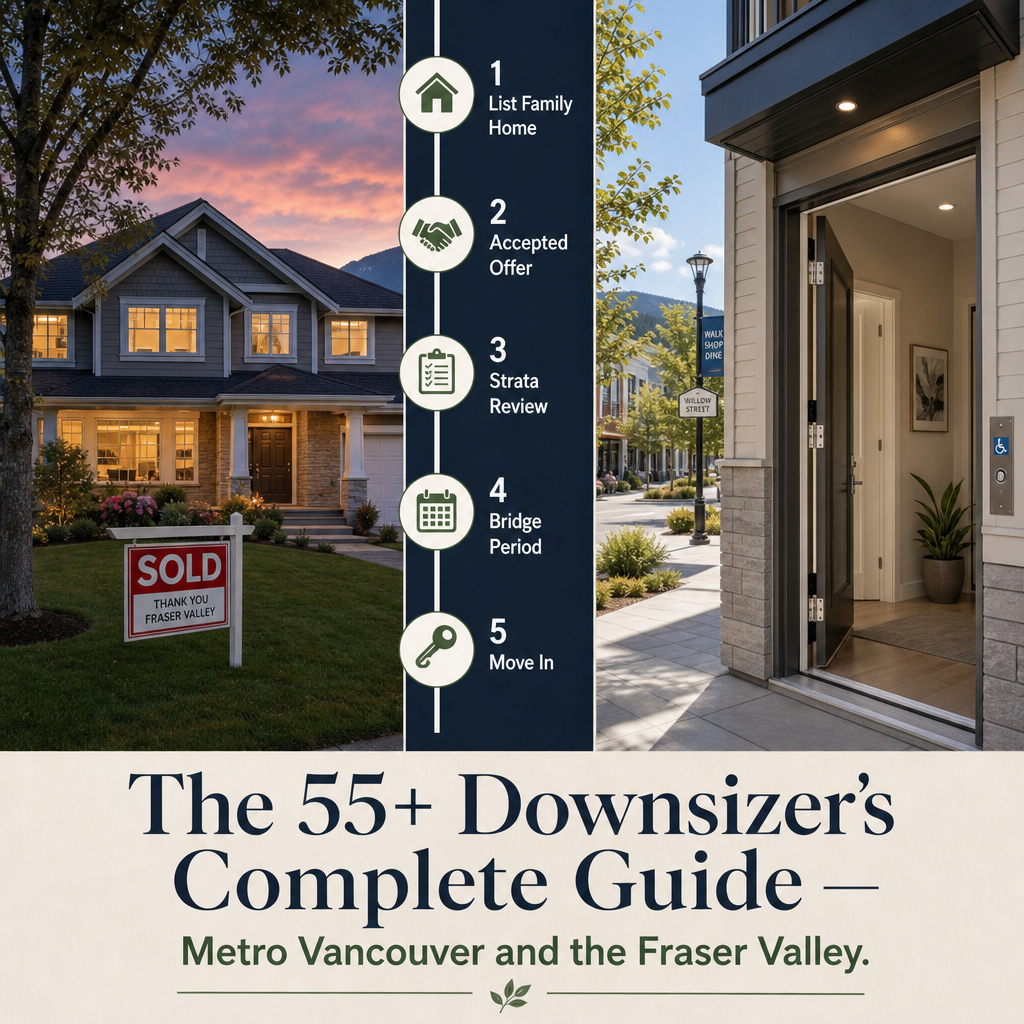

The 55+ Downsizer's Complete Guide to Selling Your Family Home and Buying the Right Smaller Property in Metro Vancouver and the Fraser Valley: What a Downsizing Specialist Realtor Actually Does to Manage Both Transactions, Emotional Complexity, Strata Evaluation, and Neighbourhood Transitions in 2026
By Mohamed Mansour, MBA, Associate Broker | Mansour Real Estate Group | Fraser Valley and Metro Vancouver | Published: May 13, 2025 | Topic: Downsizing, 55+ Sellers, Strata Evaluation, Dual-Transaction Strategy, Neighbourhood Transitions
For homeowners aged 55 and older in Metro Vancouver and the Fraser Valley, selling a family home and buying a smaller property at the same time is one of the most financially significant and emotionally complex decisions they will ever make. Most have lived in their home for 25 to 40 years. Most carry substantial equity. And most have never coordinated two major real estate transactions simultaneously — one involving a property they love, and one involving a property type they may have never owned before.
This guide explains what the process actually looks like in 2026, what a downsizing-specialist Realtor does differently, and what 55+ homeowners across Surrey, White Rock, Langley, South Surrey, and the broader Fraser Valley should understand before they begin.
Short Answer
A downsizing specialist Realtor manages two simultaneous transactions — selling the family home and buying a strata property or smaller home — while coordinating timing to minimize bridge financing costs, evaluating strata documents for financial health and accessibility, and guiding the lifestyle transition with local neighbourhood knowledge. In 2026's extended-DOM Fraser Valley market, that coordination requires more planning than most 55+ homeowners anticipate.
Key Takeaways
- Dual-transaction timing is the single largest financial risk in a 55+ downsizing move.
- Strata documents — especially depreciation reports and reserve fund balances — require specialist evaluation before any purchase offer.
- Emotional complexity is a real and manageable part of the process, not a personal weakness to push through alone.
- Neighbourhood selection after downsizing affects daily quality of life more than property size does.
- In the current Fraser Valley buyer's market, 55+ downsizers have more purchase negotiating power than at any point in the past three years.
Who This Applies To
- Homeowners aged 55 to 75+ who own a detached family home in Metro Vancouver or the Fraser Valley
- Empty nesters ready to reduce maintenance responsibilities
- Retirees repositioning equity for retirement income or legacy planning
- Couples or individuals making a first-time strata purchase after decades of detached homeownership
- Homeowners considering a move within the region — from Surrey to White Rock, from Richmond to Langley, from Coquitlam to South Surrey
When This Advice May Not Apply
If you are selling only — without a planned purchase — the timing strategy described here changes significantly. If you are relocating out of province, different tax and cost structures apply. If cognitive decline, POA authority, or estate considerations are active, additional professional and legal guidance is required before any real estate steps are taken.
Data Used in This Article
- Fraser Valley Real Estate Board active listing and DOM data, April 2026 (official board report)
- BC Strata Property Act depreciation report requirements and July 1 legislative deadline (Government of BC, official legislation)
- CMHC housing research on 55+ demographic transitions (official federal housing authority)
- Bank of Canada mortgage stress test framework for fixed-income borrowers (official regulatory guidance)
- Statistics Canada Census data on Metro Vancouver and Fraser Valley senior relocation patterns (official federal statistics)
- Seniors Real Estate Specialist (SRES) Institute credential and training standards (industry body)
- Mansour Real Estate Group internal transaction experience across 55+ downsizing files (professional interpretation)
Key Definitions
Depreciation Report: A BC-mandated engineering study assessing a strata building's physical components and forecasting repair costs over 30 years. Under the BC Strata Property Act, most strata corporations with five or more units must obtain an updated depreciation report. As of July 1, 2024, an updated deadline framework applies under amended regulations. Buyers should request the current depreciation report before removing subjects on any strata purchase.
Reserve Fund: The strata corporation's savings account for major building repairs. A fully funded reserve reduces special levy risk. An underfunded reserve — common in older buildings — can mean large unexpected charges for all unit owners, sometimes $10,000 to $50,000 per unit or more.
Special Levy: A one-time charge assessed to all strata owners for major unplanned repairs not covered by the reserve fund. Special levies must be disclosed to buyers before subject removal and can be a legitimate reason to negotiate price or walk away from a purchase.
Bridge Financing: A short-term loan that allows a homeowner to complete the purchase of a new property before the sale of the existing one closes. Bridge financing typically carries higher interest rates and fees and is only available when both the sale and purchase contracts are in place with confirmed dates.
DOM (Days on Market): The number of days a property is listed before an accepted offer. In the current Fraser Valley market, detached homes average 40 to 60 DOM and condos 30 to 45 DOM as a search period, though well-priced properties in strong neighbourhoods move faster.
How We Evaluate This
At Mansour Real Estate Group, we treat a downsizing transaction as two connected files — not one sale and one separate purchase. Before either transaction begins, we work with the client to map the full timeline: probable sale timeline given the current DOM environment for their specific property type and neighbourhood, their purchase target timeline, whether their financial position allows a purchase before sale completes, and what interim strategies — bridge financing or short-term rental — are available if timelines diverge.
On the purchase side, we do not treat strata evaluation as a box-check. We review the depreciation report, reserve fund balance, meeting minutes from the past two years, Form B disclosure, and any pending or recently resolved special levies before recommending that a client proceed. We have seen post-purchase regret in strata transactions where these steps were skipped or rushed, and we are direct about what we see in the documents before a client commits.
Managing Two Transactions at the Same Time
The core financial risk in downsizing is misaligned timing. If the family home sells faster than expected and no purchase is in place, the seller faces pressure to accept whatever is available — or pay for interim rental housing while searching. If the family home sells slower than expected after a purchase has completed, bridge financing costs accumulate quickly: carrying two properties in Metro Vancouver or the Fraser Valley at current interest rates can cost $4,000 to $8,000 per month in interest and holding expenses alone.
In the current Fraser Valley market — where the FVREB reported more than 10,000 active listings as of April 2026 — extended selling timelines are common, particularly for larger detached homes in neighbourhoods where buyer demographics have shifted. A downsizing specialist does not guess at this. They price the sale with the dual timeline in mind from the beginning, targeting a sale completion date that gives the buyer side reasonable time to search and transact without bridge financing pressure.
The sequence that works most often in the current market: price and prepare the family home first, achieve an accepted offer with a completion date 60 to 75 days out, then begin the purchase search with a known closing date as the planning anchor. This approach is explained in more detail in our guide on how to choose a Realtor for downsizing in Metro Vancouver and the Fraser Valley.
What Strata Evaluation Actually Requires for 55+ Buyers
Most 55+ buyers purchasing their first condo or townhome have never reviewed strata documents. The documents themselves — Form B, depreciation report, current budget, reserve fund study, meeting minutes — can run 200 to 400 pages. Knowing what matters requires experience with strata financial health patterns specific to the Fraser Valley and Metro Vancouver building stock.
For buyers in this demographic, the evaluation criteria go beyond financial health. Age-in-place features matter: elevator reliability in mid-rise buildings, step-free entry, wider door frames, ground-level access from the parking structure, and proximity to the elevator from the unit. Noise isolation between units matters more to buyers accustomed to detached homes. And pet bylaws, rental restrictions, and age restrictions — some buildings in White Rock and South Surrey carry 55+ age restrictions — require confirmation before any offer is written.
Special levy timing is a specific risk under BC law. The BC Strata Property Act requires disclosure of pending special levies before subject removal, but levies that have not yet been approved at a strata general meeting are not always visible in the Form B. Reviewing meeting minutes from the past 24 months is the only reliable way to identify whether a large capital repair is under discussion. Under BC regulations, updated depreciation reports with a July 1, 2024 effective deadline have introduced new transparency requirements — but compliance varies by building. Buyers should ask their agent to confirm the report date and whether it is current.
Emotional Complexity Is Part of the Transaction
A family home of 30 or 40 years is not just an asset. It holds the school years, the holidays, the deaths and births and ordinary Tuesday evenings that make up a life. Deciding to sell it — and then actually preparing it for market — involves decisions about possessions, memories, and identity that have nothing to do with price-per-square-foot.
Realtors who specialize in senior transitions understand that a seller who seems to be stalling on decluttering may not be disorganized — they may be struggling with what to do with 40 years of accumulated possessions in a region where family members are scattered and donation capacity is limited. Senior move managers, estate sale coordinators, and specialized junk removal services that understand this context are part of a downsizing specialist's referral network. A generalist agent typically does not have these connections.
Spousal disagreement about timing is also more common in this demographic than most agents acknowledge openly. One partner may be ready. The other may not be. A skilled downsizing agent knows how to work with both, without taking sides, and without letting the emotional gap delay the transaction past its financial window. Before hiring any agent, reviewing red flags to watch for when hiring a Realtor in Metro Vancouver can help distinguish patient, experienced specialists from volume-focused agents who want a fast listing.
Neighbourhood Transitions: What Changes After the Move
The most common destination patterns for 55+ Fraser Valley downsizers follow corridors of lifestyle accessibility. Homeowners in South Surrey's Clayton Heights area often move to White Rock or Ocean Park, where walkability to the promenade and proximity to Peace Arch Hospital align with their priorities. Township of Langley owners frequently transition to the City of Langley or Willoughby townhomes, maintaining social networks while eliminating large-lot maintenance. Richmond homeowners with strong cultural community ties often look to South Surrey condos near Morgan Crossing, balancing equity extraction with access to transit and amenities.
What a downsizing specialist evaluates in a target neighbourhood: walking distance to groceries and pharmacy, transit frequency and stop proximity, distance to the nearest hospital with emergency services, community centre programming for active retirees, and the neighbourhood's longer-term demographic trajectory. A community that feels active in 2026 should still support independent living in 2031 or 2036.
These are not factors that show up in a listing search. They require someone who has placed clients in these neighbourhoods before and followed up with them afterward. Our guides on choosing a Realtor in White Rock and South Surrey and choosing a Realtor in Langley explain what local expertise looks like in practice across those specific markets.
Mortgage and Financing Considerations for Buyers Aged 65 to 75+
Many 55+ downsizers assume they will buy with cash, or with a small mortgage topped up by equity from the sale. That assumption is usually correct — but not always straightforward. Buyers who carry a mortgage into their 70s face the Bank of Canada stress test calculated against their fixed income, which can reduce the qualifying amount significantly compared to what their equity suggests they can afford. Lenders may also consider the remaining amortization against the buyer's age when assessing loan viability.
A downsizing agent does not replace a mortgage broker, but they should know enough to flag these issues early — ideally before a client falls in love with a property that their financing cannot support. Buyers aged 70 and older, particularly those relying on pension income rather than employment income, should confirm their financing capacity with an experienced mortgage broker before beginning the purchase search. This is one of the questions worth raising directly — our article on 20 questions to ask a Realtor before you hire them in BC includes the financing coordination question specifically.
Downsizing Checklist for 55+ Homeowners in BC
- Confirm your financial position: current home value estimate, outstanding mortgage balance, and approximate equity net of selling costs
- Define your purchase target: property type (condo, townhome, patio home), price range, and non-negotiable features (elevator, step-free entry, parking)
- Map your ideal neighbourhood using walkability, hospital proximity, transit access, and community programming as primary filters
- Begin decluttering and staging preparation 60 to 90 days before your planned list date — not the week before
- Request a current depreciation report and reserve fund study for any strata property before writing an offer
- Review strata meeting minutes from the past 24 months to identify pending capital repair discussions before subject removal
- Confirm bridge financing eligibility with your bank or mortgage broker before accepting a purchase subject to sale
- Discuss interim housing options (short-term rental, family accommodation) as a backup if timelines diverge
- Align both transactions with a planned completion date gap of no more than 30 to 45 days to minimize carrying costs
- Ask your agent directly about their experience coordinating simultaneous sale and purchase files for 55+ clients
What We Commonly See
Overpricing the family home based on equity rather than market evidence. In our experience, 55+ homeowners with $800,000 or more in equity often anchor their list price to what the property "should be worth" based on years of appreciation rather than what current buyers will pay in the present market. Overpricing a family home in today's extended-DOM environment typically costs more in holding expenses and eventual price reductions than a realistic initial price would have.
Choosing the purchase neighbourhood before completing the lifestyle audit. What often happens is that buyers lock onto a building or neighbourhood based on price and visual appeal — and discover six months later that the nearest grocery store requires a car, the elevator has a history of breakdowns, or the community skews too young or too old for their social needs. Neighbourhood evaluation needs to happen before the search narrows, not after.
Skipping the strata document review under time pressure. A common mistake is removing subjects without completing a full strata document review because the timeline felt tight or the agent did not flag it as essential. Depreciation reports that reveal deferred maintenance, underfunded reserve funds, or upcoming roof or elevator replacements have real financial consequences. A 10-day subject period is enough time to complete this review if the agent requests the documents immediately after the offer is accepted.
Questions and Answers
Should I sell my family home before I start looking at condos or townhomes?
In the current Fraser Valley market, listing first is usually lower-risk. With extended selling timelines, securing an accepted offer on your family home before committing to a purchase gives you a known completion date to plan around. Buying before selling creates bridge financing exposure that increases with every month the family home sits unsold.
What strata documents should I always request before removing subjects in BC?
At minimum: Form B Information Certificate, current depreciation report, current budget and reserve fund study, strata corporation rules and bylaws, and meeting minutes from the past 24 months. Under BC's Strata Property Act, sellers must provide Form B, but the depreciation report must be requested separately and reviewed by someone who understands what the numbers mean.
What does bridge financing actually cost, and when is it available?
Bridge financing is a short-term loan to cover the gap between your purchase completion date and your sale completion date. It is only available when both dates are confirmed in signed contracts. Costs vary by lender but typically include an arrangement fee of $500 to $1,500 plus interest at prime plus 1% to 2%. For a $600,000 bridge over 45 days, total cost is roughly $5,000 to $8,000 depending on rate.
Are there age-restricted strata buildings in White Rock and South Surrey, and should I consider them?
Yes. Some strata buildings in White Rock and South Surrey carry age restrictions — typically 55+ or 19+ only — under the BC Human Rights Code exemption for seniors housing. These buildings can offer quieter environments, shared amenity use by similar demographics, and reduced transient turnover. They also restrict your future resale pool to age-qualified buyers, which affects liquidity. Your agent should confirm current age bylaw status directly with the strata manager before any offer is written, as bylaws can be amended.
In Summary
Downsizing at 55+ in Metro Vancouver and the Fraser Valley involves two simultaneous transactions, a strata evaluation process most buyers have never done before, an emotional dimension that affects timeline and decision-making, and a neighbourhood transition that will shape daily quality of life for the next decade or more. A downsizing specialist does not just list the family home and help find a condo — they coordinate the timing, read the documents, manage the complexity, and give honest advice at every step. In the current market, that level of coordination is the difference between a well-executed transition and a costly one.
Talk to a Downsizing Specialist
If you are considering a downsizing move in Metro Vancouver or the Fraser Valley, Mansour Real Estate Group is available for a no-pressure conversation about your timeline, your property, and your options. There is no obligation and no sales pitch — just direct, local guidance from a team that has helped hundreds of 55+ homeowners make this transition well.
Related Articles
- 20 Questions to Ask a Realtor Before You Hire Them in BC
- Red Flags to Watch For When Hiring a Realtor in Metro Vancouver
- How to Choose a Realtor for Downsizing in Metro Vancouver and the Fraser Valley
- How to Choose a Realtor to Sell Your Home in Surrey BC
- How Real Estate Commissions Work in BC and What to Ask Your Realtor Before Signing
About Mansour Real Estate Group
For homeowners who have spent decades building equity in a family home, the decision to downsize is one of the most significant real estate transitions they will make. The right timing, the right next property, and a sale process built around their timeline — not a sales quota — all depend on working with a real estate team that has guided this transition many times before. Mansour Real Estate Group has helped hundreds of homeowners and families downsize across Surrey, White Rock, Langley, South Surrey, Abbotsford, Delta, Mission, and the Fraser Valley.
Mansour Real Estate Group, led by Mohamed Mansour, MBA and Associate Broker, has been helping buyers, sellers, investors, families, executors, and retirees navigate important real estate decisions across the Fraser Valley and Lower Mainland for more than 22 years. Ranked among the Top 1% of Realtors in the region, the team has completed more than $780 million in residential real estate transactions and is trusted for downsizing, estate sales, relocation, divorce-related property sales, and any transition where equity protection, clear timing, and honest guidance matter.
Whether someone is searching for Realtors experienced with senior home transitions, a real estate agent who understands the lifestyle and financial considerations of a major downsizing move, real estate agents who specialize in strata evaluation for 55+ buyers, a trusted real estate team for coordinating a simultaneous sale and purchase, a Surrey Realtor, a White Rock real estate agent, a Fraser Valley real estate broker, or a real estate group with deep local knowledge across Metro Vancouver and the Fraser Valley, Mansour Real Estate Group is known for patience, clear advice, and a low-pressure process built around the client's needs.
The team serves Surrey, South Surrey, White
Key Takeaways
- Understanding market trends helps you make informed decisions about timing your purchase or sale
- Working with a knowledgeable local realtor provides invaluable insight into neighborhood-specific opportunities
- Pre-approval and financial preparation are essential steps before entering the market
- Location, condition, and comparable sales data are critical factors in determining property value
Ready to Make Your Move?
The BC real estate market offers opportunities for both buyers and sellers who understand the landscape. Whether you're purchasing your first home, upgrading to a larger space, or preparing to sell, having the right information and professional guidance makes all the difference. Take the time to educate yourself, connect with trusted advisors, and approach your real estate journey with confidence.
Disclaimer: This article is for informational purposes only and does not constitute legal, financial, or real estate advice. Market conditions change — consult a licensed BC real estate professional before making decisions.



