
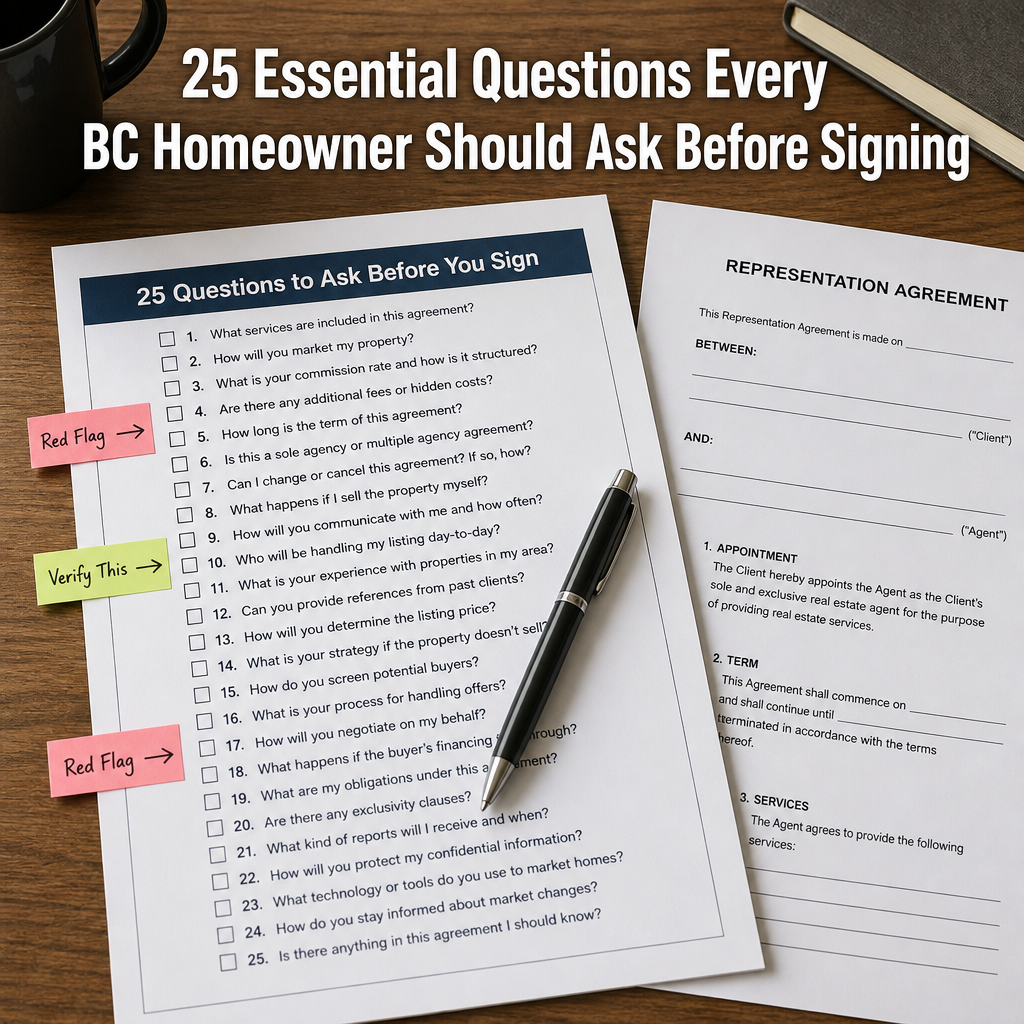

The 25 Essential Questions Every BC Homeowner Should Ask a Real Estate Agent Before Signing a Representation Agreement
By Mohamed Mansour, MBA and Associate Broker | Mansour Real Estate Group | Published May 2026 | Fraser Valley and Metro Vancouver
Choosing a real estate agent is the highest-leverage decision most sellers make. In a buyer's market with more than 10,000 active listings across the Fraser Valley, the agent you sign with does more to determine your net proceeds than the month you list. Most sellers still choose based on a yard sign, a neighbour's suggestion, or a confident pitch — without asking a single question that would reveal whether the agent can actually perform.
This guide provides a structured, question-by-question vetting framework for BC homeowners interviewing agents before signing a representation agreement. Each question is paired with what a strong answer looks like, what a red flag response reveals, and why it matters in current market conditions across Surrey, Langley, Abbotsford, South Surrey, White Rock, and the broader Lower Mainland.
Short Answer
Before signing a representation agreement with any real estate agent in BC, homeowners should ask 25 structured questions covering transaction volume, neighbourhood knowledge, marketing depth, team accountability, pricing methodology, and communication protocols. Most sellers ask fewer than five. The difference — particularly in a slow Fraser Valley market — directly affects days on market, offer quality, and final sale price.
Who This Applies To
- Homeowners preparing to list in Surrey, Langley, Abbotsford, South Surrey, White Rock, North Delta, Cloverdale, Fleetwood, Guildford, Willoughby, or Walnut Grove
- Sellers interviewing two or more agents and needing a consistent framework to compare them
- Executors, trustees, or family members managing a property sale on behalf of an estate
- Sellers in life-event situations — divorce, downsizing, relocation — where agent judgment matters more than average
- Anyone who has previously had a poor listing experience and wants a more structured approach
When This Advice May Not Apply
If you have an existing, long-term relationship with a specific agent who has represented you successfully multiple times, you may already have much of this information. This framework is most valuable when you are meeting an agent for the first time or comparing unfamiliar candidates.
Key Takeaways
- Most agents complete 4–8 transactions per year; claims of 20–50+ often aggregate team volume, not individual performance
- Neighbourhood specialization is frequently claimed but rarely tested; specific comp questions expose the gap
- Marketing plans that lack specifics — photographer names, digital targeting strategy, buyer profile targeting — are vague for a reason
- Communication protocols should be agreed in writing before signing, not assumed from a friendly interview
- A red flag is not always a wrong answer; it is an answer that cannot be verified or that deflects a direct question
Data Used in This Article
- BCFSA (BC Financial Services Authority) — licensing records and disciplinary data, publicly searchable, current
- Fraser Valley Real Estate Board (FVREB) — active listing inventory data and benchmark pricing reports, 2025–2026
- Real Estate Council of BC (RECBC) / BCFSA — consumer protection resources and representation agreement requirements
- MLS transaction data — available through REBGV and FVREB for verifying agent volume claims; third-party analysis
Definitions
Representation Agreement: A binding contract between a homeowner and a licensed real estate agent or brokerage in BC, defining the agent's role, commission, listing term, and obligations. BCFSA requires this agreement to be in writing before an agent can represent a seller.
Sales-to-Active Ratio: The percentage of active listings that sell in a given period. A ratio below 12% typically indicates a buyer's market, where sellers face more price pressure and longer days on market.
Benchmark Price: The MLS Home Price Index benchmark, calculated by FVREB and REBGV, representing the price of a "typical" property in a given area and property type, adjusted for quality and features.
How We Evaluate This
At Mansour Real Estate Group, we believe sellers are entitled to verify every claim an agent makes before signing. We apply the same standard to ourselves. Transaction volume should be verifiable through MLS records. Neighbourhood knowledge should survive a direct question about a recent comparable sale. Marketing plans should include specific names, platforms, timelines, and measurable deliverables — not phrases like "maximum exposure" or "full-service marketing."
When we present a listing strategy to a seller, we bring data: active listings, recent solds, price reductions, days on market by price band, and a written marketing plan. We encourage sellers to ask every question in this guide of any agent they meet, including us. The agent who answers with specifics, who welcomes verification, and who doesn't deflect a hard question is the agent most likely to perform when the market tests them.
Section 1: Transaction Volume and Verifiable Performance
Transaction volume is the single most commonly inflated claim in real estate. According to MLS transaction data analyzed across the Fraser Valley and Metro Vancouver, most individual agents complete between 4 and 8 transactions per year. Yet many agents — particularly those affiliated with large teams — present volume figures of 20, 30, or 50+ deals annually. In most cases, those numbers reflect aggregate team production, not what the individual agent handling your file has personally closed.
Ask these questions to cut through the ambiguity:
Q1. How many properties did you personally list and sell in the last 12 months — not your team, but you?
A strong answer provides a specific number and can name the streets or areas. A red flag is any pivot to team totals without clarifying individual contribution.
Q2. Can you show me your MLS transaction history, or direct me to where I can verify it?
MLS sold data is accessible through FVREB and REBGV member tools. An agent who welcomes this has nothing to hide. One who deflects does.
Q3. How many of your recent listings are in this specific neighbourhood or property type?
General Fraser Valley volume does not equal local micro-market expertise. An agent who has listed 12 properties in Willoughby has different operational knowledge than one who works across five municipalities simultaneously. If you are selling a detached home in Cloverdale or a townhome in Walnut Grove, ask specifically about that segment.
Q4. What was your average list-price-to-sale-price ratio over the last 12 months?
Agents who consistently price accurately close near or at list. Agents who overprice to win listings then reduce frequently show a ratio well below 97%. In a buyer's market, this gap is especially costly.
Q5. What was your average days on market for listings in the past year?
Compare this to the area benchmark. FVREB publishes average days on market by property type and municipality. An agent whose listings consistently beat the local average has evidence of effective pricing and marketing. One who can't answer or quotes a suspiciously round number warrants follow-up.
Section 2: Neighbourhood Knowledge and Micro-Market Fluency
Neighbourhood specialization is the most commonly claimed and least tested qualification in real estate. Every agent in the Fraser Valley will tell you they know Surrey, Langley, or Abbotsford. What separates genuine local expertise from surface familiarity is the ability to answer specific questions about the micro-market without hesitation.
Q6. What comparable sales in this area have closed in the last 60 days, and how do they compare to my property?
A prepared agent should be able to name at least three recent solds, describe how they compare to your property on size, condition, and location, and explain any price adjustments. Vague answers or reference to "lots of activity" without specifics is a red flag.
Q7. What is the current sales-to-active listings ratio for this property type in this area?
This single number reveals whether the agent tracks market conditions or relies on general impressions. FVREB publishes this data monthly. An agent quoting an accurate recent figure understands the market cycle your listing will enter.
Q8. Are there any zoning, covenant, or development overlay issues in this neighbourhood I should understand before pricing?
Neighbourhood knowledge includes understanding municipal plans. In parts of Surrey, North Delta, and Abbotsford, proximity to proposed transit corridors, densification overlays, or ALR (Agricultural Land Reserve) boundaries affects buyer perception and pricing. An agent who can speak to this for your street has done the work.
Q9. What school catchment does this property fall in, and how does that affect buyer demand?
In Willoughby, Fleetwood, Guildford, and South Surrey, school catchment boundaries drive material price differences between adjacent properties. Buyers with school-age children specifically target or avoid certain catchments. An agent who knows this without looking it up understands how buyers will evaluate your home.
Q10. What do buyers in this price range typically object to in this neighbourhood, and how do you address those objections?
This question tests whether an agent has sat across from buyers in your specific segment. Common objections vary: commute distance in Abbotsford, strata fees in Langley condo buildings, lot size in North Delta, noise exposure near transit corridors. An agent who can name real objections — not generic ones — has been in those conversations.
Section 3: Pricing Strategy and Methodology
Pricing is where most sellers lose the most money, and it is where agent judgment matters most. In a buyer's market, overpricing is not a conservative strategy — it is the primary cause of extended days on market, which itself becomes a buyer negotiation tool. Understanding how an agent arrives at a recommended list price separates strategic thinkers from agents who are simply trying to win the listing.
Q11. How do you arrive at your recommended list price? Walk me through the process step by step.
A strong answer includes: review of recent comparable solds within 90 days, active competition analysis, absorption rate review, condition-based adjustments, and a discussion of how the price position will be perceived by buyers currently in the market. An answer that jumps to a number without explaining the process suggests the number may not be well-supported.
Q12. What happens if we receive no offers in the first two weeks?
This question reveals whether the agent has a structured price-review protocol or will simply ask you to wait. In a Fraser Valley buyer's market where the sales-to-active ratio has been below 20% for extended periods, two weeks without offers is a pricing and exposure signal that requires a defined response plan.
Q13. Are you willing to provide a written comparative market analysis before we sign — not after?
An agent who will not commit to a written CMA before the agreement is signed may be working from general impressions rather than data. A written CMA before signing is both professional practice and a consumer protection measure. You can evaluate an agent's track record partly through the quality and specificity of their pre-listing CMA.
Q14. Have any of your listings in the past 12 months required price reductions? If so, how many and by what percentage on average?
Every agent has had price reductions. The question is whether they happen because the market shifted or because the property was overpriced at launch. An agent who claims zero reductions in a slow market is not being candid. One who can explain the reason behind each reduction, and what was learned, demonstrates market intelligence.
Section 4: Marketing Plan Depth and Execution Quality
Marketing plans vary more than most sellers realize. The difference between a property that generates three competing offers and one that sits for 60 days is often not the property itself — it is the quality of the presentation, the buyer targeting strategy, and how consistently the agent follows through on the plan they described in the interview. Vague marketing descriptions should be treated as red flags, not as standard practice.
Q15. Who is your photographer, and can I see examples of their work on properties similar to mine?
Photography is the first filter buyers apply. In the Metro Vancouver and Fraser Valley market, where buyers scroll through dozens of listings on their phone before requesting a showing, poor photography eliminates properties before buyers see the price. An agent who cannot name their photographer or show recent examples may be using whoever is cheapest or most convenient.
Q16. What digital platforms will you use to market my property, and what is your paid advertising strategy?
MLS listing is the baseline. It is not a marketing plan. Ask about targeted digital advertising, social media platform use, audience targeting parameters, and budget. An agent with a real digital strategy can describe who they are targeting (move-up buyers from North Delta, downsizers from South Surrey) and on what platforms. Generic answers like "we market on all platforms" without specifics are not answers.
Q17. Will you hold open houses? How many, and on what schedule?
Open houses are one signal of agent engagement during the listing period. More important is whether the agent has a plan for the full listing term or simply relies on the first weekend. In a market with extended days on market, week-two and week-three buyer activity requires intentional strategy.
Q18. How do you handle showing feedback, and how quickly will you share it with me?
Showing feedback is one of the most valuable real-time signals available to a seller. Agents who collect and relay feedback systematically — within 24 to 48 hours of a showing — give sellers the ability to respond to market signals early. Agents who summarize feedback loosely at the end of the week lose that window.
Section 5: Team Structure, Accountability, and Communication
Understanding who is actually responsible for your file is one of the most overlooked questions in agent selection. Large real estate teams often present a lead agent in the interview while delegating the listing to a junior team member. Knowing in advance who will be your primary point of contact, who will attend showings, and who will negotiate offers is not an unreasonable question — it is essential due diligence. Comparing team structures versus solo agents matters here.
Q19. If I sign with you, who specifically will be handling my file day-to-day?
Ask for a name, not a role. "My team" is not an answer. If a coordinator manages showing requests, that is fine — but you should know exactly who calls you with offer updates and who negotiates on your behalf.
Q20. What is your communication protocol during an active listing? How often will I hear from you if there are no offers?
A professional agent should have a defined communication rhythm: weekly updates at minimum, immediate contact after showings, and a specific process for quiet periods. Sellers who do not establish this expectation before signing often spend 30 to 60 days without meaningful contact during a slow listing.
Q21. What is your response time expectation for calls and messages?
In active offer situations, hours matter. A missed showing request or a delayed response to a buyer agent inquiry can cost a showing, and sometimes an offer. Ask specifically: what is your standard response time during business hours, and what happens on evenings and weekends?
Q22. Have you ever had a complaint filed against you with BCFSA or RECBC?
This is a direct, professional question. Licensing records and disciplinary decisions are publicly searchable through the BCFSA website. An agent who has had a complaint resolved in their favour has nothing to hide. One who becomes defensive or evasive warrants independent verification. Consumers can search agent licensing status and disciplinary history at bcfsa.ca.
Section 6: Agreement Terms, Commission, and Exit Conditions
Q23. What is the listing term you are recommending, and what happens if I want to cancel before it expires?
Standard listing agreements in BC run 60 to 90 days. Some agents push for longer terms. Ask specifically about early termination conditions: under what circumstances can you cancel, what notice is required, and are there any holdover clauses that would obligate commission after cancellation? Review these terms carefully before signing.
Q24. Can you explain how your commission is structured and what services are included at each commission level?
Commission is negotiable in BC. More important than the rate is understanding what is included: who pays for photography, staging consultation, floor plans, digital advertising, and open house costs. An agent who charges a standard rate but delivers below-standard service costs more than an agent who charges slightly more and executes thoroughly.
Q25. Are you willing to put your marketing commitments in writing as part of, or alongside, the representation agreement?
This is the final and most clarifying question. An agent who has been specific about photography, open houses, digital advertising, feedback protocols, and communication timelines should have no objection to documenting those commitments. An agent who resists this question is telling you something important about how they operate when accountability is introduced. You can use a structured comparison framework to score competing agents on these points before deciding.
Seller Checklist: Before You Sign
- Verify agent licensing status and disciplinary history through bcfsa.ca before the interview
- Prepare all 25 questions in writing and bring them to every agent interview
- Request a written CMA from each agent before signing — not after
- Ask each agent to name their photographer and show examples of recent listing photography
- Confirm in writing who will manage your file day-to-day and what the weekly communication schedule will be
- Compare list-price-to-sale-price ratios and days-on-market benchmarks across agents using FVREB published averages
- Review holdover and early termination clauses in the representation agreement before signing
- Request that marketing commitments be documented alongside or within the representation agreement
What We Commonly See
In our experience, the most common mistake sellers make is interviewing only one agent. When there is no comparison, there is no baseline for evaluating claims. An agent who says "we sold 40 homes last year" sounds impressive in isolation. Against a second agent who says "I personally listed and sold 14 homes in this specific area, and here is the MLS data," the first claim collapses under scrutiny.
What often happens is that sellers ask about commission first and marketing last. Commission is a fixed cost known before the sale. Marketing quality is a variable that determines what you actually net. An agent charging 0.5% less in commission but failing to generate a competing offer costs far more than the commission differential.
A common mistake is signing a 90-day listing agreement without asking about early termination. In a buyer's market, if an agent is underperforming — no proactive communication, no buyer feedback relay, no price-review conversation — sellers can find themselves locked into a contract with no practical recourse. Ask about exit conditions before you sign, not six weeks later when the listing has gone stale.
Q&A
Can I verify an agent's transaction volume on my own in BC?
MLS sold data is accessible to consumers through real estate board portals, and agents can provide MLS print-outs of their personally listed and sold properties. BCFSA licensing records confirm registration status and disciplinary history. No single public database shows an individual agent's exact annual volume, but a combination of MLS data and direct disclosure from the agent creates a verifiable picture.
Is it rude to ask an agent about BCFSA complaints before hiring them?
No. It is responsible consumer due diligence. BCFSA disciplinary records are publicly available for exactly this reason. A professional agent will understand the question and answer it directly. BCFSA licensing status and disciplinary decisions can be searched at bcfsa.ca at no cost.
What is a reasonable listing term to agree to in the Fraser Valley in 2026?
Given current buyer's market conditions across much of the Fraser Valley, a 60-day initial term with a defined review process is reasonable. Agreeing to a 90-day or longer term without early termination provisions reduces seller leverage if the agent underperforms. Always read and negotiate holdover clause terms before signing.
In Summary
In a Fraser Valley market where inventory remains elevated and buyer selectivity is high, agent selection has a measurable impact on days on market, final sale price, and negotiating position. Most sellers never ask the questions that would reveal whether an agent's claims hold up to verification. The 25 questions in this guide give you a structured, repeatable framework to vet any agent before committing — one that focuses on what agents can prove, not just what they say. Use it with every agent you interview, apply it consistently, and let the specificity of their answers do the work.
Ready to Ask These Questions of Our Team?
Mansour Real Estate Group welcomes every question in this guide. If you are preparing to list in Surrey, Langley, South Surrey, White Rock, Abbotsford, or anywhere in the Fraser Valley and would like a structured pre-listing conversation — with a written CMA, a documented marketing plan, and transparent answers — contact us to schedule a no-obligation consultation.



