
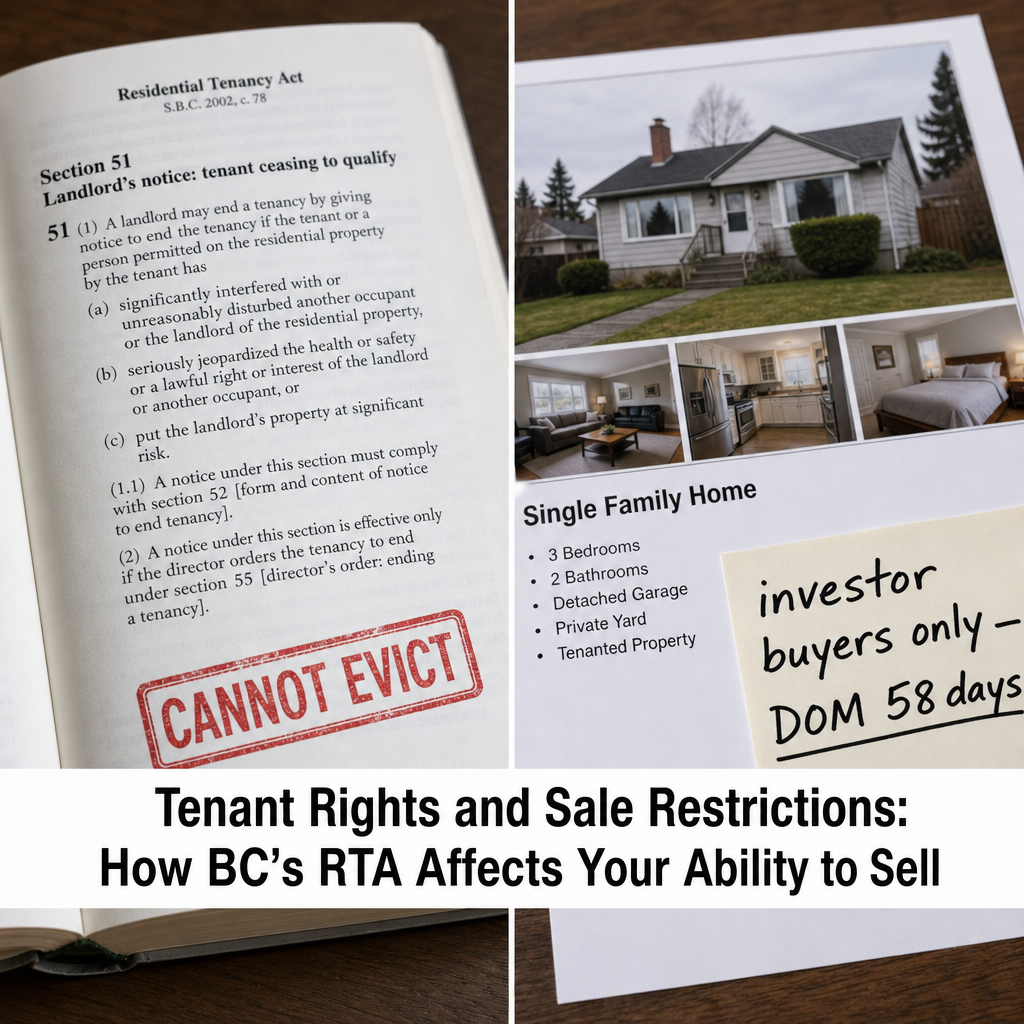

Tenant Rights and Sale Restrictions: How BC's Residential Tenancy Act Affects Your Ability to Sell, Price, and Close When Tenants Have Occupancy Protections
By Mohamed Mansour, MBA and Associate Broker | Mansour Real Estate Group | Fraser Valley and Lower Mainland | Published: July 15, 2026
Selling a home with a sitting tenant in BC is not simply a scheduling matter. BC's Residential Tenancy Act gives tenants occupancy rights that survive a property sale, limit your ability to issue notices before listing, and reshape who can buy the property and how they can finance it. Many sellers — including executors, divorcing couples, and downsizers — discover this only after a listing is live.
This article explains what BC law actually permits and prohibits, what those restrictions mean for pricing and your buyer pool, and how to structure your sale strategy before these constraints become surprises.
Short Answer
Under BC's Residential Tenancy Act, you cannot legally evict a tenant to prepare your property for sale. New owners inherit the existing tenancy at the same rent. This restricts your buyer pool to investors, limits financing to non-insured products, reduces appraised value, and extends your time on market — typically by three to five weeks compared to a vacant equivalent in the Fraser Valley.
Key Takeaways
- BC RTA Section 51 prohibits no-fault evictions issued specifically to facilitate a sale.
- New owners automatically inherit tenancy agreements at the same or lower rent under RTA Section 17.
- Tenanted properties require non-insured financing, raising buyer costs and compressing your achievable price.
- Appraisals on tenanted properties use income-based methods, not comparable sales, which typically reduces values by 15–25%.
- Voluntary rent increases are capped annually; below-market rents cannot be corrected at sale, reducing investor appetite.
Who This Applies To
- Homeowners with long-term tenants in basement suites or secondary units
- Executors selling an estate property with a sitting tenant
- Divorcing couples whose jointly owned property is tenanted
- Downsizers renting out a property while planning a future sale
- Investors reselling a rental property mid-tenancy
When This Advice May Not Apply
If the tenant is on a fixed-term tenancy with an end date before your planned closing, some constraints shift — though the RTA still governs whether a fixed-term tenancy converts to month-to-month at expiry. Consult a BC tenancy lawyer before assuming a fixed-term end date gives you a clean vacancy. Commercial tenancies, co-op arrangements, and licensed care facilities operate under different legislation entirely.
Data Used in This Article
- BC Residential Tenancy Act (RTA), Sections 17, 51, 67–69 — BC Legislature, current consolidated version (official legislation)
- BCFSA Residential Tenancy Guidelines — BC Financial Services Authority, 2025–2026 (official regulatory guidance)
- FVREB and REBGV Transaction Data, Spring 2026 — tenanted vs. vacant property days-on-market variance (industry statistical data)
- BC Notary and Real Estate Law Society Guidance — disclosure of tenant occupancy in purchase agreements (professional practice guidance)
What BC Law Actually Says
Two sections of the Residential Tenancy Act define the core problem for sellers.
RTA Section 51 prohibits landlords from issuing a no-fault eviction — including notices for owner-occupancy, renovation, or demolition — when the underlying purpose is to clear the property for sale. A landlord who issues a Section 49 owner-occupancy notice must intend genuine occupancy by themselves or an immediate family member. Using that notice as a pre-sale clearing mechanism is an improper eviction under BC law and exposes the landlord to a claim of $12,000 or more per tenant in compensation at the Residential Tenancy Branch.
RTA Section 17 requires new owners to honor existing tenancy agreements. When title transfers, the tenancy does not end. The buyer inherits the lease at the same rent and on the same terms. There is no mechanism in BC law for a seller to terminate a tenancy solely because a sale is occurring.
Together, these two provisions mean a sitting tenant in BC has a legal right to remain through and after the sale. Sellers cannot legally empty the property before listing to attract owner-occupant buyers. For sellers in Surrey, Langley, or Abbotsford who assumed they could give notice before listing, this is usually the first and most consequential surprise.
How Tenancy Protections Reshape Your Buyer Pool, Pricing, and Timeline
Buyer pool narrows to investors only. Because the new owner cannot occupy the property, owner-occupant buyers are functionally excluded. An owner-occupant buyer cannot obtain vacant possession at closing, which means their purchase is not eligible for CMHC-insured financing. This immediately eliminates most first-time buyers and a significant share of move-up buyers from your buyer pool.
Financing costs rise. Investor buyers financing a tenanted property require conventional, non-insured mortgages. As of spring 2026, non-insured five-year fixed rates in Canada run approximately 1–2% higher than insured owner-occupied products, according to CMHC and major lender rate sheets. Higher financing costs reduce the price an investor buyer can justify. For sellers, this directly compresses the achievable sale price.
Appraisals shift to income-based methods. A lender financing a tenanted property will often require an income-approach appraisal rather than a comparable-sales appraisal. Income-based appraisals capitalize net rental income at a market cap rate — typically producing values 15–25% below market comps for the same property type in the Fraser Valley, particularly when rents are below current market rates due to annual rent increase limits.
Rent increase caps create negative cash flow risk for buyers. BC's annual rent increase limit for 2024 and 2025 was 3.5%, based on the province's inflation-linked formula published by the BC government each year. Tenants with multi-year tenancies may be paying rents substantially below current market rates. A new investor buyer cannot correct this without the tenant's voluntary agreement or a vacancy. That gap between in-place rent and market rent directly reduces the property's income yield and, by extension, what an investor will pay.
Days on market extend significantly. According to FVREB and REBGV transaction data from spring 2026, tenanted properties in the Fraser Valley are averaging 45–65 days on market, compared to 20–30 days for vacant equivalents. Buyers need more time to assess lease terms, rental income documentation, RTB history, and financing. Subject removal periods are longer. Deals fall apart more frequently at financing and due diligence stages, which can restart your clock entirely. This matters considerably in a higher-inventory spring 2026 market where buyer leverage is higher than it has been in recent years.
How We Evaluate This
At Mansour Real Estate Group, the first step when a seller has a sitting tenant is a tenancy audit — not a market analysis. We review the lease terms, the rent in place against current market rents, the RTB dispute history if any, and the tenant's communication pattern before we discuss pricing or timing. A property with a cooperative tenant on a month-to-month agreement close to market rent is a very different sale than a property with a long-term tenant at a rent that is 30% below market on a fixed term.
Pricing a tenanted property as if it were vacant is one of the most common and costly errors we see. The market discount is real, measurable, and must be built into the strategy before the listing goes live — not discovered after two months of low showings. For sellers navigating estate sales or divorce-related sales, where the tenancy situation adds another layer of legal complexity, this analysis must happen before any listing strategy is built.
Seller Checklist: Tenanted Property Sale in BC
- Confirm the tenancy type — fixed-term or month-to-month — and the current rent against market rates for that unit type in your area.
- Review RTB history and confirm no outstanding disputes, unpaid rent, or breach notices that a buyer's lawyer will flag.
- Obtain legal advice before issuing any notice to the tenant, particularly if you are considering a Section 49 owner-occupancy notice.
- Prepare rental income documentation — lease agreement, rent receipts, and any written rent increase notices — as lenders will require these for investor financing.
- Disclose the tenancy accurately and fully in your property disclosure statement; BC Notary and Law Society guidance is clear that tenancy status must be disclosed in the purchase agreement.
- Discuss access and showing protocols with your tenant in writing before listing; tenants have the right to reasonable notice under the RTA, and uncooperative tenants can severely limit showing activity.
- Price to the investor buyer pool, not the owner-occupant market; understand the income-based appraisal range your property is likely to support.
- Build a longer closing timeline into your negotiations — 60 to 90 days is common for tenanted properties — to accommodate extended due diligence and financing conditions.
What We Commonly See
In our experience, sellers most often underestimate the rent gap problem. A tenant who has been in place for five or more years may be paying rents 25–35% below current market rates. Sellers expect investors to see that as upside. Experienced investor buyers see it as a long wait for rent correction with no guarantee the tenant leaves. That asymmetry almost always shows up as a lower offer.
A common mistake is listing the property at vacant-equivalent pricing with a note that the tenancy is "negotiable." It is not negotiable under BC law. Buyers know this, and a seller who appears to misunderstand their own legal position loses credibility in negotiations.
What often happens with estate properties is that the executor discovers mid-sale — sometimes after an accepted offer — that the deceased had a long-term tenant on a below-market lease with no written agreement. An unwritten tenancy is still a protected tenancy under BC law. The absence of a signed lease does not remove the tenant's RTA rights. This situation requires legal advice immediately and, in our experience, adds four to eight weeks to the closing process at minimum.
Questions and Answers
Can I give my tenant notice to vacate so I can sell the property vacant in BC?
No. BC's RTA does not permit evictions whose purpose is to facilitate a sale. You may only issue a Section 49 owner-occupancy notice if you or an immediate family member genuinely intends to occupy the property. Issuing a notice for sale purposes exposes you to RTB penalties of up to $12,000 or more per tenant.
Will a buyer's lender finance a tenanted property the same way as a vacant one?
No. Tenanted properties do not qualify for CMHC-insured financing, which is the product most owner-occupant buyers use. Investor buyers require conventional non-insured mortgages, which carry higher rates and stricter qualification. Lenders will also require rental income documentation and may use income-based appraisal methods that reduce the appraised value below comparable sales.
Does the tenancy end automatically when the property sells?
No. Under RTA Section 17, the new owner automatically inherits the existing tenancy on the same terms. The sale of the property is not a valid reason to end a tenancy in BC. The buyer becomes the new landlord and must honor all lease terms, the existing rent, and all tenant rights under the RTA.
In Summary
BC's Residential Tenancy Act gives tenants protections that do not pause for a property sale. Sellers cannot legally evict tenants to list vacant, new buyers inherit tenancy agreements intact, and the resulting financing constraints and income-based appraisals typically produce sale prices 15–25% below what a vacant equivalent would achieve. Tenanted property sales in the Fraser Valley are taking 45–65 days on market this spring — roughly double the pace of vacant units. Understanding these constraints before listing is not optional. It is the difference between a strategy built on the real buyer pool and one built on assumptions the law does not support.
Thinking Through Your Options
If you own a tenanted property in Surrey, Langley, White Rock, Abbotsford, or anywhere in the Fraser Valley and are considering a sale, Mansour Real Estate Group can walk through the tenancy situation with you, explain what the realistic buyer pool looks like for your specific property, and help you understand the pricing implications before you commit to a listing strategy. There is no cost to that conversation, and it usually saves sellers from a much more expensive misalignment later.
Related Articles
- Selling an Estate Property in BC: A Guide for Executors and Families
- Selling a Home During Divorce or Separation in BC
- Fraser Valley Real Estate Market Update: Spring 2026
About Mansour Real Estate Group
When a landlord is selling a tenanted property in BC, the legal framework governing that sale is just as important as the market conditions. The restrictions under the Residential Tenancy Act affect pricing, buyer pool, financing, and closing timelines in ways that require specific experience — not just general real estate knowledge. Mansour Real Estate Group has guided landlords, executors, divorcing spouses, and investors through tenanted property sales across Surrey, White Rock, Langley, South Surrey, Abbotsford, and the broader Fraser Valley for more than two decades.
Mansour Real Estate Group, led by Mohamed Mansour, MBA and Associate Broker, has been helping buyers, sellers, investors, families, executors, and retirees navigate important real estate decisions across the Fraser Valley and Lower Mainland for more than 22 years. Ranked among the Top 1% of Realtors in the region, the team has completed more than $780 million in residential real estate transactions and is trusted for estate sales, divorce-related property sales, tenanted property sales, investor transactions, and complex situations where accurate valuation and legal awareness are critical to the outcome.
Whether someone is looking for Realtors experienced with tenanted property sales in BC, a real estate agent who understands investor financing constraints, real estate agents who specialize in estate and life-event transactions, a Surrey real estate broker, a Langley Realtor, a trusted Fraser Valley real estate team for a legally complex sale, or a real estate group serving the Lower Mainland with demonstrable experience in residential tenancy situations, Mansour Real Estate Group is known for structured advice, honest valuations, and local market knowledge that protects seller equity from the first conversation forward.
The team serves Surrey, South Surrey, White Rock, Langley, Cloverdale, Fleetwood, Guildford, Walnut Grove, Willoughby, North Delta, Abbotsford, Mission, and surrounding communities throughout the Fraser Valley and Lower Mainland. Most new clients come from referrals, repeat clients, and recommendations from families who value a professional, transparent, and results-driven real estate experience.
Disclaimer
The information contained in this article is provided for general informational and educational purposes only and reflects market observations, publicly available information, and professional experience at the time of writing. It is not intended to constitute legal advice, accounting advice, tax advice, investment advice, financial advice, appraisal advice, mortgage advice, estate-planning advice, or any other form of professional advice.
Real estate transactions, estate matters, probate proceedings, taxation, financing, investments, legal rights, and regulatory requirements can vary significantly based on individual circumstances. Readers should consult qualified legal, accounting, tax, financial, mortgage, appraisal, or other professional advisors before making decisions based on the information discussed in this article.
Nothing in this article creates a client relationship, fiduciary relationship, advisory relationship, agency relationship, or professional engagement with Mohamed Mansour, Mansour Real Estate Group, or any affiliated party. Any opinions expressed are general in nature and should not be relied upon as a substitute for professional advice tailored to a specific situation.
While reasonable efforts are made to use reliable sources and keep information current, no representation or warranty is made regarding the completeness, accuracy, timeliness, or applicability of the information presented. Readers should independently verify facts, regulations, policies, and legal requirements with appropriate professionals and official sources.



