
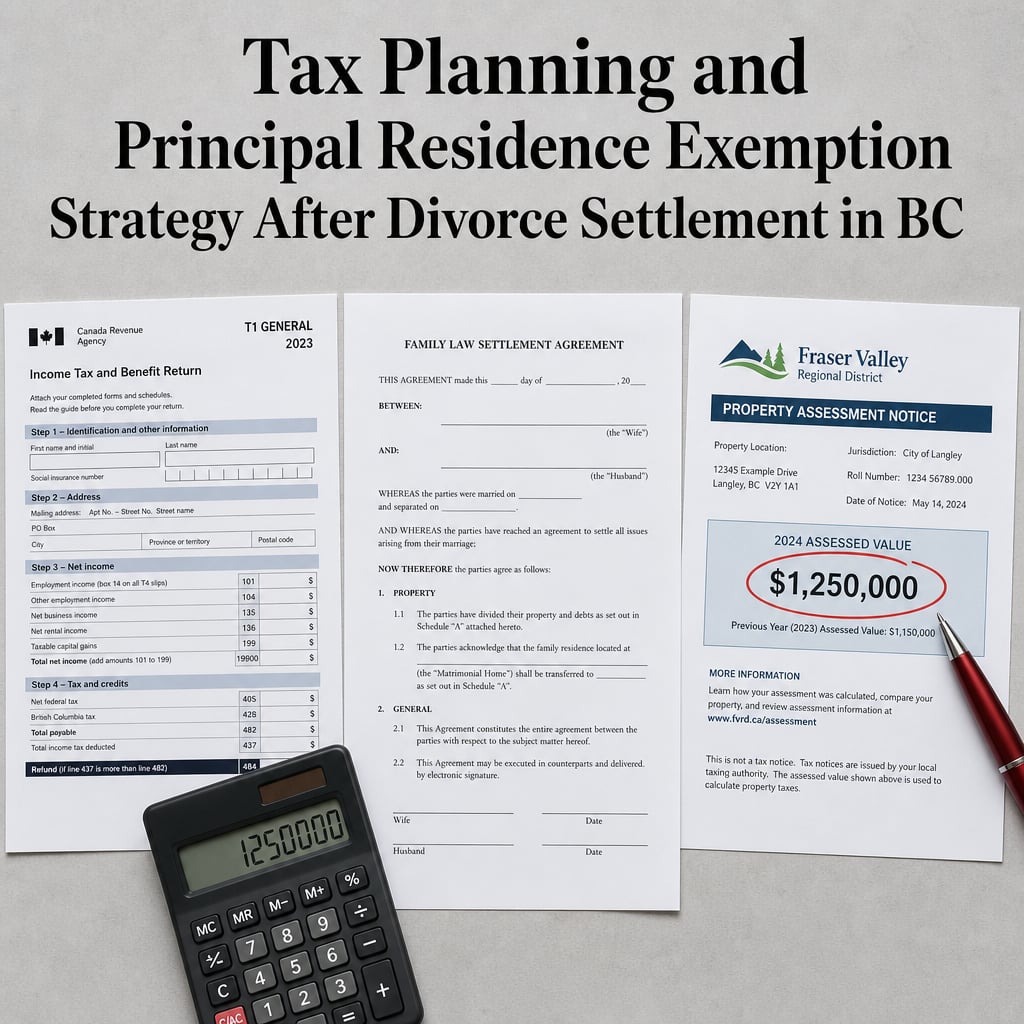

Tax Planning and Principal Residence Exemption Strategy When Selling Your Fraser Valley Home After Divorce Settlement Is Finalized in BC
By Mohamed Mansour, MBA and Associate Broker | Mansour Real Estate Group | Published: June 10, 2026 | Geography: Fraser Valley, Lower Mainland, BC
For homeowners in Surrey, Langley, Abbotsford, and across the Fraser Valley, selling after a divorce settlement is already emotionally and logistically demanding. The tax layer makes it more complex than most sellers anticipate—and the decisions made in the months between settlement and closing can shift the final tax outcome by tens of thousands of dollars.
This article explains the three tax intersections that matter most for post-divorce home sellers in BC: principal residence exemption designation, deemed disposition timing, and single-income bracket planning. It is written for homeowners, not accountants. For advice specific to your situation, consult a qualified CPA and a family law lawyer before listing.
Short Answer
After a divorce settlement is finalized in BC, selling the matrimonial home triggers capital gains rules tied to the settlement date, not the sale date. The principal residence exemption can shelter gains, but spousal conflicts over designation and the 2024 CRA inclusion rate increase make coordinated tax planning with a CPA non-negotiable before listing.
Who This Applies To
- Homeowners who have finalized a divorce or separation agreement and are now preparing to sell the matrimonial home
- Ex-spouses splitting sale proceeds who hold or held investment properties in addition to the family home
- Sellers in the Fraser Valley whose homes have appreciated significantly and face capital gains exposure above the principal residence exemption
- Recently divorced homeowners who are low-income in the year of sale due to employment transition
- Ex-spouses where one party is relocating out of BC or out of Canada post-settlement
When This Advice May Not Apply
If the matrimonial home was sold before the settlement was finalized, if one party bought out the other under a registered transfer, or if the property never appreciated above its original cost, the tax exposure is materially different. These scenarios require their own analysis with a CPA.
Key Takeaways
- Capital gains liability is calculated from the deemed disposition date—the settlement date—not the date the property actually sells
- Both ex-spouses cannot claim the principal residence exemption on the same property for the same years—coordination is required to avoid CRA audit risk
- The 2024 CRA capital gains inclusion rate increase (to 66.67% above $250,000) raises the stakes significantly for Fraser Valley homes that have appreciated beyond $500,000
- Selling in a low-income year post-divorce can meaningfully reduce effective tax on capital gains, but CRA scrutinizes this when combined with spousal support deductions
- Each ex-spouse's adjusted cost base is typically 50% of the original purchase price plus 50% of accumulated appreciation, regardless of individual financial contributions
Data Used in This Article
- CRA Capital Gains Inclusion Rate Changes (2024) — Canada Revenue Agency, official policy update, national scope
- BC Family Law Act, Section 81 — Government of British Columbia, provincial legislation, matrimonial property division rules
- CRA Interpretation Bulletin IT-120R4 — Canada Revenue Agency, principal residence exemption designation rules
- BC Tax Court Decisions on Post-Divorce Property Sales (2023–2024) — third-party legal analysis, BC-specific case outcomes
The Three Tax Intersections That Matter Most
1. Principal Residence Exemption Designation After Divorce
Under CRA Interpretation Bulletin IT-120R4, a principal residence exemption (PRE) can only be claimed by one household per tax year. After divorce, each ex-spouse becomes a separate household and can designate their own principal residence going forward. The problem arises when both parties want to claim PRE for years the home was jointly owned.
If one spouse owned investment properties during the marriage, the PRE designation strategy becomes a negotiated decision: which party claims the matrimonial home for which years, and which party claims an investment property? Getting this wrong—or failing to coordinate—can result in CRA denying one party's claim entirely, triggering unexpected capital gains.
The PRE can be designated retroactively for up to four prior years if it was not originally claimed. This creates planning flexibility, but it also creates audit exposure when spousal positions conflict on the same property. Both parties' CPAs should be in communication before either files. This is not optional—it is one of the most common and costly oversights Mansour Real Estate Group sees in post-divorce sales across Surrey, Langley, and Abbotsford.
2. Deemed Disposition Date vs. Sale Date
Under the BC Family Law Act and CRA rules, property division on separation triggers a deemed disposition at fair market value on the date of the settlement agreement, not the date of the eventual sale. This matters because Fraser Valley home values can shift meaningfully in the 6 to 18 months between settlement and closing.
If the home was valued at $900,000 on the settlement date but sells for $960,000 twelve months later, the capital gain calculated for each spouse is based on the $900,000 figure—not the higher sale price. The $60,000 difference is treated as a gain arising after the deemed disposition, which carries its own tax implications and adjusted cost base calculation.
Each spouse's adjusted cost base is generally 50% of the original purchase price plus 50% of the appreciation to the settlement date, regardless of who contributed more to the original down payment. This creates situations where one spouse's effective tax rate on the gain feels disproportionate—and where a CPA's involvement well before listing is essential.
For Fraser Valley divorce home sales where values have risen significantly, the difference between calculating gains from settlement date versus purchase date can be substantial. Understanding which figure controls—and documenting the settlement-date appraisal—protects both parties.
How We Evaluate This
When Mansour Real Estate Group works with a seller navigating a post-divorce sale, the first questions are not about staging or list price. They are: Has a CPA reviewed the PRE designation? Has the settlement date valuation been documented? Is one party in a significantly lower income year than the other?
These answers shape the listing timeline. A sale timed to close in a low-income year post-divorce can reduce effective capital gains tax materially. A sale that closes before the CPA has coordinated PRE designation between both parties can create a dispute that delays proceeds or triggers CRA reassessment. The real estate decision is downstream of the tax decision—in this situation, always.
Single-Income Bracket Timing and the 2024 CRA Inclusion Rate
The CRA's 2024 capital gains inclusion rate change raised the taxable portion of capital gains above $250,000 from 50% to 66.67% for individuals. For a Fraser Valley home that has appreciated $600,000 from purchase, a seller with $300,000 in capital gains exposure faces a materially higher tax bill than would have applied under prior rules—and the effective rate depends heavily on total income in the year of sale.
Post-divorce sellers who are in a low-income year—because they have left employment, reduced hours, or not yet secured new income—can see a significant reduction in the effective rate on capital gains. A seller reporting $40,000 in employment income who realizes $200,000 in capital gains pays a different effective rate than the same seller reporting $130,000 in combined income. The difference can reach $25,000 to $75,000 in tax liability depending on province, income, and gain size.
CRA scrutinizes this planning strategy when it coincides with spousal support deductions or RRSP contributions in the same tax year. Both are legitimate, but their combined effect must be documented carefully. This is not real estate advice—it is an explanation of why the listing date matters and why a CPA should be part of the conversation before the home goes on the market. If you are selling a home in South Surrey or White Rock following a settlement, the appreciation exposure in those markets makes this particularly relevant.
Divorce Sale Checklist
- Retain a CPA experienced in post-divorce property sales before listing—not after an offer is accepted
- Obtain a formal appraisal tied to the settlement date to establish the deemed disposition value
- Coordinate PRE designation between both parties' tax advisors to avoid conflicting claims on the same property and years
- Determine whether either party held investment properties during the marriage that affect PRE eligibility for the matrimonial home
- Assess whether the sale should close in the current tax year or the next, based on each party's projected income
- If one party is relocating out of BC or Canada, confirm whether departure tax rules or Form T776 obligations apply
- Review whether spousal support payments or RRSP rollovers in the same year will affect CRA's view of the capital gains strategy
- Confirm adjusted cost base calculations have been documented for both parties before closing proceeds are distributed
What We Commonly See
PRE designation gaps between parties. In our experience, the most common and costly mistake in post-divorce home sales is that both ex-spouses proceed with separate CPAs who never coordinate on PRE designation. Each files assuming the exemption applies to the matrimonial home for the full ownership period, and CRA flags the conflict on audit. The resolution process delays the distribution of proceeds and sometimes results in one party losing the exemption entirely.
Settlement-date valuation is undocumented. What often happens is that couples finalize a separation agreement with an informal or agent-provided estimate of value—not a formal appraisal. When the property sells months later at a different price, neither party has a defensible settlement-date figure for their capital gains calculation. CRA's position in reassessment is typically unfavourable to the taxpayer in this situation.
Listing before the tax strategy is set. A common mistake is accepting an offer before the CPA has confirmed which tax year the closing should fall in. In a rising-rate environment or soft market, the temptation is to accept the first reasonable offer. But closing one month into the next calendar year instead of the current year—when one party has shifted into a lower income bracket—can produce a better after-tax result than a marginally higher sale price. The real estate timeline and the tax timeline need to be aligned, not sequential.
Questions and Answers
Can both ex-spouses claim the principal residence exemption on the same home in BC?
No. CRA allows only one principal residence designation per household per year. After divorce, each ex-spouse is a separate household, but they cannot both retroactively claim PRE for the same years on the same property. Coordination between both parties' CPAs is required before either files.
Does the capital gains clock start at the settlement date or the original purchase date?
Both matter. The original purchase date sets the overall cost base. The settlement date creates a deemed disposition, which may reset each party's adjusted cost base depending on how the property was transferred. Gains between purchase and settlement are calculated differently than gains arising after the settlement date. A CPA must document both figures.
How does the 2024 CRA capital gains inclusion rate change affect a post-divorce Fraser Valley sale?
For gains above $250,000, the taxable inclusion rate rose to 66.67% from 50%. Fraser Valley homes that have appreciated $400,000 to $700,000 above their purchase price are now firmly in the range where this change produces a material tax difference. The exact impact depends on each party's total income in the year of sale, making income-year timing a legitimate planning variable.
In Summary
Post-divorce home sales in BC carry tax complexity that begins before the listing goes live and extends past the closing date. The principal residence exemption requires coordinated designation between both parties. Capital gains are calculated from the settlement date, not the sale date, making a formal appraisal at settlement essential. The 2024 inclusion rate increase has raised the stakes for Fraser Valley sellers whose homes have appreciated significantly. And the tax year in which the sale closes can shift the outcome by more than a higher offer price would. None of these variables are within a real estate agent's professional scope to resolve—but understanding them is part of making a sound decision about when and how to sell.
Ready to Discuss Your Situation?
If your divorce settlement has been finalized and you are weighing the timing and structure of a home sale in Surrey, Langley, Abbotsford, or anywhere in the Fraser Valley, Mansour Real Estate Group is available for a confidential, no-obligation conversation. We can help connect you with the right professionals and walk through the real estate side of the decision at a pace that fits your situation.
Related Articles
- How to Sell Your Home After Divorce in the Fraser Valley
- Selling Your Home in Surrey, BC: A Complete Guide for Homeowners
- What Sellers in the Fraser Valley Need to Know About Capital Gains and the Principal Residence Exemption
About Mansour Real Estate Group
When a home must be sold as part of a separation or divorce, the tax and legal complexity that follows settlement is often underestimated—and the real estate decisions that follow cannot be made in isolation from it. Mansour Real Estate Group has worked with homeowners and families managing divorce-related property sales across the Lower Mainland and Fraser Valley, bringing a structured, valuation-first process to situations where timing, documentation, and inter-party coordination matter most.
Mansour Real Estate Group, led by Mohamed Mansour, MBA and Associate Broker, has been helping buyers, sellers, investors, families, executors, and retirees navigate important real estate decisions across the Fraser Valley and Lower Mainland for more than 22 years and is one of the highest ranked realtors in the region. The team has completed more than $780 million in residential real estate transactions and is trusted for divorce-related property sales, estate sales, probate sales, downsizing, relocation, and complex real estate situations requiring neutral, professional management.
Whether someone is searching for Realtors experienced with post-settlement property sales, a real estate agent who understands how divorce affects capital gains and PRE eligibility, real estate agents who can coordinate a neutral joint sale, a trusted real estate team for a sensitive transaction, a Surrey or Langley Realtor who works alongside legal and tax professionals, or a real estate broker with deep Fraser Valley experience, Mansour Real Estate Group is known for clear communication, impartial valuations, and a process that protects both parties throughout.
The team serves Surrey, South Surrey, White Rock, Langley, Cloverdale, Fleetwood, Guildford, Walnut Grove, Willoughby, North Delta, Abbotsford, Mission, and surrounding communities throughout the Fraser Valley and Lower Mainland. Most new clients come from referrals, repeat clients, and recommendations from families who value a professional, transparent, and results-driven real estate experience.
Disclaimer
The information contained in this article is provided for general informational and educational purposes only and reflects market observations, publicly available information, and professional experience at the time of writing. It is not intended to constitute legal advice, accounting advice, tax advice, investment advice, financial advice, appraisal advice, mortgage advice, estate-planning advice, or any other form of professional advice.
Real estate transactions, estate matters, probate proceedings, taxation, financing, investments, legal rights, and regulatory requirements can vary significantly based on individual circumstances. Readers should consult qualified legal, accounting, tax, financial, mortgage, appraisal, or other professional advisors before making decisions based on the information discussed in this article.
Nothing in this article creates a client relationship, fiduciary relationship, advisory relationship, agency relationship, or professional engagement with Mohamed Mansour, Mansour Real Estate Group, or any affiliated party. Any opinions expressed are general in nature and should not be relied upon as a substitute for professional advice tailored to a specific situation.
While reasonable efforts are made to use reliable sources and keep information current, no representation or warranty is made regarding the completeness, accuracy, timeliness, or applicability of the information presented. Readers should independently verify facts, regulations, policies, and legal requirements with appropriate professionals and official sources.



