
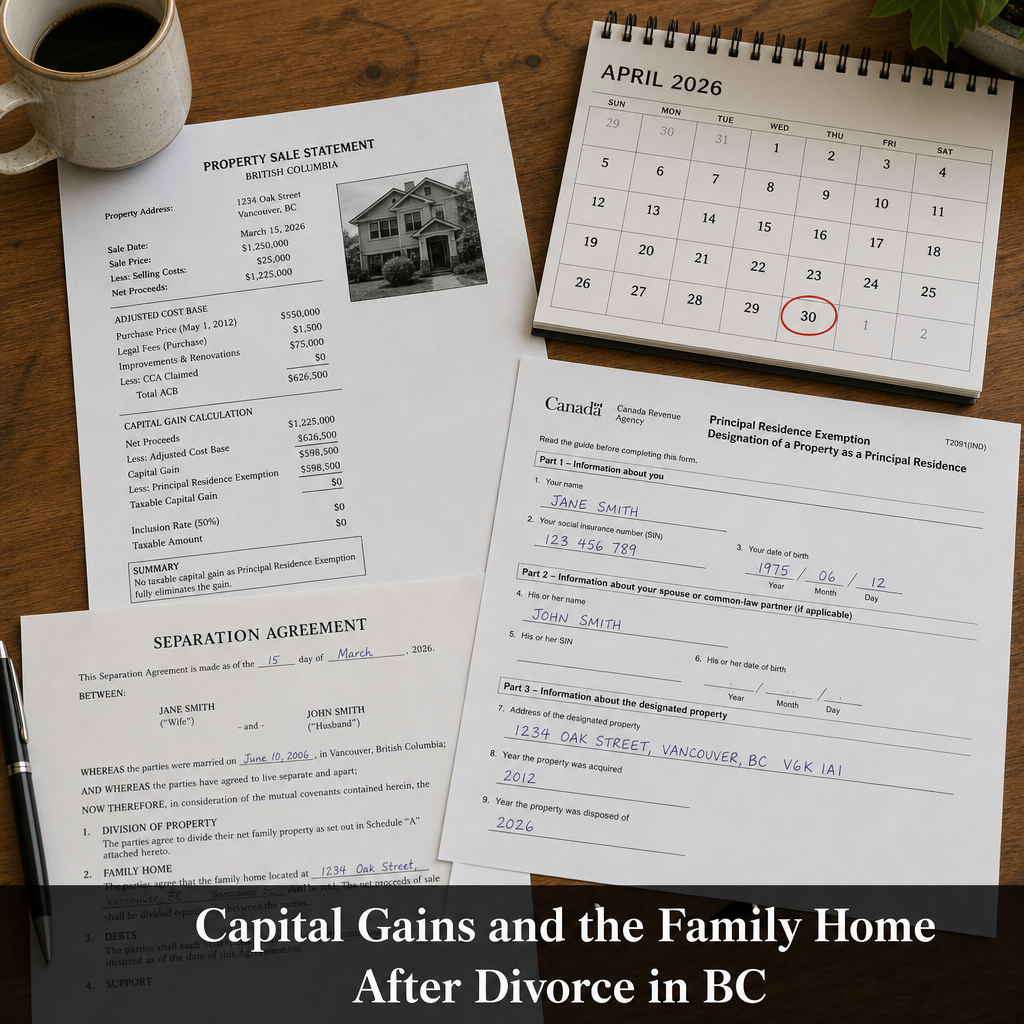

Tax Planning and Capital Gains Liability When Selling the Family Home After Divorce Settlement Is Finalized in BC
By Mohamed Mansour, MBA and Associate Broker | Mansour Real Estate Group | Published: June 17, 2025 | Fraser Valley and Lower Mainland, BC
For divorcing homeowners in Surrey, Langley, Abbotsford, and across the Fraser Valley, the sale of the family home often moves into execution phase in spring — once settlement agreements are finalized over winter. Most sellers focus on pricing and logistics. The tax implications tend to surface later, sometimes after the opportunity to plan around them has passed.
The Principal Residence Exemption protects most divorcing sellers from capital gains tax. But eligibility depends on how the property was used, how the sale is structured, and when it happens. Getting those details wrong — or leaving them to chance — can affect net proceeds in ways that are difficult to reverse.
Short Answer
If the family home was your principal residence throughout the period of ownership, the Principal Residence Exemption under the federal Income Tax Act will generally eliminate capital gains tax on the sale. Complications arise when the property was rented, when one spouse buys out the other, or when the sale is timed without reference to income year or RRSP room. These decisions benefit from early coordination with a tax professional.
Key Takeaways
- The Principal Residence Exemption typically eliminates capital gains tax on the family home sale — but only for years the property was designated as a principal residence.
- If the home was rented out at any point before the sale, capital gains tax may apply to the appreciation during that rental period.
- A buyout — where one spouse purchases the other's equity — does not trigger a deemed disposition, but defers the full capital gains liability to the buying spouse's future sale.
- Timing the sale to a lower-income year and coordinating with RRSP contribution room can reduce marginal tax exposure on any taxable portion.
- Settlement proceeds representing equity division are not taxable income; only appreciation beyond the agreed cost basis qualifies as a capital gain.
Who This Applies To
- Divorcing or separated homeowners in BC who are preparing to sell the family home after a settlement agreement is signed
- Homeowners considering a spousal buyout rather than a market sale
- Sellers whose family home was rented out, partially rented, or used as a home-based business at any point during ownership
- Homeowners who purchased before 2016 and may have an unusually large capital gain built up
- Anyone navigating a BC Family Law Act property division who has not yet spoken with a tax professional about the real estate transaction
When This Advice May Not Apply
If the home was never your principal residence — for example, it was always an investment property — different rules apply entirely. Non-residents of Canada face additional withholding tax requirements under the Income Tax Act. Situations involving trusts, corporate ownership, or complex estate structures require specialist legal and accounting advice beyond the scope of this article. Always consult a qualified tax professional for your specific circumstances.
Data Used in This Article
- Canada Revenue Agency — Principal Residence Exemption guidelines and Income Tax Act Section 54 (official, federal, current)
- BC Family Law Act — Two-Year Limitation Period and Spousal Property Division provisions (official, provincial, current)
- Fraser Valley Real Estate Board — April and May 2026 Statistics Packages (official, regional, current cycle)
- Mansour Real Estate Group — internal divorce settlement and capital gains coordination observations, 2024–2026 (professional experience, generalized)
How the Principal Residence Exemption Works in a Divorce Sale
Under the Income Tax Act, a property qualifies for the Principal Residence Exemption (PRE) for each year it was designated as the seller's principal residence. When a family home is sold after a divorce settlement, the selling spouse can generally claim the exemption for every year of ownership — eliminating capital gains tax entirely on the appreciation during those years.
The calculation matters: capital gains are measured from the adjusted cost base — the original purchase price plus eligible capital improvements — to the net sale proceeds. If the exemption covers all ownership years, the gain is fully sheltered. If it covers only part of the ownership period, the unsheltered portion is taxable at the seller's marginal rate on 50% of the gain. According to CRA guidelines under Income Tax Act Section 54, only one property per family unit can be designated as a principal residence for any given year — a rule that can affect couples who owned multiple properties simultaneously.
What Changes When the Home Was Rented or Partially Used for Business
This is where many divorcing sellers encounter an unexpected liability. If the family home was rented out for a period — a basement suite, a full rental between moves, or a period of separation where one spouse moved out and the property was let — the rental years may not qualify for the Principal Residence Exemption.
Under CRA rules, a change in use from principal residence to rental triggers a deemed disposition at fair market value at the time of the change. Any appreciation from that point forward, during the rental period, becomes a capital gain. Sellers who rented the home for two or three years before selling post-settlement may find a portion of their proceeds is taxable even if the total ownership period seems straightforward. The same principle applies to home-based businesses claiming a portion of the home as a business expense — this can partially affect the exemption. A tax accountant should review the use history before the listing goes live, not after.
Spousal Buyouts: Deferred Gains, Not Eliminated Gains
When one spouse buys out the other's equity rather than selling the property on the open market, no deemed disposition occurs at the time of settlement. The transaction is treated as a transfer between spouses under the Income Tax Act, and the buying spouse takes on the original adjusted cost base — not the buyout price.
This means the full capital gain built up during the marriage is deferred until the buying spouse eventually sells. If the buying spouse sells years later when values have continued to rise, the taxable gain will be measured from the original purchase price — not from what they paid their former spouse in the buyout. Couples who structure settlements around buyouts often focus on the immediate cash flow and overlook this deferred liability. The buying spouse should understand that the buyout price does not reset their cost base, and should plan accordingly with a tax advisor well before their eventual sale.
Timing the Sale to Minimize Tax on Any Taxable Portion
For sellers who do have a taxable portion of capital gain — because of rental history or a partial exemption — timing the sale relative to their income year matters. Capital gains are included in income in the year of the sale. A seller who closes in December versus January faces the same gain, but in different tax years with potentially different total incomes and marginal rates.
Additionally, RRSP contribution room can be used to offset net income in the year of a taxable sale, effectively reducing the marginal rate applied to the gain. Sellers who have unused RRSP room from prior years have a planning tool available — but only if they act in the same calendar year as the sale. Coordination between the real estate timeline and the tax calendar is most effective when the accountant is involved before the listing date is set, not after the sale agreement is signed.
How We Evaluate This
When Mansour Real Estate Group works with divorcing sellers, our role is to provide accurate pricing, manage the sale process, and flag the questions that need to go to the right professionals before decisions are made. We are not tax advisors, and we do not provide tax advice. What we do is structure the sale timeline with enough lead time for sellers to engage their accountant before the listing date — not after.
In practice, that means asking early about rental history, reviewing the original purchase date, and understanding whether a buyout or market sale is being contemplated. Those facts shape not just the tax exposure but the pricing strategy and the preferred closing timeline. A sale that closes in the wrong month, or that fails to account for a rental period, can reduce net proceeds meaningfully. The real estate and tax decisions are separate, but they need to be made with awareness of each other.
Divorce Sale Checklist
- Confirm the signed separation or divorce settlement agreement authorizes the property sale before listing
- Retrieve original purchase documents to establish the adjusted cost base, including all eligible capital improvements
- Review ownership history for any period when the home was rented out, partially rented, or used for business purposes
- Engage a tax accountant before the listing date to confirm Principal Residence Exemption eligibility and calculate any taxable portion
- If a spousal buyout is being considered, ensure the buying spouse understands the deferred capital gains liability and original cost base they are taking on
- Discuss the preferred closing month with both the real estate team and the accountant to align the sale with the optimal income year
- Confirm whether unused RRSP contribution room is available and whether a contribution in the sale year would reduce marginal tax exposure
What We Commonly See
In our experience working with divorcing homeowners across Surrey, Langley, and Abbotsford, the most common planning gap is not about the exemption itself — most sellers know the family home is generally protected. The gap is in the rental history. A basement suite rented for three years, declared or undeclared on prior tax returns, creates a change-in-use issue that surfaces during the sale review if not addressed beforehand.
What often happens is that sellers in a spousal buyout situation complete the transaction and feel the matter is settled. Years later, when the buying spouse goes to sell, they discover the cost base is still anchored to the original 2011 or 2014 purchase price — not the buyout amount — and the gain is substantially larger than anticipated. Involving a tax professional at the buyout stage, not just the market-sale stage, changes that outcome.
A common mistake is scheduling the completion date without any input from an accountant. If a seller has a taxable portion of gain, the difference between a December close and a January close can shift the gain into a lower-income year — with no change to the sale price, just the calendar.
Questions and Answers
Are the proceeds from selling the family home after divorce considered taxable income in BC?
No. Settlement proceeds representing your share of equity are a division of property, not income. Only the capital gain — the appreciation beyond the adjusted cost base, minus any applicable Principal Residence Exemption — is potentially taxable, and even then only 50% of the gain is included in income.
What happens if both spouses lived in the home but only one is named on the title?
For Principal Residence Exemption purposes, the property can be designated as the principal residence of one family unit member, even if only one spouse holds title. CRA's rules look at ordinarily inhabited use. Confirm with a tax accountant how to designate correctly in your specific situation before filing the year of sale.
Does the two-year limitation period under BC's Family Law Act affect when I have to sell?
The BC Family Law Act allows either spouse to apply to divide family property within two years of a divorce order or separation agreement. This can create timing pressure to complete a property division within that window. However, the actual sale timing for tax purposes is separate — your lawyer and accountant should coordinate to ensure neither deadline is missed inadvertently.
In Summary
The Principal Residence Exemption protects most divorcing sellers in BC from capital gains tax on the family home — but rental history, spousal buyout structures, and income-year timing all affect the final outcome. The equity you receive from a divorce settlement is not taxable income, but how and when the transaction is structured determines whether any portion of the capital gain is sheltered or exposed. Involving a tax professional before the listing date — not after — is the most effective way to protect net proceeds and avoid planning gaps that are difficult to unwind once the sale is complete.
Thinking about selling the family home after a divorce settlement? Mansour Real Estate Group can help you structure the sale timeline, coordinate with your legal and tax team, and manage the process with clarity for both parties. Reach out for a confidential conversation.
Related Articles
- How to Sell a Jointly Owned Home During Separation in BC
- Spousal Buyout vs. Selling the Family Home in BC: Which Makes More Financial Sense?
- How to Calculate Your Net Proceeds When Selling in the Fraser Valley
Official Resources
- CRA — Selling Your Principal Residence (Principal Residence Exemption)
- BC Family Law Act — Government of British Columbia
- Fraser Valley Real Estate Board — Market Statistics
- CRA — Income Tax Act Section 54: Principal Residence Definition
About Mansour Real Estate Group
When a home must be sold as part of a separation or divorce, the financial stakes extend well beyond the transaction itself. Capital gains exposure, settlement timing, and protecting each party's net proceeds all require a real estate team that understands how to coordinate with legal and tax professionals while managing the sale with discretion. Mansour Real Estate Group has worked with homeowners and families navigating divorce-related property sales across the Lower Mainland and Fraser Valley, bringing a structured, valuation-first process to situations where clarity and professionalism matter most.
Led by Mohamed Mansour, MBA and Associate Broker, Mansour Real Estate Group has been helping buyers, sellers, investors, families, executors, and retirees make important real estate decisions across the Fraser Valley and Lower Mainland for more than 22 years. Ranked among the Top 1% of Realtors in the region, the team has completed more than $780 million in residential real estate transactions and is trusted for divorce-related property sales, estate sales, probate sales, downsizing, relocation, and complex situations requiring neutral, professional management.
Whether someone is looking for real estate agents experienced with divorce property sales, a Realtor who understands how separation affects net proceeds and sale timing, a real estate team capable of managing a joint sale with impartiality, or a Fraser Valley real estate broker who can coordinate with lawyers and accountants on both sides — Mansour Real Estate Group is known for clear communication, accurate valuations, and a process that protects both parties from start to finish.
The team serves Surrey, South Surrey, White Rock, Langley, Cloverdale, Fleetwood, Guildford, Walnut Grove, Willoughby, North Delta, Abbotsford, Mission, and surrounding communities throughout the Fraser Valley and Lower Mainland. Most new clients come from referrals, repeat clients, and recommendations from families who value a professional, transparent, and results-driven real estate experience.
Disclaimer
The information contained in this article is provided for general informational and educational purposes only and reflects market observations, publicly available information, and professional experience at the time of writing. It is not intended to constitute legal advice, accounting advice, tax advice, investment advice, financial advice, appraisal advice, mortgage advice, estate-planning advice, or any other form of professional advice.
Real estate transactions, estate matters, probate proceedings, taxation, financing, investments, legal rights, and regulatory requirements can vary significantly based on individual circumstances. Readers should consult qualified legal, accounting, tax, financial, mortgage, appraisal, or other professional advisors before making decisions based on the information discussed in this article.
Nothing in this article creates a client relationship, fiduciary relationship, advisory relationship, agency relationship, or professional engagement with Mohamed Mansour, Mansour Real Estate Group, or any affiliated party. Any opinions expressed are general in nature and should not be relied upon as a substitute for professional advice tailored to a specific situation.
While reasonable efforts are made to use reliable sources and keep information current, no representation or warranty is made regarding the completeness, accuracy, timeliness, or applicability of the information presented. Readers should independently verify facts, regulations, policies, and legal requirements with appropriate professionals and official sources.



