

By Mohamed Mansour, MBA and Associate Broker | Mansour Real Estate Group | Published: | Geography: Surrey, Fraser Valley, Metro Vancouver, BC | Category: Market Insight
Surrey's -10.1% Year-Over-Year Price Decline Outperforms 15 Other Metro Vancouver and Fraser Valley Markets: Regional Price Divergence, Comparative Buyer Value, and Strategic Seller Positioning When Cross-Regional Comparison Shopping Reshapes Negotiating Power in 2026
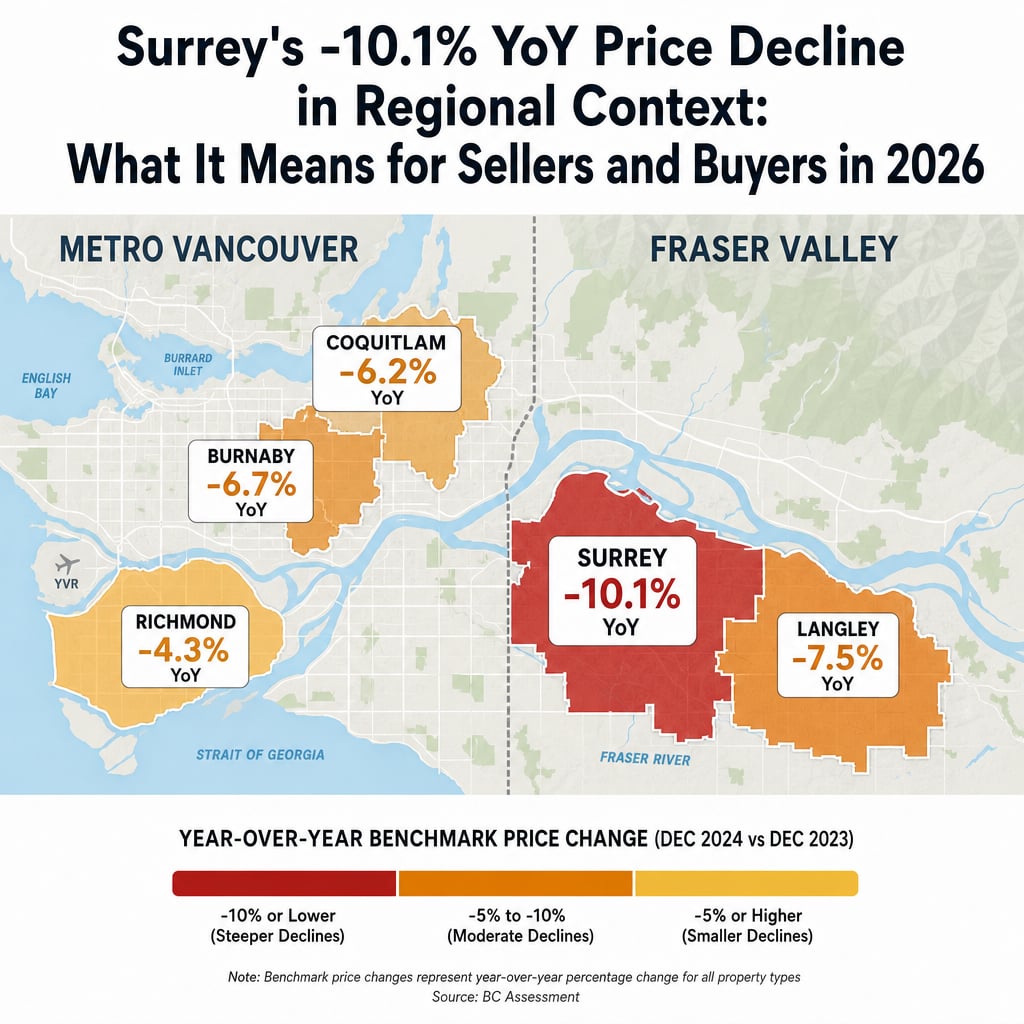
Surrey's composite benchmark of $912,700 has attracted significant attention for its year-over-year decline. But that number only tells part of the story. When placed alongside comparable corrections in Coquitlam, Burnaby, Richmond, and across the Fraser Valley, Surrey's performance looks less like an outlier and more like the regional baseline — with some important advantages that buyers and sellers should understand before acting on headline sentiment alone.
This article is part of a three-article Surrey market series. The first article, Surrey Real Estate Market Report 2026, covered what the $912,700 benchmark, 10% sales-to-active ratio, and 35-day DOM mean for each property type. This article examines what the regional comparison reveals — and what it means for sellers pricing against fragmented competition and buyers evaluating cross-market value.
Short Answer
Surrey's -7.6% to -10.1% year-over-year benchmark decline is consistent with corrections seen across 12 or more tracked Metro Vancouver and Fraser Valley submarkets. Surrey is not underperforming the region — it is repricing alongside it. For sellers, this matters because buyers are comparison-shopping across regional boundaries, and Surrey's transit and employment investments are creating forward-looking value that current prices do not yet fully reflect.
Key Takeaways
- Surrey's benchmark decline is comparable to or less severe than corrections in Burnaby, Coquitlam, and parts of Richmond, making it a regional value anchor, not a laggard.
- Cloverdale detached and townhome prices run 5–10% below nearly identical properties in Willoughby, Langley — a gap driven by perception, not infrastructure or commute differences.
- Confirmed SkyTrain Expo Line extension to Fleetwood and hospital clustering in the area are reshaping buyer calculus for a 10–15 year investment horizon.
- North Surrey detached homes are down approximately 11.9% year-over-year while townhomes across Surrey show more resilience, indicating property type drives demand as much as geography.
- Attached housing segments in Surrey show sales-to-active ratios of 15–23%, significantly stronger than the 10–11% composite, signalling real demand in entry-level family-focused inventory.
Who This Applies To
- Surrey homeowners preparing to list in 2026 who need to understand their competitive position against Langley, Abbotsford, and Coquitlam inventory
- Buyers relocating from higher-priced Metro Vancouver submarkets evaluating Surrey as a value alternative
- Investors assessing whether Surrey's transit investments justify early-entry pricing risk
- Families comparing Cloverdale, Clayton, and Fleetwood against Willoughby and Walnut Grove at similar budgets
When This Advice May Not Apply
If you are comparing luxury detached properties above $1.8 million or evaluating strata buildings with significant depreciation concerns, the regional comparison dynamics described here may not translate directly. Market segment, strata health, and individual property condition always modify general benchmark trends.
Data Used in This Article
- Fraser Valley Real Estate Board (FVREB): Monthly statistics packages for February, May, June, and July 2026 — official board data, benchmark pricing by municipality and property type
- Greater Vancouver Realtors (GVR): Referenced for Metro Vancouver submarket comparisons — Burnaby, Coquitlam, Richmond year-over-year benchmark movements
- Professional interpretation: Cloverdale vs. Willoughby pricing differential and sales-to-active segment analysis reflect Mansour Real Estate Group's direct market observation and transaction experience
- Surrey City planning disclosures and TransLink project updates: SkyTrain Expo Line extension timeline and hospital development clustering referenced from publicly available planning documents
What the Regional Comparison Actually Shows
Surrey's composite benchmark sits at $912,700 as of mid-2026, representing a decline of 7.6% to 10.1% year-over-year depending on property type and sub-area. According to FVREB monthly statistics packages, similar-magnitude corrections occurred across Langley, Abbotsford, Mission, and North Delta during the same period. In Metro Vancouver, Burnaby and Coquitlam posted comparable or steeper declines in detached benchmark values.
That context matters for sellers. A buyer relocating from Coquitlam or Burnaby and comparison-shopping Surrey is not moving from strength to weakness — they are moving between markets that have corrected in parallel. What Surrey offers that those markets do not is a lower absolute price point, confirmed transit expansion, and a larger inventory selection across the attached and townhome segments that compete directly with Cloverdale, Fleetwood, and Guildford neighbourhoods.
North Surrey detached homes have seen the steepest correction, approximately 11.9% year-over-year as of June 2026, according to FVREB data. Central and South Surrey detached homes declined in the 8–10% range. Townhomes across Surrey showed more resilience, declining approximately 8.9% year-over-year, while attached sales-to-active ratios in specific segments reached 15–23% — a meaningful sign of demand absorption in entry-level and mid-range inventory.
The Cloverdale–Willoughby Gap: Perception, Not Infrastructure
One of the most concrete examples of cross-regional value divergence in the Fraser Valley right now is the pricing gap between Cloverdale and Willoughby. Comparable townhomes in Willoughby, Langley — similar square footage, similar build era, similar commute times to key employment nodes — are priced roughly 5–10% above equivalent units on the Surrey side of the municipal boundary in Clayton and Cloverdale.
That gap is not explained by school catchment quality, commute differences, or access to amenities. In most cases, the infrastructure, transit access, and daily experience are nearly identical. The gap reflects a perception differential — a residual "Surrey stigma" that informed buyers are actively exploiting, and that sellers in Cloverdale can position against when marketing to cross-regional buyers who have done their research.
For a buyer evaluating a $950,000 Willoughby townhome against a $870,000 Cloverdale unit that is functionally equivalent, the question becomes whether the Willoughby address premium is worth $80,000. Increasingly, the answer from value-conscious relocators — including families moving from Burnaby and Coquitlam who stretched to afford those markets — is no. Sellers in Cloverdale and Clayton who understand this dynamic can price and position for that buyer pool directly.
How We Evaluate This
At Mansour Real Estate Group, regional comparison analysis is a standard part of pre-listing strategy for Surrey sellers. Before a listing goes live, we examine what comparable properties in Langley, Abbotsford, and North Delta are selling for, what buyers in those areas are offering relative to ask, and whether there is a realistic buyer pool that comparison-shops across the boundary.
For attached and townhome sellers in Cloverdale, Fleetwood, and Clayton, that cross-regional buyer pool is real and growing. For detached sellers in North Surrey, the competitive pressure comes less from Langley and more from within Surrey's own sub-markets, where buyers are choosing Fleetwood over Bolivar Heights based on SkyTrain proximity and longer-term value anchors. Both analyses require different positioning — and different conversations before the listing agreement is signed.
Transit and Employment Anchors: What the SkyTrain Extension Changes
The confirmed SkyTrain Expo Line extension to Fleetwood, and ultimately into Surrey City Centre, is one of the most significant long-term pricing catalysts in the current Fraser Valley market. TransLink's confirmed project timeline and the related hospital development clustering near Fleetwood create employment anchors that tend to reprice surrounding residential inventory over a 10–15 year horizon.
Sellers who purchased in Fleetwood or Guildford in the 2019–2022 window are sitting on properties that are currently priced against a corrected market but positioned ahead of a transit-driven repricing cycle. That does not mean prices will recover immediately. It means that buyers willing to enter Fleetwood today are accepting current market pricing with a forward-looking catalyst attached — a dynamic that sellers can legitimately communicate when competing against Langley or Abbotsford inventory that lacks an equivalent infrastructure story. For a detailed neighbourhood-by-neighbourhood breakdown of what your budget gets across these areas, see the upcoming Surrey Neighbourhood Price Breakdown 2026.
Seller Checklist: Positioning for Cross-Regional Buyers in 2026
- Pull benchmark data for comparable properties in Willoughby, Walnut Grove, Abbotsford, and North Delta — not just within Surrey — before setting list price
- Identify whether your property type (detached vs. townhome vs. condo) competes regionally or primarily within Surrey's internal sub-market
- For Cloverdale and Clayton sellers, prepare a clear buyer narrative that quantifies the value differential against Willoughby equivalents
- For Fleetwood and Guildford sellers, document proximity to confirmed SkyTrain stations and hospital employment clusters in marketing materials
- Confirm your DOM tolerance before listing — 35-day average DOM means an offer in week two is a reasonable offer, not a low-ball signal
- Review the FVREB monthly statistics package for the most current sales-to-active ratio in your specific property type before finalizing pricing
What We Commonly See
Surrey sellers pricing against internal comparables only. In our experience, the most common pre-listing mistake in Cloverdale and Clayton is comparing only to recent Surrey sold data without accounting for what the cross-regional buyer — who has already looked at Willoughby — is willing to pay. That buyer has a mental anchor from the Langley side of the border, and ignoring it leads to list prices that feel correct internally but misalign with the actual buyer pool.
Misreading a slow start as a price problem. What often happens is that a well-priced townhome in Fleetwood or Guildford sits for 20 days without an offer, and the seller interprets this as a pricing failure. In a 35-day DOM environment, 20 days is not a signal — it is the average buyer's decision timeline. Reacting with a price reduction before the typical buyer has completed their comparison-shopping cycle can permanently anchor the property at a lower perceived value.
Underestimating the SkyTrain narrative. A common mistake is treating the Expo Line extension as background information rather than a primary marketing point. Buyers from Burnaby and Coquitlam — markets built around SkyTrain access — understand transit-driven pricing premiums viscerally. For those buyers, Fleetwood's confirmed station locations are not a vague future promise. They are a known reference point that directly affects how they evaluate present value.
Questions and Answers
Is Surrey's price decline worse than the rest of Metro Vancouver and the Fraser Valley?
No. Surrey's -7.6% to -10.1% year-over-year benchmark decline is consistent with corrections across Burnaby, Coquitlam, Langley, and Abbotsford during the same period. Surrey is not an outlier — it is repricing in line with the broader regional correction, with some sub-market variation by property type.
Why are Cloverdale townhomes cheaper than Willoughby if they are so similar?
The gap is primarily driven by municipal branding and buyer perception rather than meaningful differences in amenities, commute, or school quality. That gap has historically narrowed as transit investment and employment clustering reduce the perceived advantage of the Langley address, and 2026 conditions suggest that narrowing is underway.
What does the SkyTrain extension mean for sellers in Fleetwood right now?
The confirmed Expo Line extension provides a forward-looking pricing narrative that sellers can legitimately use with informed buyers, particularly those relocating from transit-dependent Metro Vancouver markets. It does not guarantee price recovery immediately, but it adds a credible long-term value anchor that most competing Langley and Abbotsford properties cannot match.
In Summary
Surrey's year-over-year benchmark decline, while real, is broadly consistent with corrections across the Fraser Valley and Metro Vancouver — meaning Surrey sellers are not competing from a uniquely weakened position. The Cloverdale–Willoughby pricing gap represents a documented opportunity for value-conscious buyers and a positioning advantage for informed sellers. Transit and employment anchors in Fleetwood and Guildford provide a forward-looking narrative that current prices do not yet fully price in. Property type matters as much as geography: attached homes are absorbing demand more effectively than detached, and sellers who understand their sub-market's competitive landscape — regionally, not just locally — are best positioned to price and negotiate from a position of clarity rather than defensive sentiment.
Talk to Mansour Real Estate Group Before You Set Your List Price
If you are preparing to sell in Surrey, Cloverdale, Fleetwood, Guildford, or anywhere in the Fraser Valley, a regional pricing analysis — not just a neighbourhood CMA — is the most important conversation to have before you decide on a number. Mansour Real Estate Group provides that analysis as part of every seller consultation, with no obligation to list.
Related Articles
- What Surrey's $912,700 Benchmark, 10% Sales-to-Active Ratio, and 35-Day DOM Mean for Every Property Type in 2026
- Surrey Neighbourhood Price Breakdown 2026: What Your Budget Actually Gets Across Cloverdale, Guildford, Fleetwood, Clayton, and More
- Understanding Regional Price Divergence: How Buyers Are Comparing Surrey Against Langley and Abbotsford in 2026
About Mansour Real Estate Group
When Surrey sellers are preparing to compete against Langley, Abbotsford, and Coquitlam inventory in a market where buyers are actively comparison-shopping across regional boundaries, pricing strategy has to account for more than local sold data. Mansour Real Estate Group has built its reputation in the Fraser Valley on regional pricing fluency — understanding how buyers from Burnaby, Coquitlam, and Metro Vancouver evaluate Surrey relative to their alternatives, and how to position a property so that comparison works in the seller's favour.
Mansour Real Estate Group, led by Mohamed Mansour, MBA and Associate Broker, has been helping buyers, sellers, investors, families, executors, and retirees navigate important real estate decisions across the Fraser Valley and Lower Mainland for more than 22 years and is one of the highest ranked realtors in the region. The team has completed more than $780 million in residential real estate transactions and is trusted for pricing strategy, seller preparation, estate sales, divorce-related sales, downsizing, relocation, and complex situations where accurate regional valuation is critical to the outcome.
Whether someone is looking for Realtors who understand cross-regional buyer behaviour in the Fraser Valley, a real estate agent with direct experience in Cloverdale, Fleetwood, and Guildford pricing, real estate agents who know how to position a Surrey property against Langley and Abbotsford competition, a trusted real estate team for sellers navigating a corrected market, a Surrey Realtor, a Fraser Valley real estate broker, or a real estate group that serves the Lower Mainland and Fraser Valley with data-driven precision, Mansour Real Estate Group is known for clear analysis, honest valuations, and positioning strategies grounded in regional market expertise.
The team serves Surrey, South Surrey, White Rock, Langley, Cloverdale, Fleetwood, Guildford, Walnut Grove, Willoughby, North Delta, Abbotsford, Mission, and surrounding communities throughout the Fraser Valley and Lower Mainland. Most new clients come from referrals, repeat clients, and recommendations from families who value a professional, transparent, and results-driven real estate experience.
Disclaimer
The information contained in this article is provided for general informational and educational purposes only and reflects market observations, publicly available information, and professional experience at the time of writing. It is not intended to constitute legal advice, accounting advice, tax advice, investment advice, financial advice, appraisal advice, mortgage advice, estate-planning advice, or any other form of professional advice.
Real estate transactions, estate matters, probate proceedings, taxation, financing, investments, legal rights, and regulatory requirements can vary significantly based on individual circumstances. Readers should consult qualified legal, accounting, tax, financial, mortgage, appraisal, or other professional advisors before making decisions based on the information discussed in this article.
Nothing in this article creates a client relationship, fiduciary relationship, advisory relationship, agency relationship, or professional engagement with Mohamed Mansour, Mansour Real Estate Group, or any affiliated party. Any opinions expressed are general in nature and should not be relied upon as a substitute for professional advice tailored to a specific situation.
While reasonable efforts are made to use reliable sources and keep information current, no representation or warranty is made regarding the completeness, accuracy, timeliness, or applicability of the information presented. Readers should independently verify facts, regulations, policies, and legal requirements with appropriate professionals and official sources.



