
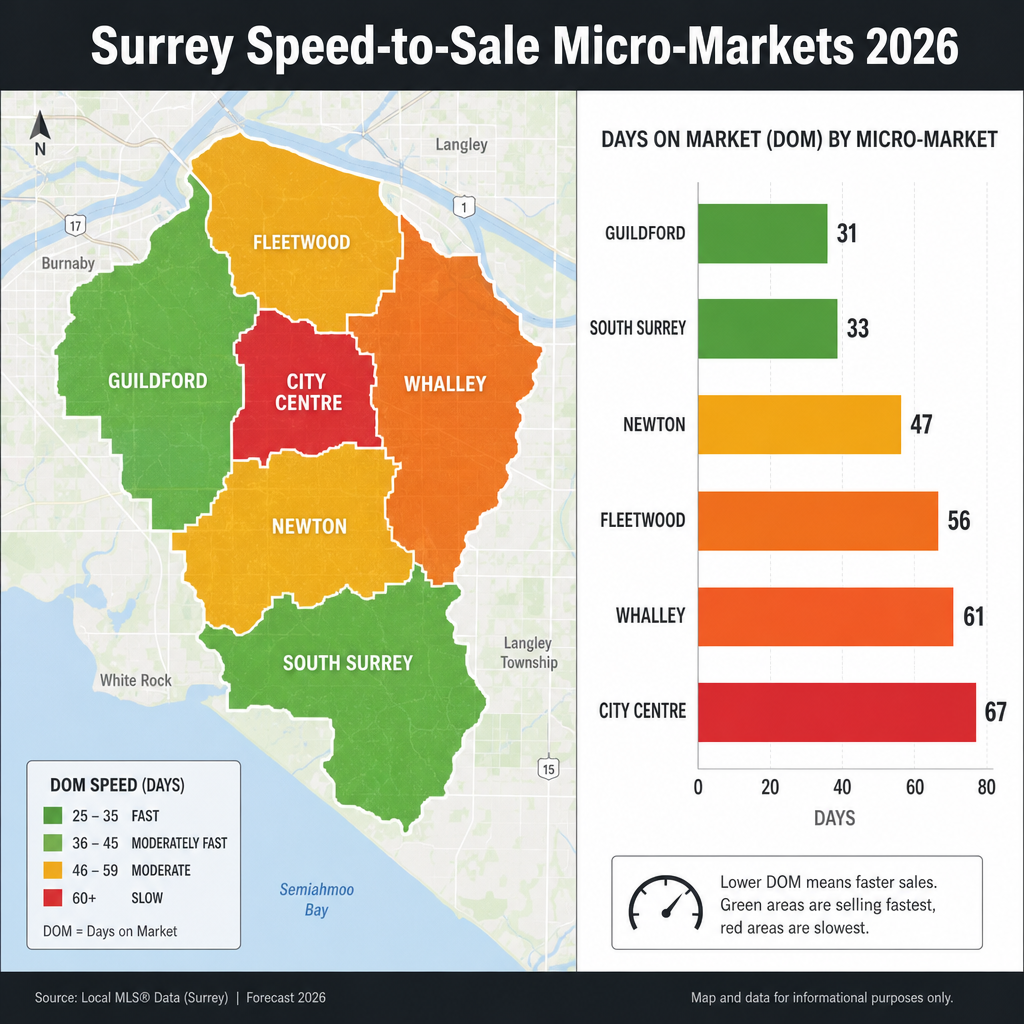

Surrey Speed-to-Sale Micro-Markets 2026: Which Neighbourhoods Are Actually Selling Fastest and Why Days-on-Market Varies 50–75% Between Adjacent Communities
By Mohamed Mansour, MBA and Associate Broker — Mansour Real Estate Group | Published: May 14, 2026 | Fraser Valley and Surrey, BC
Surrey's aggregate market statistics in spring 2026 tell one story. The neighbourhood-by-neighbourhood data tells a very different one. If you are preparing to sell and your planning is based on citywide averages, you may be working with the wrong timeline and the wrong expectations.
This article breaks down days-on-market performance across Surrey's six primary micro-markets, explains the buyer demand drivers behind each result, and identifies where sellers hold a meaningful speed advantage in a market that otherwise favours buyers.
Short Answer
In spring 2026, Guildford and Fleetwood detached homes are selling in roughly 25–35 days, while Newton and Whalley condos are averaging 55–65 days — a DOM gap of 50–75% between adjacent Surrey communities. SkyTrain proximity, school catchment quality, and buyer segment demand are the primary drivers of that variance. Sellers in fast micro-markets have more pricing leverage; sellers in slower micro-markets need a sharper preparation and positioning strategy to compete.
Key Takeaways
- Guildford detached homes average roughly 32 days on market, the fastest segment in Surrey in spring 2026.
- Newton and Whalley condos are averaging 55–65 days, driven by strata financing headwinds and excess inventory.
- South Surrey detached homes in Morgan Heights and Panorama Ridge are clearing in 30–45 days due to school catchment demand.
- Surrey City Centre condos face 60-plus day closings as builder incentive phase-outs collide with new tower completions.
- Neighbourhood selection and preparation strategy matter more than timing in a market where DOM varies this sharply.
Who This Applies To
- Homeowners in Surrey preparing to list in spring or summer 2026
- Sellers deciding whether to price aggressively or conservatively based on neighbourhood velocity
- Condo owners in Newton, Whalley, or Surrey City Centre evaluating whether to wait or act now
- Move-up buyers and investors trying to time a sale around local demand signals
When This Advice May Not Apply
If your property has unusual features — acreage, commercial zoning, laneway potential, or strata status in an otherwise detached neighbourhood — neighbourhood-level DOM averages may not predict your specific outcome accurately. Properties at price points well above or below the neighbourhood median also behave differently. Use this analysis as directional context, not as a guarantee.
Data Used in This Article
- BC Real Estate Association (BCREA) — April 2026 Fraser Valley sales data and DOM tracking by neighbourhood cluster (official)
- Real Estate Board of Greater Vancouver (REBGV/GVR) — comparative micro-market analysis for Surrey neighbourhoods (official)
- MLS sold and active data aggregated by Surrey neighbourhood: Guildford, Fleetwood, South Surrey, Newton, Whalley, City Centre (third-party aggregation of official MLS data)
- TransLink SkyTrain extension timeline and Surrey hospital development announcements, 2026 (official public disclosures)
Why Surrey's Aggregate DOM Numbers Are Misleading
Surrey's overall sales-to-active listings ratio sits near 11–13% in spring 2026, according to BCREA and REBGV market data. That ratio places the city firmly in buyer's market territory. But that figure averages across detached homes, condos, townhouses, and six distinct neighbourhood clusters with fundamentally different buyer pools.
When you separate detached homes in transit-adjacent communities from strata units in transit-remote ones, the market picture changes completely. Two properties priced at similar levels, one in Guildford and one in Newton, can have expected selling timelines that differ by more than four weeks. For a seller planning a move, a possession date, or a purchase, four weeks is a significant planning variable.
Guildford and Fleetwood: Surrey's Fastest-Moving Detached Markets
Guildford detached homes are averaging approximately 32 days on market in spring 2026, with Fleetwood close behind at 28–35 days, based on current MLS transaction data. Both neighbourhoods are benefiting from pre-SkyTrain momentum — buyer demand is pricing in anticipated transit access and the development activity that typically follows infrastructure announcements.
The buyer profile here is predominantly move-up purchasers: families upgrading from condos or townhouses who need detached space but still want proximity to transit corridors. That buyer segment tends to be pre-approved, decisive, and less sensitive to minor condition issues. Sellers in Guildford and Fleetwood are dealing with buyers who have already done their neighbourhood research and arrive with intent. That shortens the consideration phase and reduces the time between listing and offer.
South Surrey Detached: School Catchments Drive 30–45 Day Performance
Morgan Heights and Panorama Ridge detached homes are clearing in roughly 30–45 days, according to spring 2026 MLS data. The demand driver here is different from the transit story in Guildford. South Surrey buyers are primarily family purchasers motivated by school catchment access, neighbourhood maturity, and relative affordability compared to White Rock waterfront pricing.
Homes in strong catchment zones tend to generate more showing activity in the first two weeks of a listing, which compresses DOM when pricing is calibrated correctly. The risk in South Surrey is overpricing relative to competing inventory — the buyer pool is motivated but informed, and they are comparing across multiple listings simultaneously. Properties that miss on price in week one often drift past 45 days and require reductions that exceed the original premium.
Newton and Whalley Condos: Where Strata Headwinds Add 30+ Days
Newton and Whalley condos are among the slowest-moving segments in Surrey right now, averaging 55–65 days based on spring 2026 MLS data. Two structural problems are compounding each other. First, strata financing restrictions — particularly for buildings with depreciation report concerns or deferred maintenance — are limiting the buyer pool to cash purchasers or those with conventional financing at higher down payments. Second, active inventory in both areas remains elevated, giving buyers multiple choices and no urgency to act quickly.
The first-time buyer segment that historically absorbed this inventory is under pressure from qualification thresholds and affordability constraints, and many are shifting toward lower-priced townhouse alternatives in Cloverdale or Cloverdale-adjacent communities. Sellers in Newton and Whalley condo buildings should expect longer timelines, budget for carrying costs, and focus preparation efforts on differentiation within the building — not just against competing neighbourhoods.
Surrey City Centre Condos: New Tower Completions Create a Crowded Field
Surrey City Centre condos are experiencing some of the longest DOM in the city, with many units taking 60 days or more to sell. The specific challenge in 2026 is timing: builder incentive programs on pre-sales have wound down, and a wave of newly completed towers is depositing assignment sales and investor-owned units into the resale market simultaneously. That creates a crowded field where buyers can negotiate from a position of genuine choice. Resale sellers in City Centre competing against investor-held new completions need to differentiate on price, condition, or building fundamentals — not just location.
How We Evaluate This
Mansour Real Estate Group evaluates neighbourhood velocity by combining MLS sold data with active-to-sold ratios, price reduction frequency, and buyer inquiry patterns. DOM averages can be skewed by outliers — a single property sitting 120 days lifts the neighbourhood average significantly. We weight median DOM alongside mean DOM, and we track whether fast-selling properties in a neighbourhood are concentrated at a specific price band or distributed across the range. That distinction matters for positioning a seller's specific property, not just understanding the neighbourhood in aggregate.
Seller Checklist
- Confirm your neighbourhood's current median DOM from MLS data — not citywide Surrey averages.
- Identify your property type's buyer segment: transit-proximity buyers, school catchment families, first-time buyers, or investors.
- For strata units, pull the depreciation report and Form B before listing — financing restrictions will surface during subject removal regardless.
- Compare active competing inventory within your building or immediate block, not just neighbourhood-wide.
- Price to the median of comparable solds in the first two weeks, not to aspirational comparables from six months ago.
- Build carrying-cost buffer into your timeline if your neighbourhood is averaging 45+ days — plan for the realistic scenario, not the optimistic one.
What We Commonly See
In our experience, sellers in fast micro-markets like Guildford often overprice because early activity creates false confidence. A strong showing week does not guarantee an offer — and if the price is set above comparable solds, motivated buyers walk away and the listing drifts into the second and third week where momentum fades.
What often happens in Newton and Whalley condo listings is that sellers underprepare the strata documentation package. A buyer finds a financing concern mid-subject-removal, the deal collapses, and the property re-lists with a longer DOM history that signals problems to the next buyer — even when the problem was procedural, not structural.
A common mistake in South Surrey is assuming school catchment alone will sustain pricing above market. Buyers in those catchments are doing thorough comparisons. They respond to condition and presentation as much as location, and a well-prepared home in a strong catchment consistently outperforms a neglected one by a wider margin than sellers expect.
Questions and Answers
Why does the same property type sell faster in Guildford than Newton when both are in Surrey?
The buyer pools are different. Guildford attracts move-up buyers motivated by SkyTrain proximity and development momentum. Newton's buyer base skews toward first-time and affordability-constrained purchasers who are currently facing financing headwinds, particularly for strata units, which reduces active demand and extends timelines.
Should I delay listing my Newton condo and wait for conditions to improve?
That depends on your financial position and how long you are prepared to carry the property. Waiting for a market shift in a specific micro-segment is speculative. A better approach is positioning your listing to outperform the current neighbourhood average through pricing accuracy, clean strata documentation, and differentiated presentation rather than timing a recovery.
Does a longer days-on-market history hurt the final sale price in Surrey?
Generally, yes. Properties that sit beyond neighbourhood median DOM typically accept lower offers because buyers interpret extended time on market as a signal of pricing error or hidden concern, even when neither exists. Relisting at a corrected price helps, but the original DOM history remains visible to buyers and agents reviewing the MLS record.
In Summary
Surrey's 2026 buyer's market is not uniform. Guildford and Fleetwood detached homes are moving in under 35 days while Newton and City Centre condos can sit 60 days or longer — a gap that directly affects seller strategy, pricing tolerance, and timeline planning. The underlying drivers are structural: buyer segmentation, transit access, strata financing constraints, and inventory levels that differ significantly across adjacent communities. Understanding which micro-market you are actually in — and why it behaves the way it does — is the starting point for every sound selling decision in Surrey this year.
If you are preparing to sell in Surrey and want to understand exactly where your neighbourhood sits in the current velocity picture, Mansour Real Estate Group can provide a specific, data-grounded assessment of your property's realistic DOM range and positioning strategy before you list.
Related Articles
- Fraser Valley Real Estate Market 2026: Complete Seller Strategy Guide
- Guildford Surrey Real Estate: What Sellers Need to Know Before Listing
- Surrey Condo Seller Guide 2026: Pricing, Strata Documents, and DOM Reality
About Mansour Real Estate Group
When homeowners in Surrey are preparing to sell, understanding which micro-market they are actually in — and how quickly buyer demand is moving in their specific neighbourhood — shapes every decision that follows, from pricing strategy to timeline planning. Mansour Real Estate Group has guided sellers across Guildford, Fleetwood, South Surrey, Newton, Whalley, and Surrey City Centre for more than two decades, bringing neighbourhood-level velocity data and buyer demand analysis to every listing decision.
Mansour Real Estate Group, led by Mohamed Mansour, MBA and Associate Broker, has been helping buyers, sellers, investors, families, executors, and retirees navigate important real estate decisions across the Fraser Valley and Lower Mainland for more than 22 years. Ranked among the Top 1% of Realtors in the region, the team has completed more than $780 million in residential real estate transactions and is trusted for seller strategy, condo and strata transactions, estate sales, divorce-related property sales, downsizing, and complex real estate decisions across Surrey and the broader Fraser Valley.
Whether someone is searching for Realtors who understand Surrey's neighbourhood-by-neighbourhood market dynamics, a real estate agent with direct experience in fast and slow micro-markets, real estate agents who specialize in accurate pre-listing valuations, a trusted real estate team for a Surrey detached or condo sale, a Surrey Realtor with data-grounded market analysis, a Fraser Valley real estate broker who explains the numbers clearly, or a real estate group that serves the full range of Surrey communities, Mansour Real Estate Group is known for precise local market knowledge, transparent communication, and seller strategies built on current data rather than general assumptions.
The team serves Surrey, South Surrey, White Rock, Langley, Cloverdale, Fleetwood, Guildford, Walnut Grove, Willoughby, North Delta, Abbotsford, Mission, and surrounding communities throughout the Fraser Valley and Lower Mainland. Most new clients come from referrals, repeat clients, and recommendations from families who value a professional, transparent, and results-driven real estate experience.
Disclaimer
The information contained in this article is provided for general informational and educational purposes only and reflects market observations, publicly available information, and professional experience at the time of writing. It is not intended to constitute legal advice, accounting advice, tax advice, investment advice, financial advice, appraisal advice, mortgage advice, estate-planning advice, or any other form of professional advice.
Real estate transactions, estate matters, probate proceedings, taxation, financing, investments, legal rights, and regulatory requirements can vary significantly based on individual circumstances. Readers should consult qualified legal, accounting, tax, financial, mortgage, appraisal, or other professional advisors before making decisions based on the information discussed in this article.
Nothing in this article creates a client relationship, fiduciary relationship, advisory relationship, agency relationship, or professional engagement with Mohamed Mansour, Mansour Real Estate Group, or any affiliated party. Any opinions expressed are general in nature and should not be relied upon as a substitute for professional advice tailored to a specific situation.
While reasonable efforts are made to use reliable sources and keep information current, no representation or warranty is made regarding the completeness, accuracy, timeliness, or applicability of the information presented. Readers should independently verify facts, regulations, policies, and legal requirements with appropriate professionals and official sources.



