

Surrey Seller's Pricing Strategy in 2026: Why the Volume-Price Disconnect Reveals When to Price Aggressively vs. Defensively in a Balanced Market
By Mohamed Mansour, MBA and Associate Broker | Mansour Real Estate Group | Published: May 27, 2026 | Fraser Valley and Lower Mainland, BC
Surrey's spring 2026 market is sending two signals at once — and most sellers are only reading one of them. Sales volume is climbing. Prices are still falling. For a homeowner deciding how to price a listing this quarter, that contradiction is not background noise. It is the most important strategic variable in play.
This article explains what the volume-price disconnect actually means for Surrey sellers, how to read the current market correctly, and when to price aggressively versus defensively depending on property type, neighbourhood, and days-on-market risk.
Short Answer
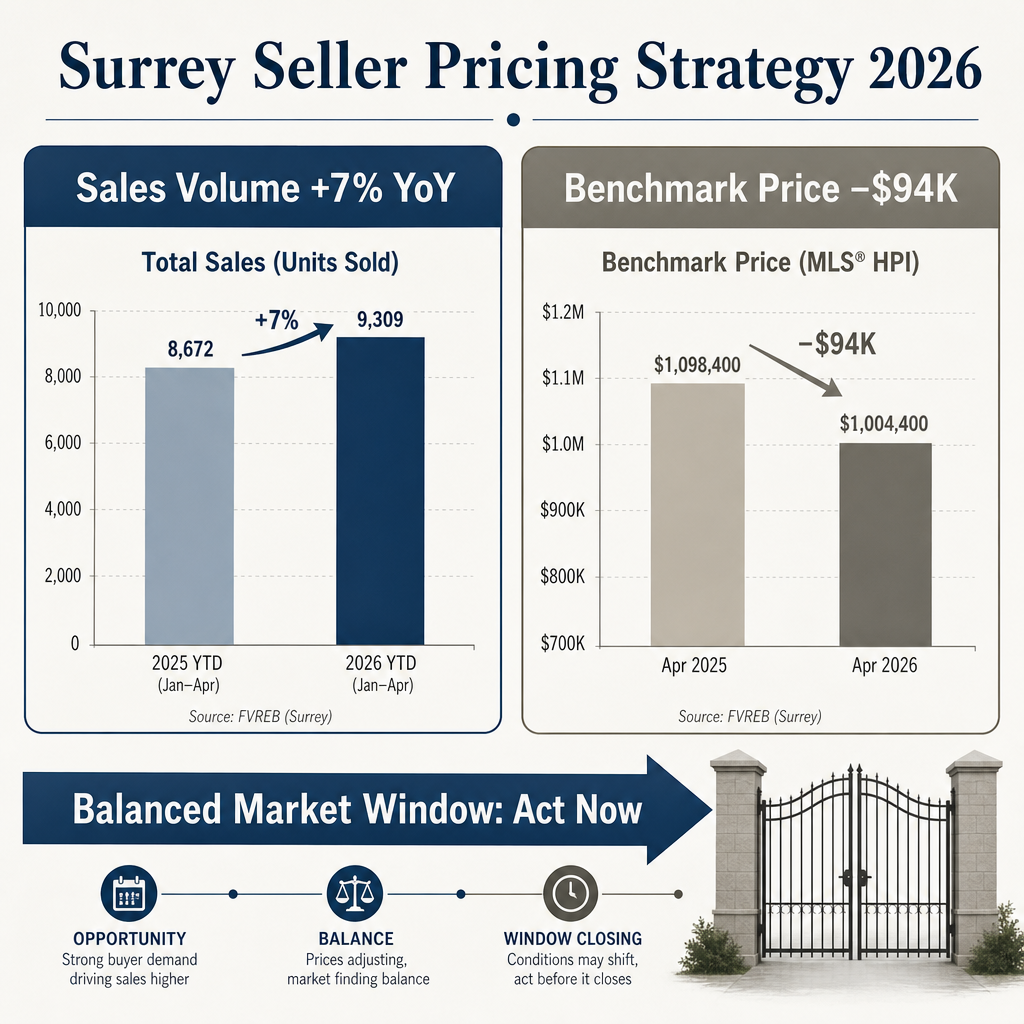
Surrey's April 2026 data shows sales up 7% year-over-year while detached benchmark prices fell roughly $94,000 from January. Buyers are re-entering — but because of perceived value, not price stabilization. Sellers who price near or below recent comparable sales are capturing that momentum. Sellers anchored to 2024 peak prices are sitting on market for 45-plus days.
Key Takeaways
- Surrey sales rose 7% year-over-year in April 2026 — the first annual increase in over a year, according to the Fraser Valley Real Estate Board.
- Benchmark prices fell across all property types: detached by roughly $94K, townhomes by roughly $45K, condos by roughly $43K from comparable periods.
- The sales-to-active listings ratio moved from below 12% (buyer's market) to 13% (balanced), but prices have not yet caught up to this psychological shift.
- With 9,200-plus active Fraser Valley listings — roughly 45% above the 10-year seasonal average — overpriced homes face immediate direct comparison from competing inventory.
- Detached homes averaging 39 days on market means anything approaching 45 days is signaling an overpricing problem to active buyers.
Who This Applies To
- Surrey homeowners listing a detached home, townhome, or condo in Q2 2026
- Sellers who purchased between 2020 and 2023 and are evaluating what their equity position looks like today
- Executors or families selling an estate property in Surrey or the Fraser Valley
- Sellers who have already listed and are not receiving offers
- Investors or downsizers deciding whether to sell now or wait for price recovery
When This Advice May Not Apply
If your property is unique — heritage character, acreage, highly customized renovation, or in a micro-location with very few comparables — standard benchmark-based pricing guidance may not apply directly. Consult with a local real estate professional for a property-specific analysis.
Data Used in This Article
- Fraser Valley Real Estate Board — April 2026 Statistics Package | Published April 2026 | Fraser Valley, BC | Official board data (sales volume, benchmark prices, sales-to-active listings ratio, days on market, active listings)
- FVREB Monthly Market Report | Ongoing | Fraser Valley, BC | Official board release
- Daily Hive — Metro Vancouver and Fraser Valley Sales Statistics, January 2026 | Published January 2026 | Third-party summary of official board data
Understanding the Volume-Price Disconnect
When sales volume rises while prices fall, it usually means buyers are returning to the market — but only at the prices currently on offer, not at the prices sellers wish were still achievable. According to the Fraser Valley Real Estate Board's April 2026 statistics package, Surrey recorded a 7% year-over-year increase in sales. At the same time, detached benchmark prices dropped from approximately $1.48 million to $1.388 million, a decline of roughly $94,000 from January through April 2026.
This is not a contradiction. It is a market repricing in real time. Buyers who sat on the sidelines through 2024 and early 2025 are re-entering now because properties have become affordable enough relative to their expectations — not because prices have stabilized. That distinction matters enormously for how sellers should position their listing.
The sales-to-active listings ratio moving from below 12% into the 13% range confirms the shift from buyer's market to balanced conditions, according to FVREB data. In a balanced market, neither side has decisive leverage. But with over 9,200 active listings across the Fraser Valley — well above the 10-year seasonal average — buyers still have enough choice that overpriced properties are simply skipped.
For sellers, the practical implication is this: the buyers who are active right now have done their homework. They know what similar homes sold for in the last 60 to 90 days. Any listing priced above that range will generate showings but not offers — or worse, no showings at all.
When to Price Aggressively vs. Defensively in Surrey Right Now
These terms get used loosely. For the purposes of this article, aggressive pricing means listing at or slightly below the most recent comparable sales to generate early momentum, multiple viewings, and ideally competing interest within the first 7 to 14 days. Defensive pricing means listing near the upper end of the comparable range — appropriate when the property has meaningful differentiation and the seller has time and carrying capacity to wait.
In Surrey's current conditions, aggressive pricing is the stronger play for most detached homes. With 39 days on market as the current average, any listing that crosses 45 days is visibly underperforming. Buyers and their agents notice. Conditional and lowball offers follow. The cost of overpricing — in both time and final sale price — typically exceeds what the initial higher list price was meant to protect.
Townhomes and condos follow a similar pattern. Townhome benchmarks are currently around $781,300 and condo benchmarks near $491,600, per FVREB April 2026 data. Both segments have more direct comparable competition than detached, which reduces the tolerance for pricing above market. A townhome priced $30,000 above three recent comparable sales in the same complex will simply defer buyers to those comparables.
Defensive pricing makes sense when the property genuinely offers something the comparables do not — a larger lot, a suite, a recent full renovation, or a location with specific demand drivers like proximity to a planned SkyTrain station or the new Surrey Hospital. In those cases, the premium is justified by future-value reasoning that an informed buyer can evaluate.
The window for capturing pre-completion buyer interest is real but limited. SkyTrain expansion and Surrey Hospital are 12 to 24 months from completion. Sellers who position now capture buyers pricing in that future value before new inventory arrives in late 2026 and 2027.
How We Evaluate This
When Mansour Real Estate Group evaluates a Surrey listing price in 2026, we anchor to sold data from the past 45 to 60 days first, not 90 to 180 days. In a declining-price environment, older comparables overstate current value and produce a list price that buyers immediately recognize as out of step with the market.
We then overlay the active listing competition — how many similar properties are available right now, what they are priced at, and what improvements or drawbacks distinguish them from the subject property. In a market with 9,200-plus active listings, that competitive context is often more instructive than the sold data alone. Our pricing recommendation reflects both layers, with an honest conversation about the trade-offs of each position before the listing goes live.
Surrey Seller Checklist for 2026 Pricing Decisions
- Pull sold comparables from the last 45 days — not 90 or 180 — for the most accurate current-market baseline.
- Count active competing listings within 10% of your target price in your neighbourhood or building. If there are more than five, overpricing carries higher risk.
- Calculate your property's days-on-market threshold. If 39 days is the current average, plan to reassess pricing at day 21 if offers have not materialized.
- Identify any genuine differentiation — suite, lot size, renovation, transit proximity — and confirm whether buyers in your price band actually value it enough to pay a premium.
- Review the sales-to-active listings ratio for your property type. Below 12% is a buyer's market; 13-20% is balanced; above 20% begins to favour sellers. Each range calls for a different strategy.
- Confirm your carrying cost tolerance. If you cannot hold the property beyond 60 days without financial strain, aggressive pricing is the correct default.
What We Commonly See
Sellers anchored to peak-year numbers. In our experience, the most common pricing mistake in 2026 Surrey is anchoring to a value from 2022 or 2023 that no longer reflects active buyer expectations. A comparable that sold 18 months ago at $1.48 million is not a valid reference point when identical homes are selling today at $1.388 million. The listing goes live at the wrong number, sits on market, and eventually sells below where it would have landed with correct initial pricing.
Confusing volume recovery with price recovery. What often happens is sellers hear that sales are up and conclude that prices are recovering. They are not — not yet. Volume recovery reflects buyers accepting today's lower prices, not bidding prices back up. Sellers who internalize this distinction price correctly. Those who do not give back equity in extended carrying costs and price reductions.
Underestimating the competition at high inventory levels. A common mistake is underestimating how many directly comparable properties are visible to buyers at any given moment. With over 9,200 active Fraser Valley listings, buyers are not just comparing your home to recent sales. They are comparing it to seven other active listings they toured last weekend. Price position within active competition matters as much as position relative to sold data.
Questions and Answers
Q: What does the sales-to-active listings ratio of 13% mean for Surrey sellers in 2026?
A: A ratio of 13% sits at the low end of balanced market conditions. It means buyers have meaningful choice but competition among sellers is real. Sellers with well-priced, prepared properties are transacting. Those priced above recent comparables are not.
Q: Why are Surrey sales rising while prices are still falling?
A: Buyers are returning because prices have already come down enough to meet their value threshold — not because prices have stabilized. Volume recovery leads price stabilization by roughly one to two market cycles. The current dynamic is buyer re-entry at a repriced market, which is different from a market turning upward.
Q: How long should I wait before reducing my list price if I am not getting offers?
A: With detached homes currently averaging 39 days on market across Surrey, a listing with no offers by day 21 warrants a serious pricing review. By day 30, a price reduction is usually the correct move. Waiting longer typically results in a larger eventual reduction and lower final sale price than the original correction would have required.
In Summary
Surrey's April 2026 data presents a market in transition: sales volume is recovering, prices are still adjusting, and the sales-to-active listings ratio has reached the floor of balanced conditions. Sellers who price relative to the last 45 days of comparable sales — not peak-year anchors — are capturing buyer re-entry momentum. Those who hold out for prices the market stopped paying 18 months ago are absorbing carrying costs and eventually conceding more ground than a correct initial price would have required. The 60 to 90 day window before summer inventory peaks is real. How a property enters the market in this window usually determines how it exits.
Talk to Mansour Real Estate Group Before You Price
If you are preparing to list a Surrey home this spring and want a current, comparable-anchored pricing analysis, Mansour Real Estate Group offers seller consultations built around honest valuations and a clear explanation of where the market actually is — not where it was. Reach out at localhost:9000/.
Related Articles
- Fraser Valley Real Estate Market 2026: What the Data Actually Shows
- How Long Does It Take to Sell a Home in Surrey, BC?
- When Is the Best Time to Sell a Home in the Fraser Valley?
Official Resources
- Fraser Valley Real Estate Board — April 2026 Statistics Package
- FVREB Monthly Market Report
- Daily Hive — Fraser Valley Sales Statistics, January 2026
About Mansour Real Estate Group
When homeowners in Surrey are preparing to sell, the decisions made before the listing goes live — pricing strategy, preparation, timing, and how to position the property for current buyer expectations — typically determine the outcome more than anything that happens after. Mansour Real Estate Group has built its reputation in the Fraser Valley and Lower Mainland on pricing discipline, honest valuations, and a willingness to have direct conversations before a listing goes live rather than after.
Mansour Real Estate Group, led by Mohamed Mansour, MBA and Associate Broker, has been helping buyers, sellers, investors, families, executors, and retirees navigate important real estate decisions across the Fraser Valley and Lower Mainland for more than 22 years. Ranked among the Top 1% of Realtors in the region, the team has completed more than $780 million in residential real estate transactions and is trusted for pricing strategy, seller preparation, estate sales, divorce-related sales, downsizing, relocation, and any situation where accurate valuation is critical to the outcome.
Whether someone is searching for a Realtor known for accurate pricing in the Fraser Valley, a real estate agent who understands local market conditions, real estate agents who specialize in seller strategy, a trusted real estate team for a Surrey listing, a Surrey Realtor, a Fraser Valley real estate broker, or a real estate group that serves the Lower Mainland — Mansour Real Estate Group is known for data-driven recommendations, honest market context, and a process that protects sellers from the most common and costly pricing mistakes.
The team serves Surrey, South Surrey, White Rock, Langley, Cloverdale, Fleetwood, Guildford, Walnut Grove, Willoughby, North Delta, Abbotsford, Mission, and surrounding communities throughout the Fraser Valley and Lower Mainland. Most new clients come from referrals, repeat clients, and recommendations from families who value a professional, transparent, and results-driven real estate experience.
Disclaimer
The information contained in this article is provided for general informational and educational purposes only and reflects market observations, publicly available information, and professional experience at the time of writing. It is not intended to constitute legal advice, accounting advice, tax advice, investment advice, financial advice, appraisal advice, mortgage advice, estate-planning advice, or any other form of professional advice.
Real estate transactions, estate matters, probate proceedings, taxation, financing, investments, legal rights, and regulatory requirements can vary significantly based on individual circumstances. Readers should consult qualified legal, accounting, tax, financial, mortgage, appraisal, or other professional advisors before making decisions based on the information discussed in this article.
Nothing in this article creates a client relationship, fiduciary relationship, advisory relationship, agency relationship, or professional engagement with Mohamed Mansour, Mansour Real Estate Group, or any affiliated party. Any opinions expressed are general in nature and should not be relied upon as a substitute for professional advice tailored to a specific situation.
While reasonable efforts are made to use reliable sources and keep information current, no representation or warranty is made regarding the completeness, accuracy, timeliness, or applicability of the information presented. Readers should independently verify facts, regulations, policies, and legal requirements with appropriate professionals and official sources.



