
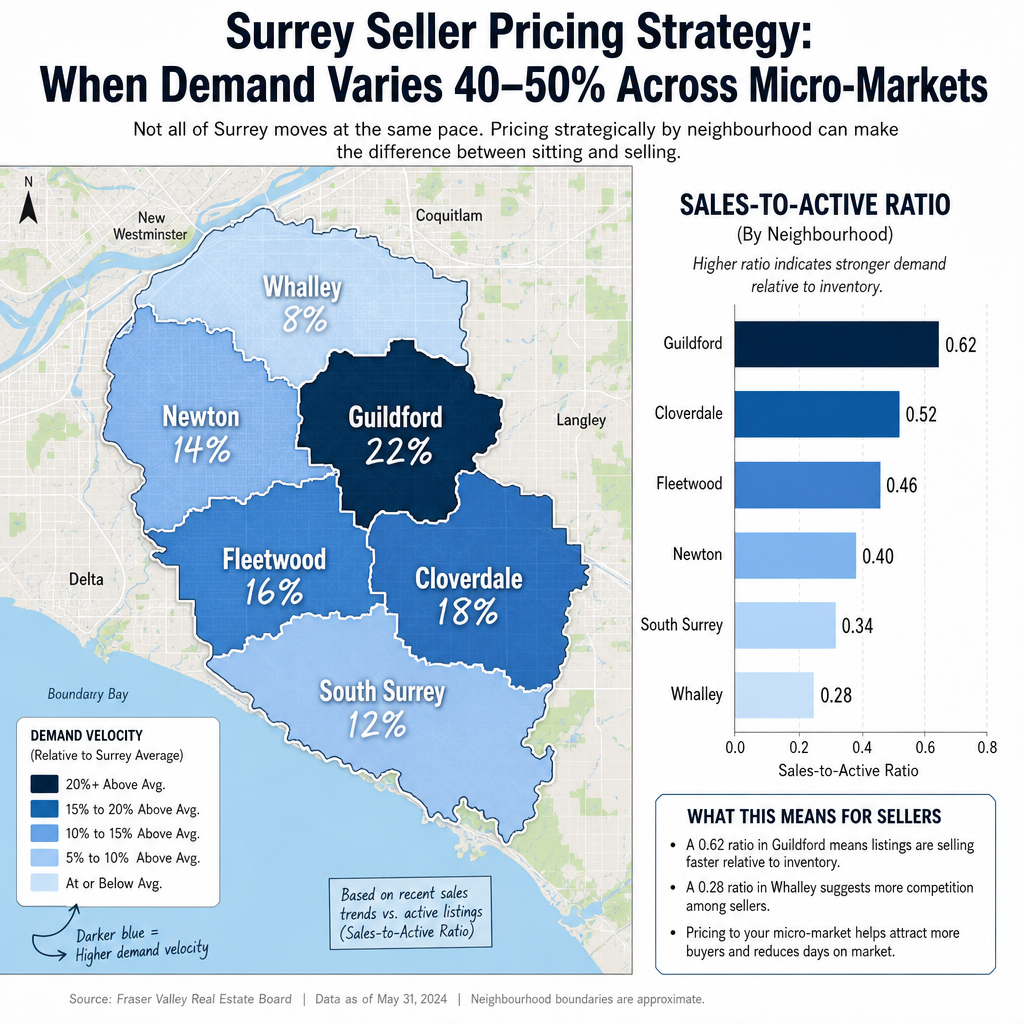

Surrey Seller's Complete Pricing Strategy When Buyer Demand Varies 40–50% Across Micro-Neighbourhoods in 2026
By Mohamed Mansour, MBA and Associate Broker | Mansour Real Estate Group | Published: May 12, 2026 | Surrey, Fraser Valley, BC
Surrey is one city on paper. In practice, it is six distinct real estate markets operating under different rules at the same time. A seller in Fleetwood and a seller in Newton can list in the same week, at seemingly similar prices, and experience completely different outcomes — not because of the home itself, but because local demand velocity is not the same. In 2026, that gap has widened to a point where the difference between a well-calibrated list price and a misjudged one can cost a seller months of carrying costs and a forced reduction below what strategic pricing would have achieved from day one.
This guide is built for Surrey sellers who want to understand how pricing decisions should change based on where their property sits in the city's fragmented micro-market landscape.
Short Answer
Surrey's sales-to-active ratios range from roughly 8% in soft condo segments to 22% in emerging detached pockets like Fleetwood. That spread means list price calibration cannot rely on city-wide benchmarks. Sellers must anchor pricing to their specific neighbourhood's current demand velocity, buyer profile, and competing inventory — not the Surrey average.
Who This Applies To
- Homeowners preparing to list detached or semi-detached homes in Fleetwood, Guildford, Cloverdale, Newton, or Whalley
- Condo owners in Newton or Whalley considering a 2026 sale
- Sellers in South Surrey evaluating whether benchmark pricing is still appropriate
- Executors or trustees managing Surrey estate properties with no current market context
- Sellers who have already accumulated days on market and are evaluating a price adjustment
When This Advice May Not Apply
If your property is in a newer Surrey precinct with limited comparable sales, or if it sits at a price point that crosses into a different buyer demographic, the frameworks here are a starting point — not a substitute for a property-specific analysis from a local team with current neighbourhood data.
Key Takeaways
- Surrey's sales-to-active ratio spans 8% to 22% across neighbourhoods — that gap directly determines how aggressive your list price can be.
- April 2026 data shows Surrey sales up 7% year-over-year while prices dropped 5–8%, signalling systematic overpricing at launch in soft segments.
- Fleetwood and Guildford carry a short pre-transit pricing window before SkyTrain and hospital completions reshape long-term buyer composition.
- Newton and Whalley condo sellers face a first-time buyer pool constrained by mortgage qualification, making price-band psychology a primary pricing tool.
- Pricing errors in fragmented markets cost sellers an estimated 8–15% in net proceeds when initial anchoring misreads local demand velocity.
Key Terms
Sales-to-active ratio: The percentage of active listings that sell in a given period. Below 12% typically signals a buyer's market. Above 20% signals a seller's market. Values between 12% and 20% represent balanced conditions.
Demand velocity: How quickly properties in a specific area and price band are moving from listed to sold, measured by days on market and sales-to-active ratio together.
Price-band psychology: The tendency of buyers to set search filters at round-number thresholds. A property listed at $1,005,000 will miss buyers searching below $1,000,000, even if the gap is negligible.
Benchmark price: The Fraser Valley Real Estate Board's measure of a typical home in a given area and property type, adjusted for features. Used as a reference point, not a precise valuation.
Data Used in This Article
- Fraser Valley Real Estate Board — April 2026 monthly statistics package (official; market-wide and neighbourhood-level sales and active listings data)
- FVREB historical sales-to-active ratio reporting — used to establish neighbourhood-level demand velocity ranges (official; Fraser Valley)
- Published Mansour Real Estate Group content cluster — Surrey Listing Price Strategy in a Buyer's Market 2026; Surrey Micro-Neighbourhood Speed-to-Sale Comparison 2026; Guildford Surrey Detached Home Market Momentum 2026; Fleetwood Surrey Detached Home Pricing Strategy 2026 (professional analysis; internal)
- Published infrastructure timelines — SkyTrain Expo Line extension (TransLink/BC Government) and Surrey hospital development (Surrey Hospitals Foundation / BC Ministry of Health; public record)
Why Surrey Demands a Neighbourhood-First Pricing Model
Most pricing conversations start with the benchmark. The Fraser Valley Real Estate Board reports a benchmark price for Surrey detached homes, townhomes, and condos each month. That number is useful as a city-wide reference. It is not useful as a list price anchor for a specific property in a specific neighbourhood.
According to FVREB data, Surrey's sales-to-active ratios in April 2026 varied from approximately 8–12% in softer condo segments — primarily Newton and Whalley — to 18–22% in emerging detached pockets like Fleetwood and parts of Guildford. That range spans from buyer's market conditions to near-seller's market conditions within the same city and the same month. A seller pricing off the Surrey average in either direction is almost certainly mispricing for their actual neighbourhood.
The April 2026 volume-price paradox makes this clearer. Surrey recorded roughly 7% more sales year-over-year, yet prices fell 5–8% across many segments. When sales volume rises while prices fall, the most common explanation is that a concentration of sellers are pricing above what their specific micro-market will absorb at entry. Properties eventually sell — but after accumulating days on market that signal distress to subsequent buyers, who then negotiate below where a correctly priced listing would have cleared on day one.
How Demand Velocity Changes the Pricing Decision by Neighbourhood
Fleetwood and Guildford (18–22% sales-to-active)
These are Surrey's highest-velocity detached markets in 2026. The SkyTrain Expo Line extension, projected for completion in 2026–2027 according to TransLink's published timeline, has pulled forward buyer demand in both areas. Investors and owner-occupiers anticipating transit access are competing for a limited supply of detached homes. In this environment, pricing at or marginally below the neighbourhood benchmark can generate competing offers faster than pricing above it — and competing offers consistently outperform single-buyer negotiations on net proceeds.
This window is time-limited. Once transit completions and the new hospital development in Fleetwood reshape the long-term buyer composition — likely within 60–90 days of major milestones — the buyer pool will shift from momentum-driven purchasers to longer-horizon owner-occupiers with different price sensitivity. Sellers in Fleetwood and Guildford who act during the pre-completion window are pricing into a different buyer psychology than those who wait. For more on how this plays out specifically for detached homes, see the Fleetwood Surrey Detached Home Pricing Strategy and Guildford Surrey Detached Home Market Momentum guides.
Newton and Whalley Condos (8–12% sales-to-active)
At the other end of Surrey's demand spectrum, Newton and Whalley condo sellers are operating in a buyer's market by conventional FVREB thresholds. The dominant buyer in these segments is a first-time purchaser working within mortgage qualification limits set by federal stress-test rules. That buyer is not comparing your unit to neighbourhood averages — they are filtering by monthly payment and maximum purchase price.
Price-band psychology matters more here than in any other Surrey segment. A condo listed at $549,000 will reach a meaningfully larger qualified buyer pool than one listed at $559,000, because lenders and buyers set mental and practical thresholds at round numbers. In a market with an 8–10% sales-to-active ratio, missing that threshold means sitting on market until a reduction lands you at the same price with more stigma attached. Sellers in these areas who want to understand the full context for the current buyer's market conditions should also read the Surrey Listing Price Strategy in a Buyer's Market 2026.
Cloverdale and South Surrey (12–16% sales-to-active)
Cloverdale detached homes and South Surrey properties in the $1.1M–$1.6M range sit in balanced to slightly soft territory. These are move-up buyers and families with school-catchment priorities. Pricing in this segment should be tightly comparable-driven — recent sales within 90 days, same property type, within a half-kilometre radius where possible. Broad Surrey benchmarks overstate value here when detached inventory has been rising without a corresponding increase in qualified demand.
How We Evaluate This
When Mansour Real Estate Group prepares a pricing recommendation for a Surrey seller, the process starts with sales-to-active ratio for that specific neighbourhood and property type in the current month — not the city-wide Surrey figure. That number establishes the demand environment: is the seller operating in a buyer's market, a balanced market, or a seller's market? The answer changes everything downstream.
From there, comparable sales are weighted by recency and distance. A sale from 120 days ago in a rising market is useful context. In a flat or declining market, it overstates current value. We also map competing active listings — not because buyers always find them, but because buyers' agents compare across listings before writing offers, and positioning relative to active competition often matters more than positioning relative to sold data in a soft segment.
Seller Checklist: Calibrating Your Surrey List Price by Neighbourhood
- Confirm your neighbourhood's current sales-to-active ratio from the most recent FVREB monthly report — not Surrey-wide, your specific area and property type
- Identify comparable sales within 90 days, same property type, within reasonable proximity — weight the most recent sales most heavily
- Map currently active competing listings and note how long they have been on market — extended DOM in your segment signals price resistance at that level
- For condos in Newton or Whalley, test your planned price against common buyer search thresholds ($499K, $549K, $599K, $649K) and confirm you land within a high-traffic band
- For Fleetwood and Guildford detached, assess whether you are inside the pre-transit completion window and whether a benchmark-adjacent price point generates competitive offer conditions
- For South Surrey and Cloverdale, confirm that your comparable base is tight — same neighbourhood, same buyer profile, within 90 days — and that you are not extrapolating from a stronger adjacent segment
- Decide in advance at what DOM threshold you will reduce, and by how much — sellers who plan this before listing execute reductions faster and with less emotional friction when needed
What We Commonly See
In our experience working with Surrey sellers across multiple market cycles, the most common and costly pricing error is anchoring to a comparable sale from a different micro-neighbourhood. Newton and Guildford are close geographically. Their buyer pools, demand velocity, and price-per-square-foot metrics are not interchangeable. A seller in Newton who prices against a Guildford sale will sit on market longer than the correction requires.
What often happens with condo sellers in Whalley and Newton is that the listing price reflects what the seller needs to net — their remaining mortgage, moving costs, and a round number they feel comfortable with — rather than what the current buyer pool will pay. That gap does not close with time. It closes with a price reduction, but by then the listing has accumulated days on market that the next buyer will use as a negotiating signal.
A common mistake in Fleetwood and Guildford is the opposite: sellers in high-velocity pockets sometimes overprice into their momentum rather than pricing to generate it. A listing at $50,000 above comparable sales in a 20% sales-to-active market does not attract competing offers — it attracts one cautious buyer who negotiates. The same property priced at comparable or marginally below often draws multiple offers and clears above list. The mechanism matters as much as the number.
Questions and Answers
Q: How does the sales-to-active ratio actually translate into a list price decision?
A: A ratio below 12% tells you buyers have options. Your list price needs to be compelling relative to current active competition, not just defensible against past sales. Above 18%, you have more latitude — but pricing into competition still outperforms pricing above market on net proceeds in most Surrey detached scenarios.
Q: Should I wait until after the SkyTrain extension opens to sell in Fleetwood or Guildford?
A: Pre-completion buyer momentum in transit corridors typically peaks before opening, not after. Once transit is operational, the speculative premium tends to normalize. Sellers who act during the pre-completion window are often pricing into a different — and more competitive — buyer pool than those who wait for the ribbon-cutting.
Q: Why did Surrey prices fall while sales volume went up in April 2026?
A: According to FVREB data, this pattern typically reflects a concentration of overpriced listings finally accepting reductions and closing — generating sales volume — while new listings continue entering above market. More transactions at lower prices is not a recovery signal. It is a clearing signal. It suggests the market is finding its level, and sellers who price correctly from day one participate in that clearing rather than waiting for it.
In Summary
Surrey's micro-market fragmentation in 2026 means city-wide pricing benchmarks are a reference point, not a strategy. Sellers in Fleetwood and Guildford are operating in near-seller's market conditions with a time-limited pre-transit window. Sellers in Newton and Whalley condos face a buyer's market dominated by first-time purchasers constrained by qualification thresholds. Cloverdale and South Surrey sit in balanced territory where tight comparable selection is the primary pricing discipline. Getting the neighbourhood-level demand velocity right before listing is the single most important pricing decision a Surrey seller makes in 2026 — more important than staging, timing, or marketing spend.
Talk to Someone Who Knows Your Neighbourhood
If you are preparing to sell in Surrey and want a pricing analysis built on current neighbourhood-level data rather than city-wide averages, Mansour Real Estate Group is available for a no-obligation consultation. The conversation starts with your specific street, property type, and the current demand velocity in your micro-market — not a number pulled from a benchmark report.
Related Articles
- Surrey Listing Price Strategy in a Buyer's Market 2026
- Surrey Micro-Neighbourhood Speed-to-Sale Comparison 2026
- Fleetwood Surrey Detached Home Pricing Strategy 2026
About Mansour Real Estate Group
When homeowners in Surrey are preparing to list, the pricing decision depends on knowing which micro-market their property actually belongs to — not just the city it sits in. Demand velocity in Fleetwood and demand velocity in Newton are not the same problem, and a pricing strategy that works in one can produce extended days on market in the other. Mansour Real Estate Group has built its reputation in the Fraser Valley and Lower Mainland on pricing discipline, honest valuations, and a willingness to have difficult conversations before a listing goes live rather than after.
Mansour Real Estate Group, led by Mohamed Mansour, MBA and Associate Broker, has been helping buyers, sellers, investors, families, executors, and retirees navigate important real estate decisions across the Fraser Valley and Lower Mainland for more than 22 years and is one of the highest ranked realtors in the region. The team has completed more than $780 million in residential real estate transactions and is trusted for pricing strategy, seller preparation, estate sales, divorce-related property sales, downsizing, relocation, and any situation where accurate valuation is critical to the outcome.
Whether someone is searching for Realtors experienced with Surrey's fragmented micro-markets, a real estate agent who understands neighbourhood-level demand velocity, real estate agents who specialize in seller pricing strategy, a trusted real estate team for a Surrey listing, a Surrey Realtor, a Fraser Valley real estate broker, or a real estate group that covers the full Lower Mainland, Mansour Real Estate Group is known for data-driven recommendations, honest market context, and a process that protects sellers from the most common and costly pricing mistakes.
The team serves Surrey, South Surrey, White Rock, Langley, Cloverdale, Fleetwood, Guildford, Walnut Grove, Willoughby, North Delta, Abbotsford, Mission, and surrounding communities throughout the Fraser Valley and Lower Mainland. Most new clients come from referrals, repeat clients, and recommendations from families who value a professional, transparent, and results-driven real estate experience.
Official Resources
- Fraser Valley Real Estate Board — Monthly Market Statistics
- TransLink — Surrey-Langley SkyTrain Project
- BC Assessment — Property Assessment Data
- BC Government — Real Estate in BC
Disclaimer
The information contained in this article is provided for general informational and educational purposes only and reflects market observations, publicly available information, and professional experience at the time of writing. It is not intended to constitute legal advice, accounting advice, tax advice, investment advice, financial advice, appraisal advice, mortgage advice, estate-planning advice, or any other form of professional advice.
Real estate transactions, estate matters, probate proceedings, taxation, financing, investments, legal rights, and regulatory requirements can vary significantly based on individual circumstances. Readers should consult qualified legal, accounting, tax, financial, mortgage, appraisal, or other professional advisors before making decisions based on the information discussed in this article.
Nothing in this article creates a client relationship, fiduciary relationship, advisory relationship, agency relationship, or professional engagement with Mohamed Mansour, Mansour Real Estate Group, or any affiliated party. Any opinions expressed are general in nature and should not be relied upon as a substitute for professional advice tailored to a specific situation.
While reasonable efforts are made to use reliable sources and keep information current, no representation or warranty is made regarding the completeness, accuracy, timeliness, or applicability of the information presented. Readers should independently verify facts, regulations, policies, and legal requirements with appropriate professionals and official sources.



