

Surrey Real Estate Price History 2015–2025: Boom, Bust, and Recovery Cycles by Property Type and Neighbourhood — What Long-Term Investors and Strategic Sellers Should Know About Current 2026 Market Position
By Mohamed Mansour, MBA, Associate Broker — Mansour Real Estate Group | Published: August 5, 2026 | Surrey, Fraser Valley, BC
Surrey accounts for approximately 48% of Fraser Valley residential sales activity, according to Fraser Valley Real Estate Board monthly reports. That scale makes every price cycle in Surrey larger, faster, and more consequential than in surrounding markets — and makes understanding historical patterns genuinely useful for sellers deciding when to list and investors deciding whether current conditions represent an entry window or continued risk.
This article traces Surrey's four market phases from 2015 through 2025, compares performance by property type and neighbourhood, and applies that history to the 2026 stabilization question that sellers and investors are actually facing.
Short Answer
Surrey's current buyer's market reflects a cyclical correction from 2022 peak values, not a structural collapse. Detached homes remain 18–22% above 2019 baselines despite 10–15% corrections from peak. The 2026 stabilization trajectory — supported by BCREA's January 2026 forecast of 1–2% price growth — favours sellers in transit-adjacent neighbourhoods and investors with a 3-to-5-year horizon who can identify trough pricing before SkyTrain completion reshapes demand.
Who This Applies To
- Homeowners who purchased between 2015 and 2019 and are evaluating whether to sell now or hold
- Investors comparing current Surrey entry prices against historical appreciation cycles
- Sellers who purchased near the 2022 peak and need to understand realistic pricing expectations
- Buyers assessing whether 2026 prices represent genuine value relative to longer-term Surrey trends
- Executors and estate trustees managing Surrey properties acquired at different price points
When This Advice May Not Apply
Price history analysis is a context tool, not a prediction model. Sellers with specific legal timelines — probate, divorce, or estate constraints — may not have the flexibility to time the market. Consult a qualified real estate professional for advice specific to your property and situation.
Key Takeaways
- Surrey detached homes remain 18–22% above 2019 baselines despite correcting 10–15% from 2022 peaks
- Condos corrected only 5–8% but now trade near 2019 levels, creating the first genuine buyer's market in eight years
- South Surrey and White Rock held 90–95% of peak valuations; Newton and Guildford corrected 15–20%
- Fleetwood volume surged 32.5% year-over-year in select months, signalling pre-SkyTrain buyer confidence
- BCREA projects 1–2% price growth in 2026 after a 4% decline in 2025 — stabilization, not recovery acceleration
Data Used in This Article
- BCREA Chief Economist Brendon Ogmundson, January 2026 forecast — official industry body, BC-wide projection
- Fraser Valley Real Estate Board monthly market reports, July 2026 — official board, Surrey benchmark and sales data
- BC Assessment and MLS comparable sales data, 2015–2025 — historical benchmark tracking, property-type divergence
- Urban Team 2026 Surrey market analysis and SurreySpeak 2026 outlook — third-party market analysis, used for corroboration only
Surrey's Four Market Phases: What the Data Shows
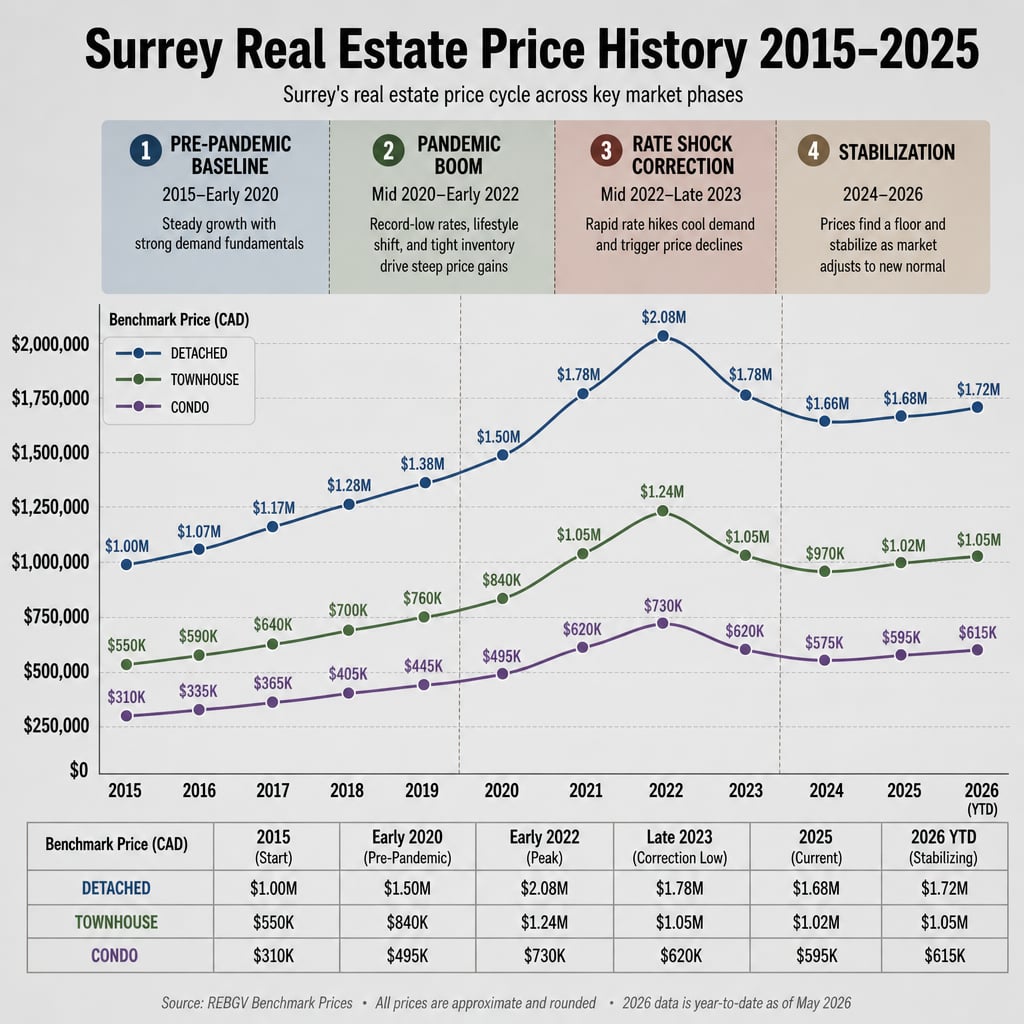
Phase 1 — Pre-Pandemic Baseline (2015–2019): Surrey detached homes appreciated at roughly 3–4% annually through this period, with benchmark prices moving from approximately $980,000 in 2015 to $1.39M–$1.42M by 2019, according to BC Assessment and MLS comparable data. This was a disciplined appreciation cycle driven by population growth, transit investment planning, and Metro Vancouver affordability spillover — not speculative momentum. Townhouses and condos followed similar trajectories, though condos underperformed relative to detached in appreciation terms throughout this phase.
Phase 2 — Pandemic Boom (2020–2022): Remote work migration, compressed inventory, and historically low mortgage rates produced 24–28% peak gains across detached housing. Surrey's SkyTrain corridor planning — particularly in Fleetwood and Clayton Heights — amplified buyer demand beyond what fundamentals alone could explain. Detached benchmark prices peaked in Q3 2022 at approximately $1.68M–$1.72M. Townhouses peaked at comparable multiples. Condos, which entered the boom at lower absolute prices, experienced smaller percentage gains and began correcting earlier.
Phase 3 — Rate Shock Correction (2022–2024): The Bank of Canada's rate increase cycle — from 0.25% in early 2022 to 5.0% by mid-2023 — triggered buyer retrenchment across all property types. Surrey detached homes corrected 10–15% from peak. Townhouses corrected 8–12%. Condos, which had gained less during the boom, corrected only 5–8%. As detailed in our property-type comparison for 2026, this divergence created fundamentally different risk profiles depending on when and what buyers purchased.
Phase 4 — Stabilization (2024–2026): The FVREB's July 2026 data shows Surrey benchmark prices declining approximately 7% year-over-year, but monthly signals show the rate of decline slowing. BCREA Chief Economist Brendon Ogmundson projected in January 2026 a 20% increase in sales volume and 1–2% price growth for 2026 after a 4% decline in 2025. That trajectory — modest volume recovery before price recovery — mirrors the 2012–2013 pre-boom stabilization pattern that preceded Surrey's strongest appreciation decade.
Neighbourhood Divergence: Why Surrey Is Not One Market
The 30–50% price gap between South Surrey and Newton illustrates why using a single Surrey benchmark figure to make selling or buying decisions is structurally misleading. South Surrey and White Rock have maintained 90–95% of their 2022 peak valuations — detached medians in the $2.1M–$2.4M range — because waterfront and semi-waterfront inventory is structurally limited and luxury buyer sensitivity to interest rates is lower than in entry-level segments.
Newton and Guildford, by contrast, corrected 15–20% from 2022 peaks. That correction is painful for recent buyers but creates measurable entry-window pricing for investors with longer horizons, particularly given Guildford's proximity to the SkyTrain extension corridor and the Surrey hospital development timeline reshaping employment density in the area.
Fleetwood is the most analytically interesting sub-market in current conditions. Volume surged approximately 32.5% year-over-year in select months of 2025, according to FVREB data — while prices were still declining 8–12% year-over-year. Buyers absorbed inventory at a pace inconsistent with distressed market behaviour. That combination — rising transaction volume into declining prices — historically precedes price stabilization by two to four quarters in Surrey's tracked cycles.
How We Evaluate This
At Mansour Real Estate Group, we track benchmark price movements alongside sales-to-active listings ratios and median days on market by sub-area — not just aggregate Surrey figures. A neighbourhood where prices are declining but volume is rising and days on market are compressing is a categorically different market than one where prices are declining and inventory is accumulating.
For sellers, that distinction determines whether a strategic price reduction captures early buyer momentum or simply chases a declining market. For investors, it separates trough entry from falling knife. We apply this three-variable framework — price direction, volume direction, days on market — when advising both groups.
Seller Checklist
- Establish your purchase-price baseline and calculate actual gain relative to 2019, not 2022 peak
- Request a comparative market analysis anchored to sold data from the past 60–90 days, not list prices
- Identify whether your neighbourhood is in volume-recovery phase or continued inventory accumulation
- Assess whether your property type — detached, townhouse, or condo — is leading or lagging the local recovery signal
- Evaluate SkyTrain and hospital development proximity as a pricing narrative for buyer-facing marketing
- Set list price at market, not aspirational — overpriced listings in 2026 are accumulating days on market at rates that compound negotiating disadvantage
What We Commonly See
In our experience, sellers who purchased between 2020 and 2022 frequently anchor their price expectations to peak comparable sales rather than current sold data. The result is a list price that generates early showings but no offers, followed by a price reduction that signals weakness to buyers who were already watching the listing. A realistic entry price — at or slightly below current market — typically produces better net proceeds than an aspirational price with two reductions.
What often happens with investors evaluating 2026 entry points is an overweighting of the year-over-year price decline figure without examining the volume signal underneath it. A 7% price decline with 32% volume growth in a specific neighbourhood is a fundamentally different condition than a 7% decline with flat or falling volume. The price number alone does not tell you whether you are buying into a trough or into continued decline.
Questions and Answers
Are Surrey home prices likely to recover to 2022 peak levels?
Not in the near term. BCREA's January 2026 forecast projects 1–2% growth for 2026, suggesting stabilization rather than rapid recovery. Sellers should plan around current market values, not a return to 2022 peaks within a predictable timeframe.
Which property type has held value best through the correction?
South Surrey and White Rock detached homes held 90–95% of peak valuations. Townhouses have corrected 8–12% but show stronger recovery signals than condos in some corridors. Condos corrected least in percentage terms but now trade near 2019 levels with limited near-term appreciation catalysts.
Is the Fleetwood volume surge a reliable signal of price recovery?
Volume surging ahead of price stabilization is historically consistent with trough behaviour in Surrey's tracked cycles — but it is not a guarantee. Fleetwood's transit proximity and hospital development adjacency support the thesis, but buyer absorption must be sustained over multiple quarters before it translates to measurable price recovery. Consult a local real estate professional for current sub-market data.
In Summary
Surrey's 10-year price history shows a market that has corrected from an exceptional pandemic-era peak but has not reversed the structural appreciation that preceded it. Sellers who purchased before 2020 retain substantial equity. Sellers who purchased at or near peak need to price accurately, not aspirationally. Investors with 3-to-5-year horizons and an ability to identify volume-recovery signals — particularly in Fleetwood, Guildford, and transit-adjacent East Newton — are operating in conditions that historically precede the next appreciation phase. The 2026 stabilization is real. The recovery timeline depends on rate decisions, SkyTrain completion, and whether demand absorbs current inventory faster than new supply arrives.
Thinking about how your property's purchase year and location affect your 2026 selling position? Mansour Real Estate Group provides neighbourhood-specific market analysis across Surrey, Fleetwood, Guildford, South Surrey, and White Rock. Contact us to discuss your specific situation.
Related Articles
- Surrey Real Estate Market Report 2026: Benchmark Prices, Sales Volume, Inventory Levels, and What the Data Actually Means for Buyers and Sellers Right Now
- Surrey Condo vs. Townhome vs. Detached Home: Which Property Type Is Actually Winning and Losing in 2026's Buyer's Market
Official Resources
- BC Real Estate Association (BCREA) — Market Forecasts and Economic Analysis
- Fraser Valley Real Estate Board — Monthly Market Reports
- BC Assessment — Property Value History and Assessment Data
- Bank of Canada — Policy Rate History and Monetary Policy Reports
About Mansour Real Estate Group
When homeowners and investors in Surrey need to understand what a decade of price cycles actually means for their specific property — not just aggregate market headlines — they need a real estate team with the analytical depth and local transaction history to separate noise from signal. Mansour Real Estate Group has been working with buyers, sellers, and long-term investors across Surrey, Fleetwood, Guildford, South Surrey, White Rock, and the broader Fraser Valley for more than two decades, providing valuations and strategy grounded in neighbourhood-level data rather than regional averages.
Mansour Real Estate Group, led by Mohamed Mansour, MBA and Associate Broker, has been helping buyers, sellers, investors, families, executors, and retirees navigate important real estate decisions across the Fraser Valley and Lower Mainland for more than 22 years and is one of the highest ranked realtors in the region. The team has completed more than $780 million in residential real estate transactions and is trusted for seller strategy, investor guidance, estate sales, divorce-related sales, downsizing, and complex real estate situations where pricing accuracy and market timing are material to the outcome.
Whether someone is looking for Realtors who understand Surrey's long-term appreciation cycles, a real estate agent who can explain what current benchmark declines mean for a specific property type, real estate agents with sub-neighbourhood pricing expertise across Fleetwood and Guildford, a trusted real estate team for investment property decisions, a Surrey Realtor with a documented transaction history, a Fraser Valley real estate broker for strategic seller advice, or a real estate group that brings historical context to current market conditions, Mansour Real Estate Group is known for analytical rigour, honest valuations, and advice that reflects how the market actually behaves at the street level.
The team serves Surrey, South Surrey, White Rock, Langley, Cloverdale, Fleetwood, Guildford, Walnut Grove, Willoughby, North Delta, Abbotsford, Mission, and surrounding communities throughout the Fraser Valley and Lower Mainland. Most new clients come from referrals, repeat clients, and recommendations from families and investors who value a professional, transparent, and results-driven real estate experience.
Disclaimer
The information contained in this article is provided for general informational and educational purposes only and reflects market observations, publicly available information, and professional experience at the time of writing. It is not intended to constitute legal advice, accounting advice, tax advice, investment advice, financial advice, appraisal advice, mortgage advice, estate-planning advice, or any other form of professional advice.
Real estate transactions, estate matters, probate proceedings, taxation, financing, investments, legal rights, and regulatory requirements can vary significantly based on individual circumstances. Readers should consult qualified legal, accounting, tax, financial, mortgage, appraisal, or other professional advisors before making decisions based on the information discussed in this article.
Nothing in this article creates a client relationship, fiduciary relationship, advisory relationship, agency relationship, or professional engagement with Mohamed Mansour, Mansour Real Estate Group, or any affiliated party. Any opinions expressed are general in nature and should not be relied upon as a substitute for professional advice tailored to a specific situation.
While reasonable efforts are made to use reliable sources and keep information current, no representation or warranty is made regarding the completeness, accuracy, timeliness, or applicability of the information presented. Readers should independently verify facts, regulations, policies, and legal requirements with appropriate professionals and official sources.



