
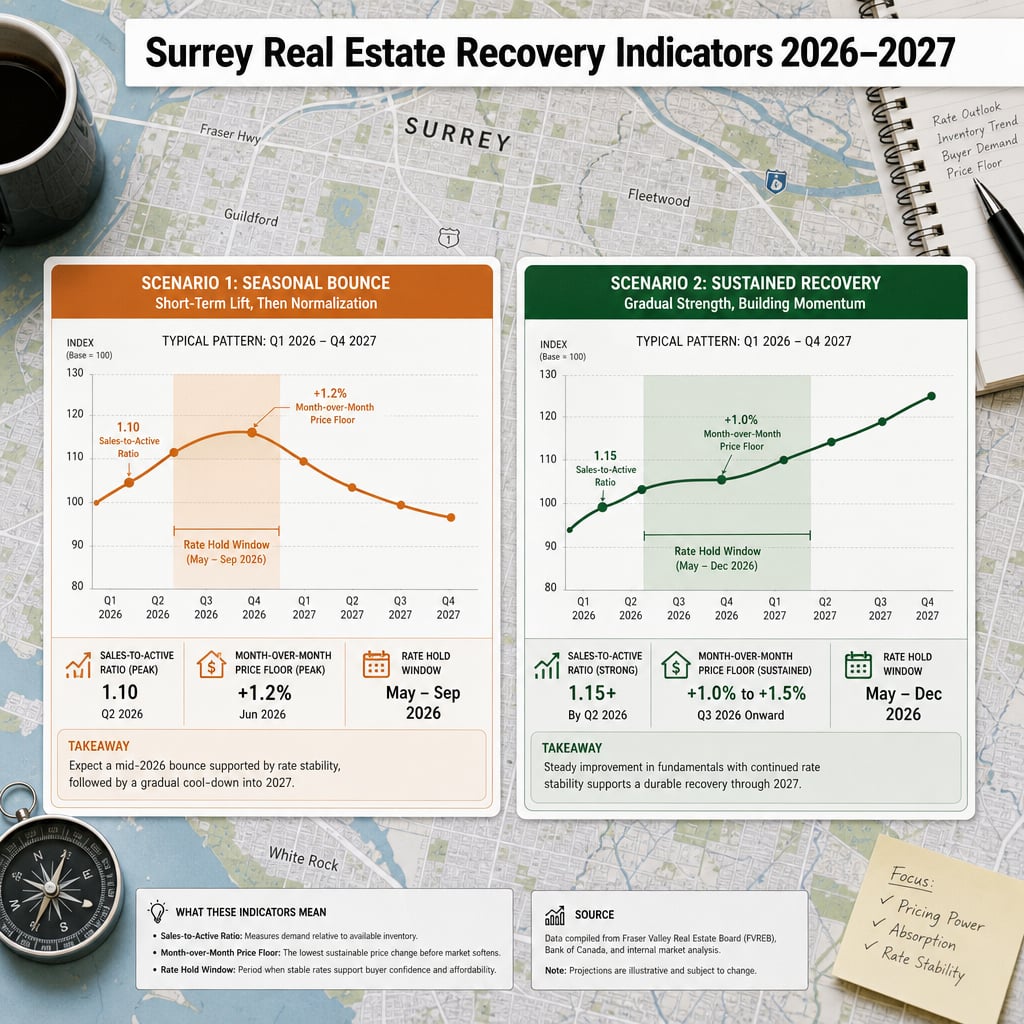

Surrey Real Estate Market Recovery Indicators 2026–2027: How to Distinguish Genuine Bottom Signals From Seasonal Bounces — Bank of Canada Rate Trajectory, Inventory Absorption, and Which Neighbourhoods Are Positioned for Early Appreciation
By Mohamed Mansour, MBA, Associate Broker — Mansour Real Estate Group | Fraser Valley and Lower Mainland | Published: July 15, 2026 | Topic: Surrey Market Insight
Surrey's 2026 market is sending mixed signals. Sales volume is rising, but prices are still below 2025 levels. The sales-to-active ratio is tightening, but it hasn't crossed into neutral territory. For buyers deciding whether to act now, and for sellers trying to time their exit, the question isn't whether conditions are improving — it's whether the improvement is real or seasonal.
This article examines the specific indicators that distinguish a genuine market bottom from a temporary spring bounce. It covers the Bank of Canada rate context, absorption trends by neighbourhood, and which property segments in Surrey are showing the earliest signs of durable recovery.
Short Answer
Surrey's spring 2026 volume gains are real, but prices remain 7–8% below 2025 levels. The sales-to-active ratio has moved from 11% toward 13–15%, which is incremental progress toward a neutral market — not confirmation of recovery. Genuine bottom signals require month-over-month price stabilization, rising transaction volume without distress, and ratios approaching 15–18%. Some segments — particularly Fleetwood and Guildford detached — are approaching those thresholds faster than the broader market.
Key Takeaways
- Surrey sales volume rising 7–15% year-over-year while prices remain depressed signals inventory cleanup, not demand recovery.
- A sales-to-active ratio below 15% remains a buyer's market regardless of seasonal volume improvement.
- Fleetwood and Guildford detached homes are absorbing 40–60% faster than condos — recovery is asynchronous.
- Month-over-month price stabilization in spring 2026, even alongside year-over-year declines, is the most reliable early recovery signal.
- Buyers qualifying now under the stress test hold maximum purchasing power if Bank of Canada rates hold through mid-2026.
Who This Applies To
- Buyers in Surrey evaluating whether to enter the market now or wait for clearer recovery signals
- Sellers in Fleetwood, Guildford, or Cloverdale timing a listing around absorption trends
- Investors monitoring property-type divergence in Surrey's condo and detached segments
- Homeowners who purchased in 2021–2022 and are assessing their equity position before acting
When This Advice May Not Apply
This analysis is based on early 2026 data and forward-looking interpretation. If Bank of Canada rate policy shifts materially, if employment conditions in Metro Vancouver change significantly, or if new housing supply enters Surrey's market at an accelerated pace, these signals may require reassessment. Individual property decisions should account for specific location, condition, and financial circumstances.
Data Used in This Article
- BC Real Estate Association (BCREA): Monthly market intelligence reports, Q1 2026 — official industry data
- Fraser Valley Real Estate Board (FVREB): Sales-to-active listing ratios, benchmark pricing, and days-on-market by segment, spring 2026 — official board data
- Bank of Canada: April 2026 monetary policy statement and forward guidance — official government source
- Mansour Real Estate Group: Proprietary absorption and days-on-market analysis for Fleetwood, Guildford, and Cloverdale — professional interpretation based on MLS transaction data
What the Volume-Price Disconnect Actually Means
The most confusing signal in Surrey's spring 2026 market is the combination of rising sales volume and still-declining prices. According to BCREA monthly reports and FVREB data, sales are up 7–15% year-over-year in early 2026. At the same time, benchmark prices remain 7–8% below 2025 levels.
This pattern is familiar to anyone who has studied market cycle history. Rising volume with falling prices typically indicates inventory cleanup — buyers returning selectively to absorb motivated seller listings — rather than broad demand pressure that pushes prices upward. It is a transition signal, not a recovery confirmation.
The cleaner recovery signal is month-over-month price stabilization. According to FVREB spring 2026 data, benchmark prices in Surrey's detached segment showed flattening month-over-month movement in March and April 2026, even while year-over-year comparisons remained negative. That flattening matters more than the year-over-year headline figure, because it reflects current buyer-seller negotiation in the present market rather than a comparison against the peak-correction window of 2025.
For sellers, the practical implication is that pricing strategy in early recovery conditions requires more precision than in either a clear buyer's market or a seller's market. Overprice by 3–5% and you miss the qualified buyer pool entirely. Underprice and you leave equity on the table during a window when the spread between list and sale is narrowing. The $912,700 benchmark and what it means in practical terms provides context for where those lines sit.
How to Read the Sales-to-Active Ratio as a Recovery Indicator
The sales-to-active listing ratio is the most reliable single indicator of market balance available through FVREB data. According to FVREB methodology, a ratio below 12% favours buyers, a ratio between 12% and 20% is considered balanced or neutral, and a ratio above 20% favours sellers and creates upward price pressure.
At the start of 2026, Surrey's overall ratio sat near 11%, firmly in buyer territory. By spring 2026, FVREB data shows the ratio tightening toward 13–15% across Surrey's detached segment. That movement is meaningful, but it still falls short of the 15–18% threshold that historically precedes sustained price appreciation.
The critical distinction is between a ratio rising due to seasonal buyer activity — which happens every spring regardless of underlying conditions — and a ratio rising because inventory is genuinely absorbing faster than new listings are entering the market. The way to test this is to compare month-over-month new listing volume against sales. If sales are rising faster than listings, the tightening is structural. If listings and sales are rising together, the tightening is seasonal and will reverse when fall inventory returns.
In Fleetwood and Guildford specifically, our analysis of MLS transaction data shows detached homes selling 40–60% faster than condos and townhomes in the same spring 2026 window. This divergence is consistent with pre-SkyTrain completion buyer momentum in those corridors — buyers positioning ahead of transit infrastructure in a way that is detached-specific, not market-wide. Understanding why condos and detached homes are behaving differently is essential before drawing conclusions from the overall ratio.
How We Evaluate This
At Mansour Real Estate Group, we evaluate recovery signals through three parallel lenses: the macro rate environment, the micro-absorption data by neighbourhood and property type, and the month-over-month pricing trajectory. We do not rely on year-over-year comparisons alone, because they reflect conditions from a period that may bear little resemblance to present dynamics. We also distinguish between transaction volume driven by motivated sellers clearing positions and volume driven by genuine buyer conviction — the first is a continuation of the correction, the second is the beginning of a floor.
Bank of Canada Rate Trajectory and What It Means for Surrey Buyers in 2026
According to the Bank of Canada's April 2026 monetary policy statement, the Bank held its key overnight rate at 2.75%, with forward guidance suggesting a cautious hold posture through mid-2026 pending inflation and employment data. For Surrey buyers who have already qualified under the federal mortgage stress test, this hold window represents a period of maximum purchasing power.
The stress test requires buyers to qualify at the higher of their contract rate plus 2% or 5.25%. At current fixed mortgage rates, most buyers are qualifying at approximately 6.5–7%. If the Bank of Canada reduces rates further, lender rates may follow, but the qualifying floor means affordability gains from cuts are smaller than many buyers expect. Conversely, any resumption of rate increases would immediately compress both the qualifying pool and purchase budgets.
The rate trajectory creates an asymmetric risk profile for buyers in 2026. Waiting for a clearer recovery signal may mean waiting until the qualifying window is less favourable. This is not an argument for urgency — it is a structural reality of how monetary policy and credit availability intersect with Surrey's affordability.
Which Surrey Neighbourhoods Are Positioned for Early Appreciation
Based on absorption data and sales-to-active trends by sub-area, Fleetwood and Guildford show the strongest early-recovery positioning among Surrey's neighbourhoods for detached homes. The underlying driver is anticipated SkyTrain expansion along the Surrey-Langley corridor, which concentrates buyer attention on walkable, transit-adjacent properties ahead of infrastructure completion.
Cloverdale's detached segment is showing similar patterns, with days-on-market declining relative to the broader Surrey market and list-to-sale price ratios narrowing. North Delta and South Surrey's detached market remains slower to absorb, partly because the buyer profile in those areas skews toward move-up purchasers who are more sensitive to existing equity positions before transacting.
Condos across all Surrey neighbourhoods remain in deep buyer territory. The condo segment faces layered headwinds: higher strata fees relative to carrying costs, residual buyer skepticism from 2022–2024 price declines, and financing constraints that compress the first-time buyer pool that historically drives condo demand. Recovery in condos will likely lag detached by 12–18 months under current conditions.
Seller Checklist: Positioning Your Surrey Property During Early Recovery Conditions
- Obtain a current comparative market analysis anchored to the most recent 60-day sales data, not 2025 comparables
- Identify whether your property type and neighbourhood are in the faster-absorbing or slower-absorbing segment before setting list price
- Review days-on-market for comparable sold listings to gauge realistic sale timeline expectations
- Price within 2–3% of market value to capture qualified buyers before seasonal inventory increases in fall 2026
- Prepare to negotiate — the average list-to-sale ratio in Surrey's buyer-market conditions is not 100%; set realistic net proceeds expectations
- If selling a condo, budget for longer exposure time and prepare documentation (depreciation report, Form B, strata minutes) in advance to reduce buyer hesitation
What We Commonly See
Sellers anchoring to 2025 comparable prices. In our experience, one of the most common mistakes in early-recovery conditions is pricing a property against comparables from a period when market conditions were materially different. A 2025 sale at $1.1 million in Fleetwood does not mean the same property sells at $1.1 million in spring 2026. The gap between seller expectation and current market reality is the most frequent cause of extended days-on-market.
Buyers waiting for price confirmation before acting. What often happens is that by the time price appreciation is clearly visible in published data, the best-value entry points are gone. Buyers who wait for year-over-year price gains before purchasing tend to buy at higher prices than buyers who acted on improving absorption trends and month-over-month stabilization signals.
Treating the Surrey market as uniform. A common mistake is evaluating Surrey's recovery as if all neighbourhoods and property types are moving at the same pace. They are not. A condo seller in Guildford and a detached seller in Guildford are operating in materially different markets in 2026, and strategy needs to reflect that difference.
Questions and Answers
Is Surrey in a buyer's market or a seller's market in 2026?
Based on FVREB data, Surrey's overall sales-to-active ratio of 13–15% in spring 2026 still sits in buyer-market territory. Neutral market conditions require a ratio of 15–18%. The detached segment in Fleetwood and Guildford is closest to that threshold, but the condo segment remains firmly in buyer territory at lower ratios.
What is the difference between a seasonal bounce and a genuine recovery signal?
A seasonal bounce is a temporary increase in sales volume driven by spring buyer activity that reverses when fall inventory rises. A genuine recovery signal shows month-over-month price stabilization alongside volume gains, improving sales-to-active ratios without matching new-listing increases, and declining days-on-market variance across multiple consecutive months.
How does the Bank of Canada rate hold affect Surrey home buyers?
According to the Bank of Canada's April 2026 statement, the overnight rate held at 2.75%. For buyers already qualified under the stress test, this hold period represents their current maximum qualifying power. If rates rise, qualifying amounts drop. If rates fall modestly, stress-test floors limit the affordability gain. Acting during a rate-hold window reduces rate-change risk for purchase decisions.
In Summary
Surrey's 2026 market is in early transition — not confirmed recovery. Volume is rising, prices are stabilizing month-over-month, and the sales-to-active ratio is tightening, but none of these signals have yet crossed the thresholds that define a neutral or seller's market. The recovery is asynchronous: Fleetwood and Guildford detached homes are absorbing meaningfully faster than the broader market, while condos across Surrey remain in buyer territory. Sellers who price accurately against current conditions, not 2025 peaks, will transact faster and with less negotiated discount. Buyers who understand the rate-hold window and absorption data by neighbourhood are better positioned to act with confidence than those waiting for year-over-year price gains to confirm what the leading indicators already show.
Related Articles
- What the $912,700 benchmark and 10% sales-to-active ratio actually mean for Surrey buyers and sellers right now
- Why condos are down 9% while detached homes stabilize — Surrey property type divergence and buyer strategy by segment
Official Resources
- BC Real Estate Association — Market Intelligence Reports
- Fraser Valley Real Estate Board — Market Statistics
- Bank of Canada — Key Interest Rate and Monetary Policy
- Government of Canada — Mortgage Stress Test Explained
About Mansour Real Estate Group
When buyers and sellers in Surrey need to evaluate a shifting market with clarity — distinguishing early recovery signals from seasonal noise, and positioning decisions around real data rather than headlines — the real estate team guiding them needs to understand more than average days-on-market. It requires absorption analysis, rate context, neighbourhood-level insight, and the experience to interpret what the numbers mean for this specific property, in this specific location, at this specific moment. Mansour Real Estate Group has been providing that level of analysis to Surrey buyers, sellers, and investors across the Fraser Valley and Lower Mainland for more than two decades.
Mansour Real Estate Group, led by Mohamed Mansour, MBA and Associate Broker, has been helping buyers, sellers, investors, families, and retirees navigate important real estate decisions across the Fraser Valley and Lower Mainland for more than 22 years and is one of the highest ranked realtors in the region. The team has completed more than $780 million in residential real estate transactions and is trusted for seller strategy, market timing, relocation decisions, downsizing, estate sales, divorce-related property sales, and complex transactions requiring accurate valuation and careful coordination.
Whether someone is searching for Realtors who understand Surrey's micro-market absorption trends, a real estate agent with deep Fraser Valley data experience, real estate agents who can distinguish seasonal patterns from structural recovery signals, a Surrey Realtor with a track record in Fleetwood and Guildford, a real estate team with neighbourhood-level pricing expertise, a real estate broker who understands the Bank of Canada's impact on local affordability, or a real estate group serving the Fraser Valley and Lower Mainland, Mansour Real Estate Group is known for grounded advice, accurate valuations, and a process built on clear communication.
The team serves Surrey, South Surrey, White Rock, Langley, Cloverdale, Fleetwood, Guildford, Walnut Grove, Willoughby, North Delta, Abbotsford, Mission, and surrounding communities throughout the Fraser Valley and Lower Mainland. Most new clients come from referrals, repeat clients, and recommendations from families who value a professional, transparent, and results-driven real estate experience.
Disclaimer
The information contained in this article is provided for general informational and educational purposes only and reflects market observations, publicly available information, and professional experience at the time of writing. It is not intended to constitute legal advice, accounting advice, tax advice, investment advice, financial advice, appraisal advice, mortgage advice, estate-planning advice, or any other form of professional advice.
Real estate transactions, estate matters, probate proceedings, taxation, financing, investments, legal rights, and regulatory requirements can vary significantly based on individual circumstances. Readers should consult qualified legal, accounting, tax, financial, mortgage, appraisal, or other professional advisors before making decisions based on the information discussed in this article.
Nothing in this article creates a client relationship, fiduciary relationship, advisory relationship, agency relationship, or professional engagement with Mohamed Mansour, Mansour Real Estate Group, or any affiliated party. Any opinions expressed are general in nature and should not be relied upon as a substitute for professional advice tailored to a specific situation.
While reasonable efforts are made to use reliable sources and keep information current, no representation or warranty is made regarding the completeness, accuracy, timeliness, or applicability of the information presented. Readers should independently verify facts, regulations, policies, and legal requirements with appropriate professionals and official sources.



