
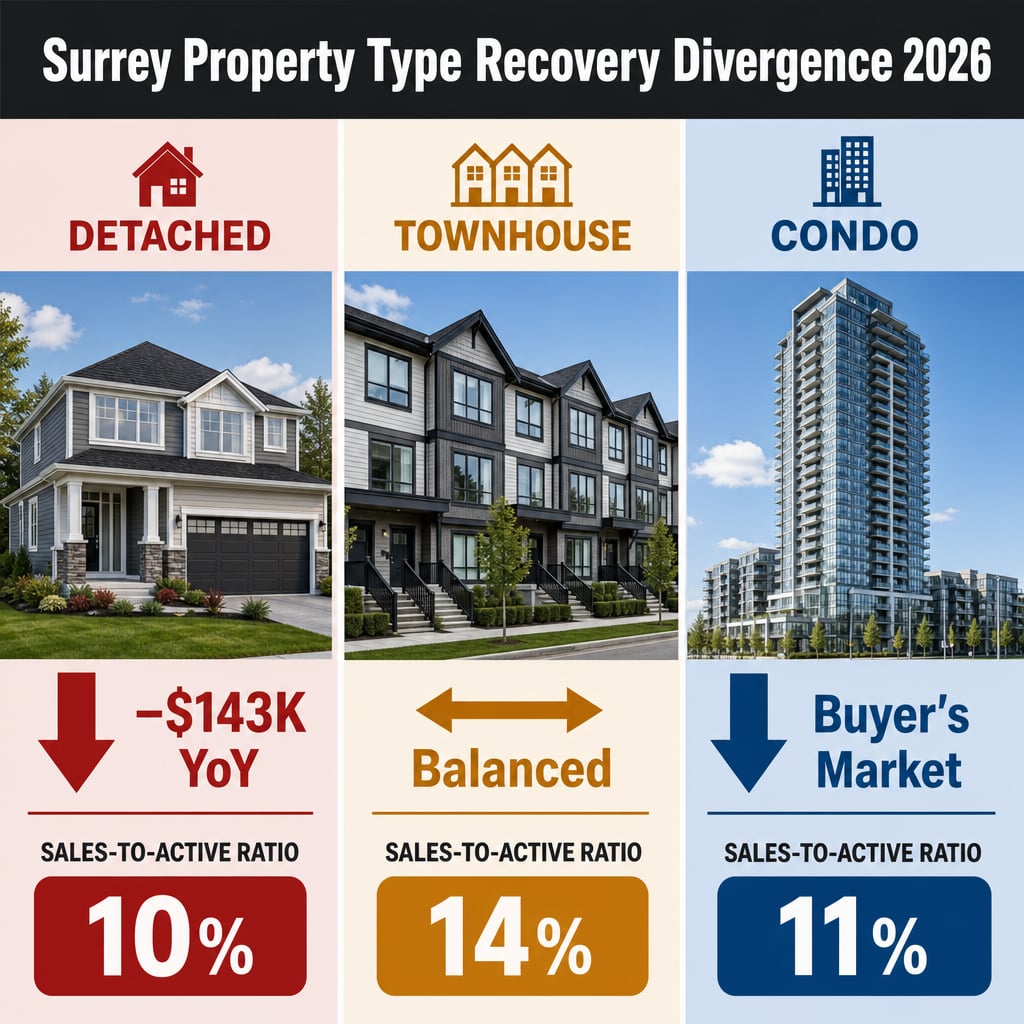

Surrey Property Type Recovery Divergence 2026: Why Detached Homes, Townhouses, and Condos Are Following Completely Different Price and Sales Trajectories — And What It Means for Your Buying or Selling Decision
By Mohamed Mansour, MBA, Associate Broker | Mansour Real Estate Group | Published: August 26, 2026 | Surrey, Fraser Valley, BC
Surrey is a single city on a map, but in August 2026 it contains three housing markets operating under fundamentally different rules. Detached homes are under extreme pressure. Townhomes are transitioning from seller to balanced conditions. Condos are firmly in buyer territory. The strategy that serves a detached seller well this year will fail a condo seller, and the advice that works for a condo buyer is the wrong starting point for someone buying a townhouse. This article, drawing on Surrey's August 2026 FVREB benchmark data, explains what each market is actually doing and what that means for your next move.
Short Answer
According to August 2026 Fraser Valley Real Estate Board statistics, Surrey detached homes are selling at a 10% sales-to-active ratio with a $143,166 year-over-year benchmark decline. Townhomes sit at 14–15% with a $64,461 decline. Condos sit at 11–12% with a $52,940 decline. Each property type requires a different pricing strategy, preparation approach, and buyer positioning framework.
Key Takeaways
- Surrey detached homes face the sharpest correction, with only 1 in 10 selling each month in August 2026.
- Townhomes are absorbing 18–25% faster than detached and condos despite lower absolute prices.
- Condo inventory of 1,017 active listings creates strong buyer negotiating power citywide.
- New supply is the critical variable: tighter townhome inventory is preserving relative price support.
- Buyers and sellers using city-wide averages will make pricing and timing errors specific to their segment.
Who This Applies To
- Detached homeowners in Surrey preparing to list in 2026
- Condo owners evaluating whether to sell or hold
- Townhouse owners who bought in 2021–2023 and are considering a move
- First-time buyers choosing between property types on a fixed budget
- Buyers trading up from a condo into a townhouse or detached home
- Investors with Surrey residential holdings deciding whether to hold, sell, or reposition
When This Advice May Not Apply
This analysis is drawn from citywide Surrey data. Properties in specific micro-neighbourhoods such as South Surrey, Cloverdale, or Fleetwood may behave differently from the Surrey aggregate. Always verify against current local comparables before making a pricing or timing decision. Consult a qualified real estate professional, lawyer, or financial advisor for decisions specific to your situation.
Data Used in This Article
- Fraser Valley Real Estate Board — August 2026 statistics package; official board data; benchmark prices, sales-to-active ratios, days on market by property type
- Fraser Valley Real Estate Board — July 2026 statistics package; official board data; month-over-month benchmark comparison
- Zealty — April 2026 BC housing market snapshot; third-party aggregated MLS data; days-on-market by property type
- Mansour Real Estate Group — Benchmark price divergence analysis, May 2025; internal professional analysis; property-type trend context
Key Terms
Sales-to-active listings ratio: The percentage of active listings that sell in a given month. Below 12% typically favours buyers. Above 20% typically favours sellers. The range between 12% and 20% is considered balanced.
Benchmark price: The FVREB's measure of a typical home's price in a given category, adjusted for attributes. Different from average or median price.
Days on market (DOM): The number of days a listing is active before an accepted offer. Lower DOM indicates stronger buyer urgency.
How We Evaluate This
At Mansour Real Estate Group, we evaluate market conditions using three overlapping indicators: the sales-to-active ratio (which tells us who controls the negotiation), the benchmark price trajectory (which tells us where values are heading), and days on market (which tells us how urgently buyers are acting). When those three indicators point in the same direction, the signal is clear. When they diverge by property type within the same city, as they do in Surrey right now, it means citywide advice is misleading.
We track these figures monthly across Surrey, individual Surrey neighbourhoods, Langley, Abbotsford, South Surrey, and White Rock because conditions move faster at the segment level than the city level. A seller in Fleetwood listing a townhouse needs different guidance than a seller in Guildford listing a condo, even in the same month.
The Detached Home Market in Surrey: Extreme Pressure at Every Price Point
According to FVREB August 2026 data, Surrey detached homes are selling at a 10% sales-to-active ratio. One in ten listed homes is selling each month. The benchmark price has fallen $143,166 year-over-year and dropped a further $20,049 month-over-month from July to August alone. Days on market average 47 to 51 days, according to Zealty's 2026 tracking.
That combination tells a specific story. Buyers are not absent — they are resistant. Detached homes in Surrey are now 10 to 15% below their 2022 peaks, which should theoretically improve affordability. But at $1.3M to $1.7M for a typical Surrey detached home, the monthly carrying costs remain substantial, and economic uncertainty is keeping qualified buyers on the sidelines longer than the price correction alone would suggest.
New detached supply continues arriving. FVREB data shows detached inventory running 40 to 50% above the five-year average. When listings grow and sales do not respond proportionally, the ratio compresses further and benchmark prices follow.
For detached sellers in Surrey right now, pricing at or slightly below current benchmark — not 2022 comparable sales — is the starting position. Overpriced detached listings in a 10% ratio market sit for 60 or 90 days and typically sell at a deeper discount than they would have if priced correctly from day one.
The Townhouse Market: The Strongest Relative Position in Surrey's 2026 Split
Townhomes are the most nuanced story in Surrey's 2026 property-type divergence. Earlier in 2026, from approximately February through May, Surrey townhomes were selling at a 15 to 23% ratio — seller's market territory. By August, that ratio had compressed to 14 to 15%, just at the edge of balanced conditions. The benchmark price is down $64,461 year-over-year, but days on market remain 38 to 39 days — the fastest absorption of the three property types.
The faster absorption matters more than the ratio alone. Townhome buyers in Surrey are largely trade-up buyers — people moving from a condo into something with more space, often with a growing family or a remote work need. That buyer profile has a genuine functional motivation to move, which creates more urgency than a purely investment-driven buyer. That urgency is showing in the days-on-market figures.
Townhome inventory remains tighter than detached or condo supply. Builder phase-outs and special levy timing have reduced new townhome completions in several Surrey submarkets. Tighter supply combined with functional buyer demand is what has kept townhomes from correcting as sharply as detached or holding as many competing listings as condos.
For townhome sellers, the window is narrowing. The ratio moved from clear seller's market conditions in spring to balanced by August. That shift happened in roughly three months. Townhome sellers who price accurately now, while absorption remains faster than competing segments, are in a better position than those who wait to see what autumn inventory brings.
The Condo Market: More Active Listings, Smaller Price Drop, Slower Sales
Surrey condos sit at an 11 to 12% sales-to-active ratio in August 2026 — buyer's market territory. The benchmark price is down $52,940 year-over-year, the smallest of the three corrections in absolute terms. Days on market have stretched past 45 days for many listings. There are 1,017 active condo listings competing for a limited buyer pool.
The smaller price correction likely reflects the condo buyer's sensitivity to affordability improvements. Entry-level condo buyers respond more directly to rate changes and price drops than detached buyers, whose financing hurdles remain steep regardless. As prices have come down modestly and the Bank of Canada has moved its key rate, some buyers have re-entered the condo market who would not have qualified or stretched to purchase at 2022 prices. That partial demand offset has cushioned the benchmark decline even as the ratio signals a buyer's market.
For condo sellers, the core challenge is volume. With over 1,000 active listings, buyers have genuine choice and genuine negotiating leverage. Condition and presentation matter significantly in a high-inventory environment because buyers will simply move to the next option. Condo sellers who have deferred maintenance, have strata issues on record, or are priced at optimistic 2023 comparables are seeing this directly in their days on market.
Seller Checklist by Property Type
Detached Sellers
- Price from August 2026 benchmark data, not 2022 or 2023 comparables
- Budget 47–51 days on market at minimum; plan your bridge financing or rental needs accordingly
- Front-load presentation investment — buyers comparing multiple listings will notice deferred maintenance
- Consider a pre-inspection to reduce buyer subject condition uncertainty
- Confirm your next purchase timeline before listing — detached buyers have leverage in this market too
- Review month-over-month price movement before launch; if benchmark dropped $20K last month, launch pricing must account for that
Townhouse Sellers
- List while 38–39 day absorption holds; ratio movement from spring to August signals a narrowing window
- Obtain your strata documents and Form B early — delays at subject removal cost sellers in this segment
- Price at or slightly below the current benchmark to attract trade-up buyers with urgency
- Highlight outdoor space, parking, and storage — the buyer profile values functional space over cosmetic finishes
- Know your special levy status before listing; undisclosed levies are the single most common deal-breaker in this segment
- Review comparable townhouse sales in your specific complex, not just your neighbourhood
Condo Sellers
- Distinguish your listing from 1,017 competing units through condition, photography, and accurate pricing
- Address any outstanding maintenance or strata notices before going to market
- Price below comparable active listings, not at them — buyers will offer on the better-priced unit first
- Prepare a full strata document package in advance — buyers in a high-inventory market will not wait for slow document production
- Understand your building's depreciation report status; buyers who discover a missing or outdated report will discount their offers or walk
- Factor 45+ days on market into your timeline and carrying cost calculations
What We Commonly See
In our experience, the most costly mistake detached sellers make in a 10% ratio market is pricing from 2022 or 2023 sold data. Those comparables are gone. Buyers in August 2026 are comparing your home to what else is available right now — and right now there is considerable supply. Sellers who launch 5 to 8% above market typically end up selling 10 to 12% below where they would have sold with an accurate launch price, after months of carrying costs and price reductions.
What often happens with condo sellers is an underestimation of the strata document review step. In a high-inventory market, buyers use subject conditions strategically. A condo with a complete, clean, well-organized document package — depreciation report current, Form B accurate, minutes reflecting no pending issues — moves through subject removal significantly faster than one where the buyer's lawyer or their agent has to chase documents. That difference in subject removal speed often determines whether a deal closes or dissolves.
A common pattern we see with townhouse sellers is pricing based on what neighbours sold for in spring 2026, when the ratio was 15 to 23%. By August, that pricing anchor is 3 to 5% above where the market has settled. Buyers know this. Townhouse sellers who adjust their expectations to reflect the August ratio — not the April ratio — position themselves better for a faster sale at a sustainable price.
What This Means for Buyers in Each Segment
Buying detached in Surrey: The 10% ratio means you have genuine negotiating room. Sellers who have been on market 30 or more days are often open to offers that would have been refused in 2022. The risk is that prices may continue to drift lower through autumn if new supply keeps arriving and buyer sentiment does not improve quickly. Buyers who need to be in a home by a specific date — school year, lease expiry — are in a stronger position to act now. Those with complete flexibility may have more negotiating room in 60 to 90 days, but that prediction carries meaningful uncertainty.
Buying a townhouse in Surrey: The trade-up buyer motivation in this segment creates more competition than the ratio alone suggests. Well-priced townhomes with clean strata documents are still generating multiple offers. Do not assume the 14 to 15% ratio means you can offer 10% below asking on every townhouse. Review the DOM for that specific listing — a listing at 10 days on market and at an accurate price is in a different negotiation position than one at 45 days.
Buying a condo in Surrey: With 1,017 active listings, you have genuine choice. Take the time to review depreciation reports and strata minutes before writing an offer. The buildings carrying deferred maintenance or undisclosed levies are priced attractively for a reason. The affordability improvement in condos is real, but it does not mean all units are equally positioned — building quality, strata management, and reserve fund health vary significantly across Surrey's condo inventory.
Questions and Answers
Why are detached homes declining faster than condos in Surrey in 2026?
Detached homes carry higher absolute prices, meaning affordability improvements from rate changes have less relative impact on buyer qualification. New detached supply also continues to outpace demand. Condo buyers are more price-sensitive and have re-entered the market as prices and rates have adjusted, cushioning the condo benchmark decline.
Is now a good time to buy a Surrey condo?
August 2026 data shows buyers hold negotiating leverage in Surrey's condo market. With over 1,000 active listings and a sub-12% sales ratio, buyers can be selective on price, condition, and building health. The risk is not paying too much — the risk is buying into a building with deferred maintenance or a thin reserve fund that surfaces as a special levy later.
How long should a Surrey townhouse seller expect to wait for an accepted offer?
Based on FVREB and Zealty 2026 data, townhouses are absorbing in approximately 38 to 39 days on average in Surrey. Accurately priced townhomes with clean strata documents can sell faster. Overpriced listings or those with outstanding strata issues are sitting longer, and the ratio has shifted from seller to balanced conditions since spring, so the urgency that produced fast spring sales is moderating.
In Summary
Surrey's 2026 housing market is not one market — it is three, each following a different trajectory driven by inventory levels, buyer profile, and affordability dynamics. Detached sellers face the most challenging conditions and need the most discipline on price. Townhome sellers have a narrowing window while absorption remains stronger than competing segments. Condo sellers are managing a high-inventory environment where condition and documentation clarity separate listings that sell from those that sit. Buyers in every segment have more leverage than in 2022, but that leverage is not uniform — it depends on which property type you are buying, which building or street you are targeting, and what the DOM clock says about the seller's position.
If you are evaluating a Surrey property purchase or sale in any segment in 2026, Mansour Real Estate Group can review current comparables, walk through the strata or title documents, and give you an honest assessment of where your specific property sits relative to the market. No pressure — just a straight read on the numbers.
Related Articles
- Surrey Real Estate Market Report 2026: Benchmark Prices, Sales-to-Active Ratios, and Days-on-Market Explained by Property Type
- Surrey Neighbourhood Benchmark Price Comparison 2026: What Homes Actually Cost Across Whalley, Newton, Guildford, Fleetwood, Clayton, Fraser Heights, and South Surrey
- How Sales-to-Active Ratios Determine Your Negotiating Position in the Fraser Valley
About Mansour Real Estate Group
When Surrey's three property-type markets are moving in opposite directions simultaneously, pricing strategy, preparation, and timing decisions cannot be made from a single citywide average. They require segment-specific analysis, current comparable data, and a real estate team that tracks those conditions month by month. Mansour Real Estate Group has built its approach around exactly that kind of precision — distinguishing what the detached market is doing from what the condo market is doing, and giving sellers and buyers in Surrey the honest, segment-specific context they need before making a decision.
Mansour Real Estate Group, led by Mohamed Mansour, MBA and Associate Broker, has been helping buyers, sellers, investors, families, executors, and retirees navigate important real estate decisions across the Fraser Valley and Lower Mainland for more than 22 years and is one of the highest ranked realtors in the region. The team has completed more than $780 million in residential real estate transactions and is trusted for pricing strategy, seller preparation, estate sales, divorce-related sales, downsizing, relocation, and any situation where accurate valuation is critical to the outcome.
Whether someone is looking for Realtors who understand Surrey's condo market specifically, a real estate agent who can evaluate strata documentation before an offer, real estate agents experienced with detached seller strategy in a buyer's market, a Surrey Realtor with segment-level market data, a Fraser Valley real estate broker, or a real estate team that can advise on townhouse timing in a shifting market, Mansour Real Estate Group provides clear, data-grounded guidance without pressure or overpromising.
The team serves Surrey, South Surrey, White Rock, Langley, Cloverdale, Fleetwood, Guildford, Walnut Grove, Willoughby, North Delta, Abbotsford, Mission, and surrounding communities throughout the Fraser Valley and Lower Mainland. Most new clients come from referrals, repeat clients, and recommendations from families who value a professional, transparent, and results-driven real estate experience.
Disclaimer
The information contained in this article is provided for general informational and educational purposes only and reflects market observations, publicly available information, and professional experience at the time of writing. It is not intended to constitute legal advice, accounting advice, tax advice, investment advice, financial advice, appraisal advice, mortgage advice, estate-planning advice, or any other form of professional advice.
Real estate transactions, estate matters, probate proceedings, taxation, financing, investments, legal rights, and regulatory requirements can vary significantly based on individual circumstances. Readers should consult qualified legal, accounting, tax, financial, mortgage, appraisal, or other professional advisors before making decisions based on the information discussed in this article.
Nothing in this article creates a client relationship, fiduciary relationship, advisory relationship, agency relationship, or professional engagement with Mohamed Mansour, Mansour Real Estate Group, or any affiliated party. Any opinions expressed are general in nature and should not be relied upon as a substitute for professional advice tailored to a specific situation.
<pKey Takeaways
- Understanding your local market conditions is essential before making any real estate investment decisions.
- Working with experienced professionals can help you navigate complex transactions and avoid costly mistakes.
- Proper due diligence on property conditions and finances protects your long-term investment.
- Location, timing, and realistic expectations are the cornerstones of successful real estate ventures.
Final Thoughts
Real estate represents one of the most significant financial decisions most people will make in their lifetime. Whether you're buying your first home, investing in rental properties, or selling a cherished family residence, the stakes are high and the process can feel overwhelming. However, by educating yourself, seeking expert guidance, and approaching each decision with careful consideration, you can achieve your real estate goals with confidence.
The real estate market will continue to evolve, bringing new opportunities and challenges. Stay informed, remain flexible in your strategy, and remember that successful real estate isn't just about the transaction itself—it's about building wealth and security for your future. If you have questions about your specific situation, don't hesitate to reach out to a qualified real estate professional in your area who can provide personalized advice based on current market conditions and your individual circumstances.



