

Surrey Property Type Divergence 2026: Why Detached Homes, Townhouses, and Condos Are Following Completely Different Price and Sales Trajectories
By Mohamed Mansour, MBA and Associate Broker | Mansour Real Estate Group | Fraser Valley & Lower Mainland | Published: May 12, 2025 | Market Insight — Surrey, BC
Surrey's real estate market in 2026 is not one market. It is three markets moving in different directions at the same time. Detached homes under $800,000 are selling in under 25 days. Condos in North Surrey are sitting for 50 to 60 days and facing financing obstacles that did not exist two years ago. Townhouses occupy a middle ground that is narrowing fast as builder completions add inventory through the summer. Understanding which segment you are in — and how its specific dynamics affect your price, timing, and negotiating position — is the single most important variable in a Surrey real estate decision right now.
This article breaks down the 2026 divergence across all three property types using benchmark price data, sales-to-active ratios, and days-on-market comparisons drawn from Fraser Valley Real Estate Board monthly statistics and BC Assessment data. It is written for both buyers and sellers who need a property-type-specific strategy, not a single Surrey market average that obscures more than it reveals.
Short Answer
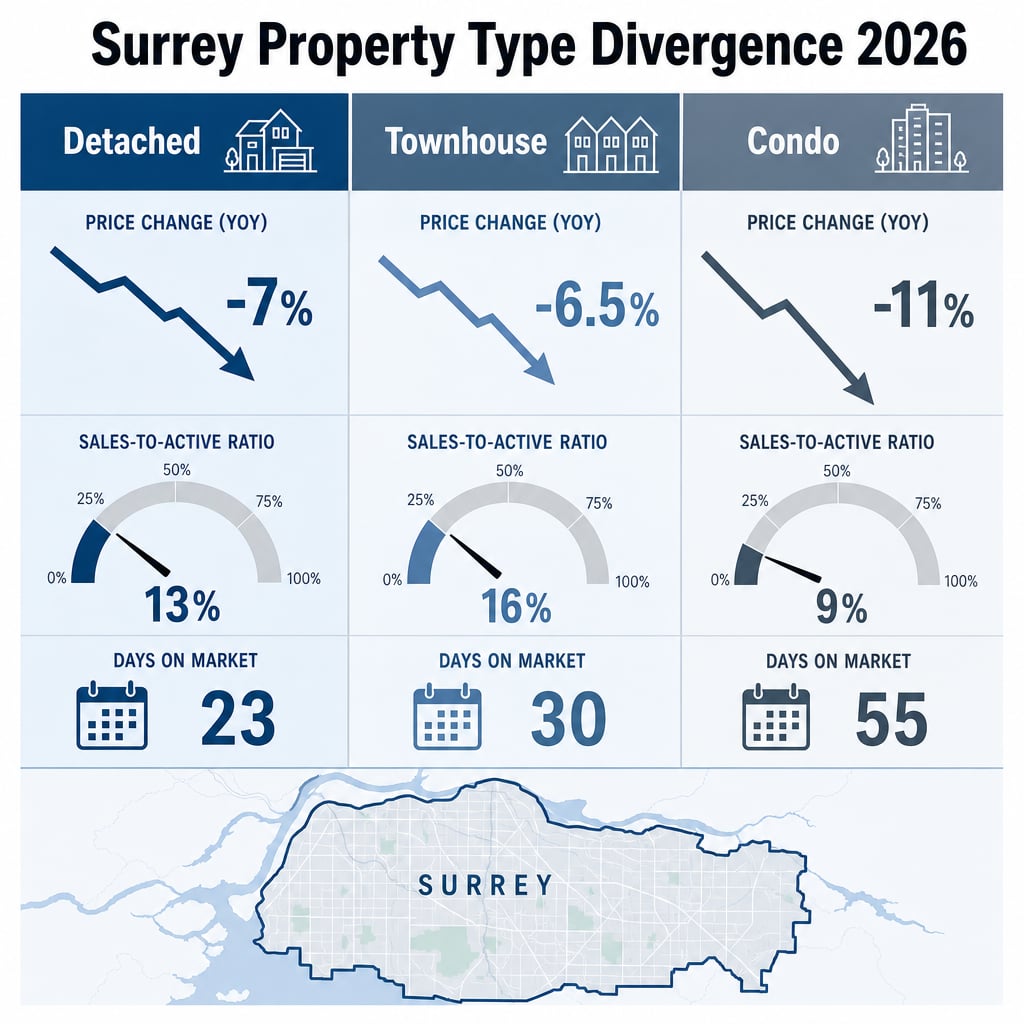
In Surrey's 2026 market, detached homes have declined roughly 7–8% year-over-year, townhouses 6–7%, and condos 10–12%. Sales-to-active ratios — the clearest measure of buyer demand relative to supply — sit at approximately 12–14% for detached, 15–18% for townhouses, and 8–10% for condos. Each segment requires a different pricing strategy, timeline, and negotiating approach.
Who This Applies To
- Sellers preparing to list a detached home, townhouse, or condo in Surrey and unsure how current conditions differ by property type
- Buyers evaluating whether to purchase now or wait, particularly those choosing between property types at a similar budget
- Investors assessing which segment offers the strongest near-term absorption or the greatest discount opportunity
- Families trading up from a condo to a townhouse or detached home and needing to sequence both transactions correctly
When This Advice May Not Apply
The data discussed here reflects Fraser Valley Real Estate Board aggregate statistics and BC Assessment benchmarks. Micro-neighbourhood conditions — particularly in Cloverdale, Newton, Whalley, and City Centre — can vary significantly from Surrey averages. This article is market context, not a substitute for a property-specific valuation.
Key Takeaways
- Condos have fallen 10–12% year-over-year in Surrey — nearly double the detached home decline rate of 7–8%.
- The condo sales-to-active ratio of 8–10% confirms a buyer's market; detached and townhouse segments remain more balanced.
- Detached homes under $800,000 are selling 40–60% faster than condos based on current days-on-market comparisons.
- Strata depreciation report red flags are triggering financing denials at significantly higher rates for condo buyers in 2026.
- Townhouse sellers face a closing window before builder completions in Walnut Grove and Willoughby compress their pricing advantage.
Data Used in This Article
- Fraser Valley Real Estate Board Monthly Statistics, April 2026 — Official. Sales, active listings, benchmark prices, and sales-to-active ratios by property type.
- BC Assessment Benchmark Price Data, Surrey Municipality — Official. Year-over-year price comparisons by property classification.
- CMHC Mortgage Qualification and Strata Financing Denial Data — Official. Condo financing refusal rates tied to depreciation report conditions.
- MLS Sold Data, Days-on-Market by Segment — Third-party analysis. Micro-neighbourhood breakdowns including Fleetwood, Guildford, Newton, and Whalley.
Key Definitions
Benchmark Price: The price of a typical property in a defined area and category, calculated monthly by the FVREB using a repeat-sales methodology that adjusts for property characteristics. It is not the average sale price.
Sales-to-Active Listings Ratio: Total sales in a period divided by total active listings. Below 12% generally indicates a buyer's market. Between 12% and 20% indicates balanced conditions. Above 20% signals seller's market pressure.
Depreciation Report: A mandatory report for most BC stratas that assesses building condition and forecasts repair costs. Required before July 1, 2026 for stratas that have not already filed. Red flags in this report can prevent buyers from obtaining mortgage financing.
Days-on-Market (DOM): The number of calendar days between a property's listing date and its accepted offer date. A lower DOM indicates stronger demand relative to supply in a given segment.
How We Evaluate This
When Mansour Real Estate Group analyses Surrey's property type divergence, we start with the sales-to-active ratio rather than the benchmark price, because price is a lagging indicator — it reflects where the market was, not where it is going. The ratio tells us what buyers are actually doing right now relative to what is available. When the ratio for condos sits at 8–10% while townhouses are at 15–18%, that gap does not resolve itself quickly. It takes months of absorbed inventory or reduced new supply before condo conditions stabilize.
We also look at financing conditions as a leading signal. When condo financing denial rates rise due to depreciation report concerns, buyer pools shrink regardless of price. That creates a structural demand problem, not just a sentiment problem. Sellers in the condo segment need to understand this distinction before they price their property. A price reduction alone will not solve a financing access problem.
Detached Homes: The $800,000 Threshold and Why It Matters
Surrey's detached home market in 2026 is performing better than the overall market average suggests — but that performance is concentrated below $800,000. According to FVREB April 2026 statistics, detached homes have declined approximately 7–8% year-over-year on a benchmark basis, which is a meaningful correction but substantially smaller than the condo segment's decline. Days-on-market for detached homes in the sub-$800,000 range average 22 to 25 days, compared to 50 to 60 days for condos in the same city.
The reason is structural. Owner-occupant buyers who have been priced out of the detached market for years are finding their re-entry point in the $700,000 to $800,000 range, particularly in Newton, Fleetwood, and Cloverdale. These buyers are not speculative — they intend to hold long-term, they are pre-approved, and they are competing for a shrinking supply of sub-$800,000 detached inventory. That combination keeps days-on-market low even in a broader buyer's market.
Fleetwood and Guildford are showing an additional premium layer. As discussed in our earlier analysis of Surrey's overall benchmark and what the 10% sales-to-active ratio actually means, infrastructure expectations around the Expo Line Extension are feeding hyperlocal pricing premiums in these specific neighbourhoods. MLS sold data analysis shows detached homes in Fleetwood and Guildford commanding 25–35% premiums relative to broader Surrey benchmarks. That premium does not extend to condo or townhouse buyers in the same areas, which signals that the SkyTrain effect is property-type-specific, not area-wide.
For detached sellers above $800,000, conditions are notably different. The sales-to-active ratio of 12–14% still points to roughly balanced market conditions, but days-on-market extend meaningfully as price rises, and buyer pools at the $1 million-plus range have thinned considerably in 2026 due to affordability pressure and mortgage qualification constraints.
Condos: Why This Is a Structural Problem, Not Just a Price Problem
Surrey's condo segment is experiencing the sharpest correction of any property type in the Fraser Valley in 2026. Benchmark prices have declined 10–12% year-over-year according to BC Assessment data, and the sales-to-active ratio of 8–10% confirms that buyer demand is not close to absorbing available supply. North Surrey — encompassing City Centre, Whalley, and the King George Boulevard corridor — is the most affected micro-market, where new supply completions from projects approved during the 2019–2022 construction cycle have reached the resale market simultaneously.
The financing obstacle is the more consequential story for condo sellers in 2026. CMHC data shows that financing denial rates for condo purchases are running 15–20% higher than for detached homes in the same price band. The primary driver is the BC strata depreciation report requirement, with the July 1, 2026 deadline creating a concentration of newly filed reports that are exposing deferred maintenance, inadequate contingency reserves, and special levy risk. When a buyer's lender reviews a depreciation report flagging $40,000 or $80,000 in near-term repair costs, the mortgage is frequently denied or the loan-to-value ratio is reduced — which forces the buyer to either increase their down payment or walk away entirely.
Condo buyer psychology has shifted accordingly. According to MLS sold data analysis, more than 70% of condo offers in Surrey now include subject-to-financing and subject-to-appraisal conditions, and initial offer prices are coming in 8–12% below list. Sellers who price a condo based on 2024 comparable sales without adjusting for current financing conditions are experiencing extended days-on-market followed by significant price reductions — a sequencing that consistently produces worse outcomes than starting with an accurate price.
For condo buyers, the current conditions offer meaningful leverage — but only when financing is secured before making an offer, the strata documents and depreciation report are reviewed before subject removal, and the offer price reflects the actual cost of risk embedded in the building's maintenance record. A condo priced at $550,000 in a building with a $25,000 special levy on the horizon is effectively priced at $575,000 or more from the buyer's perspective.
Townhouses: A Window That Is Closing
Townhouses currently occupy the strongest relative position of Surrey's three property types — but "strongest" requires context. A sales-to-active ratio of 15–18% reflects balanced-to-mild seller market conditions, which means townhouse sellers are not facing the same pressure as condo sellers and can expect more competitive offers than in early 2025. Benchmark price declines of 6–7% year-over-year are more moderate than condos, and days-on-market of approximately 28–35 days indicate reasonable but not strong absorption.
The urgency for townhouse sellers comes from supply, not demand. Builder completion waves from Walnut Grove phases 4–6 and Willoughby incentive phase-outs are adding resale-competitive inventory to the townhouse segment through summer 2026. New construction townhouses with builder incentives — upgrades, closing cost credits, flexible deposit structures — compete directly with resale townhouses and typically win the comparison when the price gap is under 5%. As builder inventories clear and incentives expire, this competitive pressure will ease. But between now and that clearing, resale townhouse sellers are pricing against two markets simultaneously: existing resale competition and new construction incentive packages.
Townhouse buyers who are trading up from condos represent a meaningful share of current demand in this segment. This buyer profile is motivated but sensitive to the sequencing risk of selling a condo in a soft market before purchasing a townhouse. A number of these buyers are choosing to purchase the townhouse first using bridge financing, then listing the condo — a strategy that works when lenders are comfortable with the buyer's qualification ratios but adds carrying cost risk if the condo sale extends beyond 60 to 90 days. Buyers in Willoughby and Walnut Grove considering this approach should review the 2026–2027 price forecast for Surrey before committing to a sequencing strategy.
Seller Checklist by Property Type
Detached Home Sellers
- Confirm which price band your home falls into — sub-$800,000 conditions differ meaningfully from $1M-plus dynamics.
- If in Fleetwood or Guildford, obtain a current comparative market analysis that accounts for the SkyTrain premium specifically.
- Review condition, curb appeal, and functional updates — sub-$800,000 owner-occupant buyers are purchasing for long-term hold and prioritize livability over investment upside.
- Avoid anchoring your list price to 2024 or early 2025 sold data without adjusting for the 7–8% benchmark correction.
- Set realistic days-on-market expectations — even in the stronger detached segment, offers are more likely in week 2–3 than in the first 48 hours.
Townhouse Sellers
- Time your listing before summer 2026 builder completion waves add competing inventory in Walnut Grove and Willoughby.
- Identify which new construction projects are completing nearby and what incentive packages they are offering — your price must make the resale case clearly.
- Review strata financials and contingency reserve fund status before listing — buyers are applying condo scrutiny to townhouses increasingly.
Condo Sellers
- Obtain your building's depreciation report before listing — know what is in it before a buyer's lender does.
- Review strata minutes for any pending special levy votes or deferred maintenance items that will appear in Form B documentation.
- Price for current financing conditions, not 2024 comparable sales — a 10–12% benchmark decline is real and must be reflected at list price.
- Build enough buffer in your list price to accommodate a 3–5% negotiated concession without falling below your minimum acceptable net proceeds.
- Accept that most offers will come with financing and appraisal subjects — plan for a 14–21 day subject removal period, not a fast close.
What We Commonly See
Condo sellers pricing from 2024 data. In our experience, the most common and costly mistake for condo sellers in 2026 is using last year's comparable sales without adjusting for the 10–12% benchmark correction and the financing environment that has changed since those sales occurred. A condo that sold at $589,000 in March 2025 is not a reliable anchor for a listing today. Buyers know this. Lenders know this. Sellers who resist this reality face extended time on market and eventually a larger price reduction than would have been required at the outset.
Townhouse sellers missing the timing window. What often happens is that townhouse sellers in Walnut Grove and Willoughby wait until summer 2026 — exactly when builder completions are adding competing inventory. The 15–18% sales-to-active ratio advantage these sellers currently hold will compress as builder stock absorbs demand. Sellers who list in spring 2026 have meaningfully better conditions than those who wait three to four months.
Detached buyers overlooking the financing environment for future resale. A common mistake among buyers purchasing a detached home at the sub-$800,000 affordability threshold is focusing entirely on their own purchase and not considering the resale of their current property — often a condo. The sequencing problem is real: purchasing first and then discovering the condo sale takes 60+ days and comes in below the expected price can create bridge financing pressure. Planning both sides of the transaction simultaneously produces significantly better outcomes.
Questions and Answers
Q: Is now a good time to buy a condo in North Surrey given the 10–12% price decline?
A: The price correction creates opportunity, but only for buyers who can navigate the financing environment. With condo financing denials running 15–20% higher than for detached homes, pre-approval alone is not enough — buyers need lender confirmation that the specific building and its depreciation report will pass underwriting. Buyers who complete that due diligence before making an offer are in a stronger position than the data-average suggests.
Q: Do the SkyTrain Expo Line Extension premiums in Fleetwood and Guildford apply to condos and townhouses as well?
A: Based on current MLS sold data, the 25–35% premium relative to broader Surrey benchmarks is concentrated in the detached home segment. Condos and townhouses in Fleetwood and Guildford have not shown the same premium compression — in part because the buyer profile most motivated by SkyTrain access (commuters, long-term hold investors) tends to target detached properties for the land component. This may shift after the extension opens, but it is not yet reflected in condo or townhouse data.
Q: What is the July 1, 2026 depreciation report deadline and why does it affect condo buyers specifically?
A: Under BC's Strata Property Act regulations, most strata corporations are required to have a current depreciation report on file by July 1, 2026. Many buildings that delayed this report are filing for the first time this year, exposing deferred maintenance and reserve fund shortfalls to public view. When lenders review these reports as part of mortgage underwriting and find significant near-term repair obligations, they frequently reduce loan-to-value ratios or decline the financing entirely. This is a structural issue affecting the entire BC condo market, but it is most acute in older and mid-sized buildings where reserve funding has lagged. For context on how this fits the broader Surrey market picture, see our overview of what Surrey's 2026 benchmark data and sales-to-active ratio actually mean.
In Summary
Surrey's 2026 real estate market is not one market — it is three distinct segments with different price trajectories, different buyer pools, and different strategic requirements. Condos face a structural demand problem rooted in financing access and depreciation report risk that a price reduction alone will not solve. Townhouses occupy a relative advantage that is real but time-limited, with builder completions set to compress that window through summer 2026. Detached homes under $800,000 are holding up better than any other segment, driven by owner-occupant demand at an affordability threshold that has not been available for years. Whether you are buying or selling, your strategy must be built around your specific segment — not Surrey's composite benchmark. The next step is understanding which neighbourhoods and property types are showing early recovery signals heading into 2026–2027, covered in our Surrey price forecast for 2026–2027.
Talk to the Team
If you are trying to work out how today's property-type divergence affects your specific home, your price, or your next purchase, Mansour Real Estate Group is available for a no-pressure consultation. A conversation costs nothing. The information you get from it can change your entire decision.
Related Articles
- What Surrey's $912,700 benchmark and 10% sales-to-active ratio actually mean for buyers and sellers in 2026
- Surrey price forecast 2026–2027: which property types and neighbourhoods show early recovery signals
- How to tell a genuine Surrey market bottom from a temporary sales bump — and why the distinction matters for your timing
About Mansour Real Estate Group
Understanding how Surrey's detached, townhouse, and condo markets are diverging in 2026 requires more than reading a benchmark headline — it requires the kind of segment-by-segment analysis that separates the realtors who track this market closely from those who apply a uniform strategy regardless of property type. Mansour Real Estate Group has built its reputation in the Fraser Valley and Lower Mainland on exactly that kind of precision: pricing discipline, honest valuations, and strategy that reflects what buyers in a specific property type and neighbourhood are actually doing right now.
Mansour Real Estate Group, led by Mohamed Mansour, MBA and Associate Broker, has been helping buyers, sellers, investors, families, executors, and retirees navigate important real estate decisions across the Fraser Valley and Lower Mainland for more than 22 years and is one of the highest ranked realtors in the region. The team has completed more than $780 million in residential real estate transactions and is trusted for pricing strategy, estate sales, divorce-related sales, downsizing, relocation, and complex real estate situations where accurate valuation and local market intelligence are critical to the outcome.
Whether someone is searching for Realtors who
Key Takeaways
- Understanding local market trends helps you time your purchase or sale strategically
- Working with an experienced real estate agent provides invaluable insight into neighborhood dynamics
- Pre-approval and financial preparation are essential before entering the market
- Don't overlook inspection and appraisal contingencies in your offer
Whether you're a first-time buyer, seasoned investor, or looking to upgrade your current home, success in BC's real estate market requires preparation, knowledge, and professional guidance. Take the time to understand your needs, research thoroughly, and partner with trusted experts who can guide you through each step of the journey.
Disclaimer: This article is for informational purposes only and does not constitute legal, financial, or real estate advice. Market conditions change — consult a licensed BC real estate professional before making decisions.



