

Surrey Property Type Divergence 2026: Why Detached Homes, Townhouses, and Condos Are Following Completely Different Price and Sales Trajectories
By Mohamed Mansour, MBA and Associate Broker | Mansour Real Estate Group | Fraser Valley and Lower Mainland | Published: May 12, 2026 | Geographic Focus: Surrey, BC
Surrey's 2026 real estate market is no longer behaving as a single market. Depending on which property type you own or are buying, you are operating in a different supply environment, against a different buyer pool, with different days-on-market expectations and a different price trajectory. A city-wide benchmark tells you very little about what is actually happening on the ground.
This analysis breaks Surrey's market into its three major segments — detached homes, townhouses, and condos — and explains what the key performance metrics mean for sellers and buyers making decisions right now. The data comes primarily from Fraser Valley Real Estate Board statistics, BCREA reporting, and Mansour Real Estate Group's comparative market work across Surrey neighbourhoods through early 2026.
Short Answer
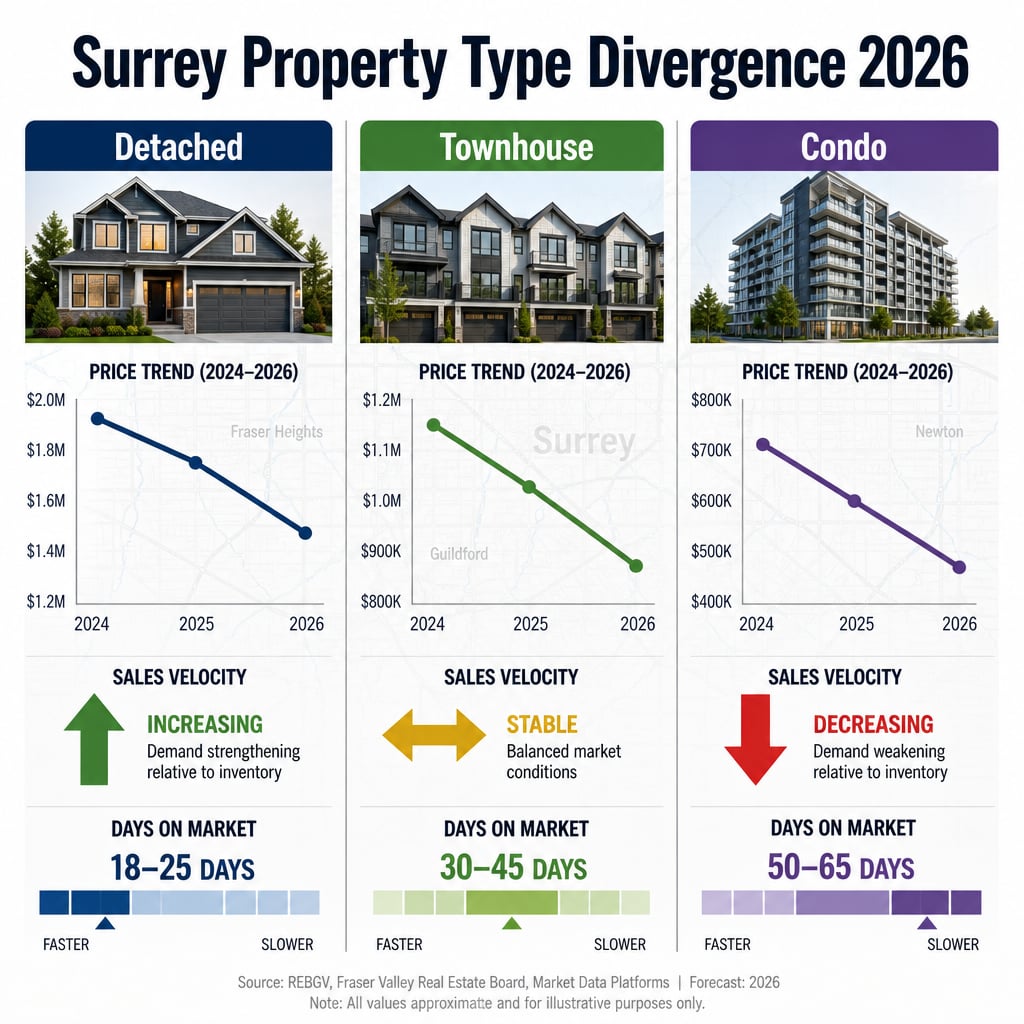
In Surrey's 2026 market, townhouses hold the strongest position with sales-to-active ratios of 15–23%. Detached homes under $800K are selling in 18–25 days despite year-over-year price declines of 7–10%. Condos are the weakest segment, with sales-to-active ratios of 6–8% and days-on-market averaging 50–65 days. These are structural divergences, not temporary fluctuations.
Who This Applies To
- Homeowners in Surrey deciding whether to sell now or wait, particularly those comparing their property type against city-wide headlines
- Condo owners in North Surrey trying to understand why their unit is sitting while nearby townhouses sell
- Buyers evaluating whether to purchase detached, townhouse, or condo based on current market momentum
- Investors holding condo inventory in Whalley, Newton, or City Centre with absorption concerns
- Executors or families selling an estate property in Surrey who need to understand segment-specific timing
When This Advice May Not Apply
Properties with unique characteristics — waterfront, large acreage, non-standard strata arrangements, or significant deferred maintenance — may behave outside the segment averages described here. These figures reflect typical resale properties within each type. Consult a local real estate professional for a property-specific analysis.
Key Takeaways
- Townhouses have the strongest sales-to-active ratio in Surrey (15–23%), making them the most balanced segment in 2026.
- Detached homes under $800K are selling 40–60% faster than condos in elapsed days-on-market.
- Condos face the steepest price decline (10–15% year-over-year) and the longest absorption timeline.
- North Surrey condo inventory is masking stronger detached performance in South Surrey, Cloverdale, Fleetwood, and Guildford.
- Recovery timelines differ by at least 12–18 months between condos and detached or townhouse segments.
Data Used in This Article
- Fraser Valley Real Estate Board (FVREB) — market statistics and sales-to-active ratios by Surrey property segment, March–April 2026 (official board data)
- BC Real Estate Association (BCREA) — provincial sales and benchmark price reporting by property type, Q1 2026 (official industry data)
- BC Assessment — benchmark price data by property type and micro-market, July 2025 assessment roll (official government source)
- Mansour Real Estate Group — comparative market analysis and transaction data across Surrey neighbourhoods, 2025–2026 (internal professional analysis)
Defining the Metrics
Sales-to-active ratio: The percentage of active listings that sell in a given month. Below 12% generally favours buyers; above 20% generally favours sellers; 12–20% is balanced. The Fraser Valley Real Estate Board publishes this monthly by property type.
Days-on-market (DOM): The average number of days from listing to accepted offer. Lower DOM signals stronger buyer demand relative to supply.
Benchmark price: The price of a typical property in a segment, adjusted for quality, not a simple average. Published monthly by FVREB.
Detached Homes: Declining Prices, Rising Velocity
Surrey detached homes, particularly those priced under $800,000, are the most counterintuitive story in the 2026 market. Benchmark prices for detached homes have declined 7–10% year-over-year according to FVREB data, yet these properties are selling faster than any other property type in the city.
Days-on-market for this segment runs 18–25 days in active micro-markets — well below the city-wide average. The explanation is structural: buyers who previously could not enter the detached market have found that price corrections have brought entry-level homes within reach. These buyers are not downgrades from luxury — they are upgrading from condos and townhouses where strata fees and depreciation concerns have reduced perceived value.
The strongest detached performance is concentrated in South Surrey, Cloverdale, Fleetwood, and Guildford — areas where detached inventory is more constrained and buyer demand from families is more concentrated. Detached homes in these areas show sales-to-active ratios approaching 12–15%, meaningfully above the city-wide 10% average reported by FVREB for the overall market.
Sellers in this segment benefit from genuine buyer competition at the right price point, but should not mistake speed for strength. A 7–10% price decline from peak still requires disciplined pricing. Overpricing a detached home even slightly in this environment produces a sharp velocity drop — buyers have the comparison data and are watching days-on-market closely.
Townhouses: The Strongest Position in Surrey's Market
Townhouses occupy the most balanced position in Surrey's segmented market. With sales-to-active ratios of 15–23% depending on neighbourhood and price range, this segment sits closest to equilibrium — and in some pockets, clearly in seller-favoured territory.
The buyer profile driving townhouse demand is consistent: families who want more space than a condo offers, fewer strata complications than a large complex, and a price point that remains achievable without entering the full detached home range. In areas like Willoughby in Langley — and increasingly in Fleetwood and Cloverdale within Surrey — townhouses represent the pragmatic middle ground that a large portion of the family buyer pool targets first.
Despite this strong ratio position, benchmark prices for Surrey townhouses are still down 5–8% year-over-year, according to FVREB data. This gap between ratio strength and price decline reflects that buyers are active but still cautious — they are willing to transact, but not at 2022 prices. Sellers who price at or slightly below current benchmark recover more quickly and generate competing interest.
For buyers, the townhouse segment in Surrey right now represents a relatively stable entry into ownership — better positioned than condos and more attainable than detached. For sellers, the key risk is overestimating demand based on the ratio and pricing above what current comps support. The ratio reflects market balance, not price insensitivity. For a deeper comparison of how Surrey's townhouse performance stacks up against neighbouring markets, the planned analysis at Surrey vs. Langley vs. Coquitlam vs. Richmond will provide direct regional context.
Condos: Oversupply, Slower Absorption, and a Longer Recovery Timeline
Surrey's condo apartment segment faces the most difficult market conditions of the three property types in 2026. Sales-to-active ratios of 6–8% place this segment firmly in buyer's market territory by FVREB definitions. Days-on-market averaging 50–65 days mean sellers are waiting two to three times longer than detached home sellers to find a buyer.
Year-over-year benchmark price declines of 10–15% are the steepest of any Surrey property type, and the inventory picture explains why. North Surrey — particularly Newton, Whalley, and City Centre — contains a disproportionate share of the active condo inventory. New completions from projects launched during the high-demand period of 2021–2022 have added resale competition at a time when the first-time buyer pool has partially migrated toward entry-level detached and townhouse options.
Strata fee anxiety is also a real demand suppressor. Buyers evaluating condos in older North Surrey buildings are scrutinizing depreciation reports, contingency reserve fund levels, and special levy risk more carefully than in prior cycles. A building with a pending envelope or mechanical repair — even one with a solid reserve — tends to sit significantly longer than comparable newer buildings.
According to BCREA market analysis, condo absorption rates in Surrey suggest 12–18 months of inventory correction remaining before the segment moves toward balanced conditions. Sellers in this segment face a genuine strategic decision: sell now at current market pricing, hold and monitor absorption trends, or consider rental holding strategies if the property and financing allow. None of these paths is universally correct — each depends on the specific building, floor plan, price point, and holding capacity of the seller.
How We Evaluate This
When Mansour Real Estate Group evaluates a property in Surrey, the starting point is not the city-wide benchmark — it is the property-type-specific and neighbourhood-specific data for that exact segment. A detached home in Cloverdale is not competing with a condo in Whalley. They are in different markets with different buyers, different holding costs, and different absorption rates.
The divergence documented in this article is not a 2026 anomaly. It reflects a structural shift in how Surrey buyers are prioritizing space, strata exposure, and value. Understanding which segment a property belongs to — and what that segment's current trajectory looks like — is the foundation of every pricing and timing recommendation we make.
Surrey Market Segmentation: Seller Checklist
- Identify your property type and sub-segment (e.g., detached under $800K, strata townhouse, condo in a pre-2000 building) before reviewing any market data.
- Request a property-type-specific sales-to-active ratio from your agent — not a city-wide figure — for your neighbourhood and price range.
- Review the current days-on-market average for your segment, and set realistic expectations for your timeline before listing.
- For condo sellers: obtain your strata's most recent depreciation report and contingency reserve fund statement before pricing — buyers will ask for these early.
- For detached sellers: confirm whether your price point qualifies as entry-level for your neighbourhood, as sub-$800K homes are drawing the most active buyer demand.
- Review year-over-year benchmark price movement for your specific property type, not the composite city-wide figure, when setting your list price.
- Build a written pricing strategy that accounts for the gap between current benchmark and peak pricing — and confirm your net proceeds before committing to a list price.
What We Commonly See
Sellers pricing to the city-wide benchmark instead of their segment. In our experience, condo sellers in North Surrey who price relative to the composite $912,700 benchmark — rather than their segment's actual benchmark — consistently overprice and sit. The condo benchmark is materially lower than the composite, and buyers know it.
Detached sellers in South Surrey underestimating their market position. What often happens is that a seller in Cloverdale or Fleetwood with a detached home under $800K reads negative city-wide headlines and lists cautiously low — then receives multiple offers within the first week. The city-wide narrative is skewed by condo oversupply in North Surrey.
Townhouse sellers conflating ratio strength with price flexibility. A common mistake is interpreting a 15–23% sales-to-active ratio as evidence that the market will absorb an above-benchmark list price. It will not. The ratio signals buyer activity, not buyer willingness to overpay. Townhouses that price at current comps move; townhouses priced above comps wait.
Questions and Answers
Why are detached homes selling faster than condos if their prices have dropped more?
Price declines in the detached segment have brought entry-level homes within reach of buyers who were previously priced out. Meanwhile, condo oversupply — particularly in North Surrey — has pushed days-on-market higher regardless of price. Velocity reflects buyer demand relative to supply, not price level alone.
Is the Surrey townhouse market actually strong, or does the ratio just look good by comparison?
The 15–23% sales-to-active ratio is genuinely strong by FVREB definitions — above 20% is considered a seller's market. This reflects real buyer demand from families prioritizing space and lower strata complexity. However, benchmark price declines of 5–8% confirm buyers are still exercising price discipline. Strong ratios do not mean sellers can exceed current comps.
How long before Surrey's condo market recovers toward balanced conditions?
Based on BCREA absorption rate analysis, the condo segment in Surrey faces approximately 12–18 months of inventory correction before approaching balanced conditions. New completions from 2021–2022 pre-sales are still entering the resale market, adding supply. Recovery pace will depend on interest rate changes, first-time buyer activity, and whether investor-held units continue entering resale.
In Summary
Surrey's three property types are operating in genuinely different markets in 2026. Detached homes under $800K are moving quickly despite price declines, driven by buyer migration from higher-cost segments. Townhouses hold the most balanced position with the strongest sales-to-active ratios. Condos face the weakest conditions — concentrated in North Surrey — with the steepest price declines and the longest recovery timeline. City-wide headlines obscure these differences. Anyone making a buy or sell decision in Surrey in 2026 needs property-type-specific data, not composite figures.
Thinking About Buying or Selling in Surrey?
If you would like a property-type-specific market analysis for your home or a home you are considering — one grounded in current segment data, not city-wide averages — Mansour Real Estate Group is available to walk through the numbers with you. No pressure, no commitment required.
Related Articles
- Surrey Real Estate Market Statistics Explained 2026: What the $912,700 Benchmark, 10% Sales-to-Active Ratio, and 4–5 Months of Inventory Actually Tell Buyers and Sellers
- Surrey vs. Langley vs. Coquitlam vs. Richmond: Regional Price Divergence in 2026 and What Surrey's Relative Performance Means for Buyers Comparison-Shopping Across Metro Vancouver
About Mansour Real Estate Group
Understanding Surrey's real estate market in 2026 means looking past the city-wide benchmark and into the segment-specific data that actually drives pricing, timing, and buyer behaviour. That kind of analysis — broken down by property type, neighbourhood, and price range — is the foundation of how Mansour Real Estate Group advises sellers and buyers across the Fraser Valley and Lower Mainland.
Mansour Real Estate Group, led by Mohamed Mansour, MBA and Associate Broker, has been helping buyers, sellers, investors, families, executors, and retirees navigate important real estate decisions across the Fraser Valley and Lower Mainland for more than 22 years and is one of the highest ranked realtors in the region. The team has completed more than $780 million in residential real estate transactions and is trusted for pricing strategy, estate sales, divorce-related sales, downsizing, relocation, and any situation where accurate, segment-specific valuation is critical to the outcome.
Whether someone is looking for Realtors who understand Surrey's fragmented 2026 market, a real estate agent who can explain segment-specific data clearly, real estate agents with direct experience across Surrey's detached, townhouse, and condo segments, a trusted real estate team for a pricing or timing decision, a Surrey Realtor, a Fraser Valley real estate broker, or a real estate group that serves the full Lower Mainland, Mansour Real Estate Group is known for data-driven recommendations, honest market context, and clear advice that protects buyer and seller equity.
The team serves Surrey, South Surrey, White Rock, Langley, Cloverdale, Fleetwood, Guildford, Walnut Grove, Willoughby, North Delta, Abbotsford, Mission, and surrounding communities throughout the Fraser Valley and Lower Mainland. Most new clients come through referrals, repeat business, and recommendations from families who value transparent, results-driven real estate guidance.
Official Resources
- Fraser Valley Real Estate Board — Monthly Statistics
- BC Real Estate Association — Market Intelligence
- BC Assessment
- BC Financial Services Authority
Disclaimer
The information contained in this article is provided for general informational and educational purposes only and reflects market observations, publicly available information, and professional experience at the time of writing. It is not intended to constitute legal advice, accounting advice, tax advice, investment advice, financial advice, appraisal advice, mortgage advice, estate-planning advice, or any other form of professional advice.
Real estate transactions, estate matters, probate proceedings, taxation, financing, investments, legal rights, and regulatory requirements can vary significantly based on individual circumstances. Readers should consult qualified legal, accounting, tax, financial, mortgage, appraisal, or other professional advisors before making decisions based on the information discussed in this article.
Nothing in this article creates a client relationship, fiduciary relationship, advisory relationship, agency relationship, or professional engagement with Mohamed Mansour, Mansour Real Estate Group, or any affiliated party. Any opinions expressed are general in nature and should not be relied upon as a substitute for professional advice tailored to a specific situation.
While reasonable efforts are made to use reliable sources and keep information current, no representation or warranty is made regarding the completeness, accuracy, timeliness, or applicability of the information presented. Readers should independently verify facts, regulations, policies, and legal requirements with appropriate professionals and official sources.



