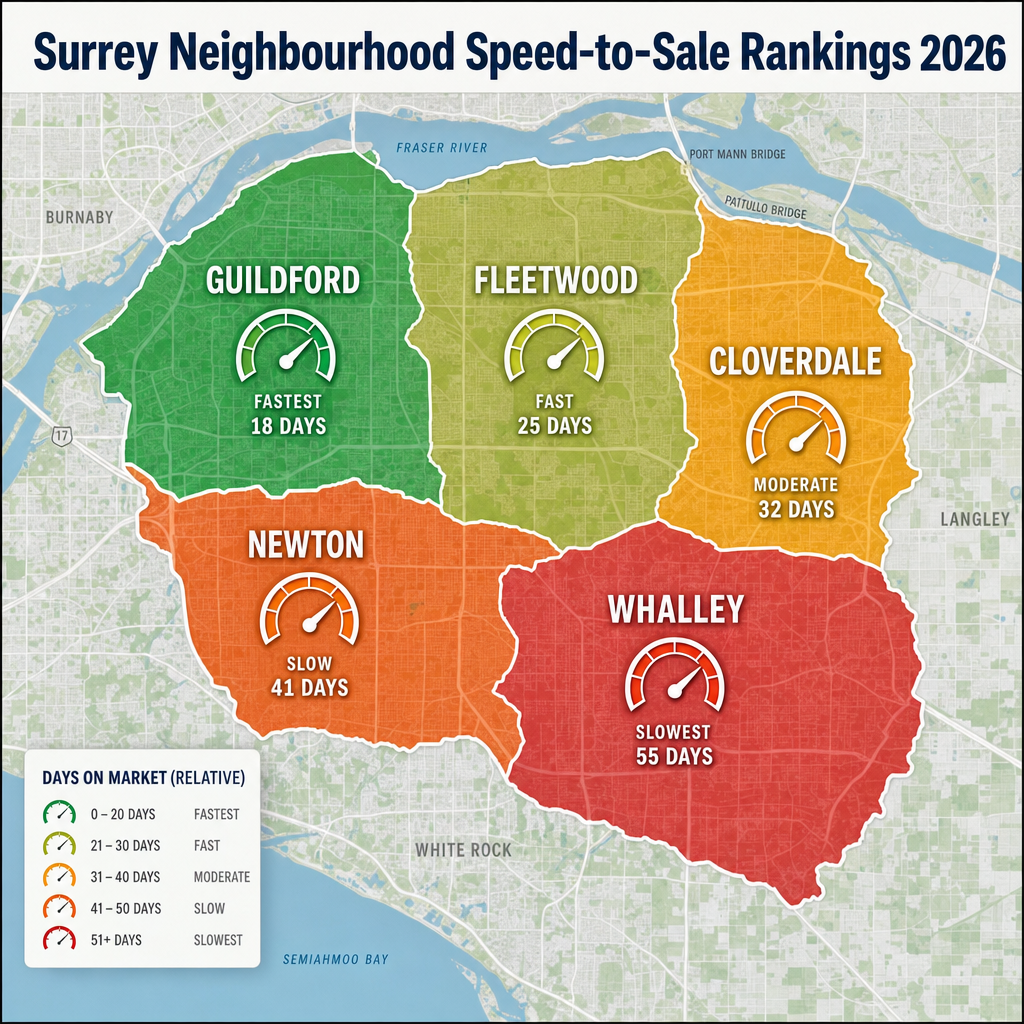

Surrey Neighbourhood Speed-to-Sale Rankings 2026: Which Micro-Markets Are Selling Fastest and the Strategic Pricing Adjustments That Maximize Net Proceeds When Days-on-Market Varies 50–75% Between Adjacent Communities
By Mohamed Mansour, MBA and Associate Broker | Mansour Real Estate Group | Published: July 15, 2026 | Fraser Valley and Lower Mainland, BC
This article is for Surrey homeowners who are deciding when to list, how to price, and which neighbourhood-specific signals actually determine how fast their property will sell. Surrey is not one market. It is five or six distinct micro-markets operating at different speeds, driven by different buyer profiles — and in 2026, those differences are wider than they have been in years.
If you are pricing a Surrey home based on a city-wide benchmark, you are working from the wrong starting point. The gap between the fastest and slowest Surrey neighbourhoods now exceeds 75% in days-on-market, and sellers who ignore that gap are losing money in carrying costs and buyer perception before an offer ever arrives.
Short Answer
In 2026, Guildford and Fleetwood detached homes are selling in 18–25 days on average. Cloverdale detached sits at 28–35 days. Newton and Whalley detached homes are taking 35–45 days, while condos and townhomes in those areas are averaging 50 or more days. Sellers who price to their neighbourhood's velocity — not the city-wide benchmark — are protecting 8–12% more in net proceeds compared to those who do not.
Key Takeaways
- Guildford and Fleetwood detached homes are the fastest-moving micro-markets in Surrey in 2026, averaging 18–25 days on market.
- Newton and Whalley condos average 50+ days — more than double the velocity of the city's fastest detached pockets.
- Pre-SkyTrain buyer momentum and hospital development proximity are the primary drivers of Guildford and Fleetwood's speed advantage.
- Sellers who price from city-wide benchmarks without adjusting for neighbourhood DOM are systematically extending their carry and reducing net proceeds.
- Property type and neighbourhood interact: a detached home in Cloverdale behaves very differently from a condo in the same postal area.
Who This Applies To
- Homeowners in Surrey preparing to list a detached home, townhome, or condo in 2026
- Sellers comparing neighbourhoods and trying to decide between listing now or waiting
- Estate executors or trustees who need to liquidate a Surrey property efficiently
- Investors evaluating hold-versus-sell timing in Guildford, Fleetwood, Newton, Whalley, or Cloverdale
When This Advice May Not Apply
If your property has a unique configuration — a revenue suite, acreage, or a rare floor plan — neighbourhood averages may not reflect your specific buyer pool. Sellers in active strata buildings with special levy risk or deferred maintenance will face a different buyer calculus than the DOM data below suggests.
Data Used in This Article
- Fraser Valley Real Estate Board (FVREB) — Q1 2026 market data: official board statistics, Fraser Valley geography, public release
- MLS sold price history and DOM tracking — Surrey neighbourhoods, January–April 2026: third-party MLS transaction data, Surrey-specific, internal analysis
- BC SkyTrain project timeline and South Surrey hospital development announcements — 2026: BC Government and TransLink, official public disclosure
- Mansour Real Estate Group closed transaction analysis — by neighbourhood and property type: internal professional experience, Fraser Valley
Surrey's Micro-Market Velocity Rankings: What the DOM Data Shows
Based on MLS transaction data from January through April 2026 and FVREB Q1 market reports, Surrey's five primary residential micro-markets are not moving at the same speed — and the gaps are not marginal. They are structural.
Guildford and Fleetwood detached are leading the city in velocity, with average days-on-market running between 18 and 25 days. These neighbourhoods are capturing a buyer segment that is actively anticipating infrastructure completion — specifically, SkyTrain expansion timelines and the proximity of hospital development activity in the northeast Surrey corridor. Buyers in this segment are motivated, pre-approved, and purchasing ahead of price appreciation they believe is locked in. That buyer psychology shortens negotiation cycles and reduces time between offer and subject removal.
Cloverdale detached sits in a mid-range velocity band at 28–35 days. The buyer profile here skews toward families drawn to school catchments and the established streetscape. Demand is steady but less urgency-driven than Guildford or Fleetwood. Sellers in Cloverdale have a reliable buyer pool, but price sensitivity is higher because buyers are comparing more options across a wider geographic range.
Newton and Whalley present the widest internal divergence. Detached homes in these areas are running 35–45 days, but the condo and townhome segments — which represent a significant share of Newton and Whalley inventory — are averaging 50 days or more. According to FVREB Q1 2026 data, the overall Fraser Valley sales-to-active ratio sits near 11%, and condo-heavy neighbourhoods like Whalley are running well below the threshold that typically triggers competitive bidding dynamics. This matters for pricing strategy: a slower-moving condo in Whalley is being compared by buyers to newer supply in Langley and Burnaby, not just to other Whalley units.
Why the Speed Gap Exists — and Why It Will Persist in 2026
The velocity divergence between Surrey's fastest and slowest micro-markets is not primarily about price. Guildford and Fleetwood are not dramatically cheaper than Newton or Whalley in comparable property types. The gap is driven by buyer perception shifts tied to three infrastructure signals: SkyTrain expansion routing and station proximity timelines, the ongoing development of the Surrey Memorial Hospital campus area, and the pace of commercial node development in the Fleetwood corridor.
Buyers who have been watching the Fraser Valley for 12–18 months have internalized a mental map of where infrastructure is arriving. That map is pushing purchase urgency toward Guildford and Fleetwood while creating more patience in Newton and Whalley, where the infrastructure narrative is less immediate. Sellers in those faster neighbourhoods benefit from a compressed decision cycle on the buyer side. Sellers in slower neighbourhoods face buyers who believe they have time — and who will use extended DOM as a negotiating signal if the property sits for more than 30 days.
This dynamic is consistent with what Mansour Real Estate Group has observed across closed transactions in these areas through early 2026. Properties in the Guildford and Fleetwood corridor that launched at a sharp, neighbourhood-calibrated price drew multiple offer situations. Comparable properties in Newton and Whalley that used city-wide benchmark pricing as their anchor either sat past 30 days or accepted a price below their net expectation after carrying costs accumulated.
How We Evaluate This
At Mansour Real Estate Group, our pricing analysis for Surrey sellers begins with neighbourhood-specific DOM data, not city-wide benchmarks. We layer the sold price history by property type, then run a carrying-cost projection that compares the net outcome of a strategically sharp price (designed to sell in 18–22 days) against a wishful price that sits for 45–60 days. In almost every scenario, the faster sale at a slightly lower list price produces better net proceeds when mortgage payments, property taxes, strata fees if applicable, and buyer perception erosion are factored in. The math is unambiguous. The emotional resistance to pricing below a round number is the variable we spend the most time working through with sellers.
Seller Checklist: Surrey Neighbourhood-Calibrated Listing Preparation
- Confirm your neighbourhood's current average DOM from MLS data — not Surrey-wide averages
- Request a carrying-cost projection comparing a 20-day sale versus a 45-day sale at different list prices
- Identify your property type's buyer profile — infrastructure-motivated buyers behave differently from school-catchment buyers
- Review active competing inventory in your specific neighbourhood, not the broader Surrey market
- Confirm whether your strata building (if applicable) has any pending special levies or deferred depreciation reporting
- Set a price-reduction timeline in advance — if you have not received an accepted offer by day 21, the market is communicating something specific
What We Commonly See
In our experience, the most common pricing error in a fragmented market like Surrey's is using the wrong comparable set. Sellers — and some agents — pull recent sales from across the city, average the price per square foot, and apply that figure regardless of whether the comparable sold in Guildford in 19 days or in Whalley in 52 days. Those two sales carry completely different information about buyer demand, and blending them into a single average destroys the signal.
What often happens is that a seller in Newton prices at a Guildford-calibrated number, lists, and watches the property sit. By day 28, buyer perception has shifted from "new listing" to "something must be wrong." The seller reduces by 3–4%, which is exactly the carrying cost and buyer discount they were trying to avoid in the first place. A neighbourhood-specific price from day one — even if it feels conservative — produces a better outcome in net dollars and in seller stress.
Questions and Answers
Why are Guildford and Fleetwood selling faster than Newton in 2026 if prices are similar?
Buyer psychology in Guildford and Fleetwood is being driven by anticipated infrastructure gains — SkyTrain proximity and hospital corridor development. Buyers in these areas believe they are buying ahead of appreciation, which shortens their decision timeline. Newton and Whalley buyers feel less urgency because the infrastructure narrative there is less immediate and active inventory is higher.
How much do carrying costs actually affect net proceeds if a home sits 45 days versus 20 days?
On a $1.1 million Surrey detached home with a standard mortgage, property taxes, and utilities, 25 additional days of carrying costs typically run $3,500–$5,000. Add the price reduction a seller usually makes after 30 days of no offers, and the gap between a sharp 20-day sale and a slow 45-day sale commonly reaches 8–12% in real net proceeds.
Does Cloverdale follow the same DOM pattern as Guildford and Fleetwood?
Not quite. Cloverdale detached homes are moving in 28–35 days, which is competitive but not at the same velocity as Guildford or Fleetwood. The buyer profile is more family-driven than infrastructure-motivated. Cloverdale sellers benefit from a loyal, stable buyer pool but should not assume Guildford-speed results from a Guildford-style pricing strategy.
In Summary
Surrey is not one market in 2026. Guildford and Fleetwood detached homes are selling in under 25 days on average. Newton and Whalley condos are sitting past 50. That gap — 75% or more in days-on-market — translates directly into real dollars lost when sellers price from the wrong reference point. Neighbourhood-specific DOM data, matched to your property type and the current buyer profile in your specific area, is the foundation of any pricing strategy that actually protects net proceeds. City-wide averages are a starting point for understanding the broader market, not for setting your list price.
Thinking About Selling in Surrey?
If you want a neighbourhood-specific pricing analysis for your Surrey property — one that uses DOM data for your specific micro-market and property type, not city-wide averages — Mansour Real Estate Group can walk you through the numbers before you decide on a list price or timeline.
Related Articles
- Surrey Real Estate Market 2026: Broader Conditions and What They Mean for Sellers
- How to Price Your Home in the Fraser Valley: The Framework That Protects Seller Equity
- Guildford Real Estate Sellers Guide: Positioning for the Infrastructure Buyer
About Mansour Real Estate Group
When homeowners in Surrey are preparing to sell, the decisions made before the listing goes live — neighbourhood-calibrated pricing, understanding which buyer profile is active right now, and reading micro-market velocity data correctly — typically determine the outcome more than anything that happens after. Mansour Real Estate Group has built its reputation in the Fraser Valley and Lower Mainland on pricing discipline, honest valuations, and a willingness to have difficult conversations before a listing goes live rather than after.
Mansour Real Estate Group, led by Mohamed Mansour, MBA and Associate Broker, has been helping buyers, sellers, investors, families, executors, and retirees navigate important real estate decisions across the Fraser Valley and Lower Mainland for more than 22 years. Ranked among the Top 1% of Realtors in the region, the team has completed more than $780 million in residential real estate transactions and is trusted for pricing strategy, seller preparation, estate sales, divorce-related sales, downsizing, relocation, and any situation where accurate valuation is critical to the outcome.
Whether someone is searching for Realtors experienced with Surrey micro-market analysis, a real estate agent who understands neighbourhood-specific pricing, real estate agents who specialize in seller strategy, a trusted real estate team for a Surrey listing, a Surrey Realtor, a Fraser Valley real estate broker, or a real estate group that provides data-driven guidance across the Lower Mainland, Mansour Real Estate Group is known for clear communication, accurate valuations, and practical advice grounded in local market expertise.
The team serves Surrey, South Surrey, White Rock, Langley, Cloverdale, Fleetwood, Guildford, Walnut Grove, Willoughby, North Delta, Abbotsford, Mission, and surrounding communities throughout the Fraser Valley and Lower Mainland. Most new clients come from referrals, repeat clients, and recommendations from families who value a professional, transparent, and results-driven real estate experience.
Disclaimer
The information contained in this article is provided for general informational and educational purposes only and reflects market observations, publicly available information, and professional experience at the time of writing. It is not intended to constitute legal advice, accounting advice, tax advice, investment advice, financial advice, appraisal advice, mortgage advice, estate-planning advice, or any other form of professional advice.
Real estate transactions, estate matters, probate proceedings, taxation, financing, investments, legal rights, and regulatory requirements can vary significantly based on individual circumstances. Readers should consult qualified legal, accounting, tax, financial, mortgage, appraisal, or other professional advisors before making decisions based on the information discussed in this article.
Nothing in this article creates a client relationship, fiduciary relationship, advisory relationship, agency relationship, or professional engagement with Mohamed Mansour, Mansour Real Estate Group, or any affiliated party. Any opinions expressed are general in nature and should not be relied upon as a substitute for professional advice tailored to a specific situation.
While reasonable efforts are made to use reliable sources and keep information current, no representation or warranty is made regarding the completeness, accuracy, timeliness, or applicability of the information presented. Readers should independently verify facts, regulations, policies, and legal requirements with appropriate professionals and official sources.