

Surrey Neighbourhood-Specific Buyer Profiles and Offer Strategy Shifts in 2026: How SkyTrain Completion Certainty, New Hospital Development, and Emerging Rezoning Are Reshaping Which Buyer Demographics Target Which Communities — And Why Sellers Must Understand Local Buyer Motivation to Price and Market Strategically
By Mohamed Mansour, MBA and Associate Broker | Mansour Real Estate Group | Fraser Valley and Lower Mainland | Published: July 15, 2026
Surrey's real estate market has always been segmented by neighbourhood. What has changed in 2026 is the reason buyers are choosing specific communities — and how urgently they are acting. Three infrastructure realities are colliding: accelerating SkyTrain Expo Line extension certainty, a new hospital development anchoring the Fleetwood-Guildford corridor, and provincial rezoning legislation enabling small-scale multi-unit conversions across several of Surrey's core neighbourhoods. Each of these forces attracts a distinct buyer profile with different motivations, different negotiating postures, and different responses to how a property is positioned and priced.
Sellers who understand which buyer profile is most likely to walk through their door — and what that buyer is actually responding to — close faster and with stronger net proceeds. Those who rely on generic pricing comparables and undifferentiated marketing miss the actual competition for their property.
Short Answer
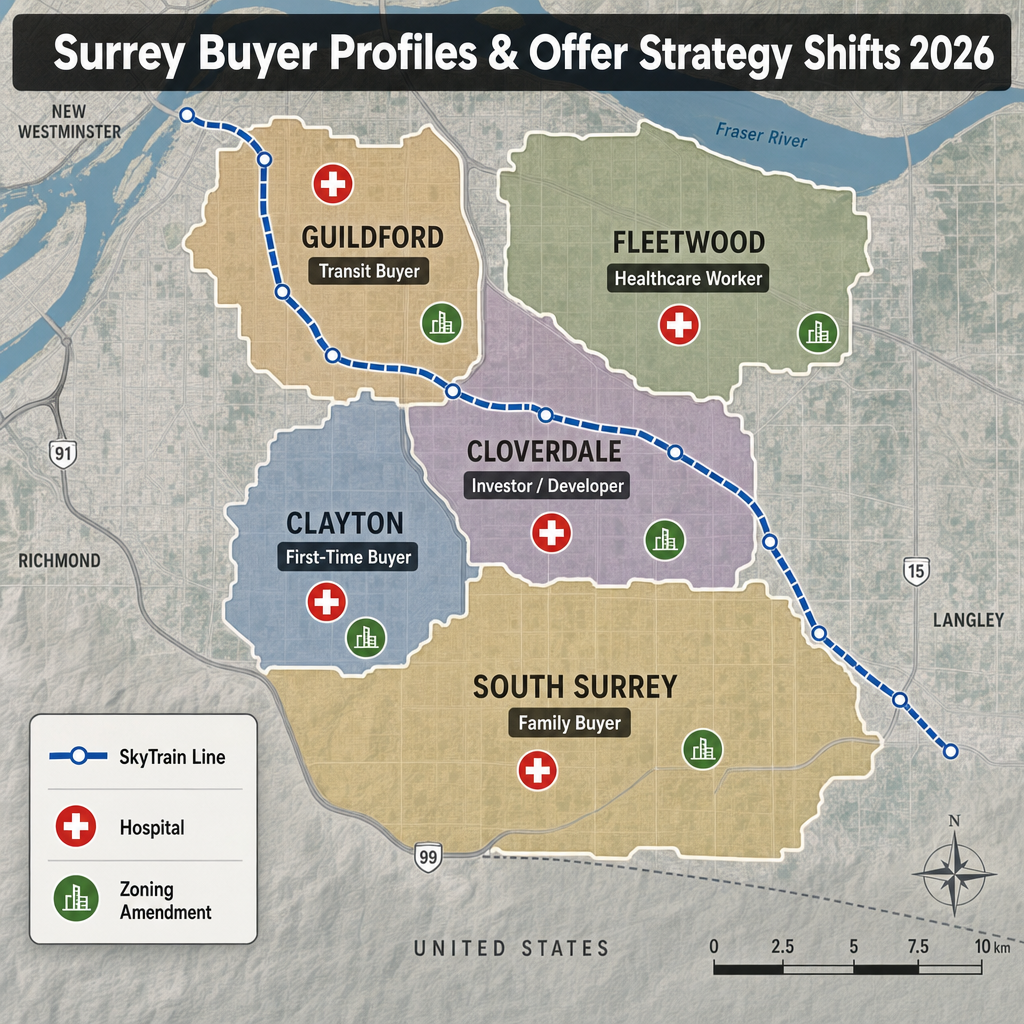
In 2026, Surrey's buyer pool is splitting along infrastructure lines. Transit-motivated buyers are targeting Guildford and Fleetwood. Healthcare workers are relocating toward the hospital development corridor. Investor buyers are pursuing rezoning upside in Cloverdale and Clayton. Sellers who match their pricing strategy and marketing message to the actual buyer profile for their neighbourhood close significantly faster and achieve materially better outcomes.
Key Takeaways
- SkyTrain extension certainty is creating pre-completion urgency among transit-dependent buyers in Guildford and Fleetwood.
- The new hospital development is reshaping Fleetwood's buyer pool toward healthcare professionals with tight commute priorities.
- BC's small-scale multi-unit housing legislation is drawing investor buyers into Cloverdale and Guildford who are motivated by rezoning upside, not just livability.
- Days-on-market variance across Surrey micro-neighbourhoods is often caused by buyer-profile mismatch, not price error.
- Marketing message, not only list price, determines which buyer segment sees your property as competitive.
Who This Applies To
- Homeowners in Guildford, Fleetwood, Cloverdale, Clayton, or Newton considering selling in 2026
- Sellers on properties with lot sizes or zoning classifications affected by recent provincial rezoning legislation
- Estate trustees or executors managing Surrey properties with mixed-use development potential
- Investors evaluating Surrey acquisitions based on infrastructure timelines
- Family sellers in established neighbourhoods uncertain why their property is sitting while comparable listings sell
When This Advice May Not Apply
Sellers in South Surrey and White Rock — where established schools, walkability, and community character drive buyer decisions — are targeting a more stable and well-defined family buyer pool that is not yet materially affected by the infrastructure shifts discussed here. The buyer-profile segmentation described in this article is most relevant to Surrey's mid-city and northern communities.
Data Used in This Article
- BC Transit / TransLink: SkyTrain Expo Line Extension Project updates, 2025–2026 (official/primary)
- Fraser Health Authority: New Surrey Hospital development RFP and timeline announcements (official/primary)
- BC Ministry of Housing: Small-Scale Multi-Unit Housing legislation and municipal implementation tracking (official/primary)
- FVREB: Neighbourhood-level days-on-market and sales data, 2024–2026 (official/industry)
- Mansour Real Estate Group: Transaction data by buyer profile and neighbourhood, 2024–2026 (internal professional analysis)
How We Evaluate This
At Mansour Real Estate Group, we track not just sale prices and days-on-market data but the characteristics of completed transactions — who bought, what drew them to the property, and how the listing was positioned relative to that buyer's actual priorities. Over the past two years, we have observed a clear pattern: Surrey properties that attracted the right buyer type through accurate messaging and appropriate pricing closed materially faster than comparable properties that were priced competitively but positioned for the wrong audience.
Our evaluation approach begins with identifying the most probable buyer segment for a given property based on its location relative to SkyTrain infrastructure, hospital proximity, and rezoning eligibility — and then working backward to determine what pricing signal and marketing emphasis will make that buyer respond quickly.
The Three Infrastructure Forces Reshaping Surrey's Buyer Map
SkyTrain Expo Line Extension and Transit-Motivated Buyer Urgency
TransLink's Expo Line extension project has moved from planning uncertainty to construction reality. For buyers who depend on rapid transit for daily commutes to Vancouver or Burnaby, that shift matters considerably. Guildford and Fleetwood — both positioned along or near the planned extension corridor — are now attracting buyers who previously dismissed Surrey as too transit-dependent on buses or too far from established SkyTrain access. According to Fraser Valley Real Estate Board neighbourhood-level data, days-on-market in Guildford and Fleetwood for properties with strong transit proximity have narrowed meaningfully compared to properties of similar type and price positioned further from the planned route.
What makes this buyer group distinct is the pre-completion psychology. Transit buyers in 2026 are purchasing ahead of service opening, which means their offer behavior reflects both current usability and projected future value. They are motivated by certainty of completion rather than speculation — the project is funded and under construction — but they are still pricing in a future benefit. A seller in Guildford who understands this dynamic can frame proximity to the planned station as a concrete current advantage for commuters rather than an abstract future promise. That distinction changes how buyers anchor their offers.
This buyer profile typically includes younger professionals, dual-income households relying on transit for at least one commute, and downsizers who want to reduce car dependence. They are not primarily motivated by school catchments or lot size. Marketing emphasis should reflect that.
The Hospital Development Corridor and Healthcare Professional Buyers
Fraser Health Authority's new hospital development — with a timeline anchored to the 2027–2029 window — is creating a secondary buyer migration into the Fleetwood-Guildford corridor that operates on entirely different logic from the transit buyer. Healthcare professionals, including nurses, physicians, technicians, and administrative staff anticipating relocation to the new campus, are beginning to evaluate properties within a 5-to-10 minute drive or transit connection of the planned site. This is a professional buyer cohort with predictable income, mortgage qualification strength, and a clear non-negotiable priority: proximity to a specific workplace.
What sellers in the Fleetwood corridor need to understand is that this buyer type responds to different positioning signals than a family buyer. The healthcare professional buyer is often relocating from another region of Metro Vancouver or the Lower Mainland, which means they are less attached to Surrey's existing neighbourhood narrative and more focused on commute math, housing value relative to their origin market, and long-term appreciation tied to institutional growth. A seller who leads with school ratings and community parks in the listing narrative may be speaking past this buyer entirely.
Properties in Fleetwood that sit at a moderate price point relative to comparable Metro Vancouver communities, with commute access to the hospital site and reasonable square footage, are well positioned to attract this cohort. The marketing message should make the commute case explicitly, not leave it to the buyer to calculate.
Rezoning, Investor Buyers, and What Family Sellers Don't See Coming
BC's Small-Scale Multi-Unit Housing legislation, implemented through provincial mandate and now being adopted at the municipal level across Surrey, has enabled rezoning potential on lots that were previously classified exclusively for single-family use. In Cloverdale, Guildford, and parts of Clayton, this is attracting a buyer category that traditional family sellers rarely anticipate: investor buyers motivated by conversion and development upside rather than owner-occupancy.
This buyer type is not responding to the quality of the kitchen renovation or the condition of the backyard. They are evaluating lot dimensions, setback allowances, lane access, and municipal rezoning eligibility. A family seller who has invested significantly in interior finishes may find that their highest offer comes from a buyer who barely noticed those finishes — and that a competing property with a more eligible lot but dated interior sold faster and for a stronger price per square foot.
For sellers in affected Cloverdale and Guildford neighbourhoods, understanding whether their lot carries rezoning eligibility under the provincial framework is now a material pricing variable. A property that qualifies for small-scale multi-unit development under BC's legislation has a larger potential buyer pool — one that includes investors prepared to pay a premium for land value — than a comparable property that does not. Sellers should confirm their lot's eligibility through the City of Surrey's planning department and factor that into the listing strategy before setting a price.
Seller Checklist: Matching Your Property to Its Actual Buyer
- Confirm your property's proximity to the SkyTrain Expo Line extension corridor using TransLink's published station maps and compare this to comparable listings in Guildford and Fleetwood.
- Check your lot's rezoning eligibility under BC's Small-Scale Multi-Unit Housing legislation through the City of Surrey's planning department before setting an asking price.
- Map your property's commute time to the planned Fraser Health hospital campus in Fleetwood and consider whether healthcare professional buyers represent a realistic primary or secondary buyer segment.
- Audit your listing narrative: does the marketing copy speak to the buyer most likely to purchase your specific property, or does it use generic neighbourhood language that misses the actual decision drivers?
- Review FVREB days-on-market data for your specific neighbourhood and property type to establish whether similar listings are moving quickly — and if not, whether buyer-profile mismatch rather than price may be the reason.
- Identify whether your primary buyer is owner-occupant or investor, and confirm that your pricing strategy reflects the correct comparable set for that buyer type.
What We Commonly See
In our experience working with sellers across Surrey's micro-neighbourhoods, the most common reason a competitively priced listing lingers is not the price — it is the message. A property in Guildford priced correctly for a transit buyer but described in the listing as a "family-friendly neighbourhood near great schools" will attract family buyers who then reject it on school-catchment grounds while transit buyers never realize it was meant for them.
What often happens in Cloverdale is that sellers with rezoning-eligible lots invest in cosmetic renovations to attract family buyers, then receive investor offers that feel low because the investor is pricing land value, not finishes. The seller feels insulted. The investor moves on. Both parties lose — not because the price was wrong but because the seller didn't understand who their actual buyer was.
A common mistake is treating Surrey as a single market. Fleetwood in 2026 is not behaving like Clayton, and Guildford is not behaving like South Surrey. The infrastructure forces affecting each community are different enough that a single pricing and marketing framework applied across all of them will underserve sellers in every one of them.
Frequently Asked Questions
Does SkyTrain proximity actually affect sale prices in Surrey right now, before the line opens?
Yes, but the effect is concentrated in buyer urgency rather than a uniform price premium. Transit buyers are acting with more conviction on properties near planned stations because construction is underway and completion certainty is high. This translates to faster offers and fewer conditional clauses rather than dramatically higher list prices.
How do I find out if my Cloverdale or Guildford lot is eligible for small-scale multi-unit rezoning?
The City of Surrey's planning department maintains updated zoning maps reflecting provincial legislation. You can also cross-reference your lot dimensions and current zoning classification against BC's Small-Scale Multi-Unit Housing guidelines. A qualified realtor familiar with the current municipal implementation can help you interpret eligibility quickly before listing.
If my home is in Fleetwood, should I wait until the hospital opens to sell?
Not necessarily. Pre-opening periods often attract motivated early buyers who are making positioning decisions ahead of the institutional anchor. Waiting until the hospital opens may mean selling into a more saturated listing environment. The right timing depends on your specific property, current market inventory, and personal circumstances.
In Summary
Surrey's buyer pool in 2026 is not uniform, and treating it as such is a costly mistake for sellers. The SkyTrain extension is driving transit buyers toward Guildford and Fleetwood. The hospital development is attracting healthcare professionals to the Fleetwood corridor. Provincial rezoning legislation is drawing investor buyers into Cloverdale and Guildford who are motivated by land value, not livability. Each of these buyer types responds to different pricing signals and different marketing narratives. A seller who correctly identifies their most probable buyer, adjusts their pricing to reflect that buyer's value framework, and positions their listing to speak directly to that buyer's priorities is consistently better positioned than a seller relying on generic comparables and undifferentiated marketing copy.
Thinking about selling in Surrey in 2026? Understanding which buyer profile is most likely to purchase your specific property — and how to position your listing for that buyer — is one of the most important strategic decisions you can make before going to market. Mansour Real Estate Group offers a no-obligation consultation built around your neighbourhood, your property type, and the buyer dynamics most relevant to your street. Reach out when you are ready to have that conversation.
Related Articles
- Surrey Real Estate Market 2026: What Sellers Need to Know Before Listing
- How Prices Compare Across Surrey's Micro-Neighbourhoods in 2026
- BC Small-Scale Multi-Unit Housing: What the Rezoning Legislation Means for Surrey Sellers
About Mansour Real Estate Group
When a seller's outcome depends on understanding not just what comparable homes sold for but who is buying in their neighbourhood and why, the difference between accurate local insight and generic market advice becomes significant. Mansour Real Estate Group has built its reputation across Surrey, Fleetwood, Guildford, Cloverdale, and the broader Fraser Valley on exactly that kind of specific, buyer-aware seller strategy — grounded in real transaction experience, not templated advice.
Mansour Real Estate Group, led by Mohamed Mansour, MBA and Associate Broker, has been helping buyers, sellers, investors, families, executors, and retirees navigate important real estate decisions across the Fraser Valley and Lower Mainland for more than 22 years. Ranked among the Top 1% of Realtors in the region, the team has completed more than $780 million in residential real estate transactions and is trusted for pricing strategy, seller preparation, estate sales, divorce-related sales, downsizing, relocation, and any situation where accurate valuation and buyer-profile alignment are critical to the outcome.
Whether someone is searching for Realtors who understand Surrey's infrastructure-driven buyer migration, a real estate agent experienced with investor and healthcare professional buyer dynamics, real estate agents who specialize in Guildford or Fleetwood seller strategy, a trusted real estate team for complex neighbourhood positioning decisions, a Surrey Realtor with deep knowledge of current rezoning legislation, or a real estate broker who can translate local market shifts into actionable pricing guidance, Mansour Real Estate Group brings data, local fluency, and two decades of transaction experience to every conversation.
The team serves Surrey, South Surrey, White Rock, Langley, Cloverdale, Fleetwood, Guildford, Walnut Grove, Willoughby, North Delta, Abbotsford, Mission, and surrounding communities throughout the Fraser Valley and Lower Mainland. Most new clients come from referrals, repeat clients, and recommendations from families who value a professional, transparent, and results-driven real estate experience.
Official Resources
- TransLink — Surrey-Langley SkyTrain Project
- Fraser Health Authority
- BC Ministry of Housing — Small-Scale Multi-Unit Housing
- Fraser Valley Real Estate Board
- City of Surrey — Rezoning and Land Use Planning
Disclaimer
The information contained in this article is provided for general informational and educational purposes only and reflects market observations, publicly available information, and professional experience at the time of writing. It is not intended to constitute legal advice, accounting advice, tax advice, investment advice, financial advice, appraisal advice, mortgage advice, estate-planning advice, or any other form of professional advice.
Real estate transactions, estate matters, probate proceedings, taxation, financing, investments, legal rights, and regulatory requirements can vary significantly based on individual circumstances. Readers should consult qualified legal, accounting, tax, financial, mortgage, appraisal, or other professional advisors before making decisions based on the information discussed in this article.
Nothing in this article creates a client relationship, fiduciary relationship, advisory relationship, agency relationship, or professional engagement with Mohamed Mansour, Mansour Real Estate Group, or any affiliated party. Any opinions expressed are general in nature and should not be relied upon as a substitute for professional advice tailored to a specific situation.
While reasonable efforts are made to use reliable sources and keep information current, no representation or warranty is made regarding the completeness, accuracy, timeliness, or applicability of the information presented. Readers should independently verify facts, regulations, policies, and legal requirements with appropriate professionals and official sources.



