
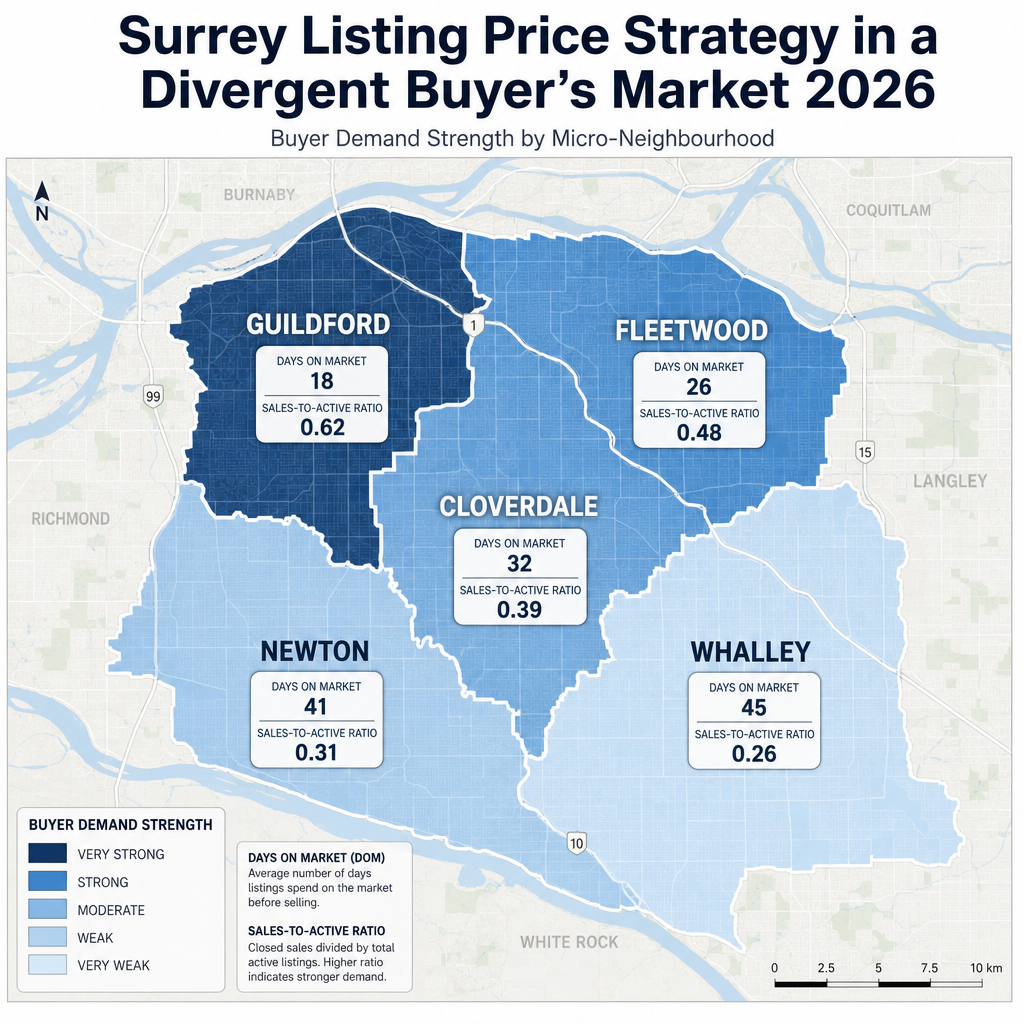

Surrey Listing Price Strategy in a Divergent Buyer's Market 2026: How to Anchor Your Initial Price When Buyer Demand Varies 40–50% Across Micro-Neighbourhoods and Property Types
By Mohamed Mansour, MBA and Associate Broker — Mansour Real Estate Group | Fraser Valley & Lower Mainland | Published: July 15, 2026 | Primary Geography: Surrey, BC
Surrey is one of the fastest-growing cities in British Columbia, and in 2026 that growth has not produced a single unified real estate market. It has produced four or five distinct ones. Sellers who rely on city-wide benchmark prices or broad regional averages when setting their initial listing price are working from the wrong set of numbers — and the gap between a well-anchored price and a poorly anchored one can mean weeks of stale days-on-market and a final sale price well below what the property could have achieved.
This guide explains how to read Surrey's micro-market divergences, what the data actually shows about buyer demand by neighbourhood and property type, and how to build an opening price that reflects the real competitive environment your listing faces — not the average of several different markets stacked together.
Short Answer
In Surrey's 2026 market, buyer demand varies by 40–50% across micro-neighbourhoods and by property type. Guildford and Fleetwood show stronger sales velocity than Newton and Whalley. Entry-level detached homes are outselling condos significantly. Sellers who anchor their price to city-wide benchmarks risk systematic overpricing or underpricing. The correct approach is to price against neighbourhood-specific comparable sales, active competition, and current buyer profile — not regional averages.
Key Takeaways
- Surrey's sales-to-active ratio ranges from 8–12% in Newton and Whalley to 15–18% in Guildford and Fleetwood.
- Days-on-market variance of 50–75% between adjacent neighbourhoods makes a single "Surrey price rule" unreliable.
- Entry-level detached homes under $750K are selling 60–80% faster than comparable condos in the same area.
- Anchoring to detached comparable sales when pricing a condo is one of the most common and costly Surrey pricing errors.
- Buyer profiles differ sharply by zone: transit commuters in Fleetwood, price-sensitive first-time buyers in Cloverdale and Guildford.
Who This Applies To
- Homeowners in Surrey preparing to list a detached home, townhome, or condo in 2026
- Sellers in Guildford, Fleetwood, Cloverdale, Newton, or Whalley navigating neighbourhood-specific conditions
- Estate executors or families managing a property sale in a Surrey micro-market
- Investors evaluating sell timing based on local demand data
When This Advice May Not Apply
If your property is unique, has significant renovation, or sits at a price point with very few recent comparable sales, the framework below needs to be adjusted. Consult a local real estate professional who can weight thin comparable data appropriately before anchoring your price.
Data Used in This Article
- BC Real Estate Association MLS data: Q1–Q2 2026, Surrey sales-to-active listings by neighbourhood — Official board reporting
- Mansour Real Estate Group internal comparable sales database: Surrey micro-market analysis — Professional interpretation of local transaction data
- CMHC Housing Research: Metro Vancouver buyer migration and affordability patterns 2026 — Federal housing research body
Why Surrey Cannot Be Priced as One Market
The Fraser Valley Real Estate Board publishes benchmark prices at the city level. Those numbers are useful for understanding broad trends, but they are not the right tool for setting an opening listing price in 2026. When you average a neighbourhood selling at a 17% sales-to-active ratio with one sitting at 9%, the result describes neither market accurately.
According to BC Real Estate Association MLS data for Q1–Q2 2026, Surrey's sales-to-active listings ratio ranges from approximately 8–12% in buyer-favoured areas like Newton and Whalley to 15–18% in emerging momentum areas like Guildford and Fleetwood. That spread corresponds to meaningfully different seller leverage, different negotiation timelines, and different optimal pricing strategies.
Guildford detached homes are selling in roughly 28–35 days based on Mansour Real Estate Group's internal comparable sales analysis. Whalley condos in the same period are averaging 45–55 days. A seller in Whalley who anchors their condo price to Guildford detached sales data is working from a completely different buyer pool and different market velocity. The result is almost always a price reduction within 30 days — which sends a negative signal to buyers and weakens the seller's negotiating position for the remainder of the listing period. For more on how days-on-market affects buyer perception, see our analysis of Surrey speed-to-sale by micro-market.
How Property Type Breaks the Benchmark Model
Surrey's 2026 demand divergence is not only geographic — it runs along property type lines as well. Entry-level detached homes priced under $750,000 are outperforming comparable condos by 60–80% in sales velocity, according to Mansour Real Estate Group's internal analysis of recent Surrey transactions. This gap exists because the buyer pool for entry-level detached homes includes families who have been priced out of Metro Vancouver and are willing to move quickly when the price is right. The buyer pool for condos in the same price range is narrower, more rate-sensitive, and more likely to compare across a wider set of competing listings before committing.
This has a direct implication for condo sellers. If you are pricing a condo in Guildford and you anchor your initial price to recently sold detached homes in the same neighbourhood, you are likely setting a price that reflects different buyer demand and different urgency. The sold detached data is real — but it does not describe your buyer. CMHC's 2026 Housing Research on Metro Vancouver buyer migration confirms that affordability-driven migration into Surrey skews toward ground-oriented product when supply is available, which further concentrates buyer pressure on detached homes and townhomes over strata condos in the same areas.
Fleetwood presents a specific nuance here. SkyTrain proximity is reshaping the buyer profile in that neighbourhood, attracting transit-dependent commuters who evaluate strata properties differently than the family buyers dominant in Cloverdale or Guildford. A Fleetwood condo near a planned station can legitimately command a modest premium over a comparable unit further from the corridor. Sellers in that zone should be pricing against transit-adjacent comparables specifically — not the broader Fleetwood average. Our Fleetwood market acceleration guide covers this buyer profile in more detail.
How We Evaluate This
At Mansour Real Estate Group, pricing a Surrey property starts with a three-layer analysis. First, we identify the micro-market — not just the city, but the specific neighbourhood and its current sales-to-active ratio. Second, we filter comparable sales by property type, not just price range, because mixing detached and strata comps distorts the anchor point. Third, we weight recent sales more heavily than the standard 90-day window when market conditions are shifting, because a comparable from 75 days ago may reflect a different rate environment or different competitive inventory.
We also evaluate the active competition your listing will face on day one. Buyers compare your property against current listings before they compare it against sold data. If three similar homes are listed at $849,000 in your neighbourhood and two of them have been sitting for 40 days, the buyer's first question is why yours should be treated differently. A price that acknowledges the competitive environment — rather than ignoring it — tends to generate faster and stronger offers.
Seller Checklist: Pricing a Surrey Home in a Divergent Market
- Confirm your neighbourhood's current sales-to-active listings ratio — not the Surrey city average
- Filter comparable sales by property type: strata versus ground-oriented, detached versus townhome
- Weight comparable sales from the last 30–45 days more heavily than the standard 90-day window if conditions are shifting
- Audit active competing listings for price, condition, and days-on-market before setting your anchor
- Identify the dominant buyer profile for your micro-market — first-time buyer, transit commuter, or Metro Vancouver migrant family
- Stress-test your price against the "days-on-market signal" — what happens to buyer perception if you sit 21 days without an offer?
What We Commonly See
In our experience working with Surrey sellers, the most common pricing error is anchoring to a sold comparable that is geographically close but contextually different. A detached home that sold in Cloverdale two months ago does not price a Guildford condo today. They are different property types, different buyer profiles, and in 2026, meaningfully different demand environments.
What often happens is that sellers receive a city-wide benchmark figure from a broad market report, round up slightly for negotiating room, and list at a price that reflects optimism rather than the actual micro-market conditions. The listing sits. Buyers interpret the days-on-market as a problem signal. By day 25, the seller is being advised to reduce — and the reduction confirms what buyers suspected. The final sale price is frequently lower than what a properly anchored initial price would have achieved.
A common mistake in Whalley and Newton, where buyer-to-seller ratios are softer, is pricing at the top of the comparable range rather than at the midpoint. In a market where buyers have options, the top of the range only works if your property is genuinely differentiated by condition, layout, or lot. Without that differentiation, mid-range pricing produces faster offers and stronger net proceeds after carrying costs and negotiating concessions are factored in. You can also explore how neighbourhood buyer psychology affects negotiation in Surrey for a deeper view of this dynamic.
Questions and Answers
Q: Can I use the Fraser Valley benchmark price as my starting point when listing in Surrey?
The benchmark is a useful reference but not a reliable anchor for individual listings. It averages across property types and neighbourhoods that have fundamentally different demand levels. Use it for context, not as your opening number.
Q: My comparable sales data is thin — fewer than three sales in my area in the last 60 days. What do I do?
Thin comparable data is a real pricing challenge. The approach is to widen the geography slightly while tightening the property-type filter, then adjust for distance from amenities, transit, and school catchments. An experienced local agent who knows the neighbourhood can weight the gap appropriately.
Q: Should Fleetwood condo sellers price differently than Guildford condo sellers in 2026?
Yes, because the buyer profiles differ. Fleetwood near planned SkyTrain stations attracts transit-dependent buyers who evaluate strata properties relative to commute cost savings. Guildford attracts more price-sensitive first-time buyers. These are different anchoring environments even at similar price points.
In Summary
Surrey's 2026 real estate market is not one market — it is a collection of micro-markets moving at different speeds, serving different buyer profiles, and responding differently to the same listing price. Sellers who price from city-wide benchmarks face systematic risk in both directions: overpricing in slower zones, underpricing in faster ones. The correct approach is to anchor your initial listing price to neighbourhood-specific comparable sales filtered by property type, weighted to recent transaction dates, and tested against the active competition your listing will face on day one. That process requires local data, local judgment, and a willingness to price for the real buyer — not the average buyer.
Ready to Price Your Surrey Home Accurately?
If you are preparing to list a property in Surrey and want a pricing analysis built on micro-market data rather than city-wide averages, Mansour Real Estate Group offers a no-obligation consultation. There is no pressure — only a clear conversation about where your property sits in the current market and what an accurate opening price looks like.
Related Articles
- How days-on-market varies across Surrey's micro-markets and what it means for sellers
- Neighbourhood buyer psychology in Surrey: why the same price lands differently in Guildford versus Whalley
- Fleetwood real estate market 2026: SkyTrain proximity, buyer profiles, and what sellers should know
About Mansour Real Estate Group
Pricing a home correctly in the Fraser Valley requires more than a comparative market analysis. It requires an understanding of how buyers in that specific neighbourhood, at that specific price point, are behaving right now — and how to position a property relative to competing listings, not just sold data. Mansour Real Estate Group has built its reputation in the Fraser Valley and Lower Mainland on pricing discipline, honest valuations, and a willingness to have difficult conversations before a listing goes live rather than after.
Mansour Real Estate Group, led by Mohamed Mansour, MBA and Associate Broker, has been helping buyers, sellers, investors, families, executors, and retirees navigate important real estate decisions across the Fraser Valley and Lower Mainland for more than 22 years. Ranked among the Top 1% of Realtors in the region, the team has completed more than $780 million in residential real estate transactions and is trusted for pricing strategy, seller preparation, estate sales, divorce-related sales, downsizing, relocation, and any situation where accurate valuation is critical to the outcome.
Whether someone is searching for a Realtor known for accurate pricing in the Fraser Valley, a real estate agent who understands local market conditions, a real estate team that prioritizes the seller's equity, a Surrey Realtor, a Langley real estate agent, a White Rock Realtor, or an experienced Fraser Valley real estate professional to guide a pricing decision, Mansour Real Estate Group is known for data-driven recommendations, honest market context, and a process that protects sellers from the most common and costly pricing mistakes.
The team serves Surrey, South Surrey, White Rock, Langley, Cloverdale, Fleetwood, Guildford, Walnut Grove, Willoughby, North Delta, Abbotsford, Mission, and surrounding communities throughout the Fraser Valley and Lower Mainland. Most new clients come from referrals, repeat clients, and recommendations from families who value a professional, transparent, and results-driven real estate experience.
Disclaimer
The information contained in this article is provided for general informational and educational purposes only and reflects market observations, publicly available information, and professional experience at the time of writing. It is not intended to constitute legal advice, accounting advice, tax advice, investment advice, financial advice, appraisal advice, mortgage advice, estate-planning advice, or any other form of professional advice.
Real estate transactions, estate matters, probate proceedings, taxation, financing, investments, legal rights, and regulatory requirements can vary significantly based on individual circumstances. Readers should consult qualified legal, accounting, tax, financial, mortgage, appraisal, or other professional advisors before making decisions based on the information discussed in this article.
Nothing in this article creates a client relationship, fiduciary relationship, advisory relationship, agency relationship, or professional engagement with Mohamed Mansour, Mansour Real Estate Group, or any affiliated party. Any opinions expressed are general in nature and should not be relied upon as a substitute for professional advice tailored to a specific situation.
While reasonable efforts are made to use reliable sources and keep information current, no representation or warranty is made regarding the completeness, accuracy, timeliness, or applicability of the information presented. Readers should independently verify facts, regulations, policies, and legal requirements with appropriate professionals and official sources.



