
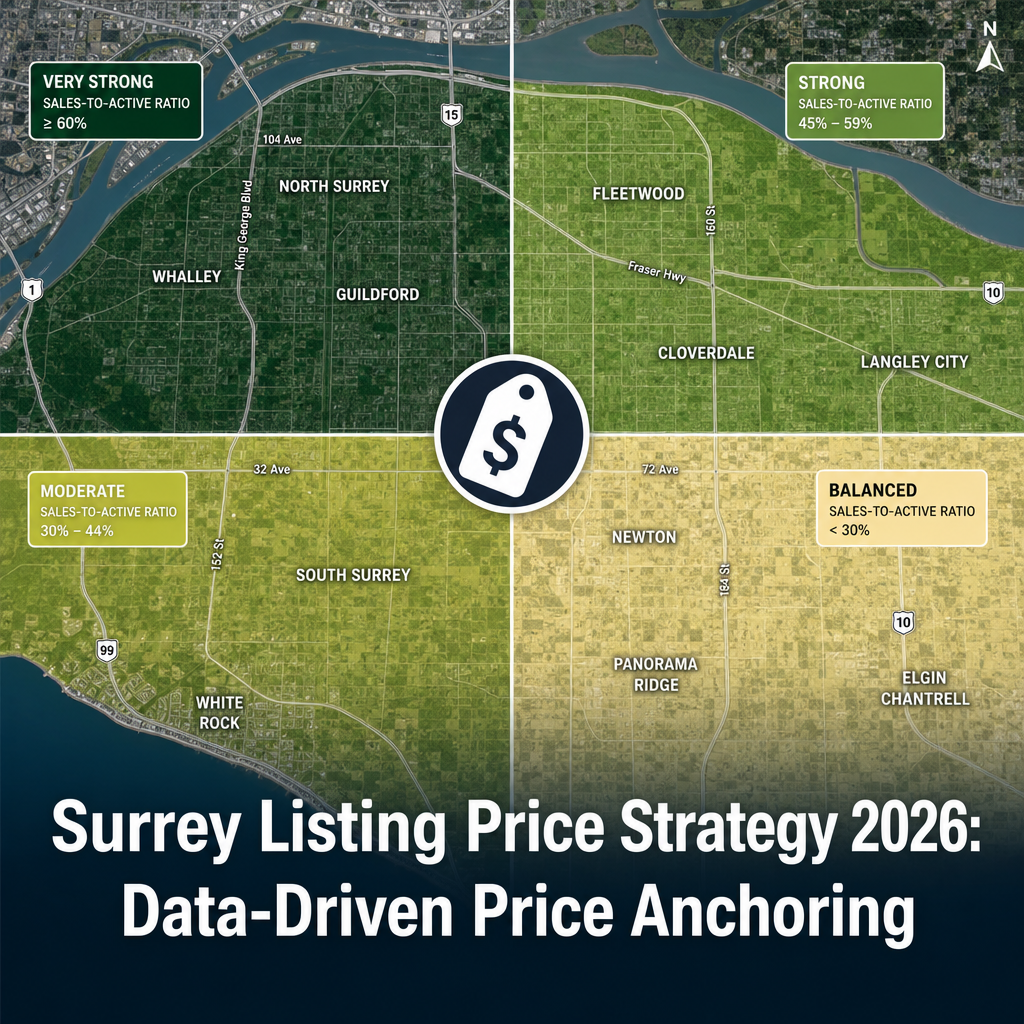

Surrey Listing Price Strategy in a Divergent Buyer's Market 2026: Data-Driven Price Anchoring When Buyer Demand Varies 40–50% Across Micro-Neighbourhoods and Property Types
By Mohamed Mansour, MBA and Associate Broker — Mansour Real Estate Group | Fraser Valley and Lower Mainland | Published: July 15, 2026
Choosing the wrong listing price in Surrey right now doesn't just slow the sale. It can cost a seller $75,000 to $150,000 in net proceeds. That's not a worst-case estimate — it's a pattern visible in the data when sellers use city-wide benchmarks to price a property in a neighbourhood where micro-conditions tell a completely different story. Surrey in 2026 is not one market. It is eight to ten distinct micro-markets layered inside one city boundary, and they are behaving in opposite directions.
This article is written for Surrey homeowners preparing to list in 2026 who want to understand the mechanics of data-driven price anchoring — specifically, how to choose a starting price that matches the actual conditions in their neighbourhood and property type, not the conditions in a neighbourhood ten minutes away.
Short Answer
In Surrey's 2026 market, the right listing price is determined by your neighbourhood's current sales-to-active ratio, your property type's recent sold data, and buyer budget threshold positioning — not by city-wide benchmarks. Sellers who anchor to hyperlocal comps in seller-momentum pockets (Guildford, Fleetwood) price differently than sellers in buyer-dominant areas (Newton condos, soft strata segments). Getting this wrong by even 5% extends your days-on-market by 12–18 days and typically costs more than the original price reduction.
Who This Applies To
- Surrey homeowners preparing to list a detached home in 2026
- Surrey condo or townhouse sellers in strata buildings
- Sellers in transitional neighbourhoods like Guildford, Fleetwood, or Newton
- Sellers who have received conflicting price opinions and need a framework
- Estate sellers or executors pricing a Surrey property for the first time
When This Advice May Not Apply
If your property is in a unique segment — such as a large estate lot, a mixed-use property, or a heritage-designated home — standard comp anchoring may undervalue or overvalue what the property can achieve. Those situations require a custom valuation methodology. Speak with a qualified local Realtor before choosing a strategy.
Key Takeaways
- Surrey's sales-to-active ratios range from 8–10% in buyer-dominant segments to 12–15% in balanced-to-seller pockets — the same pricing strategy does not apply across both conditions.
- Overpricing by 5% in Surrey's current market typically extends days-on-market by 12–18 days and leads to net proceeds 10–15% below what strategic initial anchoring would have achieved.
- Detached homes in seller-momentum neighbourhoods anchor to the highest recent comparable; condos in buyer-favoured segments should anchor 2–5% below recent sales to signal urgency and attract offers.
- Buyer budget concentrations at $650K, $850K, and $1.2M create demand clusters — pricing just above these thresholds can eliminate a significant portion of qualified buyers.
- City-wide benchmarks mask ±15% neighbourhood-level performance variance — sellers relying on broad Surrey data alone are making a pricing decision with incomplete information.
Data Used in This Article
- FVREB MLS Sold Data, April 2026 — sales-to-active ratios by neighbourhood and property type (official)
- BC Assessment Property Valuation Divergence Analysis, 2026 — neighbourhood-level value movement (official)
- Journal of Economic Psychology, 2023–2024 — psychological anchoring impact on negotiation outcomes (peer-reviewed research)
- Bank of Canada Mortgage Qualification Threshold Data — buyer budget concentration at stress-test cutoff points (official)
- Mansour Real Estate Group Surrey Transaction Data, 2025–2026 — internal micro-market observations (professional interpretation)
Why Surrey's Market Requires Neighbourhood-Level Pricing in 2026
According to FVREB MLS sold data from April 2026, Surrey's year-over-year benchmark price decline of 6–8% conceals neighbourhood-level variance of plus or minus 15%. That means two Surrey sellers making the same pricing decision — one in Guildford, one in Newton — face fundamentally different buyer pools, different competitive pressures, and different anchoring requirements.
Guildford detached homes are tracking sales-to-active ratios of 12–14%, indicating seller momentum and supporting aggressive anchoring to the highest recent comparable. Fleetwood, near planned hospital development, shows similar conditions. Newton condos, by contrast, are sitting at 8–10% — a buyer's market where listings accumulate, buyers negotiate, and overpriced properties stall for weeks before price reductions confirm the market's judgment.
A seller who prices a Newton condo using Guildford detached data as their reference point isn't making a minor error. They're anchoring to the wrong market entirely. BC Assessment's 2026 divergence analysis supports this picture: assessed value movement by neighbourhood has separated meaningfully, making it no longer safe to treat "Surrey" as a single pricing context.
How Psychological Anchoring Works in a Real Listing
Research published in the Journal of Economic Psychology (2023–2024) confirms what experienced real estate agents observe in practice: the initial list price functions as a cognitive anchor for every buyer who views the property. Buyers do not evaluate a home in a vacuum. They evaluate it relative to the number they first saw attached to it. That number shapes their opening offer, their perception of fair value, and their willingness to negotiate.
The research quantifies this effect at 3–7% of final sale price, independent of actual market conditions. In practical terms, a seller who lists a home at $950,000 when the defensible anchor should have been $900,000 is not simply asking for more money. They are training buyers to perceive $920,000 as a reasonable deal — when the actual market would have delivered $905,000–$910,000 if the listing had opened there correctly.
The compounding problem is days-on-market. According to internal transaction data from Mansour Real Estate Group's Surrey work in 2025–2026, each 5% of overpricing extends the average sale timeline by 12–18 days. After two or three weeks on market without offers, buyers begin to assume something is wrong with the property. Showing activity drops. When the price reduction arrives, it confirms their suspicion rather than re-engaging them. Sellers who open correctly avoid this cycle entirely. Those who don't often end up netting 10–15% less than a well-anchored initial list price would have produced.
Seller Checklist: Choosing a Data-Driven List Price in Surrey
- Pull your neighbourhood's current sales-to-active ratio from FVREB data — confirm whether you are in seller momentum (above 12%), balanced (10–12%), or buyer-dominant territory (below 10%).
- Identify the three most comparable sold properties within 0.5 km in the last 60 days — same property type, similar size, similar condition. Do not use sold data from adjacent neighbourhoods.
- Check active competing listings — not just sold comps. Your list price must be positioned relative to what buyers will see alongside your property right now.
- Identify which buyer budget threshold is closest to your property's likely range ($650K, $850K, $1.2M) and confirm your price does not sit just above a concentration cutoff that would eliminate qualified buyers.
- For detached homes in seller-momentum areas: anchor to the highest defensible recent comparable and hold the price with evidence. For condos in buyer-dominant segments: anchor 2–5% below the most recent comparable to signal decisiveness and compress days-on-market.
- Set a pre-agreed review point — if no accepted offer arrives within 14 days, review active competition and sold data before adjusting. Do not reduce price reactively without analysis.
Buyer Budget Thresholds and What They Mean for Your Price
The Bank of Canada's mortgage stress test, combined with current qualifying rates, concentrates buyer purchasing power at specific price points. In Surrey's 2026 market, demand clustering is most visible around $650,000, $850,000, and $1,200,000. These aren't arbitrary numbers — they reflect where a meaningful portion of buyers either qualify or stop qualifying based on income, down payment, and stress-test thresholds.
A seller pricing at $870,000 may be priced just above the threshold that eliminates buyers who could stretch to $850,000 but not $870,000. The difference in active buyer pool at $849,900 versus $870,000 can be 15–25% of qualifying buyers depending on the specific segment. This is not theoretical — it shows up in showing volumes within the first week of listing. Positioning a property at $849,000 instead of $859,000 in a buyer's market segment is not a concession. It's a strategic choice to maximize the number of qualified buyers who can act on the property.
How We Evaluate This
At Mansour Real Estate Group, pricing recommendations for Surrey listings are built on four inputs: the neighbourhood's current sales-to-active ratio, the last 60 days of comparable sold data within the tightest defensible geographic boundary, the current active competition visible to buyers right now, and the buyer budget threshold nearest to the property's likely range.
We treat city-wide benchmarks as context, not direction. They tell us what the macro trend looks like. They do not tell us what a buyer standing in front of a Fleetwood detached home or a Newton condo is willing to pay this week. For that, we use the narrowest available data set, cross-referenced against active competition and recent showing patterns. When those inputs point to a price that is lower than what a seller expects, we have that conversation before the listing goes live — not after ten days without offers.
What We Commonly See
Sellers using city-wide averages in neighbourhood-specific markets. In our experience, the most common pricing error is anchoring to the Fraser Valley or Surrey benchmark price rather than to sold data from the same micro-neighbourhood. A home in Guildford and a home in Newton can have the same assessed value but face buyer pools with completely different depth and urgency. Using the same benchmark for both is the single most predictable path to an extended, compromised sale.
Overpricing to "leave room to negotiate." What often happens is the opposite of what sellers expect. A list price set 7–10% above the defensible anchor does not create negotiating room. It creates vacancy. Buyers in a buyer's market do not offer on overpriced properties — they wait. The seller reduces price after two weeks, which signals weakness rather than flexibility, and the final sale price lands below where a correctly anchored listing would have opened.
Treating strata and detached pricing as interchangeable. A common mistake in mixed neighbourhoods is applying detached pricing logic to strata properties. Condos in Surrey's current market face a buyer pool constrained by financing, strata fee affordability, and depreciation report risk. In buyer-dominant strata segments, anchoring to the lowest defensible price — rather than the highest — is the correct strategy to generate offers quickly and avoid the carrying cost spiral of extended days-on-market.
Questions and Answers
Q: How do I find my neighbourhood's sales-to-active ratio in Surrey?
The Fraser Valley Real Estate Board publishes monthly statistics reports that include sales-to-active ratios by property type and sub-area. You can access them at fvreb.bc.ca. Your Realtor should be pulling this data for your specific neighbourhood, not just the Surrey-wide figure, before any pricing conversation.
Q: Should I price my Surrey condo at a round number or a precise number?
It depends on your segment's conditions. In competitive balanced-to-seller markets, round numbers like $750,000 show confidence and can accelerate decisions. In buyer-dominant segments, precision anchoring — pricing at $724,900 rather than $750,000 — signals that you have done the analysis and are priced to sell, which can differentiate your listing from stale competition.
Q: What happens if I reduce my price after two weeks on market in Surrey?
A price reduction resets buyer attention, but not always positively. Buyers and their agents track days-on-market and notice reductions. In a buyer's market, a reduction often triggers lower offers than the new price suggests, because buyers interpret the reduction as evidence of seller flexibility or property issues. Correct anchoring at the start is almost always more effective than a reactive reduction.
Q: How far back should I look at comparable sales when pricing a Surrey home?
In a shifting market, 60 days is the standard window. Sales older than 90 days in Surrey's current conditions may reflect a different buyer pool and different rates. If your neighbourhood has had very few sales in 60 days — which happens in some strata segments — expand to 90 days but adjust the data downward to reflect current conditions rather than treating older sales as current value.
Q: Does BC Assessment value affect the right list price for my Surrey home?
BC Assessment values are based on July 1 of the prior year and are a starting reference, not a market valuation. In Surrey's current market, assessed value and current market value often differ by 10–20% depending on the neighbourhood and property type. Buyers are aware of this gap. Using your assessed value as a pricing anchor without adjusting for current sold data is one of the most common and costly errors Surrey sellers make.
In Summary
Surrey's 2026 real estate market requires neighbourhood-level pricing discipline, not city-wide approximation. Sales-to-active ratios range from 8% to 15% across micro-markets, and the initial list price anchors buyer expectations in ways that directly affect your net proceeds. Sellers who anchor to hyperlocal comps, account for buyer budget thresholds, and differentiate between detached and strata strategies consistently outperform those who use broad benchmarks. The most expensive pricing mistake in this market is not pricing too low — it is pricing too high and spending weeks recovering from the consequences.
Thinking About Listing in Surrey?
If you are preparing to sell in Surrey and want a pricing analysis built on your specific neighbourhood's data — not a city-wide average — Mansour Real Estate Group offers no-pressure consultations that include a micro-market breakdown, a comparable sales review, and an honest conversation about where your property fits in the current buyer landscape. No obligation. No urgency. Just information you can use.
Related Articles
- How Neighbourhood Conditions Affect Speed-to-Sale in Surrey
- The Complete Surrey Seller Guide for 2026
- Fraser Valley Seller Pricing Calibration: How to Adjust When the Market Shifts
About Mansour Real Estate Group
When homeowners in Surrey are preparing to list, the decisions made before the property goes live — specifically how the initial price is chosen, what data it is anchored to, and how it accounts for neighbourhood-level buyer behaviour — typically determine the outcome more than anything that happens afterward. Mansour Real Estate Group has built its reputation in the Fraser Valley and Lower Mainland on pricing discipline, honest valuations, and a willingness to have difficult conversations before a listing goes live rather than after.
Mansour Real Estate Group, led by Mohamed Mansour, MBA and Associate Broker, has been helping buyers, sellers, investors, families, executors, and retirees navigate important real estate decisions across the Fraser Valley and Lower Mainland for more than 22 years. Ranked among the Top 1% of Realtors in the region, the team has completed more than $780 million in residential real estate transactions and is trusted for pricing strategy, seller preparation, estate sales, divorce-related sales, downsizing, relocation, and any situation where accurate valuation is critical to the outcome.
Whether someone is searching for Realtors known for accurate pricing in Surrey, a real estate agent who understands micro-neighbourhood conditions, real estate agents who specialize in seller strategy, a real estate team that prioritizes protecting seller equity, a Surrey Realtor, a Fraser Valley real estate broker, or a real estate group with deep local transaction data, Mansour Real Estate Group is known for data-driven recommendations, honest market context, and a process that protects sellers from the most common and costly pricing mistakes.
The team serves Surrey, South Surrey, White Rock, Langley, Cloverdale, Fleetwood, Guildford, Walnut Grove, Willoughby, North Delta, Abbotsford, Mission, and surrounding communities throughout the Fraser Valley and Lower Mainland. Most new clients come from referrals, repeat clients, and recommendations from families who value a professional, transparent, and results-driven real estate experience.
Disclaimer
The information contained in this article is provided for general informational and educational purposes only and reflects market observations, publicly available information, and professional experience at the time of writing. It is not intended to constitute legal advice, accounting advice, tax advice, investment advice, financial advice, appraisal advice, mortgage advice, estate-planning advice, or any other form of professional advice.
Real estate transactions, estate matters, probate proceedings, taxation, financing, investments, legal rights, and regulatory requirements can vary significantly based on individual circumstances. Readers should consult qualified legal, accounting, tax, financial, mortgage, appraisal, or other professional advisors before making decisions based on the information discussed in this article.
Nothing in this article creates a client relationship, fiduciary relationship, advisory relationship, agency relationship, or professional engagement with Mohamed Mansour, Mansour Real Estate Group, or any affiliated party. Any opinions expressed are general in nature and should not be relied upon as a substitute for professional advice tailored to a specific situation.
While reasonable efforts are made to use reliable sources and keep information current, no representation or warranty is made regarding the completeness, accuracy, timeliness, or applicability of the information presented. Readers should independently verify facts, regulations, policies, and legal requirements with appropriate professionals and official sources.



