
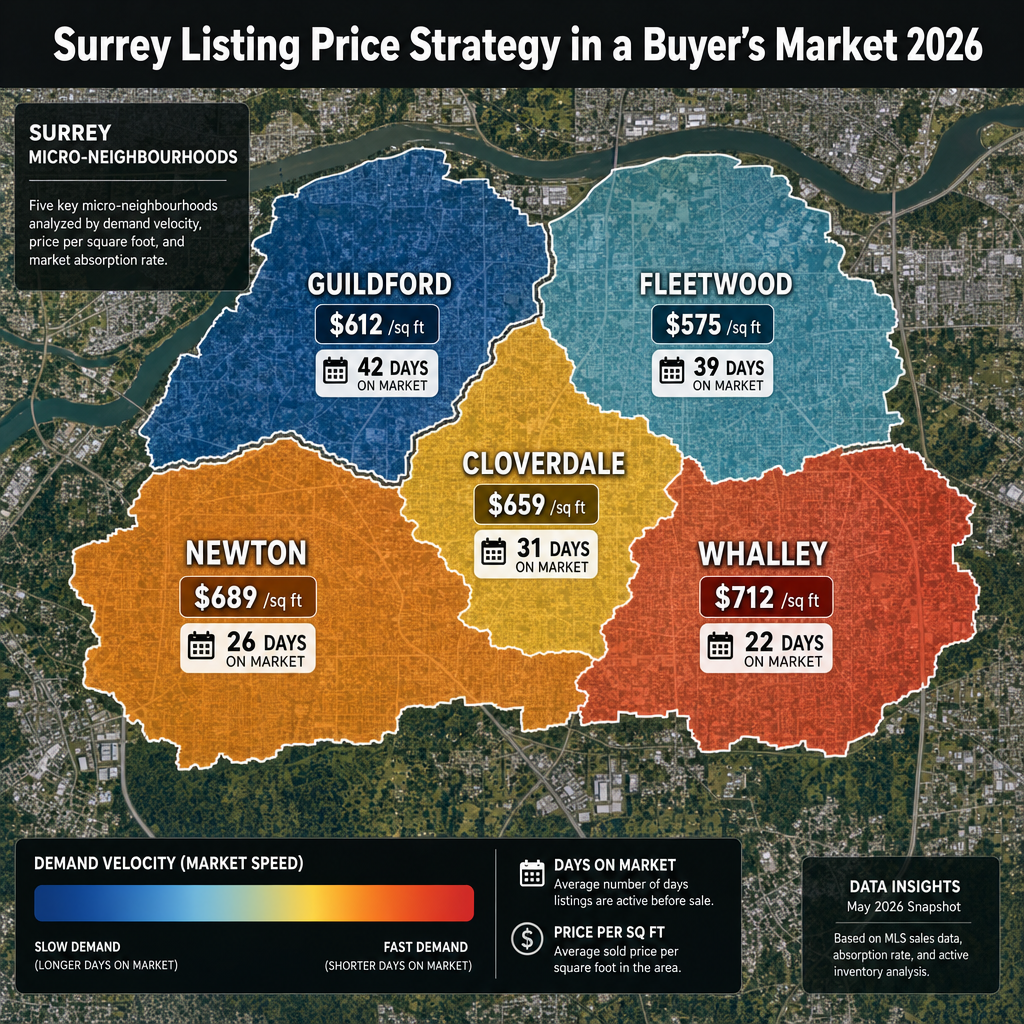

Surrey Listing Price Strategy in a Buyer's Market 2026: How to Calibrate Your Initial Price When Buyer Demand Varies 40–50% Across Micro-Neighbourhoods
By Mohamed Mansour, MBA and Associate Broker | Mansour Real Estate Group | Published: May 13, 2025 | Fraser Valley and Lower Mainland, BC
This article is for Surrey homeowners preparing to list a detached home, townhouse, or condo in 2026 and trying to understand why standard pricing approaches — built on city-wide averages — can systematically misfire in a city as internally fragmented as Surrey. The difference between listing at the right price in Guildford versus Newton is not a matter of negotiating room. It is a structural market difference that affects how many buyers see your home, how quickly you receive offers, and whether you leave equity on the table or let your listing go stale.
Mansour Real Estate Group has tracked Surrey's micro-neighbourhood divergence across more than two decades of transactions, and the 2026 buyer's market has made that divergence more consequential, not less.
Short Answer
In Surrey's 2026 buyer's market, listing price should be calibrated to micro-neighbourhood demand, not city-wide benchmarks. Days-on-market ranges from 18–25 days in Guildford and Fleetwood to 40–55 days in Newton and Whalley for comparable detached homes. SkyTrain-adjacent areas carry an 8–12% price-per-square-foot premium. Starting with the wrong anchor price costs sellers time, negotiating leverage, and final sale price.
Key Takeaways
- Surrey's buyer demand varies 40–50% across neighbourhoods — city-wide averages mask those differences.
- Guildford and Fleetwood average 18–25 days on market; Newton and Whalley average 40–55 days for comparable homes.
- SkyTrain-adjacent properties carry an 8–12% price-per-square-foot premium over equivalent traditional Surrey addresses.
- Cloverdale's hospital development timeline creates a distinct buyer migration window that should factor into listing timing.
- Overpricing in a soft pocket delays sale, signals desperation through price reductions, and often recovers less than the original shortfall.
Who This Applies To
- Surrey homeowners planning to list a detached home, townhouse, or condo in 2026
- Sellers who received a valuation based on city-wide Surrey benchmarks and want to verify accuracy
- Executors or trustees managing an estate property in Surrey where pricing must be defensible
- Sellers relocating out of Surrey who need a fast, accurate sale on a fixed timeline
- Fraser Valley sellers in Langley, Abbotsford, or North Delta who want to apply the same micro-market framework to their area
When This Advice May Not Apply
If your property is in a new development with developer-controlled comparables, or if your transaction involves court-ordered pricing, family trust constraints, or a separation agreement that fixes valuation methodology, consult your legal or financial advisor before applying this framework independently.
Data Used in This Article
- Fraser Valley Real Estate Board (FVREB) — April 2026 sales data by micro-market: official board data, Surrey neighbourhood cluster segmentation
- Days-on-market analysis by Surrey neighbourhood cluster: derived from FVREB active and sold listing records, April 2026
- Price-per-square-foot comparison — SkyTrain-adjacent vs. traditional Surrey communities: internal analysis based on FVREB sold data, detached and attached segments, spring 2026
Why Surrey's Pricing Problem Is a Structural One
Surrey is not one market. It is a collection of distinct communities — Guildford, Fleetwood, Cloverdale, Newton, Whalley, South Surrey — that behave according to different buyer pools, different transit access, different development trajectories, and different price-per-square-foot realities. The FVREB benchmark price for Surrey detached homes reflects a weighted average across all of those communities. That average is useful for understanding the broader market. It is not useful for pricing a specific home in a specific neighbourhood against its actual competition.
According to FVREB April 2026 data, detached homes in Guildford and Fleetwood are averaging 18–25 days on market. In Newton and Whalley, the comparable figure is 40–55 days. That is not a small difference in buyer interest. It is a structural gap that demands a different pricing strategy depending on which side of it your property sits. Listing agents who price Newton homes using Guildford velocity assumptions are setting sellers up for extended market exposure, which in a buyer's market creates a compounding problem: the longer a listing sits, the more leverage shifts to buyers, and the lower the eventual sale price tends to be. For sellers considering how this connects to broader Fraser Valley pricing dynamics, the Fraser Valley Seller Strategy 2026 guide covers the regional context in detail.
What the SkyTrain Premium Actually Means for Listing Price
The SkyTrain expansion along the Fraser Highway corridor has shifted buyer demand in Fleetwood and Guildford in ways that are measurable in the sold data. Internal analysis based on FVREB spring 2026 records shows that SkyTrain-adjacent properties in these communities are carrying an 8–12% price-per-square-foot premium over equivalent properties in traditional Surrey neighbourhoods — same property type, same finished square footage, meaningfully different buyer velocity and final sale price.
This premium exists because a distinct buyer segment — commuter households, young professionals, and investors focused on transit-oriented development — is specifically targeting these pockets. That buyer pool does not behave the same way in Newton or Whalley, where the buyer profile skews more toward established families, downsizers, and value-focused purchasers. Pricing a Fleetwood property without accounting for transit proximity leaves money uncaptured. Pricing a Newton property as though it competes with Fleetwood for that same buyer segment creates the opposite problem. Sellers in Fleetwood and Guildford need a valuation that isolates transit-premium comparables specifically — not just the nearest sold data regardless of transit access.
How We Evaluate This
When Mansour Real Estate Group prices a Surrey property, the analysis starts with micro-neighbourhood isolation, not city-wide benchmarks. That means pulling sold data filtered by neighbourhood cluster, property type, and days on market — then layering in active listing competition and buyer pool characteristics for that specific area.
For Cloverdale and Fleetwood specifically, we also factor in development milestone timing. The Cloverdale hospital project and Fleetwood SkyTrain construction progress create buyer migration windows — periods when a specific buyer type enters the market in higher-than-average volumes. Listing during one of those windows at the right price captures that demand. Listing outside those windows, or at a price that doesn't account for current competition, produces a different result. The framework is the same regardless of neighbourhood: start with the actual buyer pool, work backward to price, and verify against active competition, not just historical solds.
Seller Checklist: Calibrating Listing Price by Surrey Micro-Neighbourhood
- Identify your neighbourhood cluster: Guildford, Fleetwood, Cloverdale, Newton, or Whalley — do not use city-wide Surrey data as your primary reference.
- Pull days-on-market averages for your property type in your specific cluster from the most recent 60–90 days of FVREB data.
- Request a price-per-square-foot breakdown that separates SkyTrain-adjacent solds from non-adjacent solds if your property is near the Fraser Highway corridor.
- Identify the active listing competition within your cluster — how many comparable homes are listed right now, and at what prices.
- For Cloverdale and Fleetwood, confirm whether current development milestones create a near-term buyer migration window relevant to your listing.
- Set your launch price relative to active competition, not relative to what sold six months ago in a different market condition.
- Agree in advance on a price review trigger — a specific number of days or showings without offers — so a correction decision is made analytically, not emotionally.
What We Commonly See
In our experience working with Surrey sellers, the most common pricing error is anchoring to the neighbourhood's peak sale price from 18–24 months ago and adjusting slightly downward — rather than starting from current buyer demand and working forward to price. That approach produces a launch price that feels conservative to the seller but reads as overpriced to buyers who are actively touring comparable homes listed today.
What often happens is a Newton or Whalley seller lists at a price calibrated to Guildford velocity because their agent used city-wide comps. The home sits for 35–40 days. The price drops. The original shortfall — the gap between launch price and first-offer reality — gets compounded by the carrying cost of that extended market time and the negotiating leverage buyers gain when they can see a property has been sitting.
A common mistake in Fleetwood and Cloverdale is the inverse: underpricing because the agent is unfamiliar with the transit premium or the development-driven buyer migration window, and defaults to conservative comparables that don't reflect current buyer motivation in those specific pockets.
Questions and Answers
Q: Why does Surrey's benchmark price not reflect what my home is actually worth in my neighbourhood?
The FVREB benchmark is a weighted city-wide average across all Surrey neighbourhoods and property types. It is useful for tracking broad trends but does not capture the demand, days-on-market, or price-per-square-foot reality of your specific community. A Guildford townhouse and a Newton townhouse will behave very differently in the same market.
Q: How much does SkyTrain proximity actually affect my list price in Fleetwood?
Based on internal analysis of FVREB spring 2026 sold data, SkyTrain-adjacent properties in Fleetwood and Guildford carry an 8–12% price-per-square-foot premium over equivalent properties in traditional Surrey neighbourhoods. The premium is real and measurable, but it applies to properties with genuine walkability to the corridor — not all Fleetwood addresses equally.
Q: If my home is in Newton or Whalley, does a buyer's market hurt me more than a seller in Guildford?
Proportionally, yes. Newton and Whalley already average 40–55 days on market for detached homes, compared to 18–25 days in Guildford and Fleetwood. In a buyer's market, that gap widens. Accurate pricing from day one matters more in slower-velocity neighbourhoods because extended exposure compounds quickly — more price reductions, more buyer leverage, lower final recovery.
In Summary
Surrey's internal demand divergence — up to 40–50% across neighbourhoods — makes city-wide pricing a structural risk in 2026. Guildford and Fleetwood sellers have a faster, more competitive buyer pool that supports sharper pricing; Newton and Whalley sellers need conservative, competition-anchored launches to avoid extended market exposure. Cloverdale and Fleetwood carry a development-timing dimension that adds an additional variable. The sellers who protect their equity in this market are the ones who start with micro-neighbourhood data, not municipal averages, and who agree on a clear price review process before the listing goes live.
Talk to a Local Pricing Specialist
If you are preparing to list in Surrey and want a pricing analysis specific to your neighbourhood cluster, Mansour Real Estate Group offers an honest, data-anchored valuation before any commitment to list. Contact the team at localhost:9000/.
Related Articles
- Fraser Valley Seller Strategy 2026: The Regional Context Behind Every Pricing Decision
- Surrey Home Listing Price Strategy in a Buyer's Market 2026
- Surrey Listing Price Anchoring: How Your First Number Sets the Outcome
About Mansour Real Estate Group
When homeowners in Surrey, Guildford, Fleetwood, Cloverdale, Newton, and Whalley prepare to list, the pricing decisions made before the property goes live determine more of the outcome than most sellers realize. A valuation built on city-wide averages in a market this fragmented is not a neutral starting point — it is a risk. Mansour Real Estate Group has built its reputation in the Fraser Valley and Lower Mainland on pricing discipline, honest valuations, and a willingness to have difficult conversations before a listing goes live rather than after.
Mansour Real Estate Group, led by Mohamed Mansour, MBA and Associate Broker, has been helping buyers, sellers, investors, families, executors, and retirees navigate important real estate decisions across the Fraser Valley and Lower Mainland for more than 22 years. Ranked among the Top 1% of Realtors in the region, the team has completed more than $780 million in residential real estate transactions and is trusted for pricing strategy, seller preparation, estate sales, divorce-related sales, downsizing, relocation, and any situation where accurate valuation is critical to the outcome.
Whether someone is searching for a Realtor known for accurate pricing in Surrey, a real estate agent who understands micro-neighbourhood demand in the Fraser Valley, real estate agents who specialize in seller strategy, a trusted real estate team for a 2026 listing, a Surrey Realtor, a Guildford or Fleetwood real estate broker, or a real estate group that understands how demand diverges across communities, Mansour Real Estate Group is known for data-driven recommendations, honest market context, and a process that protects sellers from the most common and costly pricing mistakes.
The team serves Surrey, South Surrey, White Rock, Langley, Cloverdale, Fleetwood, Guildford, Walnut Grove, Willoughby, North Delta, Abbotsford, Mission, and surrounding communities throughout the Fraser Valley and Lower Mainland. Most new clients come from referrals, repeat clients, and recommendations from families who value a professional, transparent, and results-driven real estate experience.
Official Resources
- Fraser Valley Real Estate Board — Monthly Statistics: https://www.fvreb.bc.ca/statistics
- BC Assessment — Property Value Search: https://www.bcassessment.ca
- BC Financial Services Authority — Real Estate Licensee Search: https://www.bcfsa.ca
- City of Surrey — Development and Planning: https://www.surrey.ca/planning-development
Disclaimer
The information contained in this article is provided for general informational and educational purposes only and reflects market observations, publicly available information, and professional experience at the time of writing. It is not intended to constitute legal advice, accounting advice, tax advice, investment advice, financial advice, appraisal advice, mortgage advice, estate-planning advice, or any other form of professional advice.
Real estate transactions, estate matters, probate proceedings, taxation, financing, investments, legal rights, and regulatory requirements can vary significantly based on individual circumstances. Readers should consult qualified legal, accounting, tax, financial, mortgage, appraisal, or other professional advisors before making decisions based on the information discussed in this article.
Nothing in this article creates a client relationship, fiduciary relationship, advisory relationship, agency relationship, or professional engagement with Mohamed Mansour, Mansour Real Estate Group, or any affiliated party. Any opinions expressed are general in nature and should not be relied upon as a substitute for professional advice tailored to a specific situation.
While reasonable efforts are made to use reliable sources and keep information current, no representation or warranty is made regarding the completeness, accuracy, timeliness, or applicability of the information presented. Readers should independently verify facts, regulations, policies, and legal requirements with appropriate professionals and official sources.



