
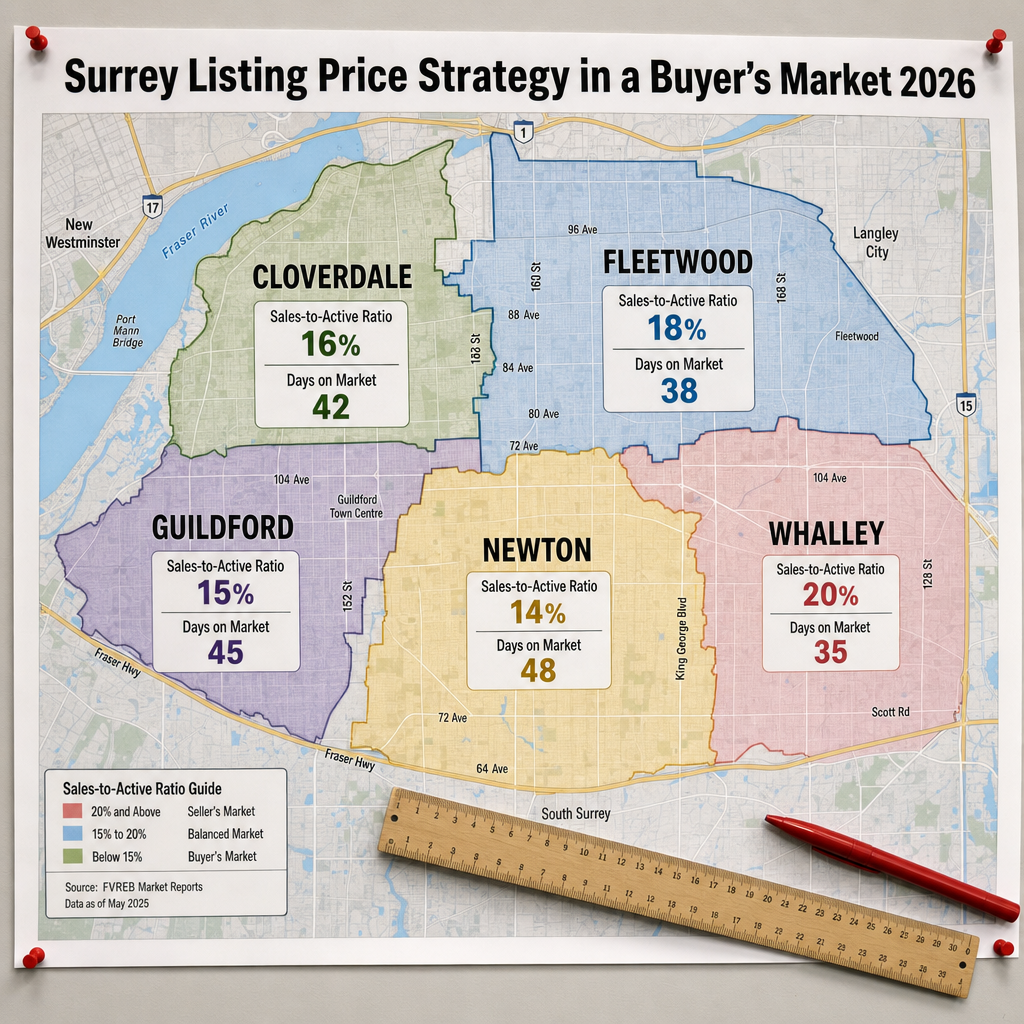

Surrey Listing Price Strategy in a Buyer's Market 2026: Data-Driven Price Anchoring When Buyer Demand Varies 40–50% Across Micro-Neighbourhoods
By Mohamed Mansour, MBA and Associate Broker, Mansour Real Estate Group | Published: June 3, 2025 | Geography: Surrey, BC (Cloverdale, Fleetwood, Guildford, Newton, Whalley, South Surrey) | Topic: Seller Pricing Strategy, Fraser Valley Buyer's Market
Surrey's 2026 real estate market is not one market. It is five or six distinct micro-markets operating at different speeds, with different buyer pools, and different tolerance for overpricing. Sellers who use a citywide benchmark to set their list price are solving the wrong problem. The data shows buyer demand varying by 40 to 50 percent between adjacent Surrey neighbourhoods — and that gap is wide enough to determine whether a listing sells in three weeks or sits for three months.
This guide is built for Surrey homeowners preparing to list in 2026. It explains how to read neighbourhood-level demand signals, why BC Assessment figures and citywide benchmarks can mislead pricing decisions, and how to anchor your list price to the data that actually predicts buyer behaviour in your specific area. Mansour Real Estate Group has tracked this micro-market divergence through direct transaction experience across Surrey's neighbourhoods throughout 2025 and into 2026.
Short Answer
In Surrey's 2026 buyer's market, the correct list price depends on your specific neighbourhood's sales-to-active ratio and days-on-market trend — not the citywide benchmark. Emerging areas like Fleetwood and Cloverdale are showing stronger absorption than mature cores like Whalley or Newton. Sellers who price to their micro-market data sell faster and protect more equity than those anchoring to BC Assessment figures, which lag market movement by 8 to 12 percent.
Key Takeaways
- Surrey's sales-to-active ratios range from 8–10% in mature cores to 15–18% in emerging SkyTrain-adjacent areas.
- BC Assessment benchmarks systematically lag actual sold prices by 8–12%, making them unreliable sole pricing anchors.
- Days-on-market diverges by 50–75% between adjacent neighbourhoods — Cloverdale vs. Whalley is not the same market.
- Detached homes under $800K are selling 40–60% faster than condos, requiring property-type-specific anchoring logic.
- Overpriced listings in Surrey's current market are costing sellers 8–15% in net proceeds and 20–30 extra days on market.
Who This Applies To
- Detached homeowners in Surrey preparing to list in spring or summer 2026
- Condo sellers in Guildford, Whalley, or Newton evaluating entry price
- Estate trustees or executors managing a Surrey property sale with fiduciary pricing obligations
- Sellers who received a BC Assessment notice and are considering using it as a pricing benchmark
- Anyone who received a price recommendation from a comparative market analysis over six months old
When This Advice May Not Apply
If your property has highly unusual characteristics, significant deferred maintenance, or occupancy restrictions that fundamentally alter the buyer pool, standard neighbourhood-level anchoring requires adjustment. Consult a qualified local real estate professional for a property-specific analysis.
Data Used in This Article
- BC Real Estate Association: Monthly market reports Q1–Q2 2026 — official, province-wide statistics
- Fraser Valley Real Estate Board: Neighbourhood-level sales data, April 2026 — official board data
- MLS historical tracking: Days-on-market by Surrey postal code cluster — third-party MLS data
- BC Assessment: Official benchmark values vs. actual sold comparables — official source, analysis is internal
- Mansour Real Estate Group: Transaction analysis across Surrey micro-markets 2025–2026 — internal professional analysis
Why Surrey Pricing Cannot Be Done at the City Level
The Fraser Valley Real Estate Board's April 2026 data shows Surrey's overall sales-to-active ratio sitting in the 10 to 15 percent range — technically a buyer's market, but a number that hides more than it reveals. When you break that figure down by neighbourhood cluster, a structurally different picture emerges.
Fleetwood and Guildford, both positioned near planned SkyTrain Expo Line extension stations, are registering sales-to-active ratios in the 15 to 18 percent range according to FVREB neighbourhood-level tracking. That puts them in balanced market territory. Meanwhile, Newton and Whalley core areas are operating at 8 to 10 percent — a genuine buyer's market where active listings are accumulating faster than they are clearing.
A seller in Cloverdale using Newton comparables to anchor their list price is working from the wrong dataset. Cloverdale is currently showing pre-SkyTrain demand momentum — a pattern Mansour Real Estate Group has observed in other Fraser Valley corridors ahead of confirmed rapid transit timelines. Days-on-market in Cloverdale are running 50 to 75 percent below the Surrey average for comparable detached properties, based on MLS postal code cluster tracking through Q1 2026.
Why BC Assessment Is Not Your Pricing Anchor
BC Assessment produces its benchmark values as of July 1 each year. By the time those figures appear on a homeowner's notice in January, the data is already six months old. In a market where prices have declined 7 to 8 percent year-over-year according to BCREA's Q1 2026 reports, a July 2025 assessment value can sit 8 to 12 percent above where buyers are actually transacting.
The practical consequence: a seller who treats their BC Assessment as a price floor, or as evidence their home is worth a specific amount, may be anchoring at a number buyers will not support. Listings priced above current market absorption points in Surrey are currently sitting an average of 20 to 30 additional days before either accepting a price reduction or expiring, based on MLS days-on-market tracking by postal code cluster.
The correct use of a BC Assessment figure is as one reference point in a broader comparable sales analysis — not as a ceiling, not as a floor, and not as a substitute for recent sold data within the same micro-neighbourhood and property type.
How We Evaluate This
When Mansour Real Estate Group builds a pricing recommendation for a Surrey seller, the analysis starts with a 90-day sold comparable set filtered to the same postal code cluster, the same property type, and the same bedroom and bathroom configuration. That sold set is then cross-referenced against active competition — not to match the lowest price, but to identify where the pricing gap between listed and sold properties is widest.
The sales-to-active ratio for that specific neighbourhood in the most recent 30 days determines how aggressively the list price needs to account for negotiation room. In a 15 to 18 percent ratio area like Fleetwood, the spread between list and sale price is narrower and sellers have more positioning flexibility. In an 8 to 10 percent ratio area like Whalley or Newton, the analysis shifts: a list price set too close to the seller's net expectation leaves no room for the negotiated discount buyers in that market expect, and the listing accumulates days-on-market damage that weakens the eventual sale price further.
The Volume-Price Disconnect and What It Means for Sellers
BCREA's 2026 data shows something that looks contradictory on the surface: sales volume in the Fraser Valley is up approximately 7 percent year-over-year, while benchmark prices are down approximately 7.5 percent. More homes are selling, but for less money. What this actually reflects is a bifurcated market where well-priced properties are transacting quickly — and overpriced properties are distorting the average days-on-market figure upward without ever contributing to a completed sale.
For Surrey sellers, the actionable implication is this: the buyers are present and active. The hesitation is specifically toward overpriced listings. In Mansour Real Estate Group's transaction analysis across Surrey micro-markets through early 2026, properties priced within 2 to 3 percent of accurate market value are receiving offers within the first 14 days at a materially higher rate than those priced at or above the previous cycle's comparable sales. The volume increase signals buyer confidence at the right price point — not a market in freefall.
Detached vs. Condo Anchoring Logic in 2026
Property type is a separate variable from neighbourhood and cannot be collapsed into the same analysis. Detached homes priced under $800,000 in Surrey are selling 40 to 60 percent faster than condos in comparable neighbourhoods, according to FVREB April 2026 data. This reflects a buyer pool responding to affordability relative to mortgage stress test thresholds — entry-level detached product in Surrey remains accessible to a wider buyer segment than mid-range condos facing the same stress test at higher prices relative to income.
For condo sellers in Guildford, Whalley, or Newton, the anchoring logic must account for a buyer pool with stricter financing constraints, higher strata fee sensitivity, and more active inventory to compare against. A condo in Guildford should be priced against Guildford condo sold data from the last 60 days — not detached comparables, not Surrey-wide condo averages, and not a building-specific figure that predates the current interest rate environment. Listings on the Guildford seller guide page provide additional neighbourhood context for condo sellers in that specific area.
Seller Checklist: Data-Driven Price Anchoring in Surrey
- Pull 90-day sold comparables filtered to your postal code cluster, property type, and bedroom configuration — not Surrey-wide averages.
- Calculate your neighbourhood's current sales-to-active ratio using FVREB monthly neighbourhood data to establish which pricing tier you are operating in.
- Cross-reference your BC Assessment notice against actual sold prices from the last 60 days — note the gap and treat the assessment as a reference point only.
- Identify active competing listings and calculate where your target list price sits relative to competing inventory, not just sold data.
- Determine your required negotiation room based on the current list-to-sale price ratio in your specific neighbourhood — this varies by 5 to 8 percent across Surrey communities.
- If your property is in a SkyTrain-adjacent area (Cloverdale, Fleetwood, Guildford), factor transit corridor momentum into your days-on-market expectations before assuming a buyer's market discount is necessary.
- Confirm your pricing recommendation is built on comparables sold within the last 60 days — anything older than 90 days in the current rate environment may reflect conditions that no longer apply.
What We Commonly See
In our experience working with Surrey sellers across Cloverdale, Fleetwood, Guildford, Newton, and Whalley through 2025 and 2026, the most consistent pricing error is anchoring to the previous year's sold data without adjusting for the current sales-to-active ratio in the specific neighbourhood. A seller in Newton who prices based on what a comparable home sold for in late 2024 — when the market had not yet absorbed the volume increase and rate sensitivity — is entering the market at a price point where buyers have already demonstrated they will not transact.
A common secondary mistake is treating the SkyTrain corridor effect as uniform across all Surrey areas. Cloverdale and Fleetwood are benefiting from confirmed extension timelines and are showing measurable demand acceleration. Whalley is a mature, stable community with a different buyer profile and different absorption dynamics. Pricing a Whalley townhouse using Cloverdale momentum assumptions will produce the same outcome as pricing a Newton condo using Surrey-wide averages: a listing that sits, accumulates days-on-market damage, and eventually sells below the price that was achievable at the start.
What often happens with overpriced listings is a predictable sequence: the first two weeks generate showings but no offers, the seller and agent discuss a price reduction, the reduction triggers a "why was this reduced?" question from every subsequent buyer, and the final sale price ends up below where an accurate initial price would have landed. In a buyer's market, initial positioning is difficult to recover from.
Questions and Answers
Q: My BC Assessment came in at $950,000. Can I list at that price?
BC Assessment values are based on market conditions as of July 1 of the prior year. In a market where prices have declined 7 to 8 percent year-over-year, your July 2025 assessment figure may be 8 to 12 percent above where Surrey buyers are currently transacting. List price should be anchored to recent sold comparables, not the assessment. Use the assessment as one data point among several.
Q: What sales-to-active ratio signals that I have pricing flexibility in my Surrey neighbourhood?
Generally, a sales-to-active ratio above 15 percent indicates balanced market conditions where sellers have modest negotiating leverage. Fleetwood and Guildford are currently in that range according to FVREB April 2026 neighbourhood data. Ratios below 12 percent — currently seen in Whalley and Newton core areas — indicate buyer leverage and require pricing discipline to avoid extended days on market.
Q: Why are detached homes under $800K selling faster than condos in Surrey right now?
Entry-level detached properties in Surrey remain accessible to a broader buyer pool under current mortgage stress test thresholds. Condos at comparable or higher price points face a buyer pool with tighter financing constraints and greater strata fee sensitivity. FVREB April 2026 data shows a 40 to 60 percent speed-to-sale advantage for detached homes under $800K versus condos in the same communities.
In Summary
Surrey's 2026 buyer's market is not uniform. Cloverdale and Fleetwood are operating in near-balanced conditions driven by SkyTrain corridor momentum, while Newton and Whalley core areas carry genuine buyer leverage. BC Assessment figures lag actual market movement by 8 to 12 percent and should not serve as a pricing anchor. Sellers who build their list price from neighbourhood-level sales-to-active ratios, recent 60-day comparables, and an honest read of active competing inventory protect more equity and spend fewer days on market than those working from citywide benchmarks or stale assessments. The buyers are present in Surrey's 2026 market — the gap is between what overpriced listings are asking and what correctly priced listings are achieving.
Ready to Price Your Surrey Home Accurately?
If you are preparing to list in Surrey and want a pricing analysis built on neighbourhood-level data — not citywide averages or last year's sold comparables — Mansour Real Estate Group is available for a no-obligation consultation. The conversation starts with your specific property, your specific neighbourhood, and what the most recent market data actually supports.
Related Articles
- Fraser Valley Real Estate Market 2026: What Sellers Need to Know Before Listing
- Selling in Cloverdale: What the SkyTrain Extension Means for Your List Price
- Fleetwood Surrey Real Estate Market 2026: Absorption Rates and Seller Strategy
About Mansour Real Estate Group
When homeowners in Surrey are preparing to list, the difference between an accurate list price and an optimistic one is often measured in weeks on market and thousands of dollars in net proceeds. Pricing a Surrey property correctly in 2026 requires neighbourhood-level data analysis, an understanding of how buyer behaviour differs across Cloverdale, Fleetwood, Guildford, Newton, and Whalley, and the willingness to have an honest conversation about where the market actually is — not where a seller hoped it would be. Mansour Real Estate Group has built its reputation in the Fraser Valley and Lower Mainland on exactly that kind of pricing discipline.
Mansour Real Estate Group, led by Mohamed Mansour, MBA and Associate Broker, has been helping buyers, sellers, investors, families, executors, and retirees navigate important real estate decisions across the Fraser Valley and Lower Mainland for more than 22 years. Ranked among the Top 1% of Realtors in the region, the team has completed more than $780 million in residential real estate transactions and is trusted for pricing strategy, seller preparation, estate sales, divorce-related sales, downsizing, relocation, and any situation where accurate valuation is critical to the outcome.
Whether someone is searching for Realtors experienced with Surrey micro-market pricing, a real estate agent who understands neighbourhood-level absorption rates, real estate agents who specialize in seller strategy during a buyer's market, a trusted real estate team for a Surrey listing, a Surrey Realtor, a Fraser Valley real estate broker, or a real estate group that serves the full Lower Mainland, Mansour Real Estate Group is known for data-driven recommendations, honest market context, and a process that protects sellers from the most common and costly pricing mistakes.
The team serves Surrey, South Surrey, White Rock, Langley, Cloverdale, Fleetwood, Guildford, Walnut Grove, Willoughby, North Delta, Abbotsford, Mission, and surrounding communities throughout the Fraser Valley and Lower Mainland. Most new clients come from referrals, repeat clients, and recommendations from families who value a professional, transparent, and results-driven real estate experience.
Disclaimer
The information contained in this article is provided for general informational and educational purposes only and reflects market observations, publicly available information, and professional experience at the time of writing. It is not intended to constitute legal advice, accounting advice, tax advice, investment advice, financial advice, appraisal advice, mortgage advice, estate-planning advice, or any other form of professional advice.
Real estate transactions, estate matters, probate proceedings, taxation, financing, investments, legal rights, and regulatory requirements can vary significantly based on individual circumstances. Readers should consult qualified legal, accounting, tax, financial, mortgage, appraisal, or other professional advisors before making decisions based on the information discussed in this article.
Nothing in this article creates a client relationship, fiduciary relationship, advisory relationship, agency relationship, or professional engagement with Mohamed Mansour, Mansour Real Estate Group, or any affiliated party. Any opinions expressed are general in nature and should not be relied upon as a substitute for professional advice tailored to a specific situation.
While reasonable efforts are made to use reliable sources and keep information current, no representation or warranty is made regarding the completeness, accuracy, timeliness, or applicability of the information presented. Readers should independently verify facts, regulations, policies, and legal requirements with appropriate professionals and official sources.



