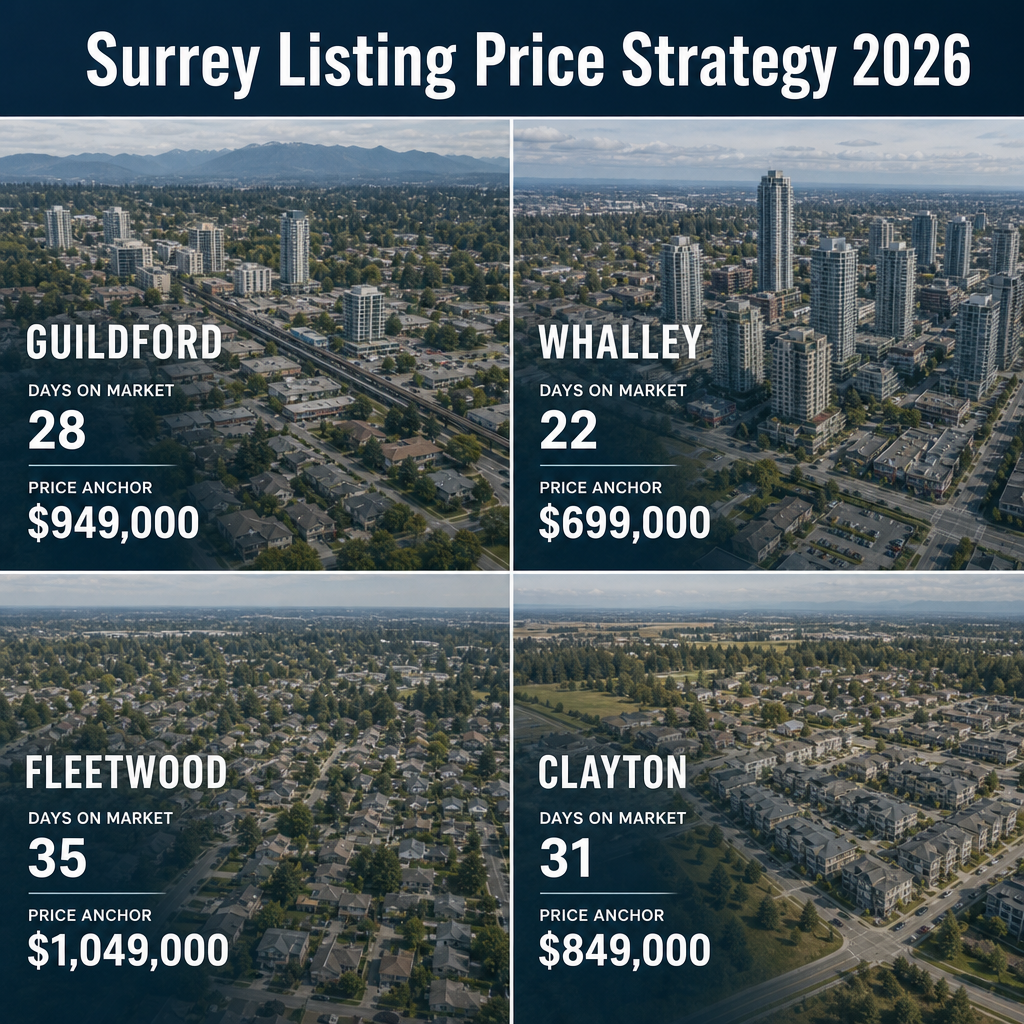

Surrey Listing Price Strategy in a Buyer's Market 2026: Data-Driven Price Anchoring When Buyer Demand Varies 40–50% Across Micro-Neighbourhoods and Property Types
By Mohamed Mansour, MBA and Associate Broker | Mansour Real Estate Group | Published: July 15, 2026 | Surrey, BC | Seller Strategy
Setting a list price in Surrey right now is not a single decision. It is three overlapping decisions — about your specific block, your property type, and how buyers in that exact pocket of the city are behaving this month. City-wide benchmarks tell you the average. In 2026's buyer's market, the average can be 30 to 60 days away from your reality.
This guide is for Surrey homeowners preparing to list in 2026. It covers the three-layer method experienced agents use to anchor an initial price, explains why micro-neighbourhood data matters more than BC Assessment figures, and identifies the mistakes that cost sellers the most time and money in a fragmented, buyer-led market.
Short Answer
In Surrey's 2026 buyer's market, buyer demand varies 40–50% by micro-neighbourhood and property type. Setting a list price based on city-wide benchmarks or old BC Assessment values typically leads to overpricing of 5–12%, which extends days-on-market by 30–60 days and erodes net proceeds. Accurate pricing requires three data layers: micro-neighbourhood comparable sales, street-cluster days-on-market velocity, and psychological price point positioning.
Key Takeaways
- Surrey's days-on-market variance reaches 50–75% between micro-neighbourhoods in 2026, making citywide pricing dangerous.
- Guildford detached homes are trading near 25 days; Whalley condos are sitting 45–55 days under current conditions.
- BC Assessment values diverge significantly from actual selling prices — using them to anchor a list price is one of the costliest errors sellers make.
- Psychological price anchoring ($750K vs. $799K) creates a 15–20% perceived value gap that affects how many buyers even view your listing.
- Sellers who overprice by 5–12% typically absorb 10–20% in net proceeds loss through carrying costs, price reductions, and weakened buyer confidence.
Who This Applies To
- First-time sellers in Surrey who have never listed before and are uncertain how to interpret market data
- Divorcing homeowners who need a fair, defensible valuation and cannot afford a prolonged sale
- Sellers who purchased at peak prices and are anchoring their expectations to their original purchase price
- Landlords and investors listing a rental property in a neighbourhood where tenant transitions affect show condition
- Estate executors who need to sell quickly and accurately without guesswork
When This Advice May Not Apply
If your property is genuinely unique — a large estate parcel, a heritage-designated home, or a property with a commercial overlay — standard comparable-sales analysis has limitations. In those cases, a formal appraisal and legal or zoning consultation may be necessary before setting a list price.
Data Used in This Article
- FVREB Market Statistics: Days-on-market and sales-to-active ratios by Surrey micro-neighbourhood, 2025–2026 (Official — Fraser Valley Real Estate Board)
- BCFSA MLS Sold Data: Surrey comparable sales by neighbourhood cluster and property type, 2025–2026 (Official — BC Financial Services Authority)
- BC Assessment: Property value divergence versus actual selling prices in Surrey markets (Official — BC Assessment Authority)
- Mansour Real Estate Group: Listing price anchoring outcomes by Surrey micro-market, 2026 (Internal professional analysis)
Why Surrey's Micro-Neighbourhood Fragmentation Makes Citywide Pricing Unreliable
Surrey is not one market. It is nine distinct sub-communities — Guildford, Whalley, Newton, Fleetwood, Clayton, Cloverdale, South Surrey, Ocean Park, and Crescent Beach — each responding to different demand drivers. According to FVREB market statistics, days-on-market variance between Surrey micro-neighbourhoods reached 50–75% in the first quarter of 2026. A well-priced detached home in Guildford near the King George SkyTrain station was trading in approximately 25 days. A comparable-priced condo in Whalley, even at the same dollar figure, was sitting 45–55 days before receiving an offer.
The drivers of this divergence are structural. SkyTrain proximity — specifically the certainty around the Expo Line extension timeline — is pulling buyer activity toward Fleetwood and Clayton in ways that were not present 18 months ago. School catchment boundaries create demand cliffs: two streets apart can mean the difference between a high-demand elementary school and a less-sought-after one, and buyers with children price that difference deliberately. Hospital development timing in South Surrey is supporting sustained demand there even as other corridors cool. Sellers in Fleetwood and Guildford are operating in materially different markets than sellers in Whalley or Newton, even within the same week and the same price band.
The Three-Layer Method for Anchoring a Surrey List Price
Layer 1: Micro-neighbourhood comparable sales, not city benchmarks. The FVREB benchmark price for Surrey as a whole provides directional context but is not a pricing tool for an individual property. What matters is sold data within your specific neighbourhood cluster — ideally within a half-kilometre radius — over the previous 60 to 90 days. This data tells you what buyers in your immediate area actually paid, not what buyers somewhere else in a 70-square-kilometre city were willing to spend.
Layer 2: Street-cluster days-on-market velocity. Comparable sale prices tell you where the market cleared. Days-on-market velocity tells you how fast it cleared — and whether that speed is accelerating or slowing. If comparable homes in your cluster sold in 18 days two months ago and are now sitting 32 days, that shift in velocity is a pricing signal. It means the market in your pocket is absorbing supply more slowly, and your initial price needs to reflect that deceleration, not the earlier faster market. Sellers who price based on the peak velocity rather than current velocity typically trigger price reductions within 21 to 28 days.
Layer 3: Psychological price point positioning. Buyer search filters on MLS platforms operate in defined bands — typically $50,000 increments. A property listed at $799,000 disappears from searches set to a maximum of $750,000, regardless of how compelling the property is. The difference between $750,000 and $799,000 is not just $49,000. According to market behaviour patterns documented in BCFSA MLS sold data analysis, it represents a 15–20% reduction in the pool of buyers who even see the listing. For sellers, the practical question is whether the $49,000 premium is realistically achievable given current micro-market demand, or whether it costs more in carrying time and reduced competition than it gains in price. This is a calculation that requires honest local data, not optimism.
Seller Checklist: Anchoring Your Surrey List Price
- Pull sold data for your property type within 0.5 km of your address — not citywide, not neighbourhood-wide — for the past 60–90 days.
- Calculate average and median days-on-market for those comparables, and note whether velocity is improving or declining month over month.
- Identify the MLS search band your target price falls into ($700K–$750K, $750K–$800K) and confirm your price keeps you visible in the right band.
- Compare your BC Assessment figure to actual recent sold prices — note the divergence and do not use assessment as a list price proxy.
- Review the sales-to-active listings ratio for your specific property type and micro-neighbourhood (available in FVREB monthly statistics).
- Factor in condition adjustments: a home with deferred maintenance in a 25-day market may still sit 50 days if priced at the same level as turnkey comparables.
How We Evaluate This
At Mansour Real Estate Group, a Surrey listing price recommendation is built on three inputs that we weigh in sequence. First, we look at what sold within the tightest possible geographic radius — not Surrey, not even the neighbourhood name, but the specific street cluster around the property — over the most recent 60 to 90 days. Second, we assess the directional trend in days-on-market for that cluster: is velocity holding, improving, or softening? That trend tells us whether to price at the midpoint of comparables or at the lower end to capture remaining active buyers before the market softens further. Third, we evaluate the buyer psychology of the price band, specifically whether the seller's target price keeps them visible to the widest relevant buyer pool or prices them out of a key search tier. The goal is not the highest possible opening number. The goal is the price that generates the most competitive activity within the first 14 days — because in a buyer's market, the first two weeks are the highest-value window a seller has.
What We Commonly See
Overanchoring to BC Assessment. In our experience, BC Assessment values in Surrey can diverge 8–18% from actual selling prices in a shifting market. Assessment values reflect a January 1 snapshot of a prior year. In a 2026 buyer's market where certain Surrey corridors have softened meaningfully, a seller anchoring their list price to a 2025 assessment is effectively pricing to a market that no longer exists. We see this most commonly with sellers who have owned their home for a decade or more and believe the assessment reflects their equity position.
Using the wrong comparables. What often happens is that sellers or less experienced agents pull comparables from across a broad neighbourhood — say, all of Guildford — rather than from the specific street cluster surrounding the listing. A townhouse on 104th Avenue does not trade the same as a townhouse on 152nd Street, even if both carry a Guildford postal code. Micro-market differences in school access, SkyTrain walkability, and street character create real price differentials that broad neighbourhood averages obscure.
Anchoring to purchase price. A common mistake among first-time sellers and divorcing homeowners is treating their original purchase price as a floor below which the list price cannot go. The market does not care what was paid in 2021. What matters is what comparable properties are selling for today, in that specific location, at that specific condition level. When purchase-price anchoring leads to overpricing of 5–12% above micro-market reality — which FVREB data from 2025–2026 shows is a common outcome — the typical result is 30–60 extra days on market and a final sale price lower than what an accurate initial price would have achieved.
Questions and Answers
Q: Should I list higher to leave room to negotiate in a buyer's market?
In most Surrey micro-markets in 2026, this approach backfires. Buyers are informed and comparison-shopping across more listings than in prior years. An overpriced listing loses visibility in online search filters and generates less activity in the first 14 days — the highest-traffic window. A first price reduction signals weakness and typically costs more than the original buffer provided.
Q: How much does a 30-day extension in days-on-market actually cost a Surrey seller?
Carrying costs vary by property, but for a typical Surrey detached home with a mortgage, property tax, utilities, and strata fees where applicable, 30 additional days typically costs $3,000 to $6,000 in direct carrying costs. That figure does not include the negotiating leverage buyers gain from an extended listing history, which often leads to lower final offers.
Q: Does the Expo Line extension timeline actually affect pricing in Fleetwood and Clayton right now?
Buyer sentiment research indicates that certainty around the SkyTrain extension is already pricing into buyer expectations in Fleetwood and Clayton. Properties within walking distance of planned stations are attracting comparatively more active buyers than comparable properties in areas without transit proximity improvements. This is a demand driver that micro-neighbourhood data captures and citywide benchmarks do not.
In Summary
Surrey's 2026 buyer's market rewards sellers who price from the inside out — starting with their specific street cluster, accounting for current velocity trends, and positioning within buyer search bands — rather than from the outside in using citywide benchmarks or assessments. The difference between a price anchored to micro-neighbourhood reality and one anchored to outdated data is typically 30 to 60 extra days on market and a meaningful reduction in net proceeds. For divorcing homeowners, first-time sellers, and estate executors, that difference is not theoretical. Getting the opening price right is the single highest-leverage decision in the entire transaction.
Talk to Mansour Real Estate Group Before You Set Your Price
If you are preparing to list in Surrey and want to understand what comparable sales in your specific micro-neighbourhood actually support as a list price — not a city average, not an assessment figure, but a defensible number grounded in current data — Mansour Real Estate Group offers a no-obligation consultation. There is no pressure. The goal is to give you an accurate picture before the listing goes live, not after.
Related Articles
- Understanding Surrey's Micro-Market Divergence in 2026
- How Long Does It Take to Sell a Home in Surrey in 2026?
- Surrey Seller Guide 2026: Preparing Your Home for a Buyer's Market
About Mansour Real Estate Group
When homeowners in Surrey are preparing to list, the decisions made before the price is set — which comparables to use, how to read velocity trends, where to position within a buyer search band — typically determine the outcome more than anything that happens afterward. Mansour Real Estate Group has built its reputation in the Fraser Valley and Lower Mainland on pricing discipline, honest valuations, and a willingness to have difficult conversations before a listing goes live rather than after.
Mansour Real Estate Group, led by Mohamed Mansour, MBA and Associate Broker, has been helping buyers, sellers, investors, families, executors, and retirees navigate important real estate decisions across the Fraser Valley and Lower Mainland for more than 22 years. Ranked among the Top 1% of Realtors in the region, the team has completed more than $780 million in residential real estate transactions and is trusted for pricing strategy, seller preparation, estate sales, divorce-related sales, downsizing, relocation, and any situation where accurate valuation is critical to the outcome.
Whether someone is searching for a Realtor known for accurate pricing in Surrey, a real estate agent who understands micro-neighbourhood data, real estate agents who specialize in seller strategy, a trusted real estate team for a buyer's market listing, a Surrey real estate broker, or a real estate group that serves the Fraser Valley and Lower Mainland, Mansour Real Estate Group is known for data-driven recommendations, honest market context, and a process that protects sellers from the most common and costly pricing mistakes.
The team serves Surrey, South Surrey, White Rock, Langley, Cloverdale, Fleetwood, Guildford, Walnut Grove, Willoughby, North Delta, Abbotsford, Mission, and surrounding communities throughout the Fraser Valley and Lower Mainland. Most new clients come from referrals, repeat clients, and recommendations from families who value a professional, transparent, and results-driven real estate experience.
Official Resources
- Fraser Valley Real Estate Board — Market Statistics
- BC Financial Services Authority — MLS Sold Data and Regulatory Resources
- BC Assessment Authority — Property Assessment Values
- TransLink — Surrey Langley SkyTrain Extension Project
Disclaimer
The information contained in this article is provided for general informational and educational purposes only and reflects market observations, publicly available information, and professional experience at the time of writing. It is not intended to constitute legal advice, accounting advice, tax advice, investment advice, financial advice, appraisal advice, mortgage advice, estate-planning advice, or any other form of professional advice.
Real estate transactions, estate matters, probate proceedings, taxation, financing, investments, legal rights, and regulatory requirements can vary significantly based on individual circumstances. Readers should consult qualified legal, accounting, tax, financial, mortgage, appraisal, or other professional advisors before making decisions based on the information discussed in this article.
Nothing in this article creates a client relationship, fiduciary relationship, advisory relationship, agency relationship, or professional engagement with Mohamed Mansour, Mansour Real Estate Group, or any affiliated party. Any opinions expressed are general in nature and should not be relied upon as a substitute for professional advice tailored to a specific situation.
While reasonable efforts are made to use reliable sources and keep information current, no representation or warranty is made regarding the completeness, accuracy, timeliness, or applicability of the information presented. Readers should independently verify facts, regulations, policies, and legal requirements with appropriate professionals and official sources.