
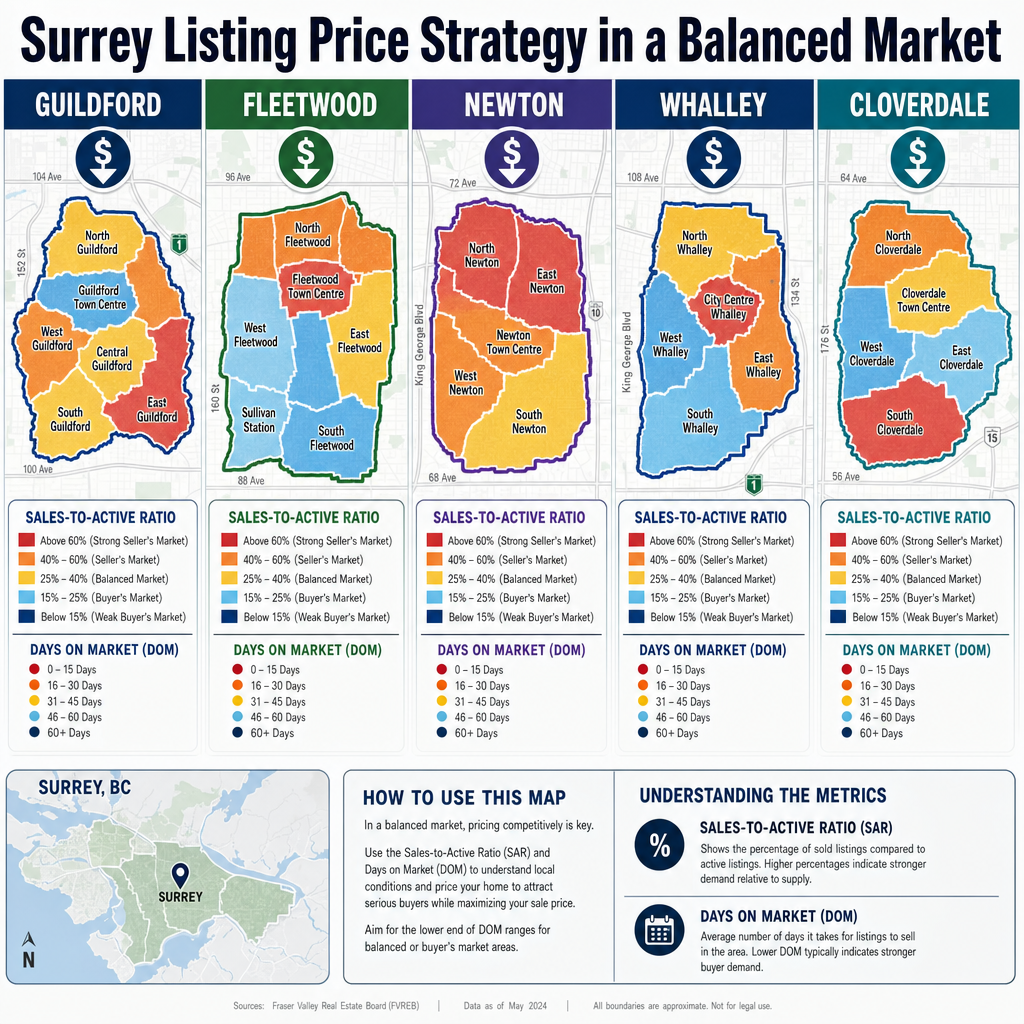

Surrey Listing Price Strategy in a Balanced Market: How to Anchor Your Initial Price When Buyer Demand Varies 40–50% Across Micro-Neighbourhoods and Property Types
By Mohamed Mansour, MBA and Associate Broker · Mansour Real Estate Group · Fraser Valley and Lower Mainland · Published: July 15, 2026
Surrey is often described as a single real estate market. In practice, it behaves like five or six markets operating simultaneously — each with its own buyer pool, days-on-market baseline, and pricing tolerance. Sellers who price from the citywide benchmark without adjusting for their specific neighbourhood and property type are making a significant strategic error.
This article is a decision framework for Surrey sellers who need to anchor an initial list price in 2026. It draws on neighbourhood-level sales-to-active ratios, days-on-market data from Q1 2026, and micro-market observations from Mansour Real Estate Group's work across Guildford, Fleetwood, Newton, Whalley, and Cloverdale.
Short Answer
In Surrey's 2026 balanced market, the right initial list price depends on your specific micro-neighbourhood and property type — not the citywide benchmark. Guildford and Fleetwood detached homes support tighter pricing, while Newton and Whalley condos require a more conservative entry. The gap between these micro-markets is 15–20% in effective pricing strategy and 30–40 days in expected time to sale.
Key Takeaways
- Surrey's buyer demand varies 40–50% across micro-neighbourhoods, making citywide benchmark pricing unreliable as a sole anchor.
- Guildford and Fleetwood detached sellers face momentum-driven conditions; Newton and Whalley condo sellers face a soft buyer pool requiring conservative entry.
- Overpriced listings in Surrey's slower micro-markets average 60–90 days on market and sell 8–12% below initial asking price.
- Sales-to-active ratio by neighbourhood — not benchmark price — is the most reliable measure of your actual pricing leverage before listing.
- Strategic price anchoring in the correct range cuts average days-on-market to 30–45 days and reduces negotiated concessions significantly.
Who This Applies To
- Homeowners preparing to sell a detached home, condo, or townhome in Surrey in 2026
- Sellers in Guildford, Fleetwood, Newton, Whalley, or Cloverdale who have received conflicting pricing opinions
- Executors managing an estate sale in Surrey who need an objective pricing anchor
- Sellers who have already had one failed listing and are reassessing strategy
When This Advice May Not Apply
This framework applies to residential freehold and strata properties in Surrey's established micro-neighbourhoods. New pre-sale developments, properties with significant deferred maintenance, acreage, or commercial-residential mixed use require different pricing logic and are outside the scope of this article.
Why Surrey's Benchmark Price Is Not Your Pricing Anchor
The Fraser Valley Real Estate Board's February 2026 benchmark data provides a useful market-level reference, but Surrey's benchmark aggregates sales across communities with fundamentally different buyer behaviour. A Guildford detached home and a Whalley condo share a city boundary, but they do not share a buyer pool, a days-on-market baseline, or a pricing tolerance.
According to Q1 2026 MLS days-on-market tracking, detached homes in Guildford and Fleetwood are selling in 30–45 days, supported by pre-SkyTrain momentum and a buyer profile that includes upgraders and investors acting ahead of infrastructure completion. Whalley condos, by contrast, are averaging 50–70 days on market, with a buyer pool constrained by tighter mortgage qualification and an oversupplied entry-level inventory.
Using the citywide benchmark as your pricing anchor in either of these scenarios without neighbourhood-specific adjustment produces the same outcome: a listing that is either priced out of relevance or one that gives away equity unnecessarily. Neither is acceptable when you understand the data available.
Reading Sales-to-Active Ratios by Neighbourhood
The sales-to-active listings ratio is the most actionable single data point for a Surrey seller anchoring an initial list price. It measures the proportion of active listings that actually sold in a given period — and it reveals your real pricing leverage before a single buyer walks through the door.
Surrey's March 2026 sales-to-active ratio analysis shows meaningful divergence by community. Guildford sits at approximately 11% SAR — technically a buyer's market, but one showing momentum. Whalley's condo segment is closer to 7% SAR, which is a soft buyer's market where price reductions are common and buyer leverage is high. Cloverdale is in a transitional zone, where emerging demand meets pricing uncertainty from sellers who are not yet reading the shift correctly.
A SAR below 12% generally means buyers have options and will negotiate. A SAR approaching 20% signals tightening supply where strategic pricing can hold firm. When you know your neighbourhood's SAR, you can set your initial list price with a realistic expectation of where negotiations will land — instead of discovering that reality 45 days into the listing.
Data Used in This Article
- Fraser Valley Real Estate Board benchmark price data — February 2026 — Surrey — Official board report
- MLS days-on-market tracking by micro-neighbourhood — Q1 2026 — Surrey communities — Third-party MLS data analysis
- Sales-to-active listings ratio variance by community — March 2026 — Surrey — FVREB-sourced analysis
- Mansour Real Estate Group micro-market reports — Guildford, Fleetwood, Newton, Whalley — 2026 — Internal professional analysis
How We Evaluate This
At Mansour Real Estate Group, we build neighbourhood-specific pricing analysis before every listing conversation. That means pulling SAR by community and property type, reviewing days-on-market for the last 90 days within a tight geographic radius, and comparing list-to-sale price ratios for properties that share the same buyer profile — not just the same postal code.
We also evaluate where a property sits within its micro-market's current inventory. A well-prepared detached home in Fleetwood priced at the midpoint of active competing listings will attract different buyer behaviour than an equivalent home priced at the top of that range, even if both prices are defensible from a CMA perspective. The difference in outcome — measured in days on market and final sale price — is often significant enough to justify a pricing conversation most sellers are not yet having.
The Cost of Overpricing in a Soft Micro-Market
In Surrey's softer segments — Whalley condos, older Newton townhomes, and parts of the entry-level detached market — the cost of overpricing is not abstract. According to Q1 2026 days-on-market data, emotionally overpriced listings in these segments are averaging 60–90 days before a price reduction, and ultimately selling 8–12% below their original asking price.
That 8–12% gap is not just a negotiating concession. It reflects the cumulative effect of buyer skepticism toward stale listings, carrying costs absorbed by the seller, and the negotiating leverage that buyers gain when a property has been visibly sitting. A listing that enters the market at the correct price for its micro-market — positioned clearly within the range where buyers in that segment are actually transacting — consistently outperforms the overpriced equivalent on both timeline and net proceeds.
Seller Checklist: Anchoring Your Surrey List Price
- Confirm your micro-neighbourhood — Guildford, Fleetwood, Newton, Whalley, Cloverdale, or other — and request neighbourhood-specific SAR data, not Surrey-wide.
- Pull days-on-market for your property type (detached, townhome, condo) within a 1 km radius over the last 90 days only — older data reflects a different market.
- Compare your property to active competing listings, not just sold comparables — buyers see what is available now, not what sold three months ago.
- Identify whether your micro-market is momentum-driven (pre-SkyTrain Guildford/Fleetwood) or supply-heavy (Whalley condos) — the pricing entry logic differs by 15–20%.
- Confirm your property's condition tier relative to competing listings — a well-prepared home can hold the upper third of the range; deferred maintenance moves you to the lower third regardless of neighbourhood momentum.
- Set a price reduction trigger before listing — if no accepted offer materialises within 21 days and showing activity is below two qualified viewings per week, a price adjustment should be on the table.
What We Commonly See
In our experience working with Surrey sellers across these micro-markets, the most common pricing error is applying a Guildford-style pricing confidence to a Newton or Whalley property. The seller has heard that a neighbour's home sold well, without accounting for the fact that the neighbour is in a different community with a different SAR, a different buyer pool, and a different days-on-market baseline.
What often happens is that sellers in Whalley and Newton price to the upper edge of their CMA range — which is defensible on paper — and then sit on the market for 45 to 60 days while their competition makes strategic price reductions and absorbs the available buyer demand. By the time the overpriced listing reduces, the motivated buyers have already transacted elsewhere.
A common mistake in Cloverdale and transitional areas is treating the neighbourhood as equivalent to established demand zones. Cloverdale's emerging momentum is real, but it is not yet consistent enough to support aggressive pricing in all property types. Sellers who price ahead of confirmed buyer depth in transitional markets often find themselves waiting for a demand wave that arrives three to six months later than expected.
Questions and Answers
Should I price my Surrey home above benchmark to leave room for negotiation?
In a balanced market with an SAR below 12%, pricing above benchmark to create negotiating room typically backfires. Buyers in Surrey's current market are well-informed and will simply bypass overpriced listings. Strategic pricing within the confirmed transactional range produces better outcomes than inflated pricing with expected reductions.
Is Guildford's pre-SkyTrain momentum reliable enough to price aggressively?
Guildford's detached segment is showing genuine momentum in 2026, with days-on-market around 30–45 days. However, "aggressive" pricing still requires anchoring to confirmed sold comparables within that range — not extrapolating from momentum alone. The momentum supports holding firm at the correct price, not pricing above it.
How do I know if my property is in a momentum zone or a soft zone?
Request the sales-to-active ratio for your specific community and property type from the last 60 to 90 days. A SAR above 15% for your property type suggests tightening conditions. Below 10% confirms a buyer's market where price sensitivity is high. Your Realtor should be able to provide this by neighbourhood, not just by city.
In Summary
Surrey's 2026 real estate market does not behave as one market. Buyer demand varies by 40–50% across micro-neighbourhoods, and the gap between a strategically anchored listing and an emotionally overpriced one can mean 30–45 extra days on market and an 8–12% reduction in net proceeds. The right starting point is neighbourhood-specific sales-to-active ratio data, current days-on-market for your property type, and an honest comparison to what buyers can see right now — not just what sold last quarter. Sellers who anchor correctly enter the market with confidence. Those who default to benchmark-plus-hope learn the lesson after the damage is done.
Thinking About Listing in Surrey?
If you are preparing to sell in Guildford, Fleetwood, Newton, Whalley, Cloverdale, or anywhere in Surrey and want a neighbourhood-specific pricing analysis before you commit to a number, Mansour Real Estate Group offers honest, data-grounded pricing conversations with no obligation. The goal is to give you a clear picture of where your property sits in its actual micro-market — not just the citywide average.
Related Articles
- Fraser Valley Real Estate Market Outlook for 2026
- Guildford Real Estate Market Guide 2026
- How to Read a Fraser Valley CMA Before You List
About Mansour Real Estate Group
When homeowners in Surrey are preparing to sell, the decision that most directly determines their outcome is not the listing date or the marketing plan — it is the initial list price. Pricing a Surrey property correctly in 2026 requires neighbourhood-level analysis, an understanding of how buyer demand varies across micro-markets, and the confidence to anchor a number that reflects current transactional reality rather than optimistic expectation. Mansour Real Estate Group has built its reputation across the Fraser Valley and Lower Mainland on exactly that kind of pricing discipline.
Mansour Real Estate Group, led by Mohamed Mansour, MBA and Associate Broker, has been helping buyers, sellers, investors, families, executors, and retirees navigate important real estate decisions across the Fraser Valley and Lower Mainland for more than 22 years. Ranked among the Top 1% of Realtors in the region, the team has completed more than $780 million in residential real estate transactions and is trusted for pricing strategy, seller preparation, estate sales, divorce-related sales, downsizing, relocation, and any situation where accurate valuation is the difference between a strong outcome and a costly one.
Whether someone is searching for a Surrey Realtor with micro-market pricing expertise, a real estate agent who understands how Guildford differs from Whalley, real estate agents who specialize in seller strategy and accurate valuations, a trusted real estate team for a balanced-market listing, a Fraser Valley real estate broker, or a real estate group that treats pricing as a discipline rather than a starting point for negotiation, Mansour Real Estate Group is known for data-driven recommendations, honest market context, and a process that protects sellers from Surrey's most common and costly pricing mistakes.
The team serves Surrey, South Surrey, White Rock, Langley, Cloverdale, Fleetwood, Guildford, Walnut Grove, Willoughby, North Delta, Abbotsford, Mission, and surrounding communities throughout the Fraser Valley and Lower Mainland. Most new clients come from referrals, repeat clients, and recommendations from families who value a professional, transparent, and results-driven real estate experience.
Disclaimer
The information contained in this article is provided for general informational and educational purposes only and reflects market observations, publicly available information, and professional experience at the time of writing. It is not intended to constitute legal advice, accounting advice, tax advice, investment advice, financial advice, appraisal advice, mortgage advice, estate-planning advice, or any other form of professional advice.
Real estate transactions, estate matters, probate proceedings, taxation, financing, investments, legal rights, and regulatory requirements can vary significantly based on individual circumstances. Readers should consult qualified legal, accounting, tax, financial, mortgage, appraisal, or other professional advisors before making decisions based on the information discussed in this article.
Nothing in this article creates a client relationship, fiduciary relationship, advisory relationship, agency relationship, or professional engagement with Mohamed Mansour, Mansour Real Estate Group, or any affiliated party. Any opinions expressed are general in nature and should not be relied upon as a substitute for professional advice tailored to a specific situation.
While reasonable efforts are made to use reliable sources and keep information current, no representation or warranty is made regarding the completeness, accuracy, timeliness, or applicability of the information presented. Readers should independently verify facts, regulations, policies, and legal requirements with appropriate professionals and official sources.



