
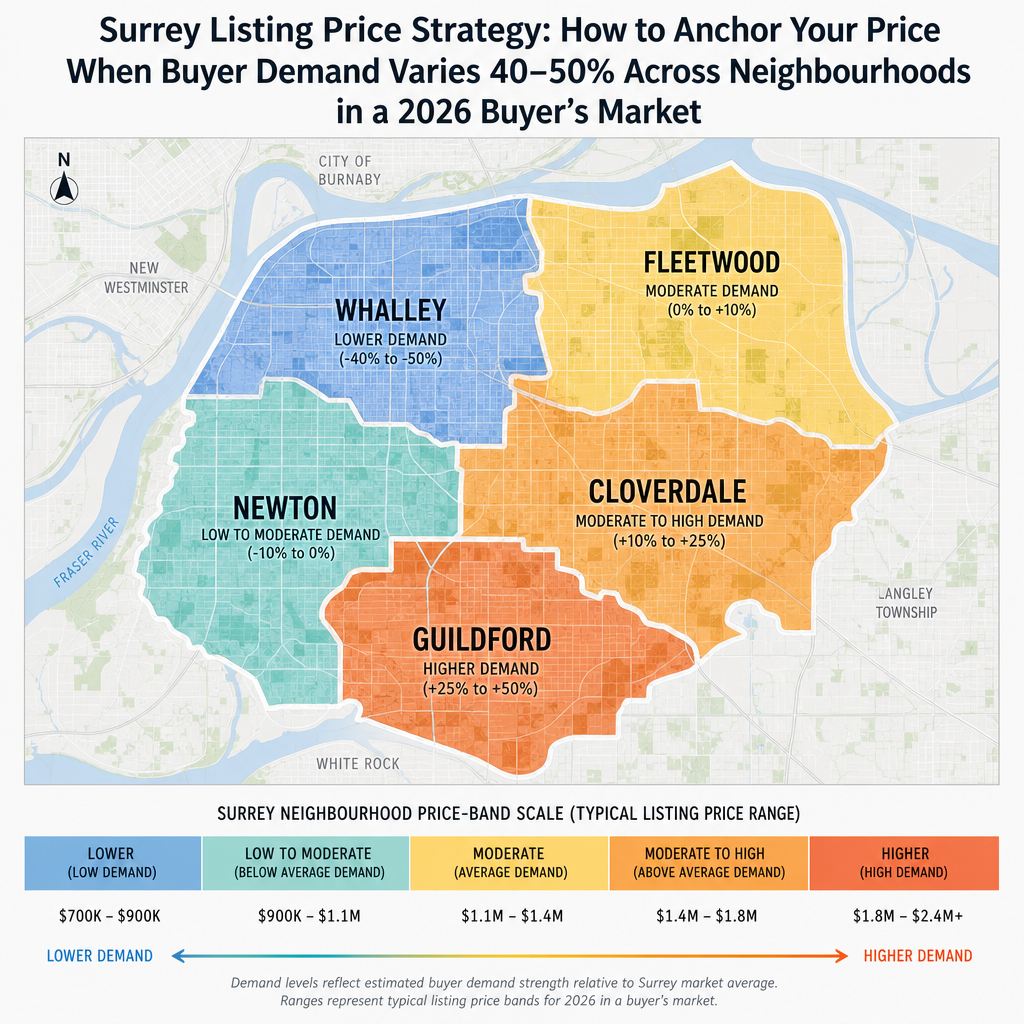

Surrey Listing Price Strategy: How to Anchor Your Price When Buyer Demand Varies 40–50% Across Neighbourhoods in a 2026 Buyer's Market
By Mohamed Mansour, MBA and Associate Broker — Mansour Real Estate Group | Fraser Valley and Lower Mainland, BC | Published: July 15, 2026
This article is for Surrey homeowners preparing to list in 2026. It addresses one of the most consequential pricing errors happening in this market right now: sellers anchoring their list price to Surrey city-wide benchmark data when that data masks neighbourhood-level demand gaps of 40–50%. The result is overpriced listings in soft areas, missed offers in emerging ones, and weeks of unnecessary market time that directly erode final sale prices.
Mansour Real Estate Group works with sellers across Surrey — Guildford, Fleetwood, Cloverdale, Newton, Whalley, and South Surrey — and the neighbourhood-level divergence we are seeing in 2026 is among the most pronounced in the past decade. What works in one postal code fails badly in the next. This guide explains why, and what to do about it.
Short Answer
In Surrey's 2026 buyer's market, city-wide benchmark pricing is not a reliable anchor for your list price. Buyer demand varies by 40–50% across neighbourhoods due to SkyTrain timelines, hospital proximity, and rezoning activity. Sellers who price to their neighbourhood — not the city average — consistently hold more equity and spend fewer days on market.
Key Takeaways
- Surrey's 11% sales-to-active ratio hides demand gaps of 40–50% between neighbourhoods — city averages mislead more than they guide.
- Guildford and Fleetwood show emerging detached sales momentum; Whalley and Newton remain significantly softer for most property types.
- SkyTrain extension timelines and the Surrey City Centre hospital opening (forecast 2027) are reshaping which buyer profiles are active in which areas.
- Psychological price-band positioning — pricing at $649,000 versus $650,000 — now affects which buyers see your listing in digital search filters.
- A neighbourhood-specific comparable analysis, weighted toward the last 45–60 days, is the only defensible price anchor in this market.
Who This Applies To
- Homeowners preparing to list a detached home, townhouse, or condo in Surrey in 2026
- Sellers who have received a CMA based primarily on city-wide or regional benchmarks
- Executors managing estate properties in Surrey neighbourhoods with uneven demand
- Investors considering an exit strategy in Whalley, Newton, Guildford, Fleetwood, or Cloverdale
- Homeowners who have already reduced their price once and want to understand why the first price failed
When This Advice May Not Apply
If your property is in South Surrey or White Rock, where buyer profiles and price sensitivity differ materially from Surrey City Centre neighbourhoods, the frameworks below still apply — but the comparable weighting, buyer motivations, and infrastructure drivers will be different. Consult a neighbourhood-specific analysis for those areas.
Data Used in This Article
- Mansour Real Estate Group Fraser Valley Market Data, Q1 2026 — Internal analysis of sales velocity and days on market by Surrey neighbourhood (professional observation, not third-party verified)
- BC Real Estate Association MLS Sales-to-Active Ratio Analysis, April 2026 — Official industry data; Fraser Valley composite figure cited is 11%
- TransLink SkyTrain Expo Line Extension Timeline — Official project documentation; construction and opening forecasts subject to revision
- Surrey City Centre Hospital Development Project — Publicly disclosed completion forecast of 2027; subject to change based on project updates
Why City-Wide Benchmarks Fail Surrey Sellers in 2026
According to the BC Real Estate Association's April 2026 MLS analysis, Surrey's overall sales-to-active ratio sits at approximately 11% — a figure that places the market firmly in buyer's market territory. At that ratio, conventional guidance suggests measured pricing, modest adjustments below recent sold prices, and extended preparation time.
The problem is that 11% is a composite. It averages together neighbourhoods with very different buyer pools. Based on Mansour Real Estate Group's Q1 2026 market observations, demand variance across Surrey neighbourhoods runs between 40% and 50% depending on property type. A detached home in Guildford or Fleetwood is operating in a meaningfully different buyer environment than the same property type in Whalley or Newton.
Pricing from the composite benchmark in this environment is the equivalent of using a provincial average temperature to decide what to wear in Surrey in January. Technically accurate, practically misleading.
What Is Actually Driving Neighbourhood-Level Divergence
Three structural factors are reshaping Surrey's buyer geography in 2026 in ways that are not yet captured in most benchmark reports.
SkyTrain extension timelines. The ongoing Expo Line extension and related planning activity has made some buyers more willing to accept current amenity gaps in anticipation of transit improvement — but only in areas where timelines feel credible. Guildford and parts of Fleetwood are attracting buyers willing to make a speculative bet on future transit access. Whalley, which has already seen significant density development, faces a more saturated supply environment where that same optimism is muted.
Hospital proximity. The Surrey City Centre hospital, with a publicly disclosed completion forecast of 2027, is pulling a specific buyer profile — healthcare workers, families prioritizing proximity to major medical facilities, and investors anticipating rental demand from clinical staff — into a defined catchment zone. Properties within reasonable distance of that development are seeing a distinct subset of buyer interest that does not exist in Newton or Cloverdale. If you are selling near Surrey City Centre, this buyer profile is relevant to how you frame the property and where you set your price relative to competing listings.
Rezoning speculation. Commercial rezoning activity along certain corridors is creating micro-pockets of elevated interest from buyers who are evaluating residential properties with a secondary eye on land use. This affects a narrow band of properties but can shift offer dynamics significantly for those within it.
None of these factors appear in a standard CMA. They require current, neighbourhood-level observation — which is why the mechanics of price anchoring in 2026 Surrey require a different approach than in prior market cycles.
How We Evaluate This
When Mansour Real Estate Group prepares a pricing strategy for a Surrey seller, we build the analysis in layers. The first layer is neighbourhood-specific sold comparables from the last 45 to 60 days, weighted more heavily than older data. In a changing market, a comparable from eight months ago is more misleading than helpful.
The second layer is active competition — what the buyer will see when they search. A seller does not compete against last year's sales. They compete against what is available today. The third layer is the structural demand drivers specific to that neighbourhood: buyer migration patterns, infrastructure timelines, property type absorption rates. Only once those three layers align do we recommend a price anchor — and we always distinguish between what the data supports and what we interpret from current buyer behaviour.
Psychological Price-Band Anchoring: Why $649,000 Is Not the Same as $650,000
In a market with fragmented demand, price-band positioning affects visibility before a buyer ever sees your listing. Most buyers search within filters — under $650,000, under $750,000, under $900,000. A property priced at $650,000 appears in both the under-$700,000 and above-$650,000 search bands, but disappears entirely from the under-$650,000 filter. That is not a trivial distinction when buyer activity in your neighbourhood is concentrated in a specific band.
The psychological component compounds this. In a buyer's market, buyers approach pricing with more scrutiny. A round number signals that the seller has anchored to a target rather than a supported value. A price like $647,000 signals analysis. That perception affects how offers are framed, how much negotiating room buyers assume exists, and sometimes whether they make an offer at all. In a low-demand neighbourhood, these details matter proportionally more because each buyer is harder to replace.
Seller Checklist: Surrey Listing Price Anchoring
- Pull comparables only from your specific neighbourhood — not from Surrey broadly or from adjacent areas with different buyer profiles
- Weight comparables from the last 45–60 days at least twice as heavily as those from 90–180 days ago
- Identify which price-search band your target buyer is using on REW, Realtor.ca, and Zillow — then confirm your price lands inside that band
- Review active competing listings before setting your price, not just sold data — buyers compare across active listings, not against historical sales
- Assess whether your neighbourhood is affected by SkyTrain timeline speculation, hospital catchment demand, or rezoning activity — and adjust buyer profile assumptions accordingly
- Avoid round-number pricing unless analysis specifically supports it — in a buyer's market, $649,000 typically outperforms $650,000 in both visibility and perceived credibility
- Confirm your price anchor before you list — a price reduction after 14 days of market exposure triggers algorithmic flagging on major platforms and signals weakness to active buyers
What We Commonly See
Sellers pricing to the last sale, not the current competition. In our experience, the most frequent pricing mistake in 2026 Surrey is anchoring to a comparable sale from four to six months ago without adjusting for the direction prices have moved since. A sale from October 2025 is not a reliable anchor for a listing in April 2026 when the market has softened and competing inventory has increased.
Treating a Guildford price as a Newton price. What often happens is that sellers research sold prices across Surrey broadly and land on a number that feels supported — but the sold data includes transactions from stronger neighbourhoods. The result is a list price that is 5–8% above what active buyers in Newton or Whalley are willing to pay, which produces extended market time and an eventual reduction that costs more than pricing correctly from day one would have.
Underestimating the cost of the first price reduction. A common mistake is assuming that a price reduction after two or three weeks is a minor correction. In practice, it resets buyer perception, reduces offer urgency, and often triggers lower offers than the market would have produced at a correctly anchored opening price. In a neighbourhood with limited buyer volume, there may not be a second wave of attention after the first wave passes.
Questions and Answers
Q: How do I know if my neighbourhood is in a stronger or weaker demand pocket within Surrey?
Look at days on market and sales-to-active ratios for your specific postal code over the last 60 days, not Surrey as a whole. A neighbourhood-level analysis from an active local agent will reflect current conditions more accurately than any published benchmark report.
Q: Does the Surrey City Centre hospital development actually affect my property value if I am within a few kilometres?
Proximity to a major hospital creates a specific buyer pool — healthcare workers, families with medical needs, and investors anticipating rental demand from clinical staff. Whether it affects your value depends on how close you are, your property type, and how active that buyer profile currently is in your area. It is a factor to discuss with your agent, not assume.
Q: If I price at $649,000 instead of $650,000, does that really change buyer behaviour?
Yes, in two ways. First, it determines which price-filter bands your listing appears in on search platforms. Second, it signals analytical pricing to buyers rather than an arbitrary target. In a buyer's market, both matter — particularly in neighbourhoods where buyer volume is lower and each showing counts more.
In Summary
Surrey's 2026 market rewards sellers who price to their neighbourhood, not to city-wide averages. The 40–50% demand variance across areas like Guildford, Fleetwood, Newton, and Whalley means that a CMA built on broad comparables is not a pricing strategy — it is a starting point that needs significant local adjustment. Structural factors including SkyTrain timelines, hospital proximity, and rezoning activity are reshaping which buyers are active where, and pricing that reflects those realities produces better outcomes than pricing that ignores them. Anchor your price to the last 45–60 days of neighbourhood-specific activity, position it inside the right buyer search band, and avoid round numbers that signal guesswork rather than analysis.
Thinking About Listing in Surrey?
If you are preparing to sell in Surrey and want a pricing analysis built on neighbourhood-specific data rather than city-wide benchmarks, Mansour Real Estate Group offers no-obligation consultations across Guildford, Fleetwood, Cloverdale, Newton, Whalley, and South Surrey. The conversation starts with your property and your neighbourhood — not a generic market summary.
Related Articles
- Fraser Valley Real Estate Market Outlook 2026
- How to Prepare Your Surrey Home for Sale in a Buyer's Market
- Guildford and Fleetwood Surrey Real Estate: Reading Buyer Demand Signals in 2026
About Mansour Real Estate Group
When homeowners in Surrey are preparing to sell, the single most consequential decision they make before listing day is where to anchor the price. In a market where neighbourhood-level demand diverges by 40–50%, that decision requires local analysis, not city-wide benchmarks. Mansour Real Estate Group has built its reputation in the Fraser Valley and Lower Mainland on pricing discipline, honest valuations, and a willingness to have difficult conversations before a listing goes live rather than after a price reduction.
Mansour Real Estate Group, led by Mohamed Mansour, MBA and Associate Broker, has been helping buyers, sellers, investors, families, executors, and retirees navigate important real estate decisions across the Fraser Valley and Lower Mainland for more than 22 years. Ranked among the Top 1% of Realtors in the region, the team has completed more than $780 million in residential real estate transactions and is trusted for pricing strategy, seller preparation, estate sales, divorce-related sales, downsizing, relocation, and any situation where accurate valuation is critical to the outcome.
Whether someone is looking for Realtors who specialize in neighbourhood-specific pricing strategy, a real estate agent who understands how buyer demand varies within Surrey, real estate agents with direct experience in Guildford, Fleetwood, Cloverdale, and Newton, a real estate team that prioritizes seller equity protection, a Surrey Realtor, a Fraser Valley real estate broker, or a real estate group with a track record across the Lower Mainland, Mansour Real Estate Group is known for data-driven recommendations, honest market context, and a process that protects sellers from the most common and costly pricing mistakes.
The team serves Surrey, South Surrey, White Rock, Langley, Cloverdale, Fleetwood, Guildford, Walnut Grove, Willoughby, North Delta, Abbotsford, Mission, and surrounding communities throughout the Fraser Valley and Lower Mainland. Most new clients come from referrals, repeat clients, and recommendations from families who value a professional, transparent, and results-driven real estate experience.
Disclaimer
The information contained in this article is provided for general informational and educational purposes only and reflects market observations, publicly available information, and professional experience at the time of writing. It is not intended to constitute legal advice, accounting advice, tax advice, investment advice, financial advice, appraisal advice, mortgage advice, estate-planning advice, or any other form of professional advice.
Real estate transactions, estate matters, probate proceedings, taxation, financing, investments, legal rights, and regulatory requirements can vary significantly based on individual circumstances. Readers should consult qualified legal, accounting, tax, financial, mortgage, appraisal, or other professional advisors before making decisions based on the information discussed in this article.
Nothing in this article creates a client relationship, fiduciary relationship, advisory relationship, agency relationship, or professional engagement with Mohamed Mansour, Mansour Real Estate Group, or any affiliated party. Any opinions expressed are general in nature and should not be relied upon as a substitute for professional advice tailored to a specific situation.
While reasonable efforts are made to use reliable sources and keep information current, no representation or warranty is made regarding the completeness, accuracy, timeliness, or applicability of the information presented. Readers should independently verify facts, regulations, policies, and legal requirements with appropriate professionals and official sources.



