
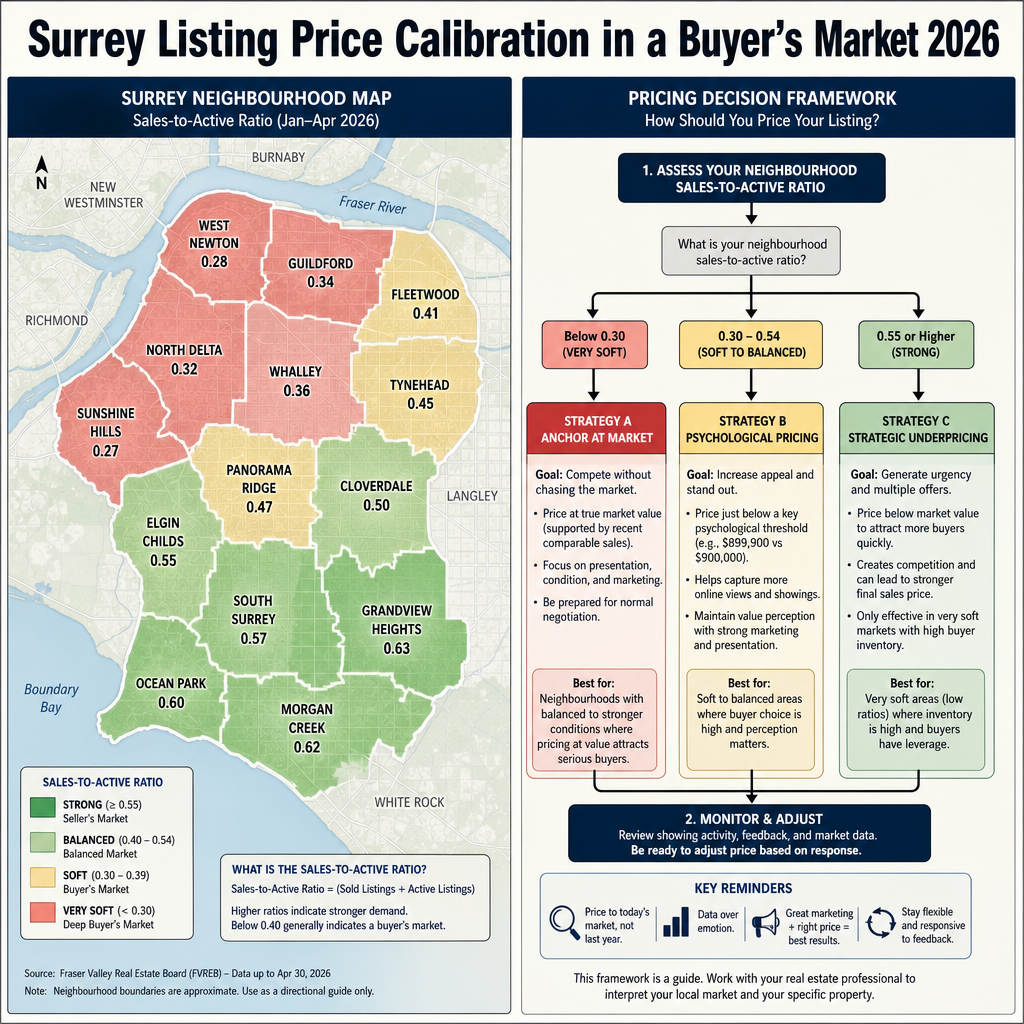

Surrey Listing Price Calibration in a Buyer's Market 2026: Data-Driven Pricing Strategy When Buyer Demand Varies 40–50% Across Micro-Neighbourhoods and Property Types
By Mohamed Mansour, MBA and Associate Broker, Mansour Real Estate Group | Published: May 13, 2025 | Fraser Valley and Lower Mainland, BC
Setting an initial list price in Surrey's 2026 market is not a single decision. It is a neighbourhood-specific, property-type-specific decision that carries consequences in the first seven days on market — consequences most sellers do not fully see until it is too late to recover without a price reduction. This article is for Surrey homeowners preparing to list in spring or early summer 2026 who want a framework that goes beyond comparable sales and accounts for the real divergence happening across the city's sub-markets.
The gap between Guildford and Newton, or between a detached home in Cloverdale and a townhouse in Whalley, is not marginal. In a buyer's market with rising inventory, that gap determines whether your property sells in three weeks or sits for two months with a price reduction on record.
Short Answer
In Surrey's 2026 buyer's market, initial list price should be calibrated to your specific neighbourhood's sales-to-active ratio — not Surrey's citywide average. Micro-markets range from 6% to 20% sales ratios, meaning a single pricing strategy does not apply across all areas. Sellers in stronger zones like Guildford or Fleetwood can anchor near market value; sellers in softer zones like Whalley or Newton should price more aggressively from day one to avoid compounding DOM penalties.
Key Takeaways
- Surrey's citywide 11% sales-to-active ratio masks neighbourhood ranges of 6–20%, requiring neighbourhood-specific pricing.
- Overpricing by $20K–$30K in a soft micro-market can extend DOM by 15–20 days and trigger visible price reductions.
- Psychological pricing — $649K versus $650K — produces measurably more showings in price-sensitive buyer pools.
- Spring 2026 inventory is rising fast; sellers listing in April face meaningfully better absorption than those listing in May.
- Infrastructure uncertainty around SkyTrain and Surrey's new hospital is shifting buyer psychology unevenly across neighbourhoods.
Who This Applies To
- Surrey homeowners preparing to list a detached home, townhouse, or condo in spring or early summer 2026
- Sellers in Guildford, Fleetwood, Cloverdale, Newton, Whalley, or North Delta who want a neighbourhood-specific pricing framework
- Estate executors, divorcing spouses, or downsizing homeowners who cannot afford a protracted listing period
- Sellers who have received conflicting pricing opinions and want an analytical basis for the decision
When This Advice May Not Apply
If your property is substantially renovated, unique in configuration, or positioned above the $1.5M threshold where the buyer pool is significantly smaller and less sensitive to psychological pricing, the framework below still applies directionally but requires different comparable weighting. Properties in master-planned strata communities with active resale competition also face supply-side dynamics that modify the absorption assumptions used here.
Data Used in This Article
- Fraser Valley Real Estate Board (FVREB) — benchmark pricing and sales-to-active ratio data by Surrey sub-market, April 2026 (official board statistics)
- BC Real Estate Association (BCREA) — monthly market reports, Surrey data, April 2026 (official industry analysis)
- MLS sold data — DOM by Surrey micro-market and property type, via Realtor.ca historical sold records (third-party aggregated)
- Published research on psychological pricing and buyer anchoring — peer-reviewed behavioural economics literature on round-number versus just-below pricing effects in price-sensitive consumer markets
Why Surrey's Average Masks What Matters
When the FVREB reports a citywide sales-to-active ratio for Surrey, that number is an average across fundamentally different sub-markets. According to FVREB sub-market data and BCREA April 2026 reporting, Surrey's overall ratio of approximately 11% sits inside a range that runs from roughly 6% in the softest areas to approximately 20% in the most active neighbourhoods. A 6% ratio describes a deep buyer's market — slow absorption, more negotiating leverage for buyers, longer DOM, and genuine price discovery risk for sellers who anchor too high. A 20% ratio describes a market where well-priced properties are moving quickly and multiple offers remain possible.
Guildford and Fleetwood have been showing stronger relative demand through late 2025 and early 2026, partly driven by pre-completion buyer psychology tied to SkyTrain corridor expectations and the proximity of planned mixed-use development. Cloverdale continues to draw detached-home demand from buyers priced out of Langley. Whalley and Newton, by contrast, are absorbing more slowly — Whalley in part because the Surrey Centre area carries buyer hesitation tied to pending infrastructure confirmation, and Newton because it competes directly with a rising inventory of entry-level townhouses across multiple adjacent communities.
For a seller, the practical implication is this: a $699,000 townhouse in Guildford and a $699,000 townhouse in Newton are not in the same market. They face different buyer pools, different absorption rates, different showing volumes, and different negotiation dynamics. The initial list price decision must reflect that difference.
The DOM Penalty: Why Overpricing Costs More in a Buyer's Market
MLS historical sold data for Surrey micro-markets shows DOM ranging from approximately 18 days at the low end — in well-positioned properties in active sub-markets — to 45 days or more for overpriced or poorly positioned listings in softer areas. That 40–50% DOM variance is not random. It tracks directly to how accurately the initial list price matched active buyer expectations at the time of listing.
In a buyer's market, overpricing by $20,000 to $30,000 carries a compounding cost that most sellers underestimate. The first week generates the highest showing volume for any new listing. Buyers who tour in week one and find the price high do not return after a price reduction — they move to the next property. The reduction itself, now visible on MLS history, signals to subsequent buyers that the seller is under pressure, triggering lower offers. Research on buyer anchoring in price-sensitive markets confirms that the original list price remains a cognitive reference point even after reduction, which means buyers perceive the reduced price as a discount from a number that was already too high rather than as fair market value.
In soft sub-markets like Whalley and parts of Newton, where buyer pools are thinner and competing inventory is rising, a 15-to-20-day DOM extension from an overpriced start is not a recoverable delay. It is a structural disadvantage that typically ends in a sale price below what a correctly priced listing would have achieved from the beginning. For sellers considering Surrey pricing strategy from the ground up, the DOM dynamic alone is reason enough to take initial calibration seriously.
How We Evaluate This
Mansour Real Estate Group does not set a list price based solely on recent sold comparables. Sold data tells you what the market paid three to eight weeks ago under conditions that may not reflect today's inventory level, interest rate environment, or buyer sentiment. We layer active listing competition — what buyers can choose instead of your property right now — over sold data to calibrate where a new listing needs to land to capture immediate showing interest.
For each listing, we assess the sub-market's current sales-to-active ratio, calculate average DOM for comparable properties at different price points, identify the psychological pricing threshold most relevant to that buyer pool, and evaluate whether the property's condition, lot, or configuration places it above or below the neighbourhood median. That evaluation produces a recommended list price range with an identified ceiling (above which showing volume drops materially) and an identified floor (below which the property is undervalued relative to current absorption). For sellers navigating what Surrey's 2026 market means for their listing, that range is the starting point for the conversation, not a final number imposed by the agent.
Psychological Pricing: When $649,000 Outperforms $650,000
Behavioural economics research on just-below pricing — setting a price at $649,000 rather than $650,000 — shows a consistent effect in price-sensitive buyer pools: the just-below price produces 8–12% more engagement at the listing stage, generates marginally faster initial offers, and reduces the perceived distance to affordability thresholds in mortgage pre-approval ranges. The effect is stronger in buyer's markets because buyers are comparing multiple properties simultaneously and the psychological gap between $649K and $650K feels larger when competing listings cluster at round numbers.
This does not mean every Surrey listing should use a just-below price. In stronger sub-markets like Guildford or Fleetwood, where a well-priced property may attract multiple buyers regardless, the round-number signal can actually communicate confidence and reduce the impression that the seller is anchoring to a budget threshold. The choice between psychological pricing and round-number pricing is itself a sub-market decision. Sellers in Cloverdale's detached segment, for example, are dealing with buyers who have often been actively searching for months and are highly sensitive to the first-digit impression of a price. Sellers in South Surrey's townhouse segment are dealing with a slightly different buyer profile where the psychological threshold operates at different price points entirely.
The Spring 2026 Timing Window
According to BCREA monthly market data and FVREB April 2026 reporting, Surrey's active listings increased approximately 12% month-over-month in the March–April period. That inventory surge compresses the pricing window in a specific way: listings entering the market in April compete against fewer alternatives than listings entering in May, when inventory is expected to continue rising and buyer demand has not historically accelerated proportionally to absorb the increase.
The practical implication for sellers is that a well-calibrated April listing in a moderately active Surrey sub-market is likely to sell 20–30% faster than an equivalent listing in May, all else being equal. That advantage disappears if the April listing is overpriced and must reduce — at that point the seller has sacrificed both the timing advantage and the clean listing history that generates buyer confidence. The window is real, but it only rewards sellers who enter it at the right price.
Infrastructure Uncertainty and Neighbourhood-Specific Buyer Psychology
Two major infrastructure projects are influencing Surrey buyer psychology in ways that affect pricing strategy unevenly across neighbourhoods. The SkyTrain Expo Line extension timeline and the Surrey hospital development — both subject to timing uncertainty in early 2026 — are generating pre-completion demand acceleration in areas perceived as direct beneficiaries (Guildford, Fleetwood) while creating deferred decision behaviour in areas where the benefit is less certain or more distant (Whalley, Newton). Sellers in Guildford and Fleetwood can reasonably price with modest confidence that infrastructure-driven buyer interest is a current market tailwind. Sellers in Whalley should not assume that proximity to the proposed Surrey Centre development translates to near-term buyer willingness — many buyers in that area are waiting for confirmation before committing. This is a pricing input that does not appear in a comparables sheet but has a real effect on absorption.
Seller Checklist: Calibrating Your Surrey List Price
- Identify your specific sub-market's current sales-to-active ratio from FVREB data — not Surrey's citywide average
- Pull DOM data for comparable sold properties in your neighbourhood over the past 45 days, segmented by list price range
- Map your list price against active competing listings buyers can see today — not just sold comparables from 6–8 weeks ago
- Determine whether your sub-market warrants psychological pricing (just-below) or round-number pricing based on buyer profile and competing inventory positioning
- Assess whether infrastructure uncertainty (SkyTrain, hospital) is a current tailwind or headwind for your specific neighbourhood
- Set a DOM ceiling before listing: decide in advance at what point and by how much you would reduce — this prevents reactive, emotion-driven reductions
- Consider your listing timing relative to the April–May inventory surge and adjust price aggressiveness accordingly
What We Commonly See
Anchoring to assessed value. BC Assessment values are calculated as of July 1 of the previous year and do not reflect current market conditions or the direction prices have moved since then. In our experience, sellers who anchor their list price to assessed value — especially in softer sub-markets where prices have declined since the assessment date — consistently overprice and experience the DOM penalty described above. Assessed value is a tax tool, not a pricing tool.
Applying one neighbourhood's momentum to an adjacent one. What often happens is that a seller in Newton hears that a neighbour in Guildford sold quickly and at a strong price, and uses that as confidence to anchor high. The two sub-markets are not interchangeable. Guildford's stronger sales-to-active ratio means buyers there are competing differently than buyers in Newton. A pricing strategy that works in Guildford can produce a 30-plus day DOM in Newton with a price reduction required at the end of it.
Leaving room to negotiate rather than pricing to sell. A common mistake is pricing $30,000–$40,000 above a realistic market value with the intention of negotiating down. In a buyer's market, this strategy produces fewer showings, not more negotiating room. Buyers in a market with rising inventory simply move to properties that appear fairly priced. The negotiating room never gets used because the conversations never start. Sellers who price to generate offers — rather than to leave room — typically net more in the final transaction, particularly in the softer Surrey sub-markets where buyer patience is highest.
Questions and Answers
How do I find my Surrey neighbourhood's actual sales-to-active ratio rather than the citywide number?
The FVREB publishes sub-market statistics monthly, and a licensed Realtor with active MLS access can pull current active listings and recent sales for your specific neighbourhood to calculate the ratio directly. The citywide figure is a starting point only — ask for the sub-market breakdown before making any pricing decisions.
If my neighbourhood has a weak sales-to-active ratio, should I wait for conditions to improve before listing?
Not necessarily. With Surrey's inventory continuing to rise through spring 2026, waiting typically means listing into a more competitive environment, not a less competitive one. A well-priced listing in a soft sub-market will sell. An overpriced listing in a hot sub-market will not. Pricing discipline matters more than timing in most cases.
Does the psychological pricing effect apply at higher price points, say $1.2 million or above?
The effect diminishes at higher price points in Surrey because the buyer pool is smaller, more informed, and less influenced by threshold pricing. At $1.2M+, pricing precision relative to active comparable listings matters more than the just-below effect. Buyers at that level are often working with a Realtor who presents a comparative analysis before any showing, which reduces the raw psychological impact of the list price number itself.
In Summary
Surrey's 2026 buyer's market is not one market — it is a collection of sub-markets with fundamentally different absorption rates, buyer pools, and pricing sensitivities. Sellers who calibrate their initial list price to their specific neighbourhood's sales-to-active ratio, account for the DOM penalty of overpricing, use psychological pricing where it fits the buyer profile, and enter the market before the May inventory surge will consistently outperform sellers who anchor emotionally or apply citywide averages to a neighbourhood-level decision. The first week on market is the most valuable pricing window a seller will have. Spending it at the wrong price is the most common and most costly mistake in a buyer's market.
Ready to calibrate your Surrey list price before the spring window closes?
Mansour Real Estate Group offers a no-obligation pricing review built on sub-market data, active listing competition, and neighbourhood-specific buyer analysis. Reach out to start the conversation.
Related Articles
- Surrey Real Estate Market 2026: What Sellers Need to Know Before Listing
- How to Price Your Home to Sell in Surrey, BC: A Complete Guide for 2026
- Surrey Neighbourhood-by-Neighbourhood Seller Guide: Guildford, Fleetwood, Cloverdale, Newton, and Whalley 2026
About Mansour Real Estate Group
When homeowners in Surrey, Guildford, Fleetwood, Newton, Whalley, or Cloverdale are preparing to list, the decisions made before the property goes live — specifically, where to set the initial price relative to active competing inventory and current buyer behaviour in that specific sub-market — typically determine the outcome more than anything that happens afterward. Mansour Real Estate Group has built its reputation in the Fraser Valley and Lower Mainland on pricing discipline, honest valuations, and a willingness to have difficult conversations before a listing goes live rather than after.
Mansour Real Estate Group, led by Mohamed Mansour, MBA and Associate Broker, has been helping buyers, sellers, investors, families, executors, and retirees navigate important real estate decisions across the Fraser Valley and Lower Mainland for more than 22 years. Ranked among the Top 1% of Realtors in the region, the team has completed more than $780 million in residential real estate transactions and is trusted for pricing strategy, seller preparation, estate sales, divorce-related sales, downsizing, relocation, and any situation where accurate valuation and market positioning are critical to the outcome.
Whether someone is searching for Realtors with a proven pricing process in Surrey, a real estate agent who understands micro-market dynamics in the Fraser Valley, real estate agents who specialize in seller strategy for buyer's market conditions, a trusted real estate team for a time-sensitive listing decision, a Surrey Realtor who works from data rather than instinct, a Fraser Valley real estate broker with deep local experience, or a real estate group that serves the full Lower Mainland, Mansour Real Estate Group is known for clear communication, analytical rigour, and a process that protects seller equity from the first pricing conversation to closing.
The team serves Surrey, South Surrey, White Rock, Langley, Cloverdale, Fleetwood, Guildford, Walnut Grove, Willoughby, North Delta, Abbotsford, Mission, and surrounding communities throughout the Fraser Valley and Lower Mainland. Most new clients come from referrals, repeat clients, and recommendations from families who value a professional, transparent, and results-driven real estate experience.
Official Resources
- Fraser Valley Real Estate Board — Market Statistics
- BC Real Estate Association — Market Analysis
- BC Assessment — Property Assessment Information
- TransLink — Rapid Transit Projects and SkyTrain Extension Information
Disclaimer
The information contained in this article is provided for general informational and educational purposes only and reflects market observations, publicly available information, and professional experience at the time of writing. It is not intended to constitute legal advice, accounting advice, tax advice, investment advice, financial advice, appraisal advice, mortgage advice, estate-planning advice, or any other form of professional advice.
Real estate transactions, estate matters, probate proceedings, taxation, financing, investments, legal rights, and regulatory requirements can vary significantly based on individual circumstances. Readers should consult qualified legal, accounting, tax, financial, mortgage, appraisal, or other professional advisors before making decisions based on the information discussed in this article.
Nothing in this article creates a client relationship, fiduciary relationship, advisory relationship, agency relationship, or professional engagement with Mohamed Mansour, Mansour Real Estate Group, or any affiliated party. Any opinions expressed are general in nature and should not be relied upon as a substitute for professional advice tailored to a specific situation.
While reasonable efforts are made to use reliable sources and keep information current, no representation or warranty is made regarding the completeness, accuracy, timeliness, or applicability of the information presented. Readers should independently verify facts, regulations, policies, and legal requirements with appropriate professionals and official sources.



