

Surrey Listing Price Anchoring Strategy in a Divergent Buyer's Market 2026: Data-Driven Pricing When Buyer Demand Varies 40–50% Across Micro-Neighbourhoods and Property Types
By Mohamed Mansour, MBA and Associate Broker | Mansour Real Estate Group | Fraser Valley and Lower Mainland | Published May 2026
Surrey is not one market. It is five or six distinct micro-markets operating simultaneously under one postal code, and in 2026 those markets are pulling in different directions. A seller in Fleetwood and a seller in Newton face different buyer pools, different competition levels, and different pricing realities — often within a fifteen-minute drive of each other. Treating them the same way is one of the most expensive mistakes a Surrey seller can make.
This article explains how to build a price anchor that reflects where your property actually sits in the market — not where Surrey sits on average. The framework draws on neighbourhood-level sales data, sales-to-active ratios by micro-market, and the specific demand signals that separate a well-priced listing from one that sits, reprices, and loses negotiating leverage before summer competition arrives.
Short Answer
Surrey's listing price anchor must be set using micro-neighbourhood sales-to-active ratios and property-type-specific comparables — not city-wide benchmarks. In 2026, demand diverges 40–50% between areas like Fleetwood and Newton. Sellers who anchor to broad Surrey averages routinely overprice by 5–12%, triggering DOM extensions and eventual reductions that cost 8–15% in net proceeds.
Who This Applies To
- Homeowners preparing to list a detached home in Fleetwood, Guildford, Cloverdale, Newton, or Whalley
- Condo owners in Newton or Whalley evaluating whether current timing supports their target price
- Sellers who received a CMA using city-wide or broad Fraser Valley benchmark data and want a second opinion
- Estate executors or trustees managing a Surrey property who need an accurate market value assessment
- Investors deciding whether to hold or sell based on current neighbourhood-level buyer activity
When This Advice May Not Apply
This framework is built for standard residential listings in Surrey's established micro-neighbourhoods. It does not replace a formal appraisal for mortgage, estate, or legal purposes. Unique properties — acreage, custom builds, mixed-use — require additional layers of analysis beyond this framework.
Data Used in This Article
- Fraser Valley Real Estate Board (FVREB) — April 2026 sales statistics by neighbourhood and property type; official board data
- BC Assessment — 2026 benchmark price comparisons vs. actual neighbourhood selling prices; official government data
- Mansour Real Estate Group internal analysis — days-on-market tracking by Surrey neighbourhood cluster, 2025–2026; professional interpretation of local sales data
Key Takeaways
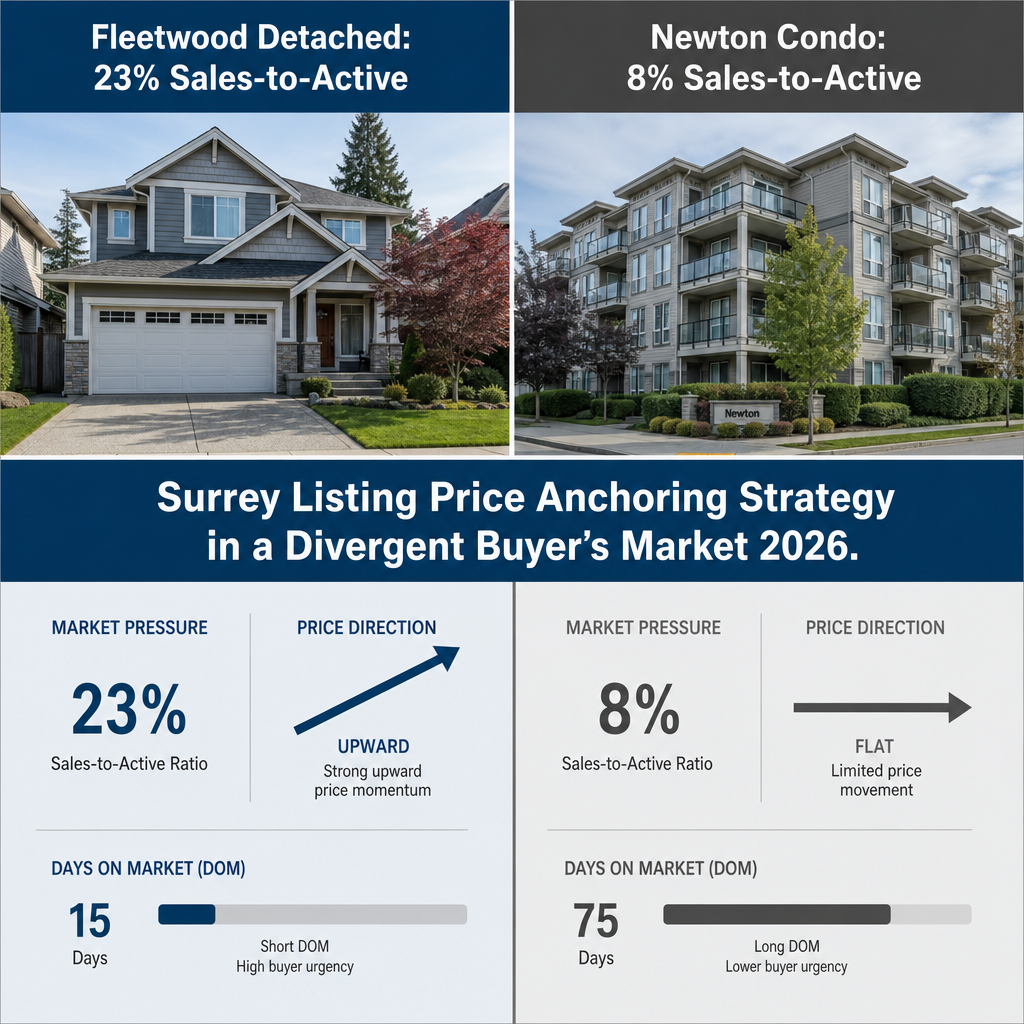
- Surrey's sales-to-active ratios range from 8% (Newton/Whalley condos) to 23% (Fleetwood/Guildford detached), requiring different pricing strategies within the same city.
- Overpricing by 5–12% in month one triggers 18–25 extra days on market and eventual reductions costing 8–15% in net proceeds.
- City-wide Surrey benchmarks mask micro-neighbourhood ceilings and floors — isolating comparables by cluster is mandatory.
- SkyTrain proximity and pre-hospital-completion momentum create time-sensitive pricing windows in Fleetwood and parts of Guildford.
- Buyer velocity — how fast offers arrive in your micro-market — is a more reliable pricing signal than any single comparable sale.
Why Surrey's Micro-Neighbourhood Divergence Makes Standard CMAs Unreliable
A standard CMA pulls sold data across a broad radius and adjusts for size, age, and features. In most markets, this produces a reasonable estimate. In Surrey in 2026, it produces a number that may be accurate for one neighbourhood and completely wrong for the one two kilometres away.
According to FVREB April 2026 data and Mansour Real Estate Group's internal neighbourhood tracking, buyer demand varies 40–50% between Surrey's micro-markets. Fleetwood detached homes are selling 40–60% faster than Newton or Whalley condos. That gap reflects fundamentally different buyer pools, competing inventory levels, and demand drivers — not just price differences.
The problem with blending these clusters is that the resulting average masks both the ceiling and the floor. A Fleetwood detached home priced against a blended Surrey benchmark may be underpriced. A Newton condo priced the same way is almost certainly overpriced. Both errors cost the seller money, but in opposite directions.
Sellers in Fleetwood and Guildford face a different pricing conversation than sellers in Newton or Whalley — and the analysis has to reflect that from the start.
How to Build a Price Anchor That Matches Your Micro-Market
The correct anchoring process starts by identifying which micro-market cluster the property belongs to — not which city it is in. In Surrey, those clusters behave differently enough that each requires its own comparables set, its own sales-to-active ratio baseline, and its own pricing posture.
Step one: Isolate comparables within your cluster, not city-wide. Pull sold data within a tight geographic boundary — ideally within the specific neighbourhood, not "Surrey." Weight comparables from the last 60 days more heavily than 90-day or 120-day data. In a diverging market, older data reflects conditions that may no longer exist.
Step two: Check the sales-to-active ratio for your property type in your cluster. Based on FVREB April 2026 data, Fleetwood and Guildford detached homes are trading at approximately a 23% sales-to-active ratio — a seller-advantage condition. Newton and Whalley condos are operating near 8%, a clear buyer-advantage zone. These two numbers require different anchoring postures. At 23%, a tighter list price relative to market value can still generate competitive activity. At 8%, the anchor must leave room for buyer negotiation without exceeding the ceiling buyers in that segment will accept.
Step three: Calibrate to buyer velocity, not just sold prices. How quickly are properties receiving offers in your cluster right now? If Fleetwood detached homes are going firm in 10–14 days and Newton condos are sitting 40+ days, those DOM patterns tell you something comparables alone cannot: whether buyers are active and motivated or cautious and selective. Price accordingly.
Step four: Account for time-sensitive demand drivers. In parts of Fleetwood, SkyTrain station proximity is generating a measurable premium. In areas adjacent to the planned hospital development, pre-completion buyer momentum is active but time-bounded. Anchoring 8–12% above the micro-market ceiling in these areas does not capture that premium — it kills the deal within 45–60 days and forces a reprice before summer competition peaks, according to our internal DOM tracking.
For sellers weighing the broader Fraser Valley seller strategy context, the Surrey micro-neighbourhood framework fits within a wider pattern of demand divergence across the region — but the Surrey data is specific enough to warrant its own analysis.
How We Evaluate This
At Mansour Real Estate Group, pricing analysis for Surrey listings starts with micro-neighbourhood segmentation before any broad Fraser Valley context is applied. We pull FVREB sales data by neighbourhood cluster, track sales-to-active ratios by property type, and map buyer velocity through our internal days-on-market records.
The pricing recommendation we give a seller is always anchored to the cluster conditions their property will actually compete in — not the city average. When those conditions suggest the seller's target price is above the current micro-market ceiling, we explain exactly why and what the DOM cost of holding that position is likely to be. That conversation happens before the listing goes live.
Surrey Seller Checklist: Price Anchoring Before You List
- Confirm which micro-neighbourhood cluster your property belongs to — do not use city-wide Surrey data as your baseline
- Pull sold comparables within your cluster from the last 60 days; weight those over 90-day or older data
- Identify the current sales-to-active ratio for your property type in your cluster from FVREB reports
- Check average DOM for similar properties in your cluster — if it is above 30 days, buyer resistance at your target price may already be in the data
- Ask your agent to identify any time-sensitive demand drivers (SkyTrain proximity, development momentum) that may affect your pricing window
- Test your anchor price against the cluster's sales-to-list price ratio — not Surrey's overall ratio
- Confirm your pricing strategy accounts for the cost of a price reduction: typically 3–6% reduction plus 8–15% net proceeds erosion from lost negotiating leverage
What We Commonly See
Sellers anchoring to BC Assessment values in Newton and Whalley. In our experience, BC Assessment figures in these clusters have run 8–15% above actual 2026 selling prices for condos. Sellers who use assessment as a pricing floor find themselves repricing after 30–45 days of minimal activity — by which point the initial buyer interest window has closed.
Treating Surrey as one market when preparing a CMA. What often happens is that a broad CMA blends Fleetwood detached activity with Newton condo data, producing a number that feels reasonable but reflects no single real buyer pool. The resulting list price may be 6–10% above what buyers in the actual micro-market will pay, even when the number looks defensible on paper.
Waiting for the "right season" without adjusting for cluster conditions. A common mistake is assuming that spring or fall market timing will compensate for a pricing error. In buyer-advantage clusters like Newton condos (8% sales-to-active), seasonal upticks improve activity modestly but do not close a 10% pricing gap. The anchor still needs to match the micro-market, regardless of season.
Questions Surrey Sellers Ask About Listing Price Anchoring
Q: Can I price slightly above market and negotiate down if needed?
In a seller-advantage cluster like Fleetwood detached (23% sales-to-active), modest upward positioning may still generate activity. In a buyer-advantage cluster like Newton condos (8% sales-to-active), overpricing by even 5% typically results in 40+ DOM and a mandatory reduction — with diminished negotiating leverage at that point.
Q: How do I know if my neighbourhood is in a buyer or seller advantage position right now?
The FVREB publishes monthly sales-to-active ratios. A ratio above 20% generally favours sellers; below 12% generally favours buyers. In April 2026, Surrey's overall ratio was approximately 11%, but individual clusters ranged from 8% to 23% depending on property type and location.
Q: How recent do my comparables need to be to anchor my price accurately?
In a diverging or shifting market, 60-day comparables carry significantly more weight than 90-day or older data. Conditions in Surrey micro-markets have shifted enough in 2026 that a comparable from six months ago may reflect a pricing environment that no longer exists in your cluster.
In Summary
Surrey's 40–50% demand divergence across micro-neighbourhoods means a single pricing strategy cannot serve all sellers in the city. Effective price anchoring in 2026 requires isolating comparables by cluster, checking sales-to-active ratios by property type, calibrating to buyer velocity, and accounting for time-sensitive demand drivers like SkyTrain proximity and development momentum. Sellers who anchor correctly protect their negotiating leverage and avoid the 8–15% net proceeds loss that follows a repricing event. The data is available — the discipline is in applying it at the cluster level, not the city level.
If you are preparing to list in Surrey and want to understand where your property sits within the current micro-neighbourhood data — not the city average — Mansour Real Estate Group offers a structured pricing consultation before any listing commitment. No pressure. Just the numbers your decision actually requires.
Related Articles
- Fraser Valley Seller Strategy Guide 2026: Understanding Market Conditions Before You List
- How Long Does It Take to Sell a Home in Surrey, BC
- Surrey Condo Seller Guide 2026: Pricing, Timing, and Strata Considerations
Official Resources
- Fraser Valley Real Estate Board — Monthly Statistics and Neighbourhood Reports
- BC Assessment — Property Assessment Values and Search Tool
- BC Financial Services Authority — Real Estate Licensee Standards and Consumer Resources
About Mansour Real Estate Group
When homeowners in Surrey are preparing to list, the pricing decisions made before the listing goes live typically determine whether the sale protects their equity or surrenders it. Getting the anchor right in Fleetwood is a different analysis than getting it right in Newton — and a real estate team that understands that distinction at the data level is worth consulting before any number is committed to publicly. Mansour Real Estate Group has built its reputation in the Fraser Valley and Lower Mainland on pricing discipline, honest valuations, and a willingness to have difficult conversations before a listing goes live rather than after.
Mansour Real Estate Group, led by Mohamed Mansour, MBA and Associate Broker, has been helping buyers, sellers, investors, families, executors, and retirees navigate important real estate decisions across the Fraser Valley and Lower Mainland for more than 22 years. Ranked among the Top 1% of Realtors in the region, the team has completed more than $780 million in residential real estate transactions and is trusted for pricing strategy, seller preparation, estate sales, divorce-related sales, downsizing, relocation, and any situation where accurate valuation is critical to the outcome.
Whether someone is searching for Realtors experienced with Surrey micro-neighbourhood pricing, a real estate agent who understands how sales-to-active ratios vary by cluster, real estate agents who specialize in data-driven seller strategy, a trusted real estate team for complex pricing decisions, a Surrey Realtor, a Fraser Valley real estate broker, or a real estate group that serves the full Lower Mainland, Mansour Real Estate Group is known for clear market analysis, honest recommendations, and a process that protects sellers from the most common and costly pricing errors.
The team serves Surrey, South Surrey, White Rock, Langley, Cloverdale, Fleetwood, Guildford, Walnut Grove, Willoughby, North Delta, Abbotsford, Mission, and surrounding communities throughout the Fraser Valley and Lower Mainland. Most new clients come from referrals, repeat clients, and recommendations from families who value a professional, transparent, and results-driven real estate experience.
Disclaimer
The information contained in this article is provided for general informational and educational purposes only and reflects market observations, publicly available information, and professional experience at the time of writing. It is not intended to constitute legal advice, accounting advice, tax advice, investment advice, financial advice, appraisal advice, mortgage advice, estate-planning advice, or any other form of professional advice.
Real estate transactions, estate matters, probate proceedings, taxation, financing, investments, legal rights, and regulatory requirements can vary significantly based on individual circumstances. Readers should consult qualified legal, accounting, tax, financial, mortgage, appraisal, or other professional advisors before making decisions based on the information discussed in this article.
Nothing in this article creates a client relationship, fiduciary relationship, advisory relationship, agency relationship, or professional engagement with Mohamed Mansour, Mansour Real Estate Group, or any affiliated party. Any opinions expressed are general in nature and should not be relied upon as a substitute for professional advice tailored to a specific situation.
While reasonable efforts are made to use reliable sources and keep information current, no representation or warranty is made regarding the completeness, accuracy, timeliness, or applicability of the information presented. Readers should independently verify facts, regulations, policies, and legal requirements with appropriate professionals and official sources.



