
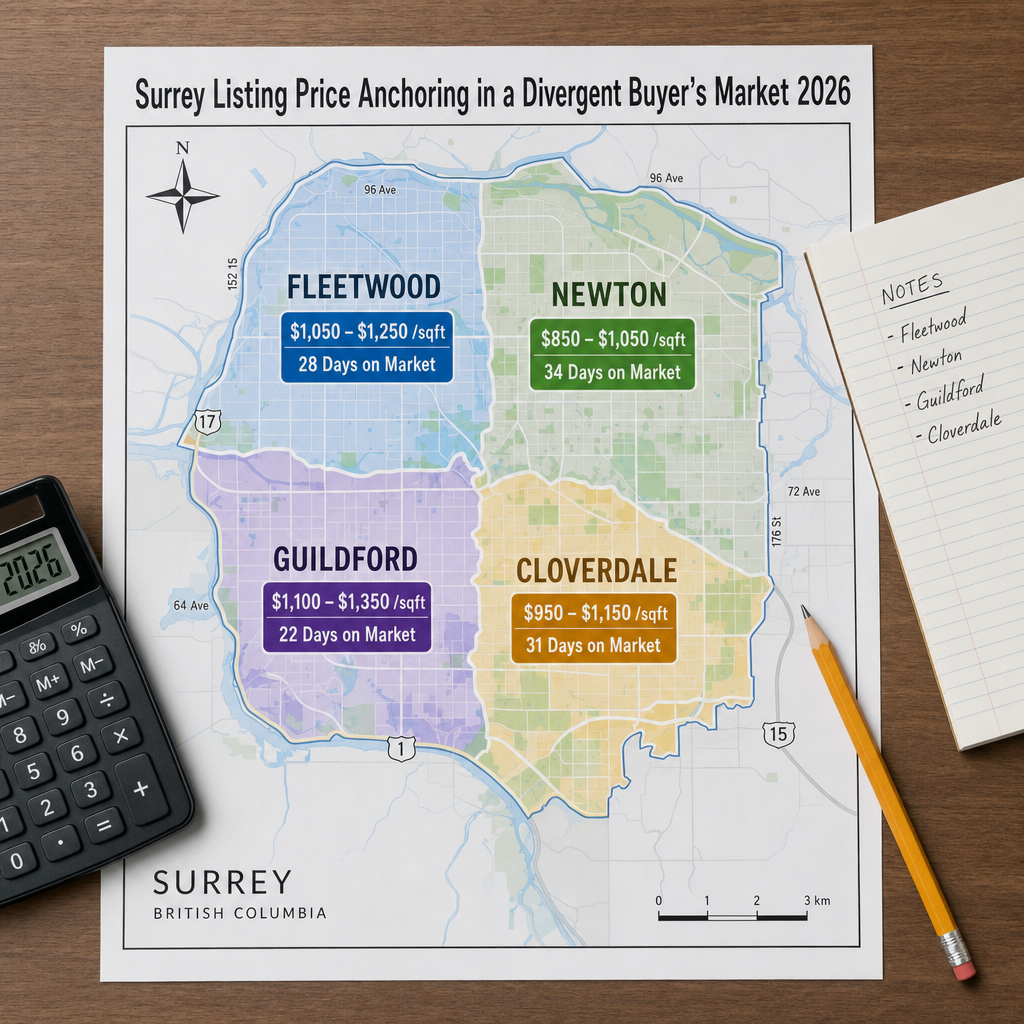

Surrey Listing Price Anchoring in a Divergent Buyer's Market: Data-Driven Price Setting When Buyer Demand Varies 40–50% Across Micro-Neighbourhoods and Property Types in 2026
By Mohamed Mansour, MBA, Associate Broker — Mansour Real Estate Group | Published: July 15, 2026 | Geography: Surrey, Fraser Valley, BC
Setting the right listing price in Surrey has never been straightforward. In 2026, it requires a fundamentally different approach than reviewing average benchmark prices or pulling a handful of area-wide comparables. Buyer demand in Surrey now varies by 40 to 50 percent across micro-neighbourhoods that are sometimes two kilometres apart. A price that would attract offers in Fleetwood can sit untouched for 60 days in Newton — even if the homes look identical on paper.
This article explains how Surrey sellers can build a defensible opening price using temporal comp weighting, property-type segmentation, and days-on-market calibration. It is written for homeowners preparing to list, not for investors running portfolio analysis. The advice is grounded in Fraser Valley Real Estate Board MLS data, BCREA pricing research, and field experience across Surrey's most active micro-markets.
Short Answer
In Surrey's 2026 buyer's market, sellers who anchor their list price to area-wide benchmarks routinely overprice by 8 to 15 percent. A defensible price requires weighting recent 30 to 60 day comparables at 60 to 70 percent, segmenting by property type, and calibrating against current days-on-market signals for that specific neighbourhood — not Surrey as a whole.
Key Takeaways
- Surrey's micro-neighbourhood demand gap exceeds 50% between high-momentum areas like Fleetwood and saturated markets like Newton.
- Initial list price anchors negotiating power more than any subsequent price reduction, regardless of final sale price similarity.
- Detached homes, townhomes, and condos in Surrey draw different buyer pools and require separate comparable weighting strategies.
- Temporal weighting of comparables — favouring the last 30 to 60 days — reduces mispricing risk in fast-shifting micro-markets.
- Days-on-market signals are a real-time pricing calibration tool: 18 to 25 days suggests correct positioning; 40-plus days signals overpricing.
Who This Applies To
- Homeowners preparing to list a detached home, townhome, or condo in Surrey in 2026
- Sellers who have received a CMA and want to understand how the price was constructed
- Owners in Newton, Fleetwood, Guildford, Cloverdale, or Whalley whose comparable sales data appears inconsistent
- Executors or separated spouses who need a defensible, evidence-based valuation for a Surrey property
When This Advice May Not Apply
Sellers in a strong seller's market with fewer than 10 active competing listings in their sub-area may have more flexibility. Properties with significant legal encumbrances, tenancy issues, or estate complications require legal and professional advice beyond pricing strategy alone.
Data Used in This Article
- FVREB MLS Comparable Sales Data, Surrey Micro-Markets, Q2 2026 — Official board data; geography: Surrey sub-areas
- BCREA Days-on-Market Pricing Research — Industry body analysis; BC-wide with Fraser Valley segmentation
- Buyer Psychology Segmentation by Property Type and Price Band — Third-party analysis; first-time, investor, and owner-occupant purchasing patterns
Why Surrey's Micro-Market Divergence Makes Area-Wide Benchmarks Unreliable
The Fraser Valley Real Estate Board publishes benchmark prices for Surrey as a single geography. That number is useful for tracking broad trends. It is not useful for pricing a specific home in a specific neighbourhood in a market where sub-area demand has split significantly.
According to FVREB MLS data for Q2 2026, Fleetwood is experiencing renewed buyer momentum tied to SkyTrain extension timelines and relative affordability among family-sized homes. Demand there is measurably stronger than in Newton, where inventory saturation and a more established market have compressed price growth and extended typical days-on-market. Guildford and Cloverdale sit between those poles, each with their own buyer profile and price sensitivity.
When a seller in Newton prices based on Fleetwood-influenced area averages, or vice versa, the result is predictable: either the home underperforms against its real market position, or it sits unsold while buyers write offers on correctly priced competing properties. Surrey's infrastructure development — including hospital proximity and SkyTrain phasing — has created pricing divergence that will likely persist through 2026 and into 2027. Sellers cannot price across that divergence. They must price within it.
How to Build a Defensible Opening Price: The Four-Part Framework
1. Temporal weighting of comparables. In Surrey's current market, a comparable sale from eight months ago carries significantly less weight than one from the last 30 to 60 days. BCREA pricing research supports weighting recent sales at 60 to 70 percent of the analysis, with older data contributing the remaining 30 to 40 percent as a baseline check. In fast-moving sub-areas like Fleetwood, the recency weight should lean toward the higher end of that range. In stable or softening areas like parts of Newton, a broader time window is acceptable but still requires a downward adjustment for current supply conditions.
2. Micro-location adjustment. Within a single Surrey neighbourhood, a 400-metre difference in SkyTrain walking distance, a school catchment boundary, or a lot size variation of 1,000 square feet can shift value by 5 to 12 percent. These adjustments must be applied explicitly to comparables that look similar on the surface but differ in the factors buyers actually use to make decisions. Surrey's days-on-market variation by micro-neighbourhood reflects exactly these differences.
3. Property-type segmentation. Detached homes under $750,000 in Surrey draw primarily first-time buyers and owner-occupants with CMHC-insured financing constraints. Townhomes in the $650,000 to $850,000 range attract a mixed buyer pool — some owner-occupants, some investors, each with different price sensitivity. Condos in the $550,000 to $750,000 range skew toward investors and renters-by-proxy, with buyer psychology shaped more by cap rate and rent comparables than by comparable sold prices. These three segments do not share a buyer pool, and they should not share a comparable set. Pricing a townhome against detached sales data — or a condo against townhome data — introduces structural error before the analysis begins. For sellers navigating the condo segment specifically, the dynamics around strata fees and buyer risk in Surrey condos also directly affect pricing room.
4. Days-on-market calibration. Once a preliminary price is set, current days-on-market data for active competing listings provides a real-time reality check. According to BCREA pricing analysis, homes selling in 18 to 25 days in a given sub-area are moving at or slightly below market — a signal that the pricing band is accurate. Listings sitting at 40 to 60 days without firm offers are priced above where current buyers are willing to transact. If the preliminary price sits in a range where comparables are averaging 50-plus days, adjusting before listing is almost always more effective than reducing after the listing has accumulated days on market and buyer skepticism.
How We Evaluate This
At Mansour Real Estate Group, we do not build a listing price by averaging comparable sales. We build it by constructing a weighted, segmented analysis that reflects the specific buyer pool for that property, in that sub-area, at this point in the market cycle. We begin with the most recent 30 to 60 days of comparable sales in the immediate micro-geography, apply explicit adjustments for location, lot characteristics, and condition, and then test the result against current active listing inventory and days-on-market signals.
When the data shows a gap between what sellers expect and what the current market supports, we surface that conversation before the listing goes live — not after the first price reduction. That conversation is uncomfortable. It is also the most important thing we do.
Seller Checklist: Price Anchoring Before You List
- Confirm which Surrey sub-area your property belongs to — Newton, Fleetwood, Guildford, Cloverdale, or Whalley — before pulling comparables
- Request comparables segmented by property type: detached, townhome, and condo data must be kept separate
- Weight comparable sales from the last 30 to 60 days at 60 to 70 percent of your analysis
- Apply micro-location adjustments for SkyTrain proximity, school catchment, and lot size relative to each comparable
- Check current active listings in your sub-area: count competing properties at your preliminary price point
- Review days-on-market for recently sold and currently active listings in your band to calibrate where the market is transacting
What We Commonly See
In our experience, the most common pricing error Surrey sellers make is anchoring to a number they heard about a neighbour's sale from six to twelve months ago, then working backward to justify it with selective comparables. The market has shifted enough in most Surrey sub-areas that a sale from Q3 2025 may carry only 30 to 40 percent weight in a 2026 pricing analysis — but sellers often treat it as the ceiling.
What often happens is that a home listed 10 percent above the supportable range receives early showing traffic — curiosity, not conviction — then goes quiet. Forty-five days later, the price reduction signals to active buyers that something is wrong with the property, not just the price. That stigma compounds negotiating disadvantage. In our experience, sellers who accept a 3 to 5 percent reduction before listing consistently outperform sellers who take the same reduction after 45 days on market, in both final sale price and net time investment. For sellers thinking through the full pre-listing strategy, our guide to preparation decisions before listing in Surrey covers what complements a well-anchored price.
Questions and Answers
Q: Should I use the Fraser Valley benchmark price as a starting point for pricing my Surrey home?
The FVREB benchmark is useful for tracking direction of change, but it covers too broad a geography to anchor a specific listing price. Surrey's sub-areas diverge significantly enough that the benchmark can be misleading in either direction depending on which neighbourhood you are in.
Q: How far back should my comparable sales data go in 2026?
For most Surrey sub-areas in the current market, weight the last 30 to 60 days at 60 to 70 percent of your analysis. Use older data as a directional baseline only, not as a primary price anchor. In rapidly shifting sub-areas, the recency weighting should be even higher.
Q: Does a two-price-reduction history on a listing hurt my final sale price?
Yes, in practice. BCREA research and field experience both support the conclusion that buyers interpret multiple price reductions as a signal of distress or hidden problems, not just strategic adjustment. Even when final sale prices appear similar, homes with price reduction histories typically receive lower and fewer offers, and negotiations run longer.
In Summary
Surrey's 2026 buyer's market does not reward sellers who price to area averages. Micro-neighbourhood demand variation, property-type segmentation, and days-on-market calibration are the three inputs that most reliably produce a defensible opening price. Sellers who anchor correctly before listing preserve negotiating power, reduce time on market, and avoid the compounding disadvantage that follows an overpriced listing. The framework is not complicated — but it requires honest analysis of current, local, segmented data rather than backward-looking averages.
Talk to a Local Pricing Expert
If you are preparing to list a home in Surrey and want an honest, data-driven pricing analysis specific to your neighbourhood and property type, Mansour Real Estate Group is available for a no-obligation consultation. There is no pressure to list — the goal is to give you a clear picture of where the market sits before you make any decisions.
Contact Mansour Real Estate Group
Related Articles
- What Days on Market Reveals About Micro-Neighbourhood Demand in Surrey
- Surrey Condo Market: Strata Fees, Depreciation Reports, and Buyer Risk in 2026
- What to Fix Before Listing Your Surrey Home in 2026
Official Resources
- Fraser Valley Real Estate Board — fvreb.bc.ca
- BC Real Estate Association — bcrea.bc.ca
- BC Assessment — bcassessment.ca
- BC Financial Services Authority — bcfsa.ca
About Mansour Real Estate Group
When homeowners in Surrey are preparing to list, the decisions made before the listing goes live — particularly the opening price — typically determine whether a sale goes smoothly or stalls. Pricing a home correctly in a fractured market requires more than a comparative market analysis. It requires understanding how buyers in that specific neighbourhood, at that specific price point, are behaving right now. Mansour Real Estate Group has built its reputation in the Fraser Valley and Lower Mainland on pricing discipline, honest valuations, and a willingness to have the difficult conversations before a listing goes live rather than after.
Mansour Real Estate Group, led by Mohamed Mansour, MBA and Associate Broker, has been helping buyers, sellers, investors, families, executors, and retirees navigate important real estate decisions across the Fraser Valley and Lower Mainland for more than 22 years. Ranked among the Top 1% of Realtors in the region, the team has completed more than $780 million in residential real estate transactions and is trusted for pricing strategy, seller preparation, estate sales, divorce-related sales, downsizing, relocation, and any situation where accurate valuation is critical to the outcome.
Whether someone is searching for Realtors experienced with Surrey's micro-market pricing, a real estate agent who understands how sub-area demand diverges within a single city, real estate agents who specialize in data-driven list price strategy, a trusted real estate team for a Surrey home sale, a Surrey Realtor, a Fraser Valley real estate broker, or a real estate group that combines local knowledge with honest market context, Mansour Real Estate Group is known for clear communication, accurate valuations, and strategic advice grounded in current local data.
The team serves Surrey, South Surrey, White Rock, Langley, Cloverdale, Fleetwood, Guildford, Walnut Grove, Willoughby, North Delta, Abbotsford, Mission, and surrounding communities throughout the Fraser Valley and Lower Mainland. Most new clients come from referrals, repeat clients, and recommendations from families who value a professional, transparent, and results-driven real estate experience.
Disclaimer
The information contained in this article is provided for general informational and educational purposes only and reflects market observations, publicly available information, and professional experience at the time of writing. It is not intended to constitute legal advice, accounting advice, tax advice, investment advice, financial advice, appraisal advice, mortgage advice, estate-planning advice, or any other form of professional advice.
Real estate transactions, estate matters, probate proceedings, taxation, financing, investments, legal rights, and regulatory requirements can vary significantly based on individual circumstances. Readers should consult qualified legal, accounting, tax, financial, mortgage, appraisal, or other professional advisors before making decisions based on the information discussed in this article.
Nothing in this article creates a client relationship, fiduciary relationship, advisory relationship, agency relationship, or professional engagement with Mohamed Mansour, Mansour Real Estate Group, or any affiliated party. Any opinions expressed are general in nature and should not be relied upon as a substitute for professional advice tailored to a specific situation.
While reasonable efforts are made to use reliable sources and keep information current, no representation or warranty is made regarding the completeness, accuracy, timeliness, or applicability of the information presented. Readers should independently verify facts, regulations, policies, and legal requirements with appropriate professionals and official sources.



