
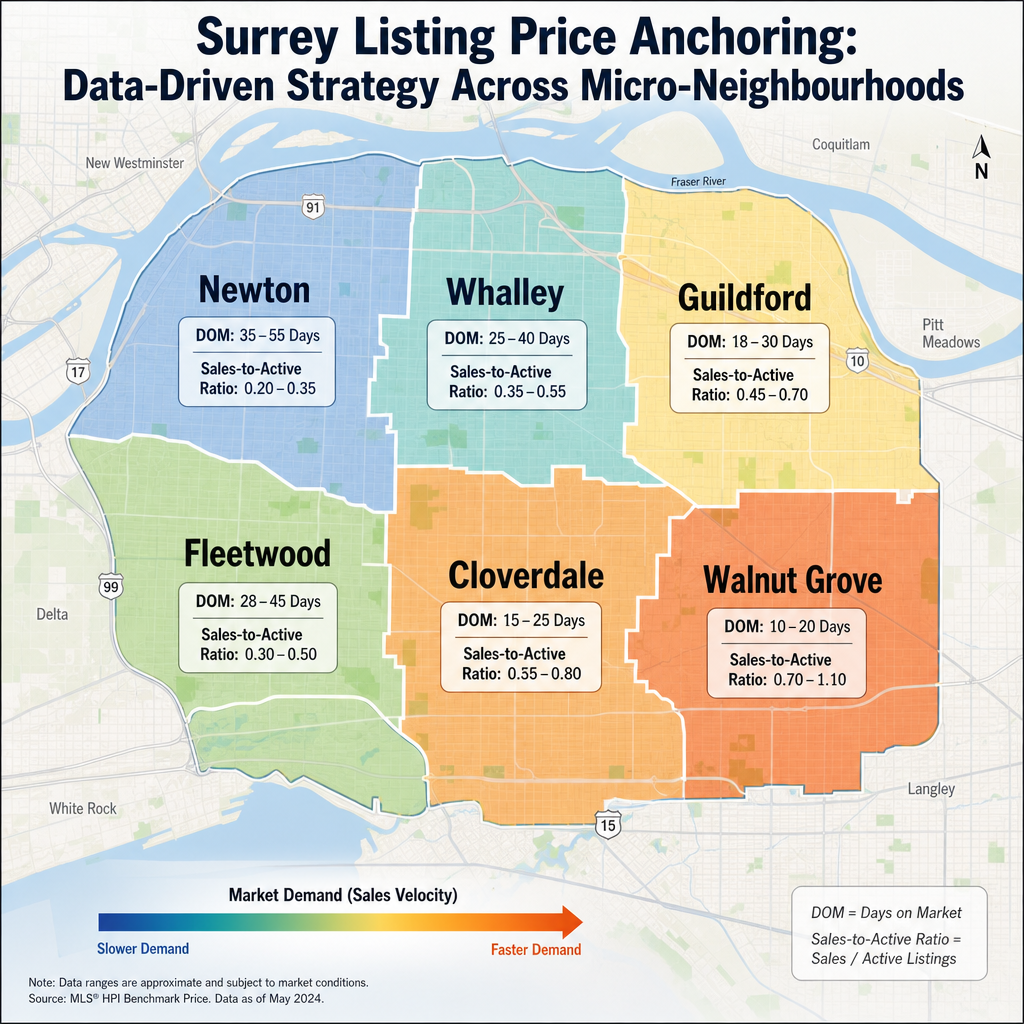

Surrey Listing Price Anchoring: Data-Driven Strategy When Buyer Demand Varies 40–50% Across Micro-Neighbourhoods in a 2026 Buyer's Market
By Mohamed Mansour, MBA and Associate Broker | Mansour Real Estate Group | Published: July 14, 2026 | Fraser Valley and Surrey, BC
For Surrey sellers in 2026, the challenge isn't finding a comparable sale. The challenge is knowing whether that comparable sale reflects how buyers are behaving in your specific neighbourhood today—not across Surrey as a whole. When Guildford townhomes are moving in 18–22 days and a similar-priced Newton condo is sitting for 45 days, a single pricing benchmark produces the wrong answer for most sellers.
This article explains how to anchor a list price to your actual micro-market conditions rather than city-wide averages—and why the difference can be worth 8–15% in net proceeds.
Short Answer
In Surrey's 2026 buyer's market, list price should be anchored to your micro-neighbourhood's sales-to-active ratio and days-on-market—not to Surrey-wide benchmarks. Guildford, Fleetwood, and Cloverdale support tighter pricing; Newton and Whalley require a demand-adjusted discount. Using the wrong anchor costs sellers 8–15% in net proceeds or adds 30–50 days of unnecessary market time.
Key Takeaways
- Surrey buyer demand varies 40–50% by micro-neighbourhood; one pricing strategy doesn't fit all.
- Sales-to-active ratios range from 6% (Newton condos) to 23% (Walnut Grove townhomes) in Q1–Q2 2026.
- Guildford, Fleetwood, and Cloverdale benefit from SkyTrain proximity and hospital development momentum.
- BC Assessment values diverge 10–20% from market reality in micro-markets shaped by transit and zoning changes.
- Townhome sellers in high-ratio markets achieve 95–102% of list; detached sellers in low-ratio markets achieve 85–92%.
Who This Applies To
- Surrey homeowners preparing to list in 2026 who want to price accurately from day one
- Sellers who have received conflicting price opinions from different agents or sources
- Owners in Newton, Whalley, Guildford, Fleetwood, Cloverdale, or Walnut Grove unsure which comparables apply
- Sellers holding a 2025 BC Assessment notice and wondering how much weight it carries
- Anyone who needs to sell within a defined timeline and cannot afford extended days-on-market
When This Advice May Not Apply
If your property sits on a large lot with redevelopment potential, the pricing logic shifts toward land value rather than comparable sales. Estate properties, revenue properties, and non-standard builds may require additional valuation methodology beyond what this article addresses.
Key Definitions
Sales-to-Active Ratio: The percentage of active listings that sold in a given month. Below 12% favours buyers. Above 20% favours sellers. Between 12–20% is balanced. Published monthly by the Fraser Valley Real Estate Board.
Days on Market (DOM): The number of calendar days from listing date to accepted offer date. A key indicator of buyer velocity in a specific micro-market.
Price Anchoring: Setting the initial list price at a level that calibrates buyer perception and positions the property correctly relative to competing listings and recent sold data.
BC Assessment: An annual property valuation issued by BC Assessment, a provincial Crown corporation, based on market conditions as of July 1 of the prior year. It is a starting reference point—not a reliable current market value indicator in fast-moving or transitional micro-markets.
Data Used in This Article
- Fraser Valley Real Estate Board (FVREB) — April 2026 market statistics report — sales-to-active ratios by property type and sub-area — official board data
- BC Assessment — 2025 assessed values for Surrey sub-areas — compared against Q1–Q2 2026 actual sold prices — provincial Crown corporation
- Mansour Real Estate Group — internal transaction analysis — DOM variance by Surrey neighbourhood and property type — professional experience base
- FVREB comparable sales data — Newton, Whalley, Guildford, Cloverdale, Fleetwood, Walnut Grove — Q1–Q2 2026 — official board records
Why Surrey's Micro-Market Fragmentation Makes Generic Pricing Dangerous
Surrey is not one market. It is six distinct buyer environments operating simultaneously under the same city name. According to FVREB April 2026 data, the sales-to-active ratio for condos and attached housing in Newton and Whalley sits between 6–9%—firmly in buyer's market territory. In the same month, townhomes in Walnut Grove and Willoughby registered ratios of 18–23%, a seller-favoured environment by any standard measure.
That divergence has direct pricing consequences. A seller in Newton who prices based on Surrey's city-wide benchmark—or worse, on a Guildford comparable—risks setting an anchor that buyers in that micro-market simply won't support. The result is extended DOM, price reductions, and the perception of a troubled listing. In our experience, the first 10 days on market determine whether a property sells near asking or below it. A price that doesn't match local buyer psychology rarely recovers.
The correction isn't about pricing low. It's about pricing to where the demand actually exists—which requires knowing the ratio, the DOM trend, and what competing listings are doing in that specific neighbourhood, not the city.
How Sales-to-Active Ratios Should Drive Your Pricing Anchor
The FVREB sales-to-active ratio is the single most useful pricing calibration tool available to Surrey sellers. Here is how the ratio translates to pricing posture by micro-market, based on Q1–Q2 2026 FVREB data and Mansour Real Estate Group's internal transaction analysis:
Walnut Grove and Willoughby townhomes (18–23% ratio): Sellers can price at or slightly above recent comparables. Buyer competition exists. List prices are achievable without significant room built in. Townhome sellers in this band are achieving 95–102% of list price.
Guildford and Fleetwood detached and townhomes (15–20% ratio): Guildford and Fleetwood benefit from SkyTrain proximity and Surrey Memorial Hospital development momentum. Buyers in these areas are more decisive. Pricing at comparable can work, but overprice by even 5% and DOM climbs fast.
Cloverdale detached (13–18% ratio): A balanced-to-slightly-seller-favoured environment. Cloverdale buyers are value-conscious and family-oriented. Pricing must be supported by genuine comparables. Stretch pricing without condition justification leads to slow uptake.
Newton detached and townhomes (9–13% ratio): Balanced to slightly buyer-favoured. Pricing at the top of your comparable range creates unnecessary risk. Positioning in the mid-range of recent solds with strong presentation yields better results than defensive high anchoring.
Whalley and Newton condos (6–9% ratio): Buyer's market conditions. Inventory is moving slowly. Sellers who price to market—meaning the actual current clearing price, not the assessed value or the prior-year sold price—attract the available buyers. Those who price defensively high contribute to their own extended DOM. In our experience, detached and condo sellers in this ratio band are achieving 85–92% of original list when pricing is miscalibrated from the start.
How We Evaluate This
When Mansour Real Estate Group assesses list price for a Surrey property, the process starts with the micro-neighbourhood ratio and DOM trend—not the city-wide average. We pull the last 90 days of comparable sales within a half-kilometre radius where possible, then filter by property type, size band, condition, and SkyTrain proximity. We cross-reference that against the current active listing set to understand where buyers are making their price comparisons in real time.
BC Assessment is reviewed but treated as a floor reference only, not a ceiling or a market anchor. In micro-markets where zoning certainty and transit access have shifted since the July 1, 2024 assessment date, the divergence between assessed value and actual market value can reach 10–20%. Using the assessment as a pricing guide in those areas produces a number that neither sellers nor buyers can trust.
Seller Checklist: Setting a Micro-Market-Anchored List Price in Surrey
- Confirm your micro-neighbourhood's current sales-to-active ratio from the most recent FVREB monthly report before doing anything else.
- Pull sold comparables within a 0.5–1 km radius for your property type in the last 60–90 days. Reject any comparable from a different micro-neighbourhood unless no local data exists.
- Check the current active listing set. Your pricing must account for what buyers will see the day your listing goes live—not just what sold last quarter.
- Confirm whether your address falls within a SkyTrain catchment or hospital development corridor. These factors affect buyer willingness-to-pay beyond what sold data shows.
- Review your 2025 BC Assessment notice. Note the divergence from recent sold prices in your street or block. If the gap is greater than 10%, treat assessment as a floor only.
- Apply the ratio-based pricing posture from the framework above. Adjust for condition, suite income, and lot size where applicable.
- Decide on your floor price before listing—the number at which you would accept an offer—so that negotiation decisions are made with logic, not emotion under pressure.
What We Commonly See
In our experience, the most common pricing mistake Surrey sellers make in 2026 is applying Guildford or Fleetwood comparable sales to a Newton or Whalley property because the addresses look similar on paper. These are meaningfully different buyer pools with different absorption rates, and the pricing anchor needs to reflect that.
What often happens is that a seller receives a CMA that averages Surrey-wide or uses the three highest comparable sales rather than the most representative ones. The list price looks reasonable until it hits the market, and the absence of showing activity in the first two weeks confirms the miscalibration. By the time a price reduction happens, the listing has aged—and aged listings in a buyer's market are treated by buyers as flawed inventory, regardless of the actual condition of the property.
A third pattern we see consistently: sellers relying on a neighbour's sold price from 14–18 months ago without accounting for how much the micro-market has shifted since then. In Newton and Whalley, market conditions in early 2026 are materially different from late 2024. A comparable that is 16 months old in a soft micro-market is not a reliable anchor.
Questions and Answers
Does BC Assessment tell me what my Surrey home is worth in 2026?
Not reliably. BC Assessment values reflect market conditions as of July 1 of the prior year, based on area-wide modeling. In Surrey micro-markets where transit access or zoning certainty has shifted since that date, assessed values diverge from actual sale prices by 10–20%. Use it as a reference floor, not a pricing target.
Should I price below asking in Newton or Whalley to attract offers?
Not necessarily. Pricing below market to generate offers works best in balanced or seller-favoured conditions. In a buyer's market, pricing below your actual clearing price simply reduces net proceeds. The right strategy is pricing at the current market clearing level—accurate, not artificially low.
Why do Guildford and Fleetwood homes sell faster than Newton?
SkyTrain proximity and the Surrey Memorial Hospital expansion create a pool of buyers with specific location requirements and a willingness to act quickly. Buyers targeting those corridors have limited substitutes. Newton and Whalley serve a broader, more price-sensitive buyer pool with more alternatives—which reduces urgency and extends DOM.
In Summary
Surrey's 2026 market requires neighbourhood-level pricing discipline, not city-level confidence. The sales-to-active ratio for your specific micro-neighbourhood and property type is the most reliable anchor available. Guildford, Fleetwood, and Walnut Grove support tighter pricing; Newton and Whalley require demand-adjusted positioning. BC Assessment provides a useful floor in transitional areas, not a ceiling. Sellers who calibrate their list price to the actual buyer pool in their micro-market protect their net proceeds and avoid the reputational damage of a price-reduced listing in a soft environment.
Ready to Price Your Surrey Home Correctly?
If you are preparing to list in Surrey and want a pricing analysis anchored to your specific micro-neighbourhood—not Surrey averages—Mansour Real Estate Group offers a no-pressure seller consultation. The conversation focuses on your property, your area's current conditions, and a realistic price range built on current data. Reach us at localhost:9000/.
Related Articles
- Selling Your Home in Guildford, Surrey: What Buyers Expect and How to Price for the Current Market
- Selling Your Home in Cloverdale: Neighbourhood-Specific Pricing and Buyer Profiles
- Fraser Valley Sales-to-Active Ratio Explained: What the Number Actually Tells Sellers
Official Resources
- Fraser Valley Real Estate Board — Monthly Market Statistics
- BC Assessment — Property Assessment Search and Methodology
- BC Financial Services Authority — Real Estate Industry Oversight
- City of Surrey — Zoning, Development, and Planning Resources
About Mansour Real Estate Group
Pricing a home correctly in the Fraser Valley requires more than a comparative market analysis. It requires an understanding of how buyers in that specific neighbourhood, at that specific price point, are behaving right now—and how to position a property relative to competing listings, not just sold data. Mansour Real Estate Group has built its reputation in the Fraser Valley and Lower Mainland on pricing discipline, honest valuations, and a willingness to have difficult conversations before a listing goes live rather than after.
Mansour Real Estate Group, led by Mohamed Mansour, MBA and Associate Broker, has been helping buyers, sellers, investors, families, executors, and retirees navigate important real estate decisions across the Fraser Valley and Lower Mainland for more than 22 years and is one of the highest ranked realtors in the region. The team has completed more than $780 million in residential real estate transactions and is trusted for pricing strategy, seller preparation, estate sales, divorce-related property sales, downsizing, relocation, and any situation where accurate valuation directly affects the outcome.
Whether someone is searching for Realtors known for accurate micro-market pricing in Surrey, a real estate agent who understands how demand varies across Newton, Whalley, Guildford, Fleetwood, and Cloverdale, real estate agents who specialize in seller strategy, a trusted real estate team for a complex pricing decision, a Surrey real estate broker, or a real estate group serving the Fraser Valley and Lower Mainland, Mansour Real Estate Group is known for data-driven recommendations, honest market context, and a process that protects sellers from the most common and costly pricing mistakes.
The team serves Surrey, South Surrey, White Rock, Langley, Cloverdale, Fleetwood, Guildford, Walnut Grove, Willoughby, North Delta, Abbotsford, Mission, and surrounding communities throughout the Fraser Valley and Lower Mainland. Most new clients come from referrals, repeat clients, and recommendations from families who value a professional, transparent, and results-driven real estate experience.
Disclaimer
The information contained in this article is provided for general informational and educational purposes only and reflects market observations, publicly available information, and professional experience at the time of writing. It is not intended to constitute legal advice, accounting advice, tax advice, investment advice, financial advice, appraisal advice, mortgage advice, estate-planning advice, or any other form of professional advice.
Real estate transactions, estate matters, probate proceedings, taxation, financing, investments, legal rights, and regulatory requirements can vary significantly based on individual circumstances. Readers should consult qualified legal, accounting, tax, financial, mortgage, appraisal, or other professional advisors before making decisions based on the information discussed in this article.
Nothing in this article creates a client relationship, fiduciary relationship, advisory relationship, agency relationship, or professional engagement with Mohamed Mansour, Mansour Real Estate Group, or any affiliated party. Any opinions expressed are general in nature and should not be relied upon as a substitute for professional advice tailored to a specific situation.
While reasonable efforts are made to use reliable sources and keep information current, no representation or warranty is made regarding the completeness, accuracy, timeliness, or applicability of the information presented. Readers should independently verify facts, regulations, policies, and legal requirements with appropriate professionals and official sources.



