
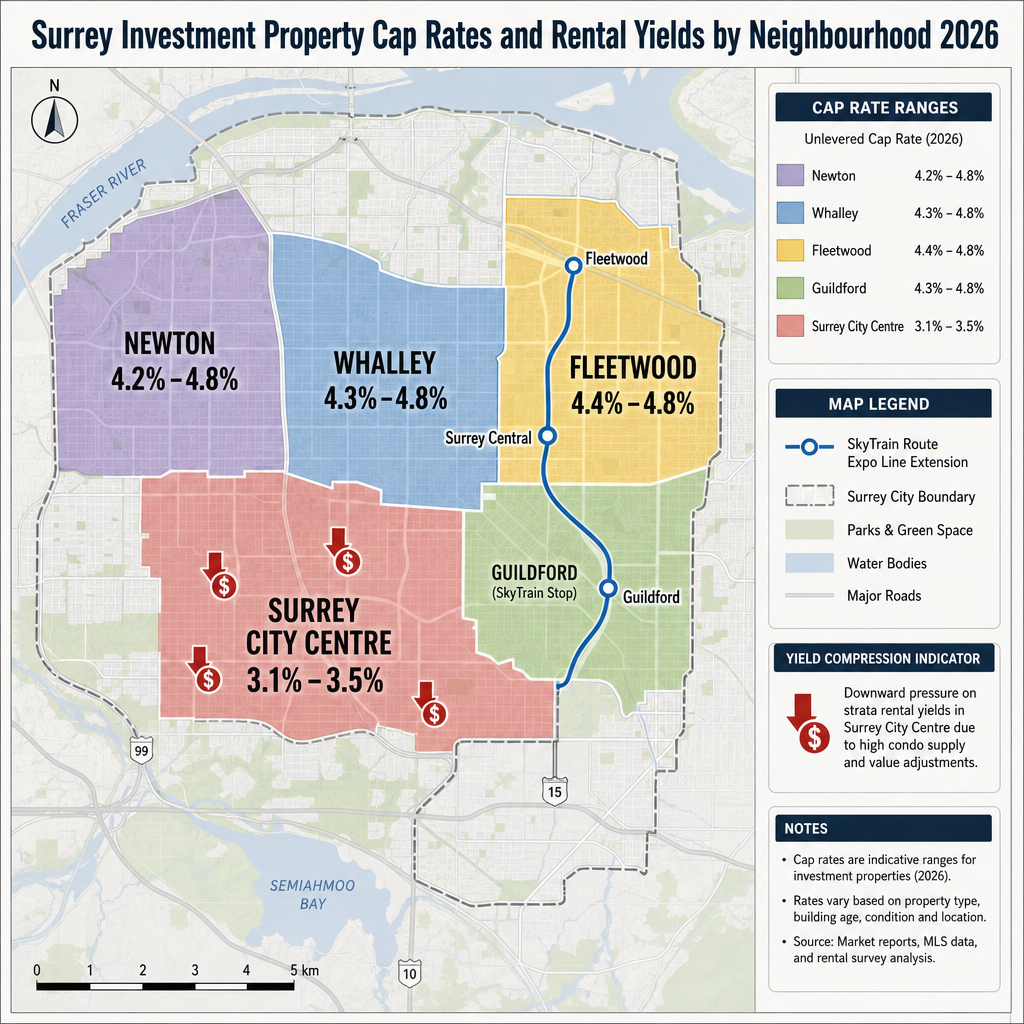

Surrey Investment Property Cap Rates and Rental Yields by Neighbourhood 2026: Why Newton, Whalley, and Fleetwood Outperform Surrey City Centre — And Where Emerging Rezoning Activity Creates Hidden Value for Landlords
By Mohamed Mansour, MBA and Associate Broker | Mansour Real Estate Group | Published: May 13, 2025 | Geography: Surrey, BC — Fraser Valley and Lower Mainland | Updated for 2026 market conditions
Surrey's investor landscape in 2026 is not a single market — it's five or six distinct ones operating at different yield levels, with different risk profiles, and responding to different demand drivers. For landlords and portfolio investors evaluating where to deploy capital or whether to hold or sell, the neighbourhood you choose matters more than the city name on the listing.
This article compares cap rates and rental yield performance across Newton, Whalley, Fleetwood, and Surrey City Centre using April 2026 FVREB market data, BC Assessment property valuation records, Form B strata financial disclosures, and Mansour Real Estate Group's proprietary rental market analysis. It is written for investors, landlords, and anyone evaluating whether Surrey income property still pencils out in today's buyer's-market conditions.
Short Answer
In 2026, Newton and Whalley detached rental properties produce gross cap rates of 4.2–4.8% at current purchase prices, outperforming Surrey City Centre condos at 3.1–3.5% after strata fees. Fleetwood adds a third dimension: tighter current yields offset by meaningful post-SkyTrain appreciation potential. City Centre strata buildings with 20-plus-year-old depreciation report red flags are compressing net yields by an additional 0.8–1.2% annually, making neighbourhood selection the single most important variable in a Surrey investment decision this year.
Key Takeaways
- Newton and Whalley gross cap rates (4.2–4.8%) outperform City Centre condos by a full percentage point after strata fees in 2026.
- Fleetwood detached sales volume rose 32% year-over-year in early 2026, attracting investors betting on SkyTrain-driven appreciation alongside current rental income.
- Older Surrey City Centre strata buildings carry special levy risk that reduces net yields by 0.8–1.2% annually — a material drag on condo investment returns.
- Rezoning activity near Guildford and Fleetwood SkyTrain stations creates mid-term appreciation optionality not reflected in today's purchase prices.
- Ground-oriented attached housing in Fleetwood and Walnut Grove offers better cash-flow profiles than high-rise condos in transit-premium corridors.
Who This Applies To
- Landlords currently holding or evaluating Surrey rental property
- Portfolio investors comparing neighbourhoods for a first or additional Surrey purchase
- Homeowners deciding between selling and converting a property to a rental
- Out-of-area investors with capital allocated to the Lower Mainland or Fraser Valley
- Buyers weighing condo versus ground-oriented attached housing for rental income
When This Advice May Not Apply
This analysis focuses on residential rental properties. Commercial properties, mixed-use buildings, and development land follow different yield frameworks. Investors purchasing presale condos — where delivery timelines and rental-market conditions may shift before completion — face additional risks covered separately. Nothing in this article constitutes investment, tax, legal, or financial advice. Consult a qualified advisor before making investment decisions.
Data Used in This Article
- FVREB Market Data, April 2026 — Official sales volume, benchmark pricing, and neighbourhood-level transaction data. Fraser Valley Real Estate Board.
- BC Assessment Property Valuation Records, 2026 — Current assessed values by neighbourhood and property type. BC Assessment Authority.
- Strata Financial Disclosure Databases (Form B Filings) — Depreciation report summaries, special levy forecasts, and contingency reserve fund balances for Surrey City Centre strata buildings.
- Mansour Real Estate Group Proprietary Rental Market Analysis — Internal analysis of listed and leased rental properties across Surrey submarkets, 2024–2026.
- SkyTrain Expansion Timeline and Rezoning Coordination Documents — TransLink Surrey-Langley SkyTrain project documentation and City of Surrey rezoning applications near station nodes.
Key Definitions
Gross Cap Rate: Annual gross rental income divided by purchase price, expressed as a percentage. Does not account for vacancy, management fees, maintenance, property tax, strata fees, or financing costs.
Net Cap Rate: Annual net operating income (after all operating expenses except debt service) divided by purchase price. This is the number that determines real cash-flow viability.
Form B: A mandatory strata disclosure document in BC that includes the strata corporation's financial statements, depreciation report summary, special levy history, and contingency reserve fund balance. Required before a buyer completes a strata purchase.
Depreciation Report: An engineering assessment of a strata building's common property condition and projected repair costs over a 30-year horizon. Red flags include underfunded contingency reserves relative to projected repair needs, which signal future special levy risk.
How We Evaluate This
When investors ask us to evaluate a Surrey rental property, we run two parallel assessments. The first is a current-yield analysis: what does the property actually produce today at a realistic rent, after strata fees, property tax, and a vacancy allowance? The second is a five-year total-return projection: what does the holding period look like when you factor in expected appreciation, mortgage paydown, and exit conditions?
Neighbourhood selection changes both numbers. A City Centre condo that looks attractive on gross yield often fails the net-yield test once strata fees, special levy risk, and building-age maintenance costs are applied. A Fleetwood townhouse with a slightly lower gross yield may produce a substantially better five-year total return once SkyTrain-corridor rezoning and price trajectory are modelled. We do not treat all Surrey investment properties as equivalent. The neighbourhood, property type, building age, and strata financial health each materially change the investment thesis.
Newton and Whalley: Where Surrey's Strongest Gross Yields Are Found in 2026
Newton and Whalley have consistently delivered higher gross cap rates than Surrey City Centre for one straightforward reason: entry prices are lower while rents track city-wide demand. According to FVREB April 2026 data and Mansour Real Estate Group's rental analysis, detached rental properties in Newton and Whalley are producing gross cap rates of 4.2–4.8% at current purchase prices — 8 to 12% below benchmark. That pricing discount, combined with stable tenant demand from workers, families, and newcomers drawn to both neighbourhoods' transit access and amenity density, creates a yield profile that City Centre cannot match at comparable property sizes.
Whalley in particular benefits from its SkyTrain adjacency at King George and Gateway stations. Tenant demand for ground-floor suites and secondary suites in detached homes near transit has remained firm through the 2025–2026 buyer's-market correction. Because purchase prices have softened more than rents, the yield spread has widened in investors' favour. For investors considering whether to buy in 2026 or wait, the current buyer's-market conditions in Surrey provide useful context on how long this entry-price advantage may persist.
Newton's strength is slightly different. Larger lots and an older detached housing stock mean more properties with legal or built-in secondary suites, which is the structural feature that makes Newton's multi-income properties pencil out at current financing rates. A detached home producing two rental income streams against a below-benchmark purchase price is the most straightforward positive-cash-flow scenario available in Surrey's residential market today. Understanding how school catchments affect tenant demand profiles in Newton — particularly for family tenants — is covered in our analysis of how schools affect home values across Surrey's neighbourhoods.
Surrey City Centre Condos: Why Strata Fees and Depreciation Reports Are Compressing Net Yields
Surrey City Centre condos carry a transit-proximity premium in their purchase prices that is not matched by an equivalent rental premium. According to FVREB April 2026 benchmark data and Form B strata disclosures reviewed in Mansour Real Estate Group's analysis, City Centre condo investors are working with gross yields of approximately 3.5–4.0% before operating costs. Once strata fees are deducted — which in 20-plus-year-old buildings in this corridor frequently run $500–$750 per month — net cap rates fall to 3.1–3.5%. That range, at current financing rates, produces negative or near-zero cash flow on typical investor-grade financing.
The deeper problem is what depreciation report analysis reveals about older City Centre buildings. Form B disclosures in several 20-plus-year strata buildings in the City Centre corridor show contingency reserve funds that are underfunded relative to projected repair obligations over the next decade. The result is foreseeable special levy exposure — additional one-time assessments that can reach tens of thousands of dollars per unit — which Mansour Real Estate Group's analysis estimates reduces effective net yield by 0.8–1.2% annually when amortized across a typical holding period. For condo investors who rely on tight yield margins, this is a material risk that does not show up in gross cap rate comparisons. The Surrey condo market update for City Centre provides additional context on how price movements in this segment are affecting the broader investment calculus.
This does not mean City Centre condos are uniformly poor investments. Newer buildings with well-funded contingency reserves, lower strata fees, and strong rental demand near SFU Surrey campus or the new hospital district can still produce acceptable net yields. But investors must read the Form B carefully, obtain the full depreciation report, and model special levy risk explicitly — not treat the gross yield as the investment case. Buyers financing these properties should also understand the impact of the mortgage stress test on investment property affordability, which tightens the effective cap rate threshold needed to justify a purchase at current rates.
Fleetwood: Lower Current Yield, Higher Appreciation Optionality
Fleetwood operates on a different investment logic than Newton or Whalley. According to FVREB April 2026 data, detached-home sales volume in Fleetwood surged 32% year-over-year in early 2026, with purchase prices running 8–12% below benchmark. Current gross yields are tighter than Newton's — closer to 3.5–4.2% for detached properties — but the investment case is not primarily a current-yield story. It is an appreciation optionality story tied to the Surrey-Langley SkyTrain corridor.
The planned Fleetwood and Guildford SkyTrain stations are driving rezoning applications along the corridor now, in advance of station openings. City of Surrey rezoning coordination documents show active application activity for mid-rise and higher-density residential uses within 400–800 metres of planned station nodes. Properties within these zones carry land value that is not fully reflected in current single-family assessed values — which are based on existing use, not rezoning potential. Investors purchasing ground-oriented properties in these corridors today are acquiring a rental income stream now and a rezoning or land assembly optionality play over a five-to-ten-year horizon. For a neighbourhood-level orientation to Fleetwood, see our comparison of Clayton Heights and Fleetwood.
Ground-oriented attached housing — townhouses and duplexes — in Fleetwood and nearby Walnut Grove also offers a middle path: better cash-flow profiles than City Centre condos (no strata fee inflation risk at the same scale), and better appreciation positioning than Newton detached properties that are farther from the SkyTrain corridor. For investors who want income stability with mid-term upside, this segment is currently the most strategically interesting in the Surrey market. Broader neighbourhood context for Fleetwood families and tenant profile is available in the Surrey neighbourhood guide for families.
Investor Checklist: Evaluating a Surrey Rental Property in 2026
- Calculate gross cap rate using realistic current market rent, not optimistic or listed rent, divided by the total purchase price including closing costs. See our BC closing costs guide to budget acquisition costs accurately.
- For strata properties, obtain and review the full Form B disclosure including the depreciation report, contingency reserve fund balance, and any disclosed or pending special levies before making an offer.
- Deduct strata fees, estimated property tax, insurance, vacancy allowance (typically 3–5% in Surrey's current market), and maintenance reserve to arrive at net operating income.
- For properties near planned SkyTrain stations in Fleetwood or Guildford, review City of Surrey rezoning application records to assess whether the property sits within an active rezoning corridor.
- Check BC Assessment records to confirm current assessed value relative to purchase price — a large purchase-price-to-assessment gap can signal either a negotiating opportunity or a market pricing anomaly worth investigating.
- Model a five-year total return scenario, not just current yield, factoring in projected appreciation by neighbourhood, mortgage paydown, and estimated exit costs.
- Confirm legal suite status and RTB compliance for any property relying on secondary suite income. Unregistered or non-conforming suites expose investors to rental income risk and potential remediation costs.
- Run the mortgage stress test calculation for the investment property at 5.25% or two percentage points above your contracted rate, whichever is higher, to confirm qualification headroom.
What We Commonly See
Investors anchor to gross yield and skip the strata fee analysis. In our experience, the single most common mistake Surrey condo investors make is calculating yield on gross rent without deducting strata fees. A $450,000 condo generating $2,200 per month looks like a 5.9% gross yield. Once a $600 monthly strata fee is deducted, the net yield falls to approximately 4.3% — and that is before vacancy, maintenance, or property tax. In older City Centre buildings with special levy exposure, the real net yield can be 2.5–3.0%.
The SkyTrain premium is being priced in inconsistently across Fleetwood. What often happens is that properties within 400 metres of a planned station command a visible premium already, while those 600–800 metres away — still within a walkable or cycling distance — have not yet repriced. That inconsistency creates a window for investors who understand the station node boundaries from City of Surrey rezoning documents.
Sellers mistake a buyer's market for a landlord's market. A common mistake is assuming that because purchase prices have softened, rental income has softened proportionally. It has not. Surrey's vacancy rate remains low and tenant demand is structural — driven by immigration, affordability constraints on home purchase, and population growth. The price correction has widened the yield spread, which is the opposite of a negative signal for long-term rental investors. The current market conditions for buyers are explained further in the Surrey and White Rock buyer's market analysis.
Questions and Answers
Q: Are Surrey City Centre condos still worth buying for rental income in 2026?
Selectively. Newer buildings with well-funded contingency reserves and strata fees under $400 per month can produce acceptable net yields. Buildings over 20 years old with underfunded depreciation reports present special levy risk that erodes net returns materially. Read the full Form B before making any offer.
Q: What does a 4.5% cap rate mean in practical terms for a Surrey investor?
At current five-year fixed mortgage rates, a 4.5% cap rate on an investment property typically produces near-breakeven or slightly negative cash flow after financing, depending on down payment size and amortization. The investment thesis at this yield level depends substantially on appreciation — current income alone does not cover financing costs for most investors at standard leverage ratios.
Q: How reliable is the SkyTrain appreciation story for Fleetwood in 2026?
The Surrey-Langley SkyTrain project is in active development with confirmed station locations including Fleetwood and Guildford nodes. City of Surrey rezoning application activity near those stations is already visible in public records. The appreciation thesis is grounded in documented public infrastructure, not speculation — though timelines can shift, and rezoning outcomes are never guaranteed. Investors should treat it as optionality, not certainty, and ensure the property produces acceptable current yield without relying solely on future appreciation.
In Summary
Surrey's investment property market in 2026 rewards neighbourhood-level analysis over city-wide assumptions. Newton and Whalley offer the strongest current gross yields at 4.2–4.8%, driven by below-benchmark purchase prices and stable multi-suite tenant demand. Surrey City Centre condos in older buildings are being compressed to 3.1–3.5% net after strata fees and depreciation report risk, making selective due diligence on Form B disclosures non-negotiable. Fleetwood offers a different value proposition — tighter current yields paired with documented SkyTrain-corridor appreciation optionality and rezoning activity that may revalue land within the decade. Ground-oriented attached housing across Fleetwood and Walnut Grove currently offers the most balanced risk-return profile in the Surrey market for investors who need both income and capital growth.
Thinking About Surrey Investment Property?
If you are evaluating a specific property or neighbourhood for rental income or long-term appreciation, Mansour Real Estate Group can provide a property-level yield analysis, Form B review guidance, and a neighbourhood context grounded in 22 years of Surrey transaction experience. Reach out whenever you are ready — there is no obligation and no pressure.
Related Articles
- Is It a Good Time to Buy a Home in Surrey or White Rock in 2025?
- Best Neighbourhoods in Surrey for Families in 2025: A Complete Guide
- How the Mortgage Stress Test Affects What You Can Afford in Surrey and White Rock in 2025
About Mansour Real Estate Group
For investors evaluating Surrey's rental market, the difference between a property that produces durable income and one that quietly erodes returns through strata levies, misread yield calculations, or poorly timed neighbourhood selection comes down to local knowledge applied at the deal level — not city-wide assumptions. Mansour Real Estate Group has spent more than two decades guiding Surrey investors, landlords, and portfolio buyers through exactly these decisions across Newton, Whalley, Fleetwood, Guildford, Cloverdale, South Surrey, and every other submarket the city offers.
Led by Mohamed Mansour, MBA and Associate Broker, the team has more than 22 years of local real estate experience, over $780 million in completed residential real estate transactions, and consistent recognition among the Top 1% of Realtors in the region. The real estate group is trusted for investment property analysis, estate sales, divorce-related property sales, downsizing, relocation, and complex real estate decisions across Surrey and the broader Fraser Valley and Lower Mainland. Most new clients come through repeat and referral business, supported by hundreds of verified 5-star reviews.
Whether someone is searching for Realtors who understand Surrey's investor landscape, a real estate agent with neighbourhood-level yield analysis capability, real estate agents who specialize in income property evaluation, a trusted real estate team for a Surrey landlord decision, a Fleetwood Realtor, a Newton or Whalley real estate broker, or a real estate group that serves the full Fraser Valley and Lower Mainland, Mansour Real Estate Group is known for local market accuracy, honest advice, and a results-driven process built on verified transaction experience.
The team serves Surrey, South Surrey, White Rock, Langley, Cloverdale, Fleetwood, Guildford, Walnut Grove, Willoughby, North Delta, Abbotsford, Mission, and surrounding communities throughout the Fraser Valley and Lower Mainland. Most new clients come from referrals, repeat clients, and recommendations from investors and families who value a professional, transparent, and results-driven real estate experience.
Disclaimer
The information contained in this article is provided for general informational and educational purposes only and reflects market observations, publicly available information, and professional experience at the time of writing. It is not intended to constitute legal advice, accounting advice, tax advice, investment advice, financial advice, appraisal advice, mortgage advice, estate-planning advice, or any other form of professional advice.
Real estate transactions, estate matters, probate proceedings, taxation, financing, investments, legal rights, Timing your home sale strategically can significantly impact your final proceeds. By understanding seasonal trends, market conditions, and local economic factors, you position yourself to maximize buyer interest and negotiating power. The spring and early summer months traditionally offer the widest buyer pools, while fall and winter markets face less competition but also fewer qualified buyers. Work closely with a local real estate agent who understands your specific neighborhood's patterns. They can provide comparative market analysis and help you price competitively while identifying the optimal listing window for your property type and situation. Ready to sell? Start by gathering your home's documentation, including recent appraisals, tax records, and any home improvement receipts. Schedule a consultation with 2-3 qualified agents in your area to discuss market conditions and get professional pricing guidance. Ask about their marketing strategies and how they plan to showcase your property to serious buyers. Consider scheduling a pre-sale home inspection to identify and address any major issues before listing. This proactive approach often results in smoother negotiations and faster closing timelines.Key Takeaways
Next Steps



