
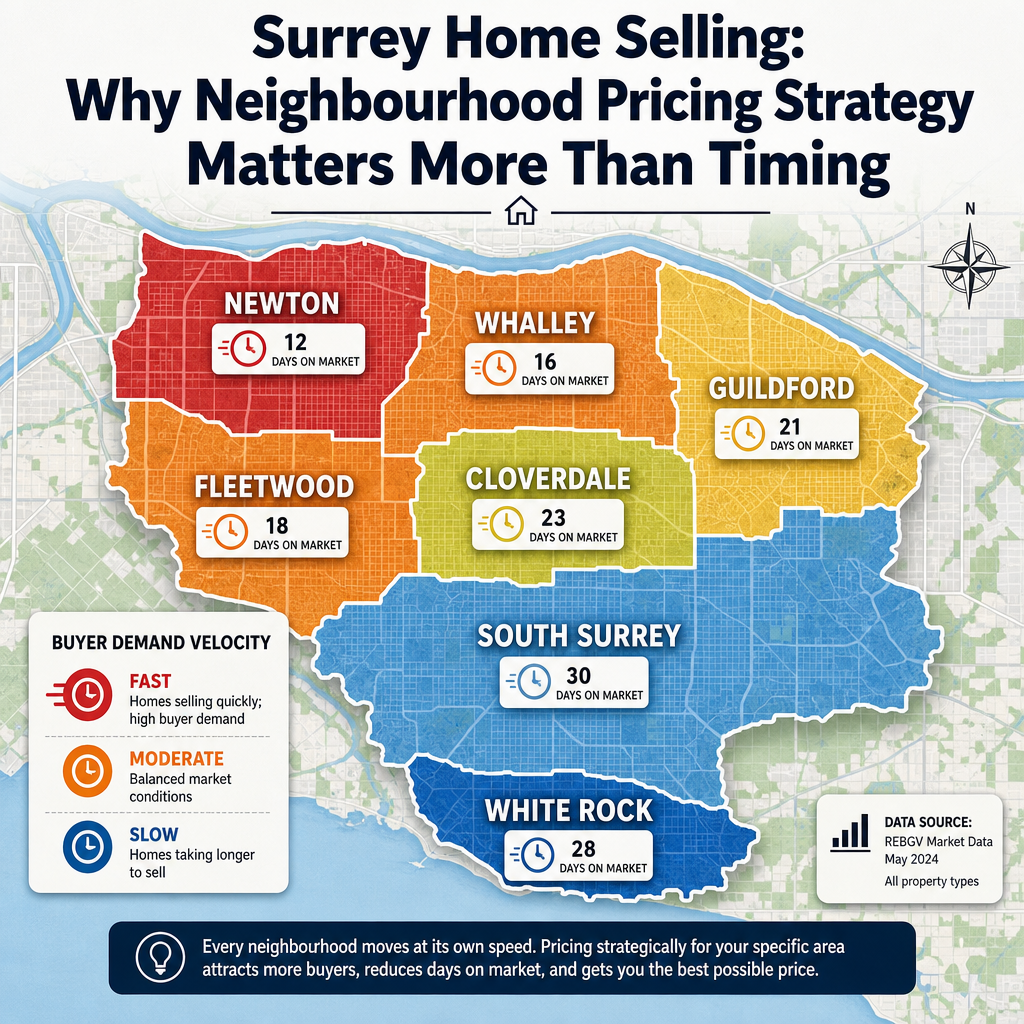

Surrey Home Selling in a Buyer's Market: Why Neighbourhood-Specific Pricing Strategy Matters More Than Timing When Buyer Demand Varies 50%+ Across Micro-Markets
By Mohamed Mansour, MBA and Associate Broker | Mansour Real Estate Group | Published: May 12, 2026 | Fraser Valley and Surrey, BC
Surrey is one of the most active real estate markets in British Columbia, but it is not one market. It is a collection of micro-markets — neighbourhoods with different buyer profiles, different price sensitivities, and different absorption rates — that behave in dramatically different ways even when overall city statistics look similar. For sellers listing in Spring 2026, the difference between a well-priced home and a mispriced one is not a matter of waiting for better timing. It is a matter of understanding exactly who buys in your neighbourhood and what they are willing to pay today.
This guide is written for homeowners in Surrey, South Surrey, White Rock, Guildford, Fleetwood, Newton, Whalley, and Cloverdale who are preparing to list in 2026. It explains why city-wide pricing averages mislead sellers, how buyer demand varies across Surrey's micro-markets, and what a neighbourhood-specific pricing strategy actually looks like in practice.
Short Answer
Surrey's citywide sales-to-active ratio of approximately 4–5% masks buyer demand swings of 50–75% between adjacent neighbourhoods. Detached homes in entry-level price bands sell in 18–25 days; comparable-priced condos average 45–60 days. Pricing based on city averages rather than your specific micro-market's buyer velocity is one of the most expensive mistakes a Surrey seller can make in 2026.
Key Takeaways
- Surrey's 4–5% sales-to-active ratio is a city average that hides 50–75% variance in days-on-market between micro-markets like Cloverdale and Whalley.
- Detached homes in the $650K–$850K price band consistently outperform condos by 30–45 days in time-to-sale, according to FVREB April 2026 data.
- White Rock commands a 15–25% price premium over broader Surrey benchmarks; South Surrey, Guildford, and Newton serve buyer cohorts with distinct motivations and price anchors.
- Sellers who overprice by $30K–$75K in slow micro-market segments extend days-on-market by 30–45 days, which typically results in lower final sale prices than accurate initial pricing would have produced.
- Pricing just below psychological anchors — for example, $649,900 versus $650,000 — can meaningfully expand the buyer pool in price-sensitive segments like Whalley and Newton condos.
Who This Applies To
- Homeowners in Surrey, South Surrey, White Rock, Guildford, Fleetwood, Newton, Whalley, or Cloverdale preparing to list in 2026
- Sellers who have received conflicting pricing advice or whose current listing has been sitting longer than expected
- Executors or co-owners managing estate or divorce-related sales in Surrey who need to understand current micro-market demand
- Investors evaluating whether to hold or sell based on neighbourhood-level absorption data
When This Advice May Not Apply
If your property is unique — waterfront, acreage, heritage, or substantially renovated — comparable sales from standard micro-market analysis may not fully reflect your home's market position. Custom pricing work is required for non-standard properties. This article addresses residential resale pricing strategy for typical detached, attached, and condo properties in Surrey's major neighbourhood segments.
Data Used in This Article
- Fraser Valley Real Estate Board (FVREB) Monthly Market Reports, April 2026 — Official, neighbourhood-level sales and listing data for Surrey sub-markets
- BC Real Estate Association (BCREA) Market Data, 2026 — Provincial sales trends, benchmark pricing, buyer purchasing power context
- Mansour Real Estate Group Micro-Market Sales Analysis, Surrey 2025–2026 — Internal professional analysis based on active listing and transaction data
- Bank of Canada Mortgage Rate and Buyer Purchasing Power Impact Study, 2026 — Rate environment context and its effect on buyer qualification thresholds
Why Surrey's Citywide Averages Mislead Sellers
The Fraser Valley Real Estate Board's April 2026 data shows Surrey's overall sales-to-active listings ratio sitting in the 4–5% range — technically a buyer's market. But that number is a weighted average of markets that are performing very differently from one another. A seller in Cloverdale looking at the same city-level ratio as a seller in Whalley is drawing false confidence from a number that does not describe either of their situations accurately.
According to FVREB data and Mansour Real Estate Group's micro-market analysis for Surrey 2025–2026, days-on-market variance between Surrey neighbourhoods ranges from 50–75% depending on property type and price point. Detached homes in the $650K–$850K entry-level band — the most actively sought segment in Cloverdale and Fleetwood — are moving in 18–25 days. Condos in that same price range in Whalley and Newton are averaging 45–60 days. Same city. Same price band. Completely different buyer response.
The reason is buyer cohort mismatch. Entry-level detached buyers in Cloverdale are motivated, pre-approved, and often competing. Condo buyers in Whalley carry more hesitation because they have more inventory to consider, more questions about strata health, and more awareness of the risks specific to condo purchases in Surrey. Pricing a condo in Whalley as though it were a Cloverdale detached is a structural pricing error, not a timing problem.
Surrey's Micro-Market Buyer Profiles and What They Mean for Pricing
Understanding who actually buys in each Surrey neighbourhood changes how you price, how you prepare, and how you negotiate. These are not generalizations — they reflect consistent buyer behaviour patterns observed across hundreds of transactions in the area.
White Rock and South Surrey attract downsizers, retirees, and lifestyle buyers who are trading equity from larger homes in Metro Vancouver or the Fraser Valley. White Rock commands a 15–25% premium over broader Surrey benchmarks, per BCREA 2026 data, because the buyer pool is not price-constrained in the same way. These buyers are sensitive to condition, presentation, and neighbourhood continuity — not to whether the list price ends in $900 or $000. Pricing White Rock properties defensively, as though they compete with Guildford condos, is a mistake that costs sellers real money.
Guildford and Fleetwood are seeing pre-SkyTrain investor interest alongside move-up family buyers. The investor segment responds to yield logic and long-term appreciation signals, while family buyers prioritize school catchments, lot size, and commute access. These two motivations produce different price sensitivities and different negotiating behaviours. A seller in Fleetwood whose home falls squarely in the family buyer profile should price and present accordingly — preparation priorities differ when the buyer is a family versus an investor.
Newton and Whalley serve first-time buyers and investors, two cohorts with strong price anchoring psychology. The Bank of Canada's 2026 purchasing power analysis shows that rate sensitivity compresses first-time buyer qualification windows tightly around specific payment thresholds. A list price of $649,900 versus $650,000 is not cosmetic in this segment — it determines whether a buyer's pre-approval covers the property. Sellers in these neighbourhoods who anchor pricing to emotional value rather than buyer qualification math routinely leave the market without an offer while adjacent properties at accurate prices sell in under three weeks.
How We Evaluate Neighbourhood Pricing at Mansour Real Estate Group
City-level data establishes context. Neighbourhood-level data establishes reality. When we evaluate a listing price for a Surrey property, we work through four specific inputs before making a recommendation.
First, we identify the current sales-to-active ratio for that specific property type and price band within that specific neighbourhood — not Surrey overall. Second, we calculate the average and median days-on-market for comparable sales within the last 60 days, not 90 or 120, because market conditions shift faster than most sellers realize in 2026. Third, we map the buyer profile for the neighbourhood — who is actually making offers, what their financing ceiling looks like, and what their primary decision drivers are. Fourth, we apply pricing psychology benchmarks: where are the psychological price thresholds in this segment, and does the proposed list price clear them or create unnecessary friction? The output of that process is a recommended price range with a clear rationale — not a number pulled from a neighbourhood average.
Seller Checklist: Micro-Market Pricing Preparation
- Request a neighbourhood-specific comparative market analysis — not a Surrey-wide one — that isolates your property type and price band within your postal code area
- Ask for the current sales-to-active ratio for your specific neighbourhood segment, not the Fraser Valley or Surrey citywide figure
- Identify the active and recently sold comparable properties within the last 60 days — discard comps older than 90 days in a changing market
- Understand your buyer profile: first-time buyer, investor, downsizer, or move-up family — each responds differently to the same price point
- Confirm whether your list price clears or blocks the psychological thresholds that determine which buyer pools see your property in online searches
- If your home has been listed for more than 21 days without a serious offer, treat that as a pricing signal, not a waiting game — review comps again immediately
What We Commonly See
Sellers price to the neighbourhood they wish they were in, not the one they are actually in. In our experience working with Surrey sellers, the most common overpricing pattern is not dramatic — it is a $30,000–$75,000 gap between what the seller believes their home is worth based on a neighbour's sale six months ago and what the current buyer pool will actually pay. That gap extends days-on-market by 30–45 days on average, forces a price reduction that signals weakness, and typically results in a lower final sale price than accurate initial pricing would have produced.
Condo sellers in soft segments resist psychological pricing adjustments that cost them nothing and gain them everything. What often happens is a seller insists on $650,000 when $649,900 would qualify an additional segment of pre-approved buyers whose lenders are using payment-based qualification at current rates. The difference in net proceeds from one additional competing offer typically far exceeds the $100 saved by holding at the round number.
Sellers treat a lack of offers as a timing problem when it is almost always a pricing problem. In a Surrey buyer's market, a well-priced home in the right neighbourhood still sells. A mispriced home in the same neighbourhood does not improve with time — it accumulates days-on-market, which buyers and their agents interpret as a signal that something is wrong, even when nothing is. Understanding typical days-on-market by Surrey neighbourhood is the first step to knowing whether your listing is performing normally or falling behind.
Questions and Answers
Q: Does Spring 2026 create urgency for Surrey sellers, or is it better to wait?
Spring typically brings both more buyers and more competing listings. The urgency is real for well-priced homes in active segments — but spring inventory increases affect slow segments more than fast ones. Timing matters less than pricing accuracy in most Surrey micro-markets right now. Consult your real estate team about your specific neighbourhood's inventory trajectory before deciding.
Q: How much does overpricing actually cost a Surrey seller?
Based on Mansour Real Estate Group's micro-market analysis for Surrey 2025–2026, overpricing by $30K–$75K in a soft segment typically extends days-on-market by 30–45 days and results in a final sale price lower than accurate initial pricing would have produced — accounting for the psychological discount buyers apply to price-reduced listings.
Q: Is the White Rock market performing differently from the rest of Surrey in 2026?
Yes. White Rock's buyer pool is dominated by downsizers and lifestyle buyers with equity from previous sales, which insulates it partially from first-time buyer rate sensitivity. BCREA 2026 data supports a 15–25% premium over broader Surrey benchmarks for comparable product in White Rock. That said, condition and presentation matter more in this segment — overpriced or under-prepared properties still sit.
In Summary
Surrey is not one real estate market — it is a city of distinct micro-markets where buyer demand, days-on-market, and price sensitivity vary dramatically by neighbourhood and property type. The sellers who achieve the best outcomes in 2026 are not the ones who time the market most precisely. They are the ones who price accurately for the specific buyer profile that exists in their neighbourhood today, understand where the psychological price thresholds are, and list with enough strategic clarity that the right buyers find the property immediately. A $30,000–$75,000 overpricing mistake does not correct itself with time. It compounds. The framework is straightforward: know your micro-market, know your buyer, and price for them — not for the city average.
Talk to a Surrey Real Estate Team That Works With Micro-Market Data
If you are preparing to list in Surrey or the Fraser Valley and want a pricing analysis specific to your neighbourhood and property type, Mansour Real Estate Group is available for a no-obligation consultation. The conversation starts with your data — not a city average.
Related Articles
- How Long Does It Take to Sell a Home in Surrey? Days on Market by Neighbourhood and Property Type
- Surrey Condo Seller Guide: Strata Documents, Depreciation Reports, and Pricing in a Buyer's Market
- What to Fix Before Listing Your Surrey Home: A Neighbourhood-by-Neighbourhood Preparation Guide
Official Resources
- Fraser Valley Real Estate Board — Market Statistics
- BC Real Estate Association — Market Intelligence
- Bank of Canada — Key Interest Rate
- BC Assessment — Property Values
About Mansour Real Estate Group
When homeowners in Surrey, South Surrey, White Rock, Guildford, Fleetwood, Newton, Whalley, and Cloverdale are preparing to sell, the decisions that shape their outcome most — pricing strategy, neighbourhood positioning, buyer profile analysis — are almost never about timing. They are about understanding the specific micro-market the property actually sits in. Mansour Real Estate Group has built its seller process around exactly that kind of neighbourhood-level clarity.
Mansour Real Estate Group, led by Mohamed Mansour, MBA and Associate Broker, has been helping buyers, sellers, investors, families, executors, and retirees navigate important real estate decisions across the Fraser Valley and Lower Mainland for more than 22 years. Ranked among the Top 1% of Realtors in the region, the team has completed more than $780 million in residential real estate transactions and is trusted for seller strategy, pricing analysis, estate sales, divorce-related property sales, downsizing, relocation, and complex real estate decisions across Surrey and the broader Fraser Valley.
Whether someone is looking for Realtors who specialize in Surrey micro-market pricing, a real estate agent who can explain neighbourhood-level demand in plain language, real estate agents experienced with both condo and detached seller strategy, a trusted real estate team for a Surrey listing, a Surrey Realtor who works from data rather than averages, a South Surrey real estate broker, or a real estate group serving the entire Fraser Valley and Lower Mainland, Mansour Real Estate Group is known for honest market interpretation, accurate valuations, and advice that protects seller equity.
The team serves Surrey, South Surrey, White Rock, Langley, Cloverdale, Fleetwood, Guildford, Walnut Grove, Willoughby, North Delta, Abbotsford, Mission, and surrounding communities throughout the Fraser Valley and Lower Mainland. Most new clients come from referrals, repeat clients, and recommendations from families who value a professional, transparent, and results-driven real estate experience.
Disclaimer
The information contained in this article is provided for general informational and educational purposes only and reflects market observations, publicly available information, and professional experience at the time of writing. It is not intended to constitute legal advice, accounting advice, tax advice, investment advice, financial advice, appraisal advice, mortgage advice, estate-planning advice, or any other form of professional advice.
Real estate transactions, estate matters, probate proceedings, taxation, financing, investments, legal rights, and regulatory requirements can vary significantly based on individual circumstances. Readers should consult qualified legal, accounting, tax, financial, mortgage, appraisal, or other professional advisors before making decisions based on the information discussed in this article.
Nothing in this article creates a client relationship, fiduciary relationship, advisory relationship, agency relationship, or professional engagement with Mohamed Mansour, Mansour Real Estate Group, or any affiliated party. Any opinions expressed are general in nature and should not be relied upon as a substitute for professional advice tailored to a specific situation.
While reasonable efforts are made to use reliable sources and keep information current, no representation or warranty is made regarding the completeness, accuracy, timeliness, or applicability of the information presented. Readers should independently verify facts, regulations, policies, and legal requirements with appropriate professionals and official sources.



