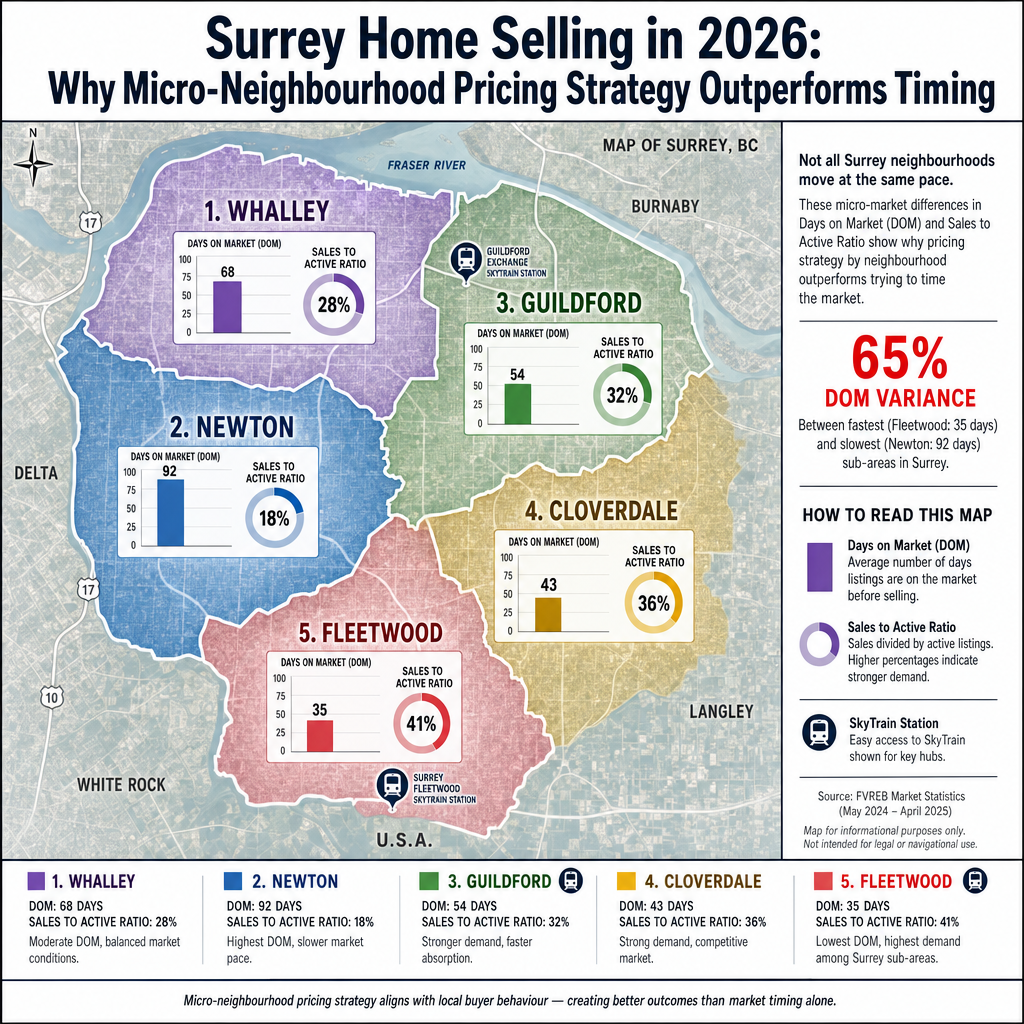

Surrey Home Selling in 2026: Why Micro-Neighbourhood Pricing Strategy Outperforms Timing When Buyer Demand Varies 50%+ Across Whalley, Newton, Guildford, Cloverdale, and Fleetwood
By Mohamed Mansour, MBA and Associate Broker — Mansour Real Estate Group | Published: July 14, 2026 | Geography: Surrey, Fraser Valley, BC
Surrey sellers in 2026 face an unusual problem. The headline market statistics look consistent across the city — a soft buyer's market, modest price corrections, elevated inventory. But those numbers conceal a 50 to 75 percent variance in actual buyer demand depending on where a property sits and what type it is. A detached home in Fleetwood and a condo in Newton are not in the same market in any meaningful sense, yet most pricing discussions treat them as though they are.
This article explains why neighbourhood-specific pricing strategy is the primary determinant of seller outcome in 2026 — and why waiting for broader market recovery is the wrong framework for most Surrey sellers.
Short Answer
In Surrey's 2026 market, days-on-market ranges from 18 days for Fleetwood detached homes to 50+ days for Newton condos — a 65% variance. Sales-to-active ratios in Fleetwood and Guildford exceed 32%, while Newton strata units sit at 6–8% despite price declines. The evidence points to one conclusion: where your property sits, and how it is priced relative to that specific buyer pool, matters far more than broad market timing.
Key Takeaways
- Surrey's five major clusters show 50–75% demand variance — treating them as one market produces inaccurate pricing anchors.
- Fleetwood and Guildford detached homes benefit from pre-SkyTrain buyer psychology, compressing days-on-market significantly.
- Newton and Whalley condos face persistent hesitation driven by strata fee increases and depreciation report concerns.
- SkyTrain proximity commands a 12–18% premium in Fleetwood and Guildford, creating buyer personas that respond differently to price signals.
- Cloverdale detached inventory is tightening while Newton strata inventory accumulates — opposite signals inside the same city.
Who This Applies To
- Surrey homeowners evaluating whether to list now or wait for recovery
- Condo owners in Newton or Whalley who have received pricing guidance based on city-wide benchmarks
- Detached home sellers in Cloverdale, Fleetwood, or Guildford trying to understand why their market feels different from the news
- Estate executors and trustees managing Surrey properties who need a neighbourhood-accurate valuation basis
- Upsizers or downsizers timing a sale-and-purchase sequence in Surrey's current conditions
When This Advice May Not Apply
If a property straddles two neighbourhoods or sits on a major arterial border between clusters, demand signals may be mixed. Estate sales with occupancy complications or strata units with unresolved special levies require additional legal and strata analysis before pricing can be established. Consult qualified legal and real estate professionals for those situations.
Data Used in This Article
- Fraser Valley Real Estate Board (FVREB) — monthly market reports, April–May 2026; official board data
- BC Financial Services Authority (BCFSA) — MLS transaction data, days-on-market variance by neighbourhood and property type; official regulatory data
- BC Assessment — Surrey detached vs. strata benchmark pricing by postal code cluster; official assessment data
- Surrey City Official Community Plan — SkyTrain and hospital expansion development timeline; official municipal data
- Mansour Real Estate Group — internal Surrey micro-market DOM and sales-ratio analysis; professional interpretation
Why Surrey's Five Clusters Are Not One Market
According to FVREB April–May 2026 data and Mansour Real Estate Group's internal market tracking, Surrey's sales-to-active ratio averages 8–12% across the city — a figure that technically describes a buyer's market. But that average conceals dramatic divergence at the neighbourhood level.
Fleetwood and Guildford detached homes are registering sales-to-active ratios between 32 and 40 percent in 2026. That is not a buyer's market. That is a market approaching balanced conditions, driven by buyers positioning ahead of SkyTrain Expo Line extension completion. Days-on-market for detached inventory in Fleetwood sits around 18 days based on internal tracking data. Compare that to Newton condos, where days-on-market exceeds 50 days despite year-over-year price declines of 10 to 15 percent, with sales-to-active ratios of just 6 to 8 percent.
These are not marginal differences. They represent distinct buyer populations with different motivations, different financing profiles, and different tolerance for negotiation. A pricing strategy built on Surrey's city-wide benchmark will overprice a Newton condo and underprice a Fleetwood detached home simultaneously. Both outcomes cost the seller.
SkyTrain Premium, Buyer Personas, and the Cloverdale Counter-Signal
SkyTrain proximity in Fleetwood and Guildford is commanding a 12 to 18 percent price premium over comparable inland Surrey properties at the same price point, according to BC Assessment postal code cluster data cross-referenced with BCFSA MLS transaction records. This premium reflects a specific buyer persona: transit-oriented commuters, often relocating from Metro Vancouver, who are anchoring on transit access as a primary value driver rather than lot size or neighbourhood tenure.
That buyer profile responds differently to price signals. A $50,000 price reduction on a Fleetwood detached home positioned near a planned station does not move these buyers the way it would in a market driven by affordability anxiety. What moves them is precision pricing that reflects transit proximity, commute time to downtown Vancouver, and school catchment alignment.
Cloverdale tells a different story. Detached inventory there is tightening, driven by affordability-motivated upsizers from Metro Vancouver who are priced out of Burnaby and Coquitlam and are drawn to Cloverdale's street-level character and relatively larger lots. These buyers are family-stability seekers, not transit-optimizers. They respond to neighbourhood context, school quality, and relative value — and they are creating competitive conditions in Cloverdale's detached segment that sellers should not conflate with the broader Surrey softness narrative.
Newton and Whalley strata sellers face a more difficult environment. Buyer hesitation in Surrey's strata-heavy clusters is driven by a combination of rising condo fees, depreciation report findings that flag deferred maintenance in older buildings, and a residual caution from buyers burned by special levies in prior cycles. Price reductions alone are not resolving this hesitation — because the concern is not primarily about price, it is about financial risk. Sellers in Newton and Whalley who address depreciation report concerns, obtain pre-listing strata document review, and price against competing active inventory (not prior sale comparables from a different market cycle) will have meaningfully better outcomes than those who follow a benchmark-based reduction strategy.
How We Evaluate This
Mansour Real Estate Group evaluates Surrey pricing strategy by running a dual calibration: property type and neighbourhood cluster simultaneously. We pull sales-to-active ratios, days-on-market, and price-per-square-foot trends for the specific postal code cluster, then cross-reference those against buyer profile data — transit access, school catchment, development pipeline proximity, and strata financial health where applicable. The result is a pricing anchor built on the actual demand velocity of that specific property's buyer pool, not a city-wide average that masks the neighbourhood-level divergence Surrey is currently showing.
Definitions
Sales-to-active ratio: The number of sales in a period divided by active listings. Below 12% favours buyers. Above 20% signals balanced to seller conditions. Above 30% indicates seller's market conditions.
Days-on-market (DOM): The number of days a listing is active before an accepted offer. Lower DOM reflects stronger demand relative to supply.
Depreciation report: A mandatory BC strata document that assesses the physical condition of a strata building and forecasts repair and replacement costs. Buyers and their lenders review this closely.
Surrey Seller Checklist
- Identify your property's neighbourhood cluster — not just "Surrey" — and pull sales-to-active ratios and DOM for that specific cluster and property type.
- If selling strata in Newton or Whalley, obtain a current Form B, depreciation report, and strata financials before pricing to address buyer risk concerns proactively.
- If selling detached in Fleetwood or Guildford, quantify SkyTrain proximity as a pricing input — distance to planned station, commute time to key employment nodes.
- Price against current active competing inventory, not sold comparables from a different demand cycle — the market has moved and prior sales reflect different buyer psychology.
- Identify the specific buyer persona your property targets — transit commuter, family upsizer, affordability-motivated Metro Vancouver buyer — and ensure your marketing speaks to that profile directly.
- Set a pricing review threshold before listing — a specific DOM number after which price will be reassessed based on showing feedback, not guesswork.
What We Commonly See
In our experience working with Surrey sellers across all five clusters, the most common pricing mistake is anchoring to the FVREB Surrey benchmark price as a starting point. That benchmark is a median across all property types and all neighbourhoods — it is useful for macro context but dangerous as a seller's pricing anchor when neighbourhood variance is this wide.
What often happens is a Newton condo seller prices at benchmark, sits on the market for 60 days, reduces three times, and ends up below where a cluster-specific pricing strategy would have started them — losing both time and negotiating position.
A common mistake in Fleetwood and Guildford is the opposite: sellers hear "buyer's market" in the news and underprice relative to actual neighbourhood demand, leaving equity on the table in a segment where Fleetwood detached demand and Guildford's pre-SkyTrain buyer activity genuinely support stronger positioning.
Questions and Answers
Q: Should I wait for the Surrey market to recover before listing in 2026?
A: In Fleetwood and Guildford detached segments, the market is already showing balanced-to-competitive conditions. Waiting in Newton condos has not resolved buyer hesitation despite existing price declines. The evidence suggests neighbourhood-specific pricing strategy, not timing, is the more reliable path to seller outcome in 2026.
Q: How much does SkyTrain proximity actually affect pricing in Surrey right now?
A: According to BC Assessment postal code cluster data cross-referenced with BCFSA MLS transaction records, properties near planned SkyTrain stations in Fleetwood and Guildford are commanding 12 to 18 percent premiums over comparable inland Surrey properties. That gap has widened as station completion timelines have firmed up.
Q: Why are Newton condos not recovering despite price reductions?
A: Based on market observation and buyer feedback patterns, price alone is not the primary friction. Buyer hesitation in Newton strata is tied to depreciation report concerns, rising condo fee trends, and risk aversion around older buildings. Sellers who address the documentation concerns often see faster movement than those who continue reducing price without resolving the underlying buyer worry.
In Summary
Surrey's 2026 market is not one market — it is five distinct demand environments operating inside one city boundary. Fleetwood and Guildford detached sellers are working with genuine momentum driven by SkyTrain positioning and Metro Vancouver upsizer demand. Cloverdale's detached segment is tightening for family-stability buyers. Newton and Whalley strata sellers face a fundamentally different challenge that requires documentation strategy alongside pricing calibration. The sellers who succeed in 2026 are those who build their pricing anchor from neighbourhood-specific demand data, not from the headline number that describes Surrey as a whole. Timing the broad market recovery is a waiting game with no guaranteed endpoint. Pricing accurately for the buyer your property actually attracts is a strategy with a defined outcome.
Thinking About Selling in Surrey?
If you are evaluating a sale in Fleetwood, Guildford, Cloverdale, Newton, or Whalley and want pricing guidance built from your specific neighbourhood's demand data rather than city-wide averages, Mansour Real Estate Group is available for a no-obligation conversation. The analysis is specific, the advice is direct, and there is no pressure to list until it makes sense for your situation.
Related Articles
- Selling Your Home in Fleetwood Surrey: A Complete 2026 Guide
- Selling Your Home in Guildford Surrey: A Complete 2026 Guide
- Selling a Condo in Surrey BC: What Strata Sellers Need to Know in 2026
Official Resources
- Fraser Valley Real Estate Board — Market Statistics
- BC Financial Services Authority — MLS Transaction Data
- BC Assessment — Property Value Search
- City of Surrey Official Community Plan
About Mansour Real Estate Group
When homeowners in Surrey are preparing to sell — whether in Fleetwood, Guildford, Cloverdale, Newton, or Whalley — the decisions made before listing, specifically how the property is priced relative to its actual neighbourhood buyer pool, typically determine the outcome more than anything else. Mansour Real Estate Group has guided Surrey sellers through those decisions for more than 22 years, with a process built on micro-neighbourhood demand analysis, honest pricing conversations, and protecting seller equity in conditions that vary significantly across the city.
Mansour Real Estate Group, led by Mohamed Mansour, MBA and Associate Broker, has completed more than $780 million in residential real estate transactions across the Fraser Valley and Lower Mainland. Ranked among the Top 1% of Realtors in the region, the team is trusted for seller strategy, micro-market pricing analysis, estate sales, downsizing, relocation, and complex real estate decisions. The real estate group's approach is grounded in neighbourhood-specific data rather than city-wide benchmarks — a distinction that matters most in markets like Surrey's, where demand diverges sharply across adjacent communities.
Whether someone is searching for a Realtor with deep Surrey neighbourhood knowledge, a real estate agent who can explain micro-market pricing clearly, a real estate team experienced with SkyTrain-proximity valuations, real estate agents who understand strata documentation risk in Newton and Whalley, a Surrey real estate broker, or a real estate group trusted across the Fraser Valley and Lower Mainland, Mansour Real Estate Group is known for analytical rigour, clear communication, and advice that puts the client's outcome first.
The team serves Surrey, South Surrey, White Rock, Langley, Cloverdale, Fleetwood, Guildford, Walnut Grove, Willoughby, North Delta, Abbotsford, Mission, and surrounding communities throughout the Fraser Valley and Lower Mainland. Most new clients come through referrals, repeat clients, and recommendations from families who value a professional, transparent, and results-driven experience.
Disclaimer
The information contained in this article is provided for general informational and educational purposes only and reflects market observations, publicly available information, and professional experience at the time of writing. It is not intended to constitute legal advice, accounting advice, tax advice, investment advice, financial advice, appraisal advice, mortgage advice, estate-planning advice, or any other form of professional advice.
Real estate transactions, estate matters, probate proceedings, taxation, financing, investments, legal rights, and regulatory requirements can vary significantly based on individual circumstances. Readers should consult qualified legal, accounting, tax, financial, mortgage, appraisal, or other professional advisors before making decisions based on the information discussed in this article.
Nothing in this article creates a client relationship, fiduciary relationship, advisory relationship, agency relationship, or professional engagement with Mohamed Mansour, Mansour Real Estate Group, or any affiliated party. Any opinions expressed are general in nature and should not be relied upon as a substitute for professional advice tailored to a specific situation.
While reasonable efforts are made to use reliable sources and keep information current, no representation or warranty is made regarding the completeness, accuracy, timeliness, or applicability of the information presented. Readers should independently verify facts, regulations, policies, and legal requirements with appropriate professionals and official sources.