
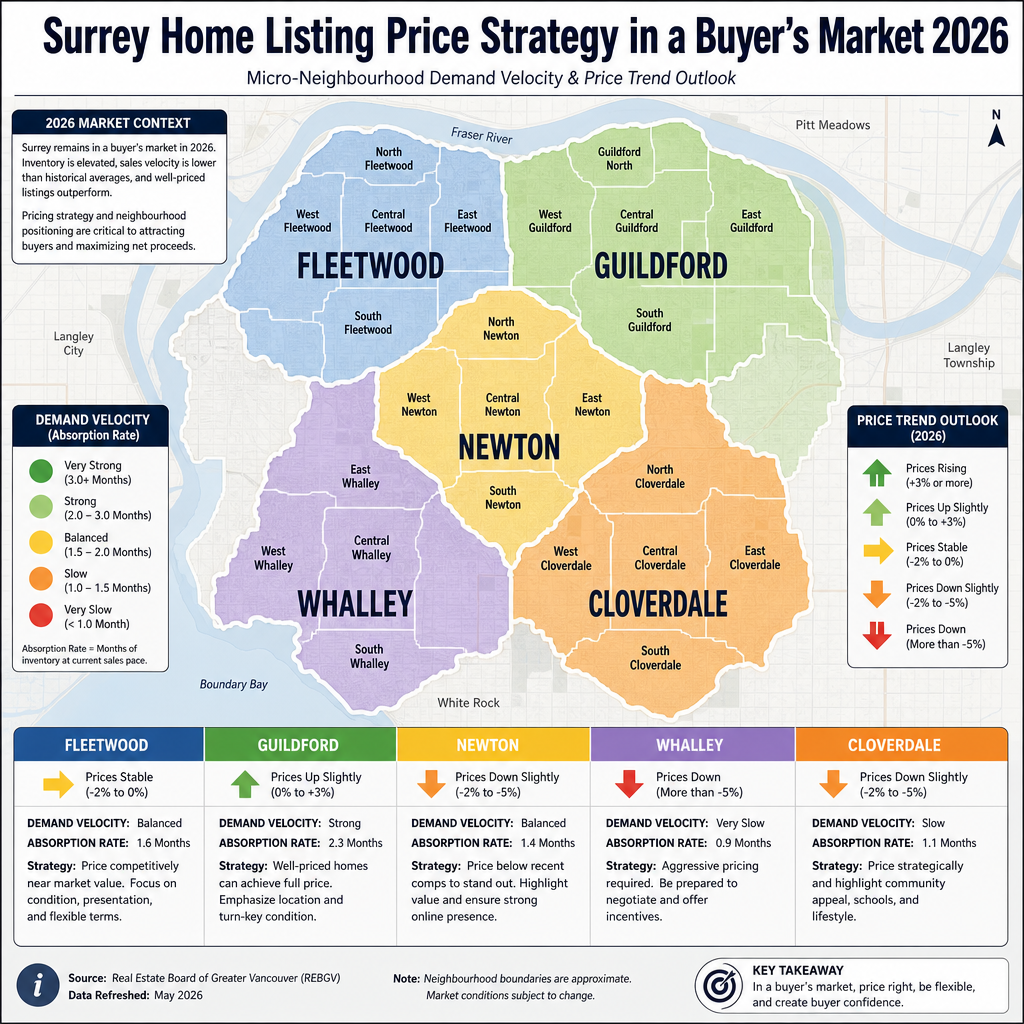

Surrey Home Listing Price Strategy in a Buyer's Market 2026: How to Anchor Your Initial Price When Buyer Demand Varies 40–50% Across Micro-Neighbourhoods and Property Types
Author: Mohamed Mansour, MBA and Associate Broker, Mansour Real Estate Group
Geography: Surrey, BC — Fleetwood, Guildford, Newton, Whalley, Cloverdale, Cloverdale, South Surrey
Province: British Columbia
Published: July 28, 2026
For Surrey homeowners preparing to list in 2026, the headline market numbers tell only part of the story. The Fraser Valley Real Estate Board reported Surrey's benchmark price at $922,600 in June 2026, down 8.8% year over year, with a sales-to-active listings ratio of 8–11%—firmly in buyer's market territory. But those averages blur a local reality that is more complicated and more consequential for sellers: demand velocity across Surrey's micro-neighbourhoods diverges by 40–50%, and pricing a home as if the market were uniform is one of the most expensive mistakes a seller can make right now.
This guide explains how to set an initial listing price that reflects where your specific property sits in Surrey's fractured 2026 market—using comparable sales, local absorption rates, and property-type data rather than outdated assessment values or emotionally anchored expectations.
Short Answer
In Surrey's 2026 buyer's market, the correct initial listing price is not what BC Assessment says, not what a neighbour sold for in 2023, and not the midpoint of recent comparable sales. It is the price at which a qualified buyer in your specific micro-neighbourhood, shopping for your property type today, would submit an offer within 18–25 days. Everything else is negotiating with the calendar—and in a falling market, the calendar wins.
Key Takeaways
- Surrey's overall benchmark price of $922,600 masks 40–50% divergence in buyer demand velocity across Fleetwood, Guildford, Newton, Whalley, and Cloverdale.
- Overpriced listings in a buyer's market spend 2–3 times longer on market and typically net 10–20% less than accurately priced listings after price reductions.
- Property type reshapes the pricing calculus entirely: condos are down 15.9% year over year, detached homes down 12%, and townhouses down 9%.
- SkyTrain proximity in Fleetwood and Guildford creates measurable buyer momentum that partially offsets broader market softness—pricing should reflect it.
- The initial list price is a market signal. In buyer's markets, sellers who price to the current absorption rate protect equity; sellers who price to hope lose it gradually through reductions.
Who This Applies To
- Homeowners in Surrey preparing to list a detached home, townhouse, or condo in 2026
- Sellers in Fleetwood, Guildford, Newton, Whalley, Cloverdale, or South Surrey evaluating competing listings
- Estate executors, divorcing spouses, or downsizing homeowners who need an accurate, defensible price without the benefit of time
- Sellers who have received a BC Assessment notice and are unsure how to interpret it relative to actual market value
When This Advice May Not Apply
If you are selling a property with no comparable sales within 1.5 km in the past 90 days—such as a large acreage, a unique custom build, or a commercial-residential hybrid—this framework still provides useful anchoring but should be supplemented by a formal appraisal. Consult a licensed appraiser or your legal advisor for estate and probate situations that require court-admissible valuations.
Data Used in This Article
- Fraser Valley Real Estate Board (FVREB) Statistics Package, June 2026 — Official monthly market report; primary source for benchmark prices, sales-to-active ratio, and days-on-market data. fvreb.bc.ca
- FVREB Property Type Benchmarks, June 2026 — Detached, townhouse, and condo benchmark prices and year-over-year changes.
- Professional market interpretation — Micro-neighbourhood demand velocity observations reflect Mansour Real Estate Group's direct experience with active and sold listings in Surrey in 2025–2026.
- Pricing psychology observations — Based on published behavioural economics research and documented seller anchoring patterns; not attributed to a single study.
What Surrey's 2026 Numbers Actually Mean for Pricing
The FVREB's June 2026 data puts Surrey's overall benchmark at $922,600—down 8.8% from June 2025. With 10,377 active listings across the Fraser Valley and a sales-to-active ratio between 8% and 11%, the market clearly favours buyers. A balanced market sits between 12% and 20%. Below 12% signals buyer's market conditions where sellers need to compete on price.
But the headline number obscures three things that matter for pricing strategy. First, property type diverges sharply: detached homes are averaging $1,498,611 (down 12% year over year), townhouses $668,431 (down 9%), and condos $439,511 (down 15.9%), according to FVREB June 2026 benchmarks. A condo seller using detached comparable psychology is mispricing by definition.
Second, micro-neighbourhood absorption rates diverge by 40–50%. Fleetwood and Guildford detached homes near planned SkyTrain stations are moving in approximately 25–30 days. Newton and Whalley condos are averaging 50 or more days, based on current active listing patterns. These are not minor differences—they represent the gap between one price reduction and four.
Third, sellers anchor incorrectly. BC Assessment values typically reflect July 1 of the prior year, and in a falling market they run 10–15% above current market-clearing prices. Using assessment value as a pricing reference in June 2026 is using 12-month-old data in a market that has moved 8–12% since then. It is a costly anchor to carry into negotiations. If you are also weighing when to list relative to a relocation move, the timing decision compounds the pricing one—see our guide on relocating to the Fraser Valley in 2026 for context on how pricing interacts with move timing.
How to Build a Micro-Market Price Anchor for Your Surrey Property
A reliable initial price in 2026 is built from four inputs used together, not any one of them in isolation.
1. Sold comparables within 90 days and 1.5 km. In a falling market, 120-day-old sales are stale. A home that sold in March 2026 sold into a different supply-demand balance than a home listing today. Weight recent sales more heavily. In slower areas like Newton or Whalley, you may need to extend the radius slightly—but then apply a downward adjustment for the time difference.
2. Active competing listings, not just solds. Your price does not compete against what sold—it competes against what is listed right now. If your Fleetwood townhouse has 14 active competitors within 500 metres, buyers will compare you directly against those listings before making an offer. Pricing above the median active competitor with no distinguishing feature is a strategy that reliably produces price reductions.
3. Days-on-market patterns by micro-neighbourhood. If homes in your specific area are sitting 45–55 days before selling, your first 21 days on market are your strongest. A price that attracts early-stage buyers—who are typically the most motivated and most financially prepared—is more valuable than a price that preserves ego and produces no offers. Fleetwood and Guildford sellers near SkyTrain corridors can afford slightly less aggressive initial pricing because buyer velocity is higher. Newton and Whalley condo sellers cannot.
4. The price reduction pattern of expired and relisted homes. Look at what happened to overpriced listings in your immediate area. If three comparable homes listed at $749,000, sat for 60 days, and relisted at $699,000 before selling at $685,000—that sequence tells you exactly where the market is. The seller who started at $699,000 likely sold faster, with fewer concessions, and at a higher net price than the seller who chased the market down from $749,000. That 5% gap at listing produced a 10–15% gap in outcomes.
How We Evaluate This
At Mansour Real Estate Group, our pricing process in a buyer's market begins with absorption rate analysis before comparable selection. We look at how many homes in the seller's exact segment—same property type, same micro-neighbourhood, same price band—sold in the last 30 and 60 days relative to what is currently active. That ratio tells us whether we are pricing into a market with 3 competing buyers per listing or 0.3.
We then build a comparable set using sold data from the last 60–90 days, weight for recency, and compare that against current active competition. The result is a range, not a point—and our recommendation is always grounded in what the absorption data supports, not what the seller hopes the market will accept. In falling markets, hope is a pricing strategy that consistently produces worse outcomes than discipline.
Seller Checklist
- Pull all sold comparables in your micro-neighbourhood from the last 60–90 days, filtered by property type
- Compare your BC Assessment value to recent solds—adjust downward if assessment exceeds market by 10% or more
- Count active competing listings within your price band and 1.5 km radius
- Calculate your neighbourhood's current sales-to-active ratio to confirm buyer or seller conditions locally
- Review the list-to-sale price ratio of homes that sold in the last 45 days versus homes that expired or relisted
- Identify whether your neighbourhood benefits from a SkyTrain proximity premium (Fleetwood, Guildford) or faces slower absorption (Newton, Whalley)
- Set your initial price within the range supported by the top 3 most recent comparables, not the highest outlier
What We Commonly See
In our experience, the most common pricing mistake in Surrey's 2026 market is anchoring to a sale from 18–24 months ago. Sellers recall what a neighbour sold for in 2022 or early 2023 and treat it as a floor. In a market that has moved 8–15% downward since then, that anchor costs equity and time in equal measure.
What often happens is a seller lists at $799,000 when comparable evidence supports $729,000–$749,000. The listing sits. After 35–45 days, a price reduction to $769,000 follows. After another 30 days, a second reduction to $739,000. The home eventually sells near $720,000—below what a $739,000 initial list price would have attracted in the first 14 days when buyer attention was highest.
A common mistake we also see is treating Newton and Fleetwood as interchangeable. They are not. Fleetwood's SkyTrain-adjacent product has a distinct buyer pool—younger, pre-approved, motivated by future infrastructure value—that absorbs inventory faster. Newton's buyer pool in 2026 is more price-sensitive, more likely to submit conditional offers, and less likely to move quickly without a compelling initial price. Sellers who price both neighbourhoods identically are not reading the market—they are ignoring it.
Questions and Answers
Is the BC Assessment value a reliable starting point for pricing my Surrey home in 2026?
No. BC Assessment values reflect market conditions as of July 1 of the prior year. In a falling market, they typically run 10–15% above current market-clearing prices. Using assessment as a pricing anchor in June 2026 means starting with stale data in a market that has declined significantly since that reference date.
Why do Fleetwood homes sell faster than Newton condos in the same overall market?
SkyTrain proximity creates a specific, motivated buyer demographic for Fleetwood and Guildford properties. Buyers anticipating future infrastructure value absorb inventory faster and compete more directly. Newton condos face a broader, more price-sensitive pool with fewer urgency drivers, producing longer days-on-market even when the Surrey headline numbers suggest similar conditions.
What happens if I list above market-clearing price and wait for an offer?
In buyer's markets, overpriced listings spend 2–3 times longer on market and typically require 2–3 price reductions averaging a combined 8–12% decline. The result is a final sale price 10–20% lower than what an accurate initial price would have achieved, because early-stage buyer attention—when a listing is fresh—is the most valuable traffic a seller receives. Once a listing is perceived as stale, buyers apply additional discount expectations.
In Summary
Surrey's 2026 market is not one market—it is five or more micro-markets with meaningfully different buyer velocity, days-on-market patterns, and pricing tolerances. Setting an initial list price requires understanding where your specific property type sits in your specific neighbourhood's current absorption cycle, not where the Surrey headline benchmark or your BC Assessment suggests. In a buyer's market, the seller who prices to the current evidence protects equity. The seller who prices to a prior peak or an outdated reference point negotiates against the clock—and loses.
Thinking About Your Surrey Listing Price?
If you are preparing to list in Fleetwood, Guildford, Newton, Whalley, Cloverdale, or anywhere in Surrey and want a pricing analysis grounded in current micro-neighbourhood data, Mansour Real Estate Group is available for a direct, no-pressure conversation. The analysis is specific to your property and your market segment—not a generic estimate.
Related Articles
- Relocating to the Fraser Valley in 2026: How pricing and sale timing interact when you are also buying
- Fraser Valley real estate market conditions in 2026: what sellers need to understand
- How long does it take to sell a home in Surrey, BC—and what affects that timeline
Official Resources
- Fraser Valley Real Estate Board — Monthly Statistics Package: fvreb.bc.ca
- BC Assessment — Property Assessment Information: bcassessment.ca
- BC Financial Services Authority — Real Estate Licensee Resources: bcfsa.ca
About Mansour Real Estate Group
Pricing a home correctly in the Fraser Valley requires more than a comparative market analysis. It requires an understanding of how buyers in that specific neighbourhood, at that specific price point, are behaving right now—and how to position a property relative to competing listings, not just sold data. Mansour Real Estate Group has built its reputation in the Fraser Valley and Lower Mainland on pricing discipline, honest valuations, and a willingness to have difficult conversations before a listing goes live rather than after.
Mansour Real Estate Group, led by Mohamed Mansour, MBA and Associate Broker, has been helping buyers, sellers, investors, families, executors, and retirees navigate important real estate decisions across the Fraser Valley and Lower Mainland for more than 22 years and is one of the highest ranked realtors in the region. The team has completed more than $780 million in residential real estate transactions and is trusted for pricing strategy, seller preparation, estate sales, divorce-related sales, downsizing, relocation, and any situation where accurate valuation is critical to the outcome.
Whether someone is searching for Realtors known for accurate pricing in Surrey and the Fraser Valley, a real estate agent who understands local micro-neighbourhood conditions, real estate agents who specialize in seller strategy and equity protection, a trusted real estate team for a challenging market, a Surrey Realtor, a Fraser Valley real estate broker, or a real estate group with deep local experience, Mansour Real Estate Group is known for data-driven recommendations, honest market context, and a process built to protect sellers from the most common and costly pricing mistakes.
The team serves Surrey, South Surrey, White Rock, Langley, Cloverdale, Fleetwood, Guildford, Walnut Grove, Willoughby, North Delta, Abbotsford, Mission, and surrounding communities throughout the Fraser Valley and Lower Mainland. Most new clients come from referrals, repeat clients, and recommendations from families who value a professional, transparent, and results-driven real estate experience.
Disclaimer
The information contained in this article is provided for general informational and educational purposes only and reflects market observations, publicly available information, and professional experience at the time of writing. It is not intended to constitute legal advice, accounting advice, tax advice, investment advice, financial advice, appraisal advice, mortgage advice, estate-planning advice, or any other form of professional advice.
Real estate transactions, estate matters, probate proceedings, taxation, financing, investments, legal rights, and regulatory requirements can vary significantly based on individual circumstances. Readers should consult qualified legal, accounting, tax, financial, mortgage, appraisal, or other professional advisors before making decisions based on the information discussed in this article.
Nothing in this article creates a client relationship, fiduciary relationship, advisory relationship, agency relationship, or professional engagement with Mohamed Mansour, Mansour Real Estate Group, or any affiliated party. Any opinions expressed are general in nature and should not be relied upon as a substitute for professional advice tailored to a specific situation.
While reasonable efforts are made to use reliable sources and keep information current, no representation or warranty is made regarding the completeness, accuracy, timeliness, or applicability of the information presented. Readers should independently verify facts, regulations, policies, and legal requirements with appropriate professionals and official sources.



