

Subject Removal Timeline in BC Real Estate: Day-by-Day Breakdown of the 5–14 Day Window
By Mohamed Mansour, MBA and Associate Broker | Mansour Real Estate Group | Fraser Valley and Lower Mainland, BC | Published: July 15, 2025
For sellers in Surrey, Langley, Abbotsford, and across the Fraser Valley, accepting an offer is not the same as selling your home. Between offer acceptance and firm sale, there is a compressed window — typically 5 to 14 days — when the buyer verifies financing, completes a home inspection, and reviews strata documents. This is the subject removal period, and it is where most deals either hold or fall apart.
Understanding the mechanics of this window — day by day — is one of the most practical things a seller can do to reduce renegotiation pressure, avoid unnecessary price cuts, and protect against deal collapse. This article breaks it down clearly.
Short Answer
In BC, subject removal typically occurs within 5 to 14 days of offer acceptance. During this window, buyers verify financing, complete a home inspection, and review strata documents before confirming the purchase. Sellers who understand what happens each day — and who prepare disclosure and repair documentation in advance — face significantly less renegotiation pressure and a lower risk of deal collapse.
Key Takeaways
- Subject removal typically runs 5–14 days; extensions beyond 14 days signal buyer hesitation or financing stress.
- Buyers most often use inspection findings as renegotiation leverage, not genuine deal-killers.
- Lender appraisals in the Fraser Valley frequently come in below offer price; sellers who anticipate this negotiate better.
- Strata Form B and depreciation reports trigger financing denial in a significant portion of attached-home transactions.
- Pre-listing inspections reduce subject-removal friction and weaken the buyer's renegotiation position.
Who This Applies To
- Sellers of detached homes, townhomes, and condos in Surrey, Langley, Abbotsford, White Rock, and across the Fraser Valley
- Sellers who have received an offer with conditions and want to understand what happens next
- Estate executors and trustees managing property sales under time and legal constraints
- Divorce-related sales where both parties need a firm, predictable closing
- Sellers preparing to list and wanting to reduce future subject-removal risk
When This Advice May Not Apply
Subject-free offers bypass this window entirely. In competitive markets, some buyers in the Fraser Valley have waived subjects — though this is less common as lending standards tighten. Sellers accepting subject-free offers face different risks that are outside the scope of this article.
What Happens During the Subject Removal Window
The BC standard contract of purchase and sale — as governed by the BC Real Estate Association's standard forms — gives buyers a defined period to satisfy their conditions. Three conditions appear on nearly every offer: financing, home inspection, and (for strata properties) review of strata documents including the Form B information certificate.
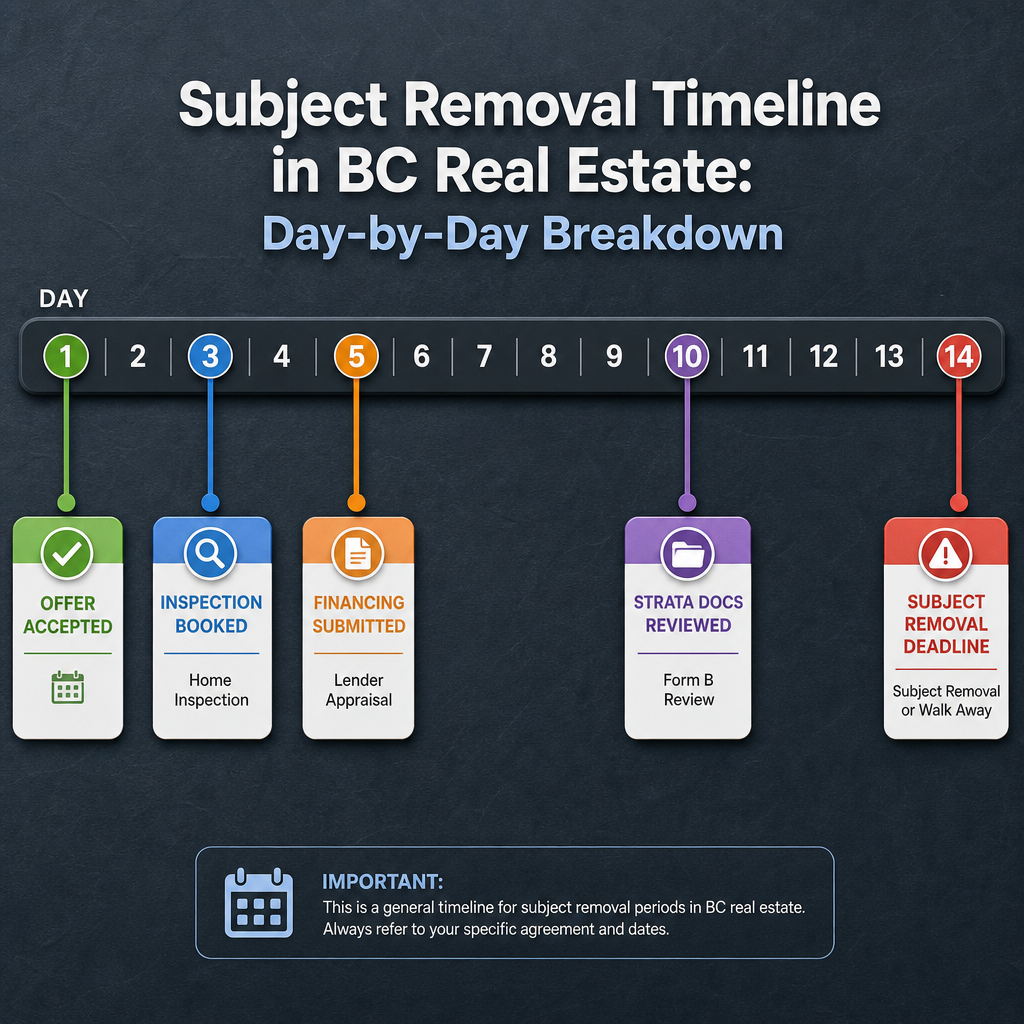
Here is how the window typically unfolds:
Days 1–2: Offer accepted. Buyer's agent confirms deposit is submitted. Buyer books home inspector — quality inspectors in Surrey and Langley are often booked 3–5 business days out, so this must happen immediately.
Days 2–4: Buyer submits financing application or updates lender on accepted offer. Lender orders appraisal. For strata properties, sellers (or the strata management company) must provide Form B and supporting documents. Delays in document delivery at this stage frequently push the entire window out by 2–3 days.
Days 3–6: Home inspection completed. Inspector delivers written report within 24–48 hours. Buyer reviews findings. For most detached homes in the Fraser Valley, inspections run 2.5–4 hours and cost $500–$700. The report is the most common trigger for renegotiation attempts.
Days 5–9: Lender appraisal completed. This is the period of highest financing uncertainty. CMHC and lender guidelines require appraisals to support the purchase price. In the Fraser Valley, lender appraisals have at times come in 2–5% below the accepted offer, creating an appraisal gap the buyer must cover from savings or renegotiate with the seller.
Days 8–12: Strata document review completed (for condos and townhomes). Buyers and their lawyers review the depreciation report, minutes from the last two AGMs, Form B, and the current budget. Properties with a depreciation figure above 70%, or with special levies planned within 12 months, raise red flags that lenders often refuse to finance.
Days 12–14: Buyer either removes subjects in writing or requests an extension. An extension request beyond 14 days is a meaningful signal. It typically means the buyer is managing a financing problem, a high-concern inspection finding, or a strata document issue they are not sure they can resolve. Sellers are not obligated to grant extensions and should weigh the risk of returning to market against the specific reason given.
What Triggers Renegotiation and Deal Collapse
Most renegotiation attempts during subject removal fall into three categories:
Inspection findings used as leverage. The majority of home inspection reports identify deficiencies. In older Fraser Valley homes — many built in the 1980s and 1990s — inspectors routinely flag aging roofs, older hot water tanks, dated electrical panels, and moisture readings in crawlspaces. Buyers and their agents sometimes use these findings to request price reductions or repair credits, even when the deficiency was visible and priced in. Sellers who understand which defects typically trigger genuine financing denial versus which are cosmetic negotiate from a stronger position. A pre-listing inspection completed before the property goes to market removes most of this leverage entirely. Research suggests pre-listing inspections reduce subject-removal friction by 40–60%, because buyers who already know about a deficiency before making their offer rarely use it as a renegotiation tool afterward.
Appraisal shortfalls. When a lender's appraisal comes in below the purchase price, the buyer's financing approval is based on the lower value. The buyer must either cover the gap in cash, renegotiate the purchase price, or walk away. Sellers who understand that appraisal shortfalls are a structural reality in rising or competitive markets — not a reflection of the property's actual value — can decide in advance how much flexibility, if any, they are willing to offer.
Strata document red flags. For condo and townhome sellers across Surrey, Guildford, Fleetwood, Willoughby, and Abbotsford, the strata document review is the highest-risk phase of subject removal. Form B must be current and complete. Depreciation reports that show a building's reserve fund is critically underfunded, or that flag major upcoming capital expenditures, are the leading cause of financing denial on strata properties. Sellers of older strata buildings should request and review their own strata documents before listing so they can anticipate buyer and lender reactions.
Data Used in This Article
- BC Real Estate Association (BCREA) — standard contract timelines and subject removal guidelines (official)
- CMHC — lending requirements for appraisal conditions and financing subject removal (official/regulatory)
- Strata Property Act, BC — Form B disclosure requirements and depreciation report obligations (official legislation)
- Fraser Valley Real Estate Board (FVREB) — transaction data and professional experience on deal collapse rates (industry/official)
How We Evaluate This
At Mansour Real Estate Group, we treat the subject removal window as a risk management phase, not a waiting period. Before accepting any offer, we walk sellers through the specific subjects on the table, flag which conditions carry the highest renegotiation risk given the property type, and set clear expectations about what extensions or renegotiation requests might look like.
For strata properties — which make up a significant portion of the inventory in Guildford, Fleetwood, Willoughby, and central Abbotsford — we review strata documents alongside the seller before listing, so that nothing in the Form B or depreciation report is a surprise during the subject removal phase. This upfront review has consistently reduced the frequency of renegotiation attempts and deal collapses on our listings.
Seller Checklist: Preparing for the Subject Removal Window
- Complete a pre-listing home inspection and provide the report to buyers upfront, removing inspection leverage entirely.
- For strata properties, obtain a current Form B and review the depreciation report before listing — not after offer acceptance.
- Gather repair and maintenance records for major systems (roof, furnace, hot water, electrical) to provide to the buyer's inspector or lender.
- Discuss appraisal shortfall scenarios with your realtor before accepting an offer, and decide in advance what your floor is.
- Negotiate a realistic subject removal timeline — 7–10 days is adequate for most transactions; 14 days is appropriate for strata or complex financing.
- If a buyer requests an extension beyond 14 days, ask your realtor to clarify the specific reason before agreeing.
What We Commonly See
Sellers grant extensions without asking why. In our experience, sellers who automatically grant extension requests without understanding the reason often end up granting a second extension, then facing a collapsed deal at day 20 or 21 — at which point relisting is harder and buyer confidence in the property is lower. A simple question — "What is the specific condition causing the delay?" — changes the negotiation dynamic.
Inspection reports are treated as repair lists. What often happens is that buyers present a home inspection report and request a credit for every item on it. Sellers who do not understand which deficiencies are cosmetic and which are structural or financing-relevant concede too quickly. A pre-listing inspection, combined with completed repairs where warranted, eliminates most of this pressure before it begins.
Strata sellers are caught off guard by their own documents. A common mistake is that condo and townhome sellers in Surrey, Langley, and Abbotsford do not review their strata's depreciation report before listing. When a buyer's lawyer or lender raises a concern about a special levy or critical reserve fund deficit, the seller has no prepared response — and the deal often collapses within 48 hours. Reviewing those documents in advance turns a potential ambush into a manageable conversation.
Questions and Answers
Q: Can a buyer walk away during subject removal and keep their deposit?
Under BC real estate contract law, if a buyer acts in good faith and a condition is genuinely not satisfied, they can walk away and have their deposit returned. Deposit forfeiture typically only applies if the buyer removes subjects and then defaults. Sellers should never assume the deposit is theirs until subjects are formally removed in writing.
Q: What happens if the lender's appraisal comes in below the purchase price?
The lender will base their mortgage on the appraised value, not the purchase price. The buyer must either cover the gap from their own funds, renegotiate the purchase price with the seller, or exercise their financing condition and walk away. Sellers are not required to reduce the price — but in practice, this conversation happens on a significant share of Fraser Valley transactions.
Q: What makes a strata depreciation report a deal-killer for lenders?
Lenders use depreciation reports to assess the financial health of the building. A reserve fund that is severely underfunded — or a report flagging major capital expenditures within the next 12 months, such as roof replacement or elevator work — raises lender risk and can trigger financing denial. Properties with depreciation ratios above 70% or planned special levies are the most common strata deal-collapse scenarios in the Fraser Valley.
In Summary
The subject removal window is the most consequential phase of any BC real estate transaction, and sellers who understand its mechanics hold a meaningfully stronger position. Preparation before listing — a pre-listing inspection, strata document review, and a clear internal limit on appraisal flexibility — removes most of the leverage buyers use during this window. Extensions beyond 14 days deserve a specific explanation before they are granted. And the difference between a cosmetic deficiency and a genuine financing risk is a distinction worth understanding before any offer arrives.
Ready to Talk Through Your Specific Situation?
If you are preparing to sell in Surrey, Langley, Abbotsford, White Rock, or anywhere across the Fraser Valley and have questions about how subject removal will work for your specific property, Mansour Real Estate Group is available for a straightforward, no-pressure conversation. We can walk through what to expect, what to prepare, and how to position your sale to reduce risk before an offer even arrives.
Related Articles
- Selling a Condo in the Fraser Valley: Strata Documents, Pricing, and Buyer Expectations
- Strata and Condo Selling Guide for Fraser Valley Homeowners
- Should Fraser Valley Sellers Get a Home Inspection Before Listing?
Official Resources
- BC Real Estate Association (BCREA) — standard forms and subject removal guidelines
- CMHC — mortgage insurance and appraisal requirements
- Strata Property Act, BC — Form B and depreciation report obligations
- Fraser Valley Real Estate Board (FVREB) — regional transaction data
About Mansour Real Estate Group
When a seller's position during subject removal depends on preparation, accurate pricing, and knowing how to respond to renegotiation pressure, the real estate team guiding the transaction needs direct experience with exactly this phase. Mansour Real Estate Group has managed hundreds of transactions across the Fraser Valley and Lower Mainland, navigating subject removal windows that involved appraisal disputes, strata financing challenges, inspection renegotiations, and tight timelines requiring clear, decisive guidance.
Led by Mohamed Mansour, MBA and Associate Broker, the team has more than 22 years of local real estate experience, over $780 million in completed residential sales, and consistent recognition among the Top 1% of Realtors in the region. Mansour Real Estate Group is trusted for seller strategy, estate sales, divorce-related property sales, downsizing, and situations where the stakes of getting the process right are high.
Whether someone is looking for real estate agents who understand BC contract conditions, a Realtor with direct experience managing strata document reviews, real estate agents who know how to hold a deal together during financing delays, a Surrey Realtor, a Langley real estate agent, or a Fraser Valley real estate team with the experience to advise sellers at every stage of the transaction, Mansour Real Estate Group brings the same structured, data-grounded approach to every file.
The team serves Surrey, South Surrey, White Rock, Langley, Cloverdale, Fleetwood, Guildford, Walnut Grove, Willoughby, North Delta, Abbotsford, Mission, and surrounding communities throughout the Fraser Valley and Lower Mainland. Most new clients come through referrals, repeat business, and recommendations from families who value a transparent, results-driven real estate experience.
Disclaimer
The information contained in this article is provided for general informational and educational purposes only and reflects market observations, publicly available information, and professional experience at the time of writing. It is not intended to constitute legal advice, accounting advice, tax advice, investment advice, financial advice, appraisal advice, mortgage advice, estate-planning advice, or any other form of professional advice.
Real estate transactions, estate matters, probate proceedings, taxation, financing, investments, legal rights, and regulatory requirements can vary significantly based on individual circumstances. Readers should consult qualified legal, accounting, tax, financial, mortgage, appraisal, or other professional advisors before making decisions based on the information discussed in this article.
Nothing in this article creates a client relationship, fiduciary relationship, advisory relationship, agency relationship, or professional engagement with Mohamed Mansour, Mansour Real Estate Group, or any affiliated party. Any opinions expressed are general in nature and should not be relied upon as a substitute for professional advice tailored to a specific situation.
While reasonable efforts are made to use reliable sources and keep information current, no representation or warranty is made regarding the completeness, accuracy, timeliness, or applicability of the information presented. Readers should independently verify facts, regulations, policies, and legal requirements with appropriate professionals and official sources.



