
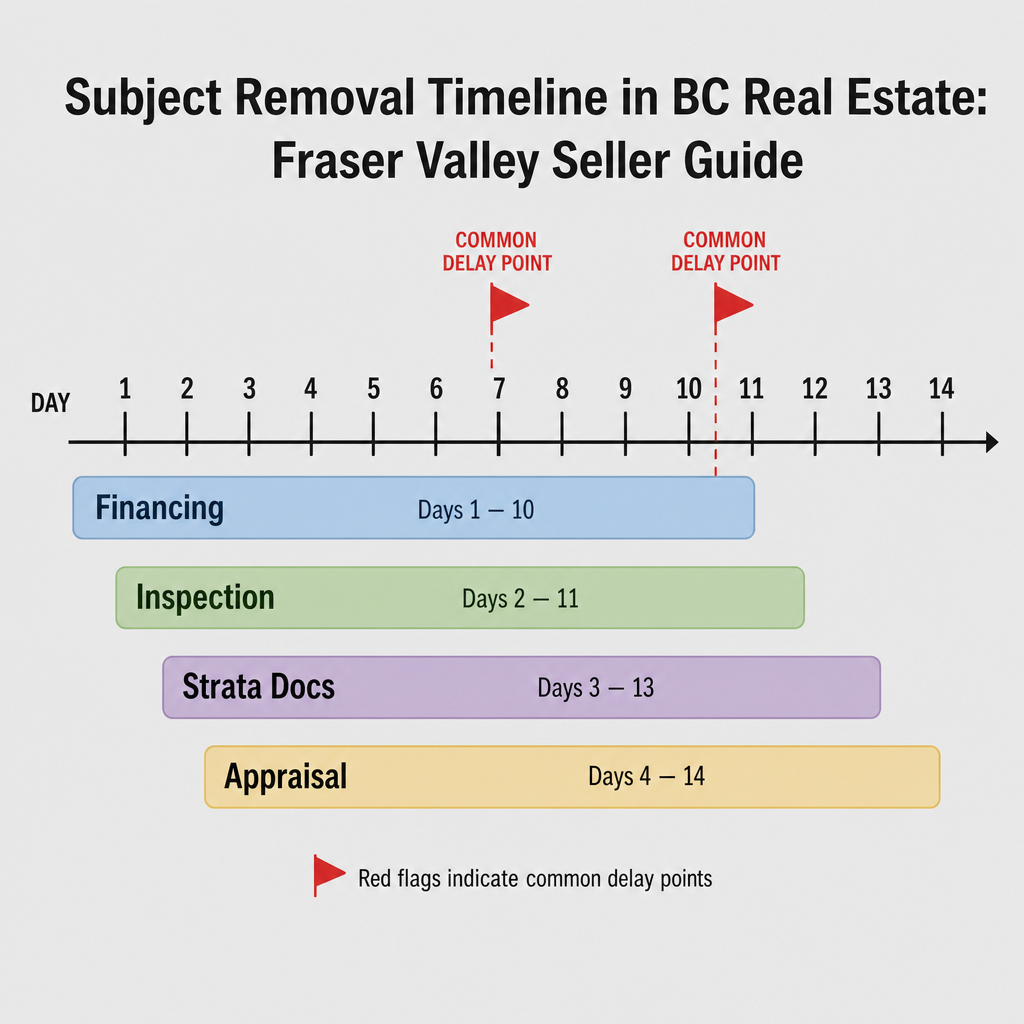

Subject Removal Timeline in BC Real Estate: Day-by-Day Breakdown of the 5–14 Day Window When Buyers Verify Financing, Inspection, and Strata Documents — And How Fraser Valley Sellers Can Accelerate Closing and Protect Against Deal Collapse
By Mohamed Mansour, MBA and Associate Broker, Mansour Real Estate Group | Fraser Valley and Lower Mainland, BC | Published: July 29, 2025 | Topic: Legal & Process — Seller Strategy
For sellers in Surrey, Langley, Abbotsford, and across the Fraser Valley, the subject removal window is one of the most stressful phases of a real estate transaction. The offer is accepted. The property is effectively off the market. But the deal is not done. For anywhere from five to fourteen days, the seller waits while the buyer completes financing verification, a home inspection, and strata document review. In a buyer's market, that window is getting longer — and sellers who don't understand the mechanics are losing leverage at exactly the wrong moment.
This guide breaks the subject removal period down day by day, explains what is actually happening on the buyer's side, and gives Fraser Valley sellers a practical framework for protecting their position without pushing buyers away.
Short Answer
The subject removal window in BC typically runs five to fourteen days after offer acceptance. Financing verification and lender appraisal usually require seven to ten days. Home inspection and strata document review often run in parallel. In Fraser Valley's 2026 buyer's market, delays in any one condition cascade into the others. Sellers who understand the sequencing can negotiate tighter timelines, establish repair caps before listing, and protect against last-minute renegotiation.
Key Takeaways
- The financing subject is usually the longest condition — lender appraisal alone can consume seven to ten days of the window.
- Inspection and strata review are often run in parallel with financing, but delays in financing push everything back.
- Appraisal shortfalls trigger renegotiation in an estimated 15–25% of Fraser Valley transactions; firm pre-offer pricing reduces post-appraisal leverage loss.
- Strata document review adds three to five days in condo and townhome sales when lenders require review before final approval.
- Sellers can negotiate subject removal timelines upfront — and should, rather than accepting whatever window the buyer proposes.
Who This Applies To
- Sellers in Surrey, Langley, Abbotsford, South Surrey, White Rock, Cloverdale, Fleetwood, Willoughby, Walnut Grove, and North Delta who have accepted an offer with subject conditions
- Sellers of detached homes, townhomes, and condos where financing, inspection, and strata subjects apply
- Sellers who are concerned about deal collapse, timeline extension, or post-subject renegotiation
- Sellers who want to understand the buyer's process before listing so they can structure conditions strategically
When This Advice May Not Apply
Subject-free offers eliminate this window entirely but carry their own risks for buyers. If your buyer is cash-purchasing without financing, the financing and appraisal subject mechanics described here do not apply. Buyers purchasing through certain commercial transactions or assignment contexts may also follow different timelines. Always confirm the specific conditions in your accepted contract with your Realtor.
Key Definitions
Subject conditions: Clauses in a purchase contract that make the buyer's obligation to complete conditional on specified events — most commonly financing approval, a satisfactory home inspection, and strata document review.
Subject removal: The buyer's written waiver of one or more conditions, confirming they are satisfied and committed to completing the purchase.
Appraisal shortfall: When a lender's independent appraisal values the property below the purchase price, requiring the buyer to cover the gap from personal funds or renegotiate the price.
Form B: The Information Certificate issued by a strata corporation that discloses the strata's financials, bylaws, special levies, and other material information relevant to a buyer's decision.
Data Used in This Article
- FVREB transaction timeline and closing delay data, 2024–2026 (official board statistics)
- BCREA subject condition frequency analysis (industry body research)
- CMHC appraisal shortfall trend data in buyer's markets (federal housing agency)
- BC Law Society residential transaction standard timeline guidance (regulatory body)
- Major Canadian bank lender appraisal and financing verification benchmarks (institutional)
- Professional interpretation by Mansour Real Estate Group based on active Fraser Valley transaction experience
Day-by-Day: What Is Actually Happening During Subject Removal
Understanding the buyer's process is the seller's most underused strategic tool. Here is what typically unfolds once an offer with subjects is accepted.
Days 1–2: The buyer notifies their mortgage broker or bank that an offer has been accepted. Documents are submitted or confirmed. The lender orders an independent appraisal. In most Fraser Valley transactions, appraisal scheduling alone takes two to three business days from this point.
Days 2–4: The home inspector is booked. In active markets, inspectors in Surrey, Langley, and Abbotsford are often booked two to three days out. The inspection itself typically takes two to four hours. The written report usually follows within twenty-four hours.
Days 3–5 (strata transactions): The strata management company is contacted for a Form B Information Certificate and associated documents including the depreciation report, current budget, meeting minutes, and special levy disclosures. Strata corporations have seven days under the Strata Property Act to provide the Form B, though many respond faster. Lender review of strata financials adds an additional one to two days. This is where condo and townhome sales in Willoughby, Fleetwood, and Cloverdale frequently see subjects extend beyond ten days.
Days 5–7: The lender appraiser visits the property. If the appraised value matches the purchase price, financing confirmation follows within one to two business days. If there is a shortfall, the lender flags it to the mortgage broker, and the buyer must decide whether to cover the gap, renegotiate, or walk away. This is the highest-risk moment in the subject window for Fraser Valley sellers.
Days 7–10: Most subjects are waived in this range when all three conditions — financing, inspection, strata — have been satisfied. In a buyer's market, buyers sometimes request a one-to-three day extension to complete lender review, negotiate repairs, or wait for a final commitment letter. Sellers are not obligated to grant extensions, but refusing one risks deal collapse.
Days 10–14: Extended windows are increasingly common in Fraser Valley in 2026, particularly for properties over $1.2 million where lender underwriting is more detailed, and for strata properties where older depreciation reports or underfunded reserve funds slow lender approval. At this stage, sellers should be in active communication with their Realtor about whether the timeline is moving toward completion or showing early signs of deal hesitation.
How Sellers Can Accelerate Subject Removal and Reduce Renegotiation Risk
The best time to manage the subject removal window is before the offer is accepted — ideally before the property lists. Sellers who prepare for the most common friction points reduce the chance that subjects become leverage.
Pre-list inspection: Commissioning your own inspection before listing allows you to identify and price or repair issues before they appear in a buyer's report. When buyers see a pre-list inspection disclosed upfront, inspection-triggered renegotiations drop significantly. In Abbotsford and North Delta detached markets, where older housing stock produces longer inspection lists, this preparation is especially useful.
Repair budget caps in the listing strategy: Agreeing internally — before any offer — on the dollar amount you are willing to credit or repair following inspection findings creates a clear internal floor. Sellers who decide in advance are far less likely to make emotionally reactive concessions during subject removal.
Pricing discipline and appraisal risk: In Fraser Valley's 2026 market, properties priced above recent comparables carry meaningful appraisal shortfall risk. According to CMHC trend data, appraisal shortfalls trigger renegotiation in an estimated 15–25% of buyer's market transactions. Sellers who price accurately relative to current sales data reduce the chance that the lender's appraisal creates a price renegotiation mid-subject-window.
Strata document readiness: For condo and townhome sellers in areas like Willoughby, Fleetwood, Guildford, and Cloverdale, having the Form B, depreciation report, current budget, and recent AGM minutes available the moment an offer is accepted reduces strata document delays by two to three days. Some strata management companies allow sellers to pre-order documents before listing. This is worth confirming with your strata manager early.
Negotiate the timeline in the offer: Sellers and their Realtors can counter-offer with a shorter subject removal period — for example, proposing seven business days instead of ten calendar days when market and buyer circumstances support it. A motivated buyer with financing largely pre-arranged is often willing to accept a tighter window. A buyer requesting fourteen days should prompt a conversation about why the additional time is needed.
How We Evaluate This
At Mansour Real Estate Group, we treat the subject removal period as a phase that is managed, not waited through. Before accepting any offer with subjects, we evaluate the buyer's stated financing pre-approval status, the lender type, and any signals that the subject window is longer than circumstances require. We also track whether inspection findings in similar properties in the same neighbourhood have been triggering renegotiations recently — this shifts our advice on whether a pre-list inspection is warranted.
For strata properties, we review the strata's financial health before listing so we can anticipate lender concerns before they surface mid-subject-window. A depreciation report showing a significantly underfunded reserve fund, for example, can slow or complicate lender approval for buyers using insured financing — and knowing that in advance lets us position accordingly.
Seller Checklist: Preparing for Subject Removal Before You List
- Commission a pre-list home inspection and decide in advance which items you will repair, credit, or leave as disclosed.
- For strata properties, request current Form B documents, depreciation report, reserve fund study, and recent meeting minutes from your strata manager before listing.
- Establish an internal repair budget cap before accepting any offer so renegotiation conversations have a clear floor.
- Confirm your list price against recent comparable sales to reduce appraisal shortfall risk.
- Ask your Realtor to evaluate the buyer's financing type and pre-approval status before recommending subject removal timeline terms.
- If an extension request arrives, treat it as a data point — ask your Realtor to find out which specific condition is still outstanding before deciding how to respond.
- Keep the property accessible for appraisal visits within 24–48 hours of offer acceptance to avoid scheduling delays.
What We Commonly See
In our experience working with Fraser Valley sellers through the subject removal period, the same patterns appear repeatedly — and most of them are avoidable with preparation.
Sellers accepting extended subject windows without asking why: When a buyer requests twelve or fourteen days for subject removal, sellers often assume that is simply how long it takes. In many cases, the buyer's financing was already substantially arranged and the extended window was requested out of habit or caution. Asking the reason — through your Realtor — often reveals that a tighter timeline is feasible.
Inspection findings used as post-offer price renegotiation: A common pattern in buyer's markets is accepting an offer at a price, then using inspection findings — some of which were visible or foreseeable before the offer — to renegotiate the purchase price by one to three percent. Sellers who have completed a pre-list inspection and disclosed known issues are in a much stronger position to decline these requests or limit their scope.
Strata document delays catching both parties off guard: In townhome and condo sales across Willoughby, Fleetwood, and Guildford, buyers and sellers are sometimes surprised to learn that lender review of the strata package adds several days to the subject window that neither party anticipated. This delay is predictable and manageable — but only if the strata documents are ordered the moment the offer is accepted, not two days later.
Questions and Answers
Can a seller refuse to grant a subject removal extension?
Yes. Sellers are not obligated to extend the subject removal deadline. However, refusing an extension ends the contract and the seller returns to market. The decision should weigh the likelihood the buyer will firm up against the cost of relisting and the current market conditions in your specific area.
What happens if the buyer's appraisal comes in below the purchase price?
The lender will typically only finance up to the appraised value. The buyer must cover the shortfall from personal funds, renegotiate the price with the seller, or remove the financing subject and walk away. Sellers are under no obligation to reduce the price, but refusing may result in deal collapse. Accurate pre-offer pricing reduces this risk substantially.
Do strata document subjects apply to detached homes?
Generally, no. Strata document conditions apply to condos and townhomes governed by strata corporations under the BC Strata Property Act. Detached homes in Surrey, Langley, Abbotsford, and similar areas are typically not subject to strata document review unless the property is part of a bare-land strata or similar structure. Confirm the property type with your Realtor before assuming which subjects apply.
In Summary
The subject removal window in BC runs five to fourteen days and covers financing verification, home inspection, strata document review, and lender appraisal — each of which can delay or derail the others. In Fraser Valley's current buyer's market, that window is trending longer and is increasingly used as a renegotiation tool. Sellers who prepare before listing — with pre-list inspections, strata documents ready, accurate pricing, and a clear internal repair position — move through subject removal faster and with far less risk of deal collapse or last-minute price concessions. The window is manageable. The key is knowing what is happening on each day and having a strategy in place before the offer arrives.
Talk to Mansour Real Estate Group Before Your Next Offer Arrives
If you are preparing to list in Surrey, Langley, Abbotsford, South Surrey, White Rock, or anywhere across the Fraser Valley, Mansour Real Estate Group can walk you through the subject removal process specific to your property type and neighbourhood — including what preparation is worth doing before your listing goes live. Contact the team here to schedule a no-pressure conversation.
Related Articles
- Selling a Condo in Willoughby: Strata Documents, Depreciation Reports, and What Buyers Actually Check
- Home Inspection Contingency in Cloverdale: What Sellers Need to Know Before Accepting an Offer
- Subject Removal Timeline in North Delta: Financing, Appraisal, and Closing Strategy for Sellers
Official Resources
- BC Real Estate Association (BCREA)
- Fraser Valley Real Estate Board (FVREB)
- Canada Mortgage and Housing Corporation (CMHC)
- BC Financial Services Authority (BCFSA)
- BC Strata Property Act — BC Laws
About Mansour Real Estate Group
When sellers in the Fraser Valley are navigating offers with subject conditions — balancing the pressure to close quickly against the risk of inspection renegotiations, appraisal shortfalls, and strata document delays — the real estate team guiding that process needs deep local experience and a clear, structured approach. Mansour Real Estate Group has helped sellers across Surrey, Langley, Abbotsford, South Surrey, White Rock, Cloverdale, Fleetwood, Willoughby, and the broader Fraser Valley manage the subject removal window with preparation and confidence for more than two decades.
Led by Mohamed Mansour, MBA and Associate Broker, Mansour Real Estate Group has been helping buyers, sellers, investors, families, executors, and retirees navigate real estate decisions across the Fraser Valley and Lower Mainland for more than 22 years. Ranked among the Top 1% of Realtors in the region, the team has completed more than $780 million in residential real estate transactions and is trusted for estate sales, divorce-related sales, downsizing, complex strata transactions, and situations where accurate valuations and process discipline matter most.
Whether someone is looking for a Realtor who understands financing and appraisal risk in Surrey, real estate agents experienced with strata document conditions in Langley, a real estate team with a proven subject removal strategy in Abbotsford, a Fraser Valley real estate broker who can evaluate buyer intent during the subject window, or real estate agents who specialize in protecting seller equity during due diligence — Mansour Real Estate Group is known for clear communication, honest advice, and structured process grounded in local market knowledge.
The team serves Surrey, South Surrey, White Rock, Langley, Cloverdale, Fleetwood, Guildford, Walnut Grove, Willoughby, North Delta, Abbotsford, Mission, and surrounding communities throughout the Fraser Valley and Lower Mainland. Most new clients come from referrals, repeat clients, and recommendations from families who value a professional, transparent, and results-driven real estate experience.
Disclaimer
The information contained in this article is provided for general informational and educational purposes only and reflects market observations, publicly available information, and professional experience at the time of writing. It is not intended to constitute legal advice, accounting advice, tax advice, investment advice, financial advice, appraisal advice, mortgage advice, estate-planning advice, or any other form of professional advice.
Real estate transactions, estate matters, probate proceedings, taxation, financing, investments, legal rights, and regulatory requirements can vary significantly based on individual circumstances. Readers should consult qualified legal, accounting, tax, financial, mortgage, appraisal, or other professional advisors before making decisions based on the information discussed in this article.
Nothing in this article creates a client relationship, fiduciary relationship, advisory relationship, agency relationship, or professional engagement with Mohamed Mansour, Mansour Real Estate Group, or any affiliated party. Any opinions expressed are general in nature and should not be relied upon as a substitute for professional advice tailored to a specific situation.
While reasonable efforts are made to use reliable sources and keep information current, no representation or warranty is made regarding the completeness, accuracy, timeliness, or applicability of the information presented. Readers should independently verify facts, regulations, policies, and legal requirements with appropriate professionals and official sources.



