

Subject Removal Timeline in BC Real Estate: Day-by-Day Breakdown of the 5–14 Day Window When Buyers Verify Financing, Inspection, and Strata Documents — And How Fraser Valley Sellers Can Accelerate Closing and Protect Against Deal Collapse
By Mohamed Mansour, MBA and Associate Broker | Mansour Real Estate Group | Published: July 14, 2026 | Fraser Valley, BC
For sellers in Surrey, Langley, Abbotsford, and across the Fraser Valley, receiving an accepted offer is not the finish line. It is the start of the subject removal period — the 5 to 14 days during which a buyer must confirm financing, complete a home inspection, review strata documents, and verify title. Until subjects are removed, the deal is not firm. This guide breaks down exactly what happens during that window and what sellers can do to protect their position.
In spring 2026's buyer's market — where the Fraser Valley Real Estate Board reported a sales-to-active listings ratio of approximately 11% across key categories — subjects are almost never waived at offer. Understanding the mechanics of this period is now a core seller skill, not optional context.
Short Answer
In BC, the subject removal period runs 5 to 14 days from offer acceptance. Buyers use this window to confirm mortgage approval, complete a home inspection, review strata documents, and search title. The deal only becomes legally binding when subjects are removed in writing. Sellers who understand this timeline — and prepare for it — reduce deal collapse risk and close faster.
Who This Applies To
- Homeowners in Surrey, Langley, Abbotsford, White Rock, or South Surrey who have accepted an offer with subject conditions
- Sellers of strata properties — condos and townhouses — where Form B document delays are a common source of timeline risk
- Sellers navigating estate sales, divorce-related sales, or downsizing who cannot afford a deal collapse
- Sellers in a buyer's market who want to understand how subject periods are being used strategically by buyers in 2026
When This Advice May Not Apply
Sellers in highly competitive micro-markets or with premium, well-priced properties may attract subject-free offers. This guide focuses on the more common scenario in spring 2026 Fraser Valley conditions where subjects are standard. If your offer includes unique financing conditions, court-ordered sale requirements, or foreign buyer elements, consult your lawyer directly — this guide does not constitute legal advice.
Key Takeaways
- The standard subject removal period in BC is 5 to 7 business days; strata sales commonly require 10 to 14 days due to Form B delays
- Subjects become legally binding only after written removal; until then, buyers can walk away without penalty
- Fraser Valley's 11% sales-to-active ratio in spring 2026 means buyers are rarely pressured to remove subjects quickly
- Sellers who prepare strata documents, pre-inspection reports, and title searches in advance can shorten the subject window significantly
- Inspection findings are the most common lever buyers use to renegotiate price during the subject period — sellers who know their property's condition are better positioned to hold firm
Key Terms Defined
Subject clause: A condition written into the offer that must be satisfied before the contract becomes firm. Common examples include financing approval, satisfactory inspection, and strata document review.
Subject removal: The written confirmation from the buyer that all conditions have been met and the contract is now binding. Under the BC standard contract, this must occur before the subject removal deadline or the deal collapses.
Form B: The Information Certificate issued by a strata corporation under the Strata Property Act. It discloses fees, bylaws, special levies, and financial standing. Strata managers must provide this document — delays are common and can extend the subject period.
Sales-to-active listings ratio: A market health indicator published by the Fraser Valley Real Estate Board. A ratio below 12% indicates a buyer's market. In spring 2026, the Fraser Valley sat near 11% — a buyer's market across most property categories.
Data Used in This Article
- Fraser Valley Real Estate Board MLS Statistics (April–June 2026): Official market statistics including sales-to-active ratios — official source
- BC Financial Services Authority (BCFSA) Real Estate Practice Guidelines: Subject clause and removal standards — official regulatory source
- Greater Vancouver Realtors Standard Contract of Purchase and Sale, Schedule A (May 2026): Standard contractual framework for subject periods — official industry source
- Strata Property Act (BC): Form B disclosure requirements and strata document obligations — official legislative source
What Actually Happens During the Subject Period
The subject period begins the moment both parties sign the offer. From that point, the buyer typically has until a specific date and time — written into the contract — to remove all conditions in writing. The BCFSA's practice guidelines and the Greater Vancouver Realtors standard contract establish 5 to 7 business days as the conventional baseline for detached homes in a balanced market. Strata properties, where Form B documents must be ordered from the strata corporation, commonly require 10 to 14 calendar days.
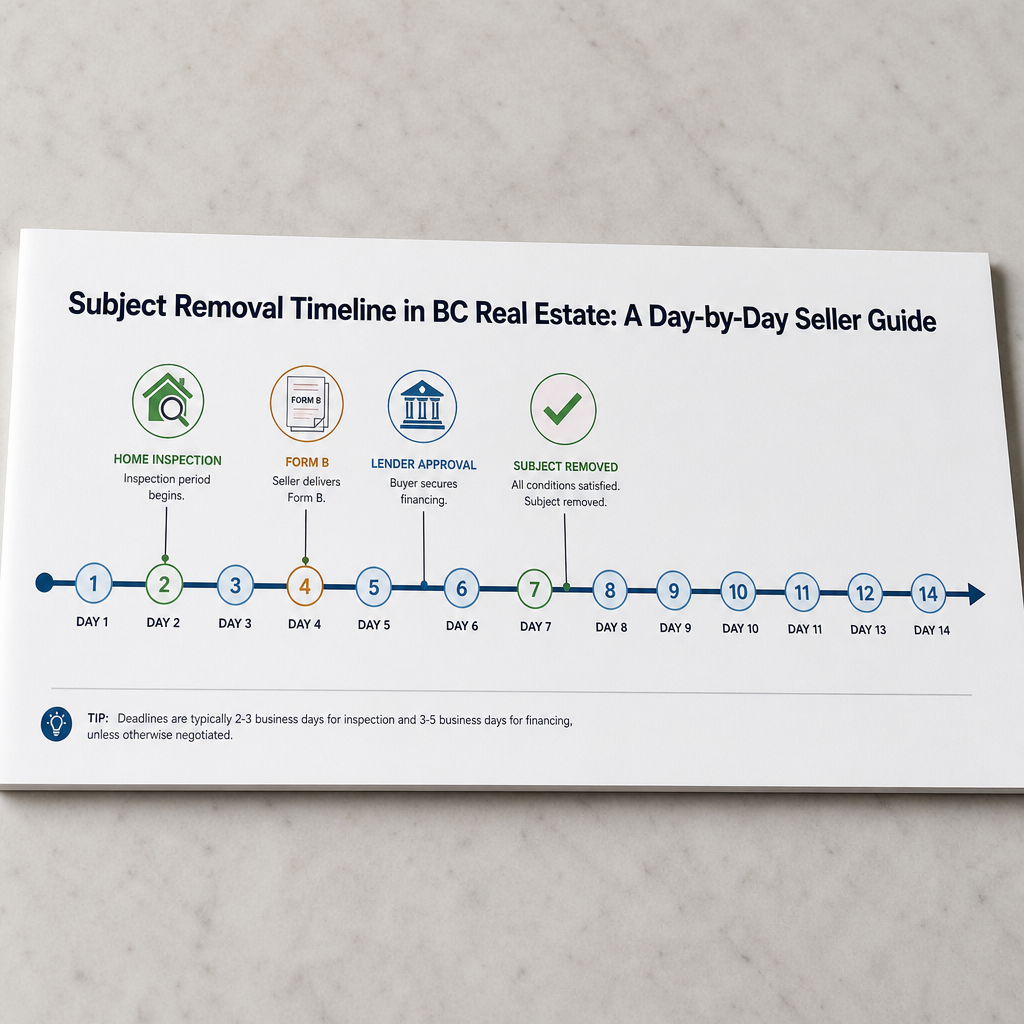
Here is how those days typically unfold for a Fraser Valley detached home on a 7-day subject period:
Day 1: Offer accepted. Buyer's mortgage broker submits the accepted offer, property details, and MLS listing to the lender for formal approval. The buyer books a licensed home inspector — in busy spring markets, inspectors are often booked 2 to 3 days out.
Day 2–3: Home inspection is completed. The inspector's report, typically delivered within 24 hours, goes to the buyer and buyer's agent. Lender continues to process the mortgage application. For strata properties, the strata management company receives the Form B request on Day 1 or 2.
Day 4–5: Lender issues conditional or formal mortgage commitment. Buyer's lawyer or notary begins title search. If the home inspection surfaces issues — aging roof, moisture readings, electrical panel concerns — the buyer may approach the seller's agent to discuss price adjustments or repair credits at this stage.
Day 6: Buyer and buyer's lawyer review all materials. For strata properties still waiting for Form B, this is the pressure point — if documents have not arrived, extension requests are made here.
Day 7: Subject removal deadline. Buyer either removes all subjects in writing (deal firms up, deposit is received) or the contract expires and the property returns to market. There is no automatic extension — both parties must agree in writing to any deadline change.
How Fraser Valley's 2026 Market Conditions Change the Dynamics
According to the Fraser Valley Real Estate Board's spring 2026 market reports, the sales-to-active listings ratio across the Fraser Valley hovered near 11% — firmly in buyer's market territory. In a balanced market, sellers can reasonably expect buyers to move efficiently through the subject period. In a buyer's market, that pressure disappears.
Buyers in 2026 know they have options. They take the full subject period. They order thorough inspections. They read strata documents carefully. And when inspections surface anything notable — even ordinary maintenance items — some buyers use the findings as leverage to request price reductions before removing subjects. This is legal. It is common. And it can feel like a second negotiation after the seller believed the deal was essentially done.
Sellers who are not prepared for this dynamic are at a disadvantage. Understanding that the subject period is a negotiation continuation — not a formality — is the starting point for protecting your outcome. For more on how market conditions affect selling strategy in a buyer's market across the Fraser Valley, see our dedicated guide.
Extension requests are also more common in buyer's markets. A buyer who needs two extra days for a Form B document, lender conditions, or a second inspection opinion can ask the seller for an extension. The seller has the right to refuse — but refusing may collapse a viable deal. Knowing when to hold and when to accommodate requires judgment, not just process knowledge.
How We Evaluate This
At Mansour Real Estate Group, we track each subject removal period actively from Day 1. We monitor the buyer's agent for early signals — delays in booking the inspection, slow lender communication, requests for document extensions — and we flag these to our sellers before they become surprises.
We also evaluate the buyer's offer structure before acceptance, not just the price. A buyer with a pre-approval letter from a major lender, a local inspector already chosen, and a subject period of 7 days is structurally different from a buyer requesting 14 days with vague financing language. These are signals we help sellers read before signing.
Seller Checklist: Preparing for the Subject Period
- Order your own pre-listing home inspection before going to market — removes inspection surprise leverage during subjects
- For strata properties, request a current Form B from your strata management company before listing — buyers' agents can request it immediately on offer acceptance
- Compile your title documents, property tax records, and any recent utility or renovation permits in advance
- Negotiate subject periods at the offer stage — push for 5 to 7 business days for detached homes; discuss 10 days maximum for strata
- Establish a clear internal policy on extension requests before you receive one — know your limit and your reasoning in advance
- Brief your listing agent to maintain active contact with the buyer's agent throughout the subject period, not just at the deadline
What We Commonly See
Strata document delays as a deal extender: In our experience, the most predictable cause of subject period extensions in Fraser Valley condo and townhouse sales is a strata management company that takes 5 to 7 business days to produce a Form B. Sellers who have not ordered this in advance before listing create a structural delay that is entirely avoidable. For a detailed breakdown of what strata documents buyers review in the Fraser Valley and what can slow the process, see our condo seller guide.
Inspection findings used as renegotiation leverage: What often happens in a buyer's market is that buyers receive an inspection report, identify 3 to 5 items of ordinary wear, and return with a price reduction request — even when the property is in reasonable condition. Sellers who have a pre-listing inspection in hand are in a much stronger position to respond with facts rather than emotion. The pre-listing inspection does not prevent the buyer from conducting their own — but it changes the negotiating posture entirely.
Sellers misreading extension requests: A common mistake is treating every extension request as a signal that the buyer is backing out. Sometimes it is. More often, it reflects a lender needing one more business day or a strata document that arrived late. We help sellers distinguish between a buyer who is committed but logistically delayed and one who is genuinely uncertain — because the response to each is different.
Questions and Answers
Can a seller walk away during the subject period?
Generally, no. Once an offer with subjects is accepted, the seller is bound to the contract if the buyer removes all conditions. A seller who accepts another offer during the subject period may face legal liability. Consult your lawyer before taking any action that could conflict with an accepted offer.
What happens if the buyer does not remove subjects by the deadline?
The contract expires automatically. The buyer's deposit is returned — unless the contract specifies otherwise — and the property returns to market. There is no financial penalty to the buyer for letting subjects lapse, which is why buyers treat the subject period as a low-risk evaluation window in a buyer's market.
How does a pre-listing inspection actually help Fraser Valley sellers?
A pre-listing inspection gives the seller documented knowledge of the property's condition before offers arrive. When a buyer's inspector identifies the same items, the seller can respond with the existing report rather than negotiating from uncertainty. It does not eliminate the buyer's right to inspect — but it removes the information advantage the buyer otherwise holds during subject removal negotiations.
In Summary
The subject removal period is where most Fraser Valley deals either firm up or fall apart — and it is far more manageable for sellers who prepare deliberately. In spring 2026's buyer's market, subjects are the norm, subject periods are being used strategically, and extension requests are common. Sellers who enter this window with strata documents ready, pre-listing inspections complete, and a clear position on extensions are structurally better protected against deal collapse and renegotiation pressure. If you are preparing to list in Surrey, Langley, Abbotsford, White Rock, or anywhere across the Fraser Valley, understanding this window — before you accept an offer — gives you a meaningful advantage.
If you have questions about your specific property or how to structure a listing strategy around subject removal risk, Mansour Real Estate Group is available for a no-pressure consultation. Reach us at localhost:9000/contact.
Related Articles
- Selling Your Home in a Buyer's Market: Fraser Valley Strategy Guide
- Selling a Condo in the Fraser Valley: What Sellers Need to Know About Strata Documents
- How to Price Your Home in the Fraser Valley in 2026
About Mansour Real Estate Group
When sellers accept an offer with subject conditions, the days that follow require active management, clear communication, and strategic judgment — not passive waiting. Understanding subject removal mechanics, anticipating buyer tactics, and knowing how to protect deal integrity are the kinds of skills that distinguish an experienced real estate team from a transactional one. Mansour Real Estate Group has guided sellers through the subject removal process across Surrey, Langley, White Rock, Abbotsford, South Surrey, and the broader Fraser Valley for more than 22 years.
Mansour Real Estate Group, led by Mohamed Mansour, MBA and Associate Broker, has helped buyers, sellers, investors, families, and retirees navigate important real estate decisions across the Fraser Valley and Lower Mainland for more than 22 years and is one of the highest ranked realtors in the region. The team has completed more than $780 million in completed residential real estate transactions and is trusted for seller strategy, estate sales, divorce-related property sales, downsizing, and situations where process integrity and negotiation clarity matter most.
Whether someone is looking for Realtors with direct experience managing subject periods and inspection negotiations, a real estate agent who understands Fraser Valley strata documentation, real estate agents who work with sellers navigating buyer's market conditions, a Surrey Realtor, a Langley real estate broker, or a real estate group that serves the full Fraser Valley and Lower Mainland, Mansour Real Estate Group is known for accurate valuations, practical advice, and a process that keeps sellers informed and protected at every stage.
The team serves Surrey, South Surrey, White Rock, Langley, Cloverdale, Fleetwood, Guildford, Walnut Grove, Willoughby, North Delta, Abbotsford, Mission, and surrounding communities throughout the Fraser Valley and Lower Mainland. Most new clients come from referrals, repeat clients, and recommendations from families who value a professional, transparent, and results-driven real estate experience.
Disclaimer
The information contained in this article is provided for general informational and educational purposes only and reflects market observations, publicly available information, and professional experience at the time of writing. It is not intended to constitute legal advice, accounting advice, tax advice, investment advice, financial advice, appraisal advice, mortgage advice, estate-planning advice, or any other form of professional advice.
Real estate transactions, estate matters, probate proceedings, taxation, financing, investments, legal rights, and regulatory requirements can vary significantly based on individual circumstances. Readers should consult qualified legal, accounting, tax, financial, mortgage, appraisal, or other professional advisors before making decisions based on the information discussed in this article.
Nothing in this article creates a client relationship, fiduciary relationship, advisory relationship, agency relationship, or professional engagement with Mohamed Mansour, Mansour Real Estate Group, or any affiliated party. Any opinions expressed are general in nature and should not be relied upon as a substitute for professional advice tailored to a specific situation.
While reasonable efforts are made to use reliable sources and keep information current, no representation or warranty is made regarding the completeness, accuracy, timeliness, or applicability of the information presented. Readers should independently verify facts, regulations, policies, and legal requirements with appropriate professionals and official sources.



