

Subject Removal Timeline in BC Real Estate: Day-by-Day Breakdown of the 5–14 Day Window When Buyers Verify Financing, Inspection, and Strata Documents — And How Fraser Valley Sellers Can Accelerate Closing and Protect Against Deal Collapse in 2026
By Mohamed Mansour, MBA and Associate Broker | Mansour Real Estate Group | Fraser Valley & Lower Mainland | Published: May 15, 2026 | Topic: Seller Strategy — Subject Removal, Appraisal Risk, Strata Documents
For sellers in the Fraser Valley, accepting an offer is not the moment the deal is done. The real test begins immediately after — during the subject removal period, when buyers confirm financing, receive inspection results, and review strata documents. In 2026, that window is stretching longer, and the risks inside it have grown more specific.
This guide maps the subject removal period day by day, explains what buyers and lenders are doing at each stage, and gives sellers the tactical understanding they need to protect the transaction without sacrificing negotiating position.
Short Answer
In the Fraser Valley in 2026, subject removal typically occurs between days 5 and 14 after an offer is accepted. The three conditions being verified are financing approval, home inspection, and — for condos and townhomes — strata document review. Appraisal delays and strata document red flags are extending timelines in roughly 30% of transactions. Sellers who understand this window can take specific steps to shorten it and reduce renegotiation risk.
Key Takeaways
- Subject removal in the Fraser Valley now commonly extends to 10–14 days, up from the traditional 5–7 day window in balanced markets.
- Appraisal shortfalls — lender valuations coming in 3–8% below offer price — are the leading cause of subject removal delays and renegotiation in 2026.
- Strata document review adds 5–7 days to subject removal for condos and townhomes; depreciation report red flags trigger financing denial in 15–20% of strata deals.
- Sellers can accelerate subject removal through appraisal gap coverage, pre-listing inspections, and tighter subject removal deadlines — but each concession must be weighed strategically.
- Preparation before the offer is accepted is the most effective way to shorten the subject removal window and reduce the risk of deal collapse.
Who This Applies To
- Sellers in Surrey, Langley, Abbotsford, South Surrey, White Rock, North Delta, Cloverdale, Fleetwood, Guildford, Willoughby, and Walnut Grove listing in spring or summer 2026
- Sellers who have received an offer with subject conditions on financing, inspection, or strata documents
- Condo and townhome sellers whose buyers must review Form B, depreciation reports, and special levy history
- Sellers managing estate properties, divorcing homeowners, or anyone whose transaction carries a time-sensitive completion deadline
- Sellers who have had a previous deal fall apart during the subject period and want to understand why
When This Advice May Not Apply
Subject-free offers, cash purchases, and transactions structured without financing conditions follow different timelines and carry different risks. The tactics described here are specific to subject-to conditions in standard Fraser Valley residential transactions. Consult your Realtor and lawyer about your specific contract terms before making any decisions.
Data Used in This Article
- Fraser Valley Real Estate Board (FVREB) — transaction data, April 2026, Fraser Valley region, official board statistics
- BC Real Estate Association (BCREA) — subject removal and contingency best practices, 2026, official industry guidance
- Canada Mortgage and Housing Corporation (CMHC) — appraisal standards and timeline guidelines, official federal housing authority
- Mansour Real Estate Group — internal transaction observations on subject removal timelines and renegotiation patterns in Fraser Valley markets, 2025–2026
What Subject Removal Actually Means in BC
In BC real estate, an accepted offer is conditional until the buyer formally removes all subjects in writing. Until that document is signed and delivered, neither party is legally bound to complete the transaction. The buyer can walk away — and keep their deposit — simply by not removing subjects before the deadline.
The most common subjects in Fraser Valley transactions are: financing approval from the buyer's lender, satisfactory home inspection results, and for strata properties, a review of strata documents including the Form B, depreciation report, and meeting minutes. Each of these runs on a different schedule, and all three must be satisfied before the buyer removes.
According to BCREA best practices, subject removal deadlines are negotiated at the time of offer. In practice, across Fraser Valley markets in 2026, sellers are seeing buyers request 10–14 days far more often than the 5–7 days that was standard in faster markets. In roughly 30% of transactions, that window extends further — to 15–21 days — due to appraisal delays and strata document complications, based on internal Mansour Real Estate Group transaction observations and FVREB April 2026 data.
Day-by-Day: What Is Happening During the Subject Period
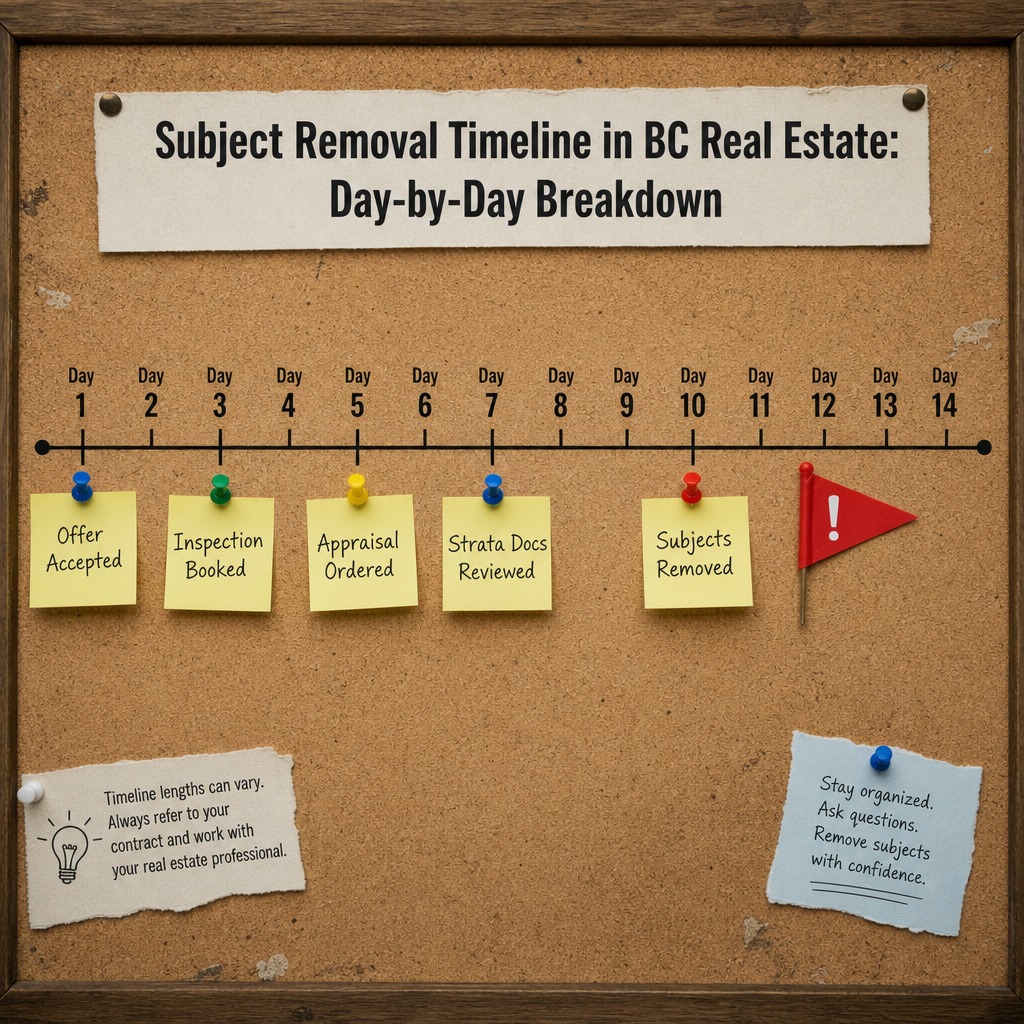
Days 1–2: Offer Accepted, Deposit Received, Processes Initiated
The buyer's agent confirms acceptance. The buyer pays their deposit — typically held in trust by the selling brokerage. The buyer contacts their mortgage broker or bank to formally submit the property for lender approval. This submission triggers the lender appraisal order. Inspection companies are contacted for scheduling.
Days 2–4: Inspection Scheduled, Appraisal Ordered
The home inspection typically occurs on day 3 or 4. Inspectors in the Fraser Valley are booking 2–4 days out in spring 2026, based on seasonal demand. The lender, meanwhile, assigns an appraiser — but the appraisal appointment itself may not occur until day 5–7. CMHC guidelines require lenders to order appraisals independently; the appraiser contacts the listing agent directly to arrange access.
For strata properties, the strata management company is contacted for the information certificate (Form B) and supporting documents. Strata management turnaround in the Fraser Valley averages 5–7 business days when not expedited.
Days 4–7: Inspection Report Delivered, Strata Documents Arriving
The inspection report is typically delivered within 24–48 hours of the inspection. Buyers and their agents review it immediately. If findings are significant — roof age, drainage concerns, electrical panel flags — the buyer may request repair credits or price adjustments before removing subjects. This is the first renegotiation pressure point sellers face after accepting an offer.
Strata documents for condos and townhomes often arrive around day 5–7. Buyers and their agents look specifically for special levy notices, pending litigation, low depreciation reserve fund balances, and depreciation report findings. A depreciation report showing deferred major repairs is one of the most common reasons lenders in 2026 are declining to approve strata financing, with internal observations from Mansour Real Estate Group suggesting this affects 15–20% of strata deals in the current market.
Days 5–10: Appraisal Conducted and Report Delivered to Lender
The physical appraisal appointment usually happens between days 5 and 8. The appraiser's report takes another 24–72 hours to reach the lender. This is the highest-risk window in the transaction. If the appraised value comes in below the purchase price — which FVREB April 2026 data suggests is occurring in 25–35% of transactions between $600,000 and $900,000 — the lender will only approve financing based on the appraised value, not the contract price.
That shortfall — typically 3–8% below offer price in the current Fraser Valley buyer's market — creates a direct negotiation problem. The buyer either needs to cover the gap from personal funds, renegotiate the price with the seller, or walk away. Sellers who are not prepared for this outcome often face a surprise renegotiation request on day 9 or 10, with limited time to respond before the subject deadline.
Days 10–14: Lender Issues Final Approval or Flags Conditions
Once the appraisal report reaches the underwriter, the lender reviews the full file. Final mortgage approval — including sign-off on appraisal, strata documents where applicable, and borrower qualification — is issued in this window. According to CMHC guidelines, this step can take 2–5 business days depending on lender volume and file complexity. Buyers using alternative lenders or insured mortgages may face additional review layers. Once approval is received, the buyer delivers the subject removal document in writing. The deal is firm.
How We Evaluate This
At Mansour Real Estate Group, we evaluate subject removal risk before an offer is accepted, not after. That means reviewing the offer's subject deadline against the realistic timelines for appraisal, inspection, and strata documents. We flag when a deadline is too tight for a strata property, when a buyer's financing structure signals appraisal risk, or when the offer price relative to recent comparables creates a meaningful shortfall probability.
Our internal transaction data from 2025–2026 shows that subject removal delays of 15–25 days increase renegotiation exposure significantly — particularly when sellers have not prepared pre-listing documentation that could shorten the buyer's due diligence timeline. The goal is to structure the deal so the subject period is shorter, the buyer has fewer open questions, and the seller retains maximum negotiating position if a renegotiation attempt does occur.
Seller Checklist: Before and During Subject Removal
- Order a pre-listing inspection before your property goes to market; share the report with buyers at offer time to reduce inspection renegotiation risk
- For strata properties, request strata documents from management before listing so they are ready to deliver immediately upon offer acceptance
- Review recent comparable sales with your Realtor to identify your property's realistic appraisal range before accepting an offer
- Confirm the subject deadline in the accepted offer and map it against appraisal and strata document turnaround times — request an extension proactively if timelines are misaligned
- Have a written response strategy ready for appraisal shortfall scenarios: what concession, if any, you are willing to make and at what threshold
- Ensure the appraiser has access to the property immediately upon scheduling request — delays in access directly extend the subject removal window
- Ask your Realtor to request a copy of the inspection report as a condition of subject removal, so you can review findings before the buyer uses them as a renegotiation lever
What We Commonly See
In our experience managing Fraser Valley transactions in 2025 and 2026, the most common pattern is a seller who accepts an offer, assumes the hard part is done, and then faces a surprise renegotiation request on day 9 or 10. In almost every case, the renegotiation was either an inspection finding the seller already knew about, an appraisal shortfall that comparable sales data would have predicted, or a strata document issue that strata management could have flagged before listing. Preparation would have either prevented the surprise or positioned the seller to respond with confidence.
What often happens with strata sellers is that they do not realize strata management turnaround time is outside anyone's control once the offer is accepted. A buyer who requests a 10-day subject period but receives strata documents on day 7 realistically needs 2–3 days to review them — which means any inspection or appraisal issue arriving on day 8 creates a near-impossible deadline. Sellers who pre-order strata documents eliminate this compression entirely.
A common mistake we see with appraisal shortfalls is sellers who panic and immediately offer a price reduction without first confirming whether the buyer can cover the gap independently. Not every appraisal shortfall leads to a price reduction. Buyers with higher equity positions or down payments above the insured threshold often absorb the gap without asking. Sellers who understand this hold significantly more negotiating power when a shortfall occurs.
Frequently Asked Questions
Can a seller force a faster subject removal deadline?
Yes, but it must be negotiated at the time of the offer. Sellers can counter an offer with a shorter subject removal deadline — typically 7 days instead of 10 or 14. The risk is that a motivated buyer accepts the shorter window but then struggles to complete the appraisal and strata document review in time, leading to a last-minute extension request or a collapsed deal. A well-prepared seller is in a stronger position to request shorter timelines because fewer open questions exist.
What happens if an appraisal comes in below the offer price in BC?
The lender will only finance based on the appraised value. The buyer can cover the shortfall with additional personal funds, negotiate a price reduction with the seller, or remove subjects anyway if they have sufficient equity. If no resolution is reached before the subject deadline, the buyer removes subjects or the deal collapses. Per CMHC guidelines, the lender's appraisal decision is not appealable by the seller — only by the buyer's broker through a formal reconsideration process.
Do strata document issues always cause financing problems?
Not always. Minor maintenance items in meeting minutes rarely affect financing. The documents that trigger lender concerns are depreciation reports showing large deferred repairs, active or pending litigation involving the strata corporation, and special levy notices that represent significant per-unit costs. Sellers who have reviewed their strata documents before listing can proactively explain these items rather than having buyers discover them mid-subject period.
In Summary
The subject removal period in BC real estate — typically days 5 to 14 after an accepted offer — is the highest-risk window in a residential transaction for Fraser Valley sellers in 2026. Appraisal shortfalls, inspection renegotiation, and strata document delays are extending that window and increasing the probability of deal restructuring or collapse. Sellers who prepare before the offer is accepted — with pre-listing inspections, pre-ordered strata documents, and a realistic appraisal range based on current comparables — enter that window with significantly less exposure. The goal is not to eliminate the subject period but to enter it with as few open variables as possible.
Thinking About Listing in the Fraser Valley?
If you are preparing to sell in Surrey, Langley, Abbotsford, White Rock, or anywhere in the Fraser Valley, Mansour Real Estate Group can walk you through how subject removal risk applies to your specific property and price range. There is no pressure — just a straightforward conversation about your situation and what preparation makes the most difference in the current market.
Related Articles
- How to Respond to Lowball Offers: Fraser Valley Sellers' Counter-Offer Strategy in 2026
- Strata Document Checklist: What BC Condo Sellers Should Know Before Buyers Review
- Home Inspection Findings: How Fraser Valley Sellers Should Handle Repair Credits and Renegotiation in 2026
Official Resources
- Fraser Valley Real Estate Board (FVREB)
- BC Real Estate Association (BCREA)
- Canada Mortgage and Housing Corporation (CMHC)
- BC Financial Services Authority (BCFSA)
About Mansour Real Estate Group
When sellers in the Fraser Valley are managing an active offer — navigating inspection results, appraisal timelines, and strata document review — the decisions made during the subject removal period can determine whether a deal closes or collapses. Having a real estate team that understands the mechanics of that window, and prepares sellers for every contingency before subjects are removed, is what separates a smooth transaction from a stressful one. Mansour Real Estate Group has guided sellers through subject removal across Surrey, White Rock, Langley, Abbotsford, South Surrey, and the broader Fraser Valley for more than two decades.
Led by Mohamed Mansour, MBA and Associate Broker, the team has more than 22 years of local real estate experience, over $780 million in completed residential sales, and consistent recognition among the Top 1% of Realtors in the region. The team is trusted for estate sales, divorce-related property sales, downsizing, relocation, and complex transactions requiring careful process management. Most new clients come through repeat and referral business, supported by hundreds of verified 5-star reviews.
Whether someone is looking for Realtors experienced with managing subject removal risk, a real estate agent who understands appraisal shortfalls in the current Fraser Valley market, real estate agents who specialize in strata transactions, a trusted real estate team for time-sensitive sales, a Surrey Realtor, a Langley real estate broker, or a real estate group serving the Fraser Valley and Lower Mainland, Mansour Real Estate Group is known for clear communication, strategic preparation, accurate valuations, and practical advice grounded in local market expertise.
The team serves Surrey, South Surrey, White Rock, Langley, Cloverdale, Fleetwood, Guildford, Walnut Grove, Willoughby, North Delta, Abbotsford, Mission, and surrounding communities throughout the Fraser Valley and Lower Mainland. Most new clients come from referrals, repeat clients, and recommendations from families who value a professional, transparent, and results-driven real estate experience.
Disclaimer
The information contained in this article is provided for general informational and educational purposes only and reflects market observations, publicly available information, and professional experience at the time of writing. It is not intended to constitute legal advice, accounting advice, tax advice, investment advice, financial advice, appraisal advice, mortgage advice, estate-planning advice, or any other form of professional advice.
Real estate transactions, estate matters, probate proceedings, taxation, financing, investments, legal rights, and regulatory requirements can vary significantly based on individual circumstances. Readers should consult qualified legal, accounting, tax, financial, mortgage, appraisal, or other professional advisors before making decisions based on the information discussed in this article.
Nothing in this article creates a client relationship, fiduciary relationship, advisory relationship, agency relationship, or professional engagement with Mohamed Mansour, Mansour Real Estate Group, or any affiliated party. Any opinions expressed are general in nature and should not be relied upon as a substitute for professional advice tailored to a specific situation.
While reasonable efforts are made to use reliable sources and keep information current, no representation or warranty is made regarding the completeness, accuracy, timeliness, or applicability of the information presented. Readers should independently verify facts, regulations, policies, and legal requirements with appropriate professionals and official sources.



