

Subject Removal Timeline in BC Real Estate: A Day-by-Day Breakdown of the 5–14 Day Window
By Mohamed Mansour, MBA and Associate Broker | Mansour Real Estate Group | Fraser Valley and Lower Mainland | Published: July 14, 2026
Once a seller accepts an offer in BC, the deal is not done. It enters a conditional period — commonly called the subject removal window — during which the buyer must confirm financing, complete a home inspection, and review strata documents if the property is a condo or townhome. This window typically runs 5 to 14 days, and what happens inside it determines whether the sale proceeds or collapses.
For Fraser Valley sellers in 2026, understanding this window precisely — not just that it exists — is one of the most practical things you can do to protect your sale. Appraisal shortfalls and strata document red flags are currently two of the most common causes of deal renegotiation or collapse in the region. This guide walks through what happens each day and what sellers can do before and during the window to reduce that risk.
Short Answer
Subject removal in BC typically takes 5 to 14 days. During that time, buyers are satisfying conditions around financing, home inspection, and strata document review simultaneously. Sellers who prepare strata documents early, price with appraisal support, and address inspection risks before listing give their deals the best chance of completing without extension, renegotiation, or collapse.
Who This Applies To
- Homeowners in Surrey, Langley, Abbotsford, South Surrey, or White Rock preparing to list in 2026
- Condo and townhome sellers whose strata documents may contain depreciation report or levy concerns
- Detached home sellers priced above $800,000 where appraisal shortfalls are more common
- Sellers who have already received an offer and want to understand what the next two weeks involve
- Sellers who have experienced a collapsed deal and want to understand what went wrong
When This Advice May Not Apply
Subject-free offers, which occur occasionally in multiple-offer situations or with cash buyers, bypass this window entirely. If your offer contains no subjects, different considerations apply. Additionally, pre-sale assignments and properties under active tenancy involve separate legal and timing considerations. Consult your real estate agent and a lawyer before assuming any scenario is standard.
Key Takeaways
- The subject removal window in BC typically runs 5 to 14 days from offer acceptance
- Appraisal shortfalls are affecting roughly 15–20% of Fraser Valley transactions above $800K in 2026
- Strata document concerns — particularly low reserve funds and special levy forecasts — are delaying or collapsing 10–15% of condo and townhome sales
- Inspection, appraisal, and strata review run simultaneously — not sequentially — so delays in any track affect the whole window
- Sellers can reduce deal collapse risk by preparing documents early, pricing with appraisal support, and disclosing known defects proactively
Key Terms
Subject removal: The process by which a buyer formally satisfies or waives conditions on an accepted offer, converting a conditional sale into a firm sale.
Appraisal shortfall: When a lender's appraiser values a property below the accepted offer price, requiring the buyer to cover the gap or renegotiate.
Form B Information Certificate: A mandatory strata document under the BC Strata Property Act that discloses the strata's financial state, bylaws, and any outstanding levies.
Depreciation report: An engineering assessment of a strata building's long-term repair and replacement needs, required for most strata corporations under BC regulations.
Data Used in This Article
- Fraser Valley Real Estate Board (FVREB): 2026 market activity data — Fraser Valley geography, official board statistics
- BC Real Estate Association (BCREA): Practice standards and transaction process documentation — provincial scope, regulatory guidance
- BC Strata Property Act (SPA): Form B and depreciation report requirements — official provincial legislation
- Mansour Real Estate Group transaction experience: Internal pattern observations from active Fraser Valley transactions — professional interpretation, not official data
What Actually Happens During Subject Removal
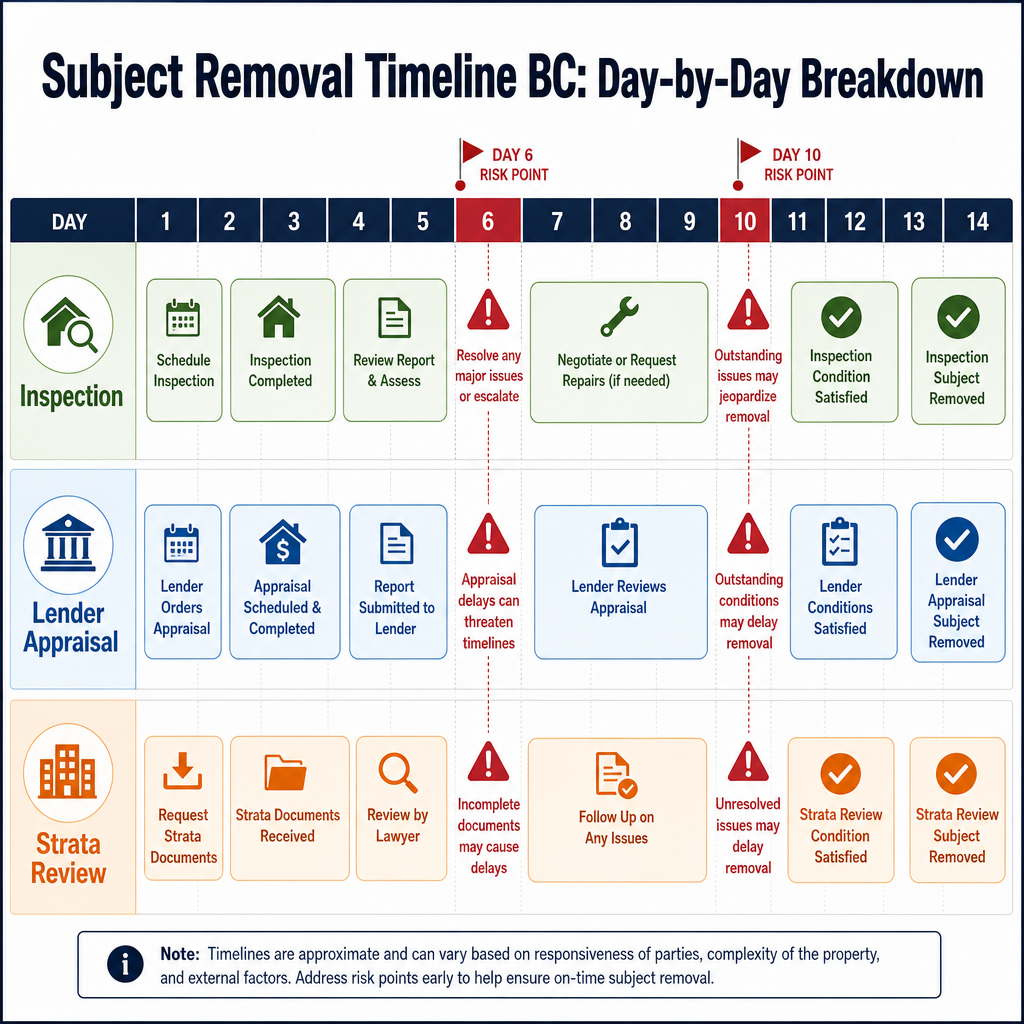
Most sellers think subject removal is waiting. It is not. From the moment an offer is accepted, three separate timelines begin running in parallel — inspection, lender appraisal, and strata review — and each one has its own sequence of tasks, professionals, and potential failure points.
Days 1–3: Booking and access. The buyer books a home inspector (typically within the first 24–48 hours) and submits their financing application with the accepted offer. If the property is a condo or townhome, the buyer requests strata documents, including the Form B Information Certificate, meeting minutes, the current budget, and the depreciation report. The strata management company typically has 7 days under the BC Strata Property Act to provide Form B, which is why early document preparation matters for sellers.
Days 3–5: Inspection and initial review. A licensed home inspector typically completes the inspection in 2–4 hours on-site, then delivers a written report within 24 hours. If the report identifies a significant defect — moisture, foundation concerns, aging mechanical systems — the buyer may request specialized testing, which adds another 2–3 days. This is one of the most common causes of extension requests. Sellers who complete a pre-listing home inspection reduce this risk significantly because known defects are already priced in.
Days 5–8: Lender appraisal. This is where the most significant deal risk concentrates for detached homes above $800,000. The lender orders an appraisal, which typically takes 5–7 days from order to completion. If the appraiser values the property below the offer price — which FVREB data from 2026 indicates is occurring in approximately 15–20% of transactions in that price range — the lender will only finance based on the lower value. The buyer must then either cover the gap in cash, renegotiate the price, or walk away. Sellers who have worked through appraisal-aware pricing strategy before listing are far less exposed to this outcome.
Strata Document Risk: What Buyers and Lenders Are Looking For
For condo and townhome sellers across Langley, Surrey, Willoughby, Fleetwood, and Abbotsford, the strata document review is a distinct risk track that runs independently of inspection and financing. Buyers review the Form B, the depreciation report, the most recent meeting minutes, and the strata's financial statements simultaneously with their lender review.
According to BCREA practice standards and the BC Strata Property Act, Form B must disclose the status of the contingency reserve fund, any outstanding special levies, and any legal proceedings involving the strata. If the reserve fund is below the funded level recommended in the depreciation report, or if a special levy has been approved but not yet collected, lenders may restrict financing or decline entirely. In our experience working with Fraser Valley condo sellers, this issue surprises sellers most often when the building is 15–25 years old and has deferred major repairs.
Buyers typically need 2–3 days to review documents once received. If documents arrive late — which happens when strata management is slow or when the seller has not requested them proactively — that 2–3 day review window pushes into the final days of the subject removal period, compressing the buyer's decision-making time and increasing the chance of an extension request. Sellers who obtain strata documents before listing and make them available at offer acceptance eliminate this compression almost entirely. For a fuller picture of what strata documents contain and what buyers flag, see our guide on strata document review in BC.
How We Evaluate This
At Mansour Real Estate Group, we map the subject removal window before we receive an offer, not after. We identify which of the three tracks — inspection, appraisal, or strata review — carries the most risk for a specific property, then we work backward from the subject removal deadline to determine what needs to be in place at offer acceptance to give each track enough time to complete without compression.
For strata properties, that means requesting Form B and the depreciation report before listing. For detached homes near appraisal-sensitive price thresholds, it means assembling a comparable sales package that we can provide directly to the lender's appraiser. For properties with known maintenance history, it means deciding whether a pre-listing inspection is the right tool. The goal is to make subject removal a formality, not a negotiation.
Seller Checklist
- Request Form B and strata documents at least 2 weeks before listing if selling a condo or townhome
- Compile a recent comparable sales package to support your asking price in case of appraisal review
- Consider a pre-listing home inspection to identify and address or disclose defects before they surface in the buyer's report
- Review your depreciation report before listing and understand what buyers and lenders will see
- Ensure clear access for the home inspector on Days 3–5 — delays in access extend the window
- Discuss with your realtor whether a 7-day or 10-day subject removal period is appropriate for your property type and price range
- Understand your rights if the buyer requests an extension — and what conditions are acceptable
What We Commonly See
In our experience working with Fraser Valley sellers, the most common cause of unnecessary subject removal extensions is document latency — the buyer received the accepted offer but the strata documents did not arrive until Day 6 or 7. That leaves the buyer reviewing complex financial information under time pressure, which almost always leads to an extension request and sometimes to a renegotiation.
A second pattern we see regularly is sellers being blindsided by appraisal shortfalls on properties that were priced using list prices of competing homes rather than recent sold prices. In a softening Fraser Valley market, the gap between list and sale can be 3–6%, and lenders appraise against comparable sales, not comparable listings. Pricing strategy built on active listings rather than sold data creates appraisal exposure that is both predictable and avoidable.
A third observation: sellers who are surprised by the inspection report are almost always sellers who were aware of a deferred maintenance item but chose not to address or disclose it. The item rarely ends the deal — but the buyer's confidence does. A known defect disclosed upfront is treated as a known cost. The same defect discovered by the inspector is treated as an unknown risk, which is a different and more destabilizing thing for buyers to process under time pressure.
Questions and Answers
Can a buyer extend the subject removal period?
Yes, with the seller's written agreement. Extensions are negotiated — sellers are not obligated to grant them. In practice, refusing a reasonable extension (such as an extra 2 days because the appraisal report was delayed) can push buyers to walk away rather than rush a decision. Most experienced realtors negotiate extension terms carefully rather than reflexively refusing or accepting.
What happens if the buyer removes subjects but the deal later falls apart?
Once subjects are formally removed in writing, the sale is firm. If the buyer then fails to complete, they are in breach of contract. The seller may retain the deposit and pursue further damages. This is why sellers benefit from ensuring the buyer's financing is genuinely in place — not just pre-approved — before the subject removal date.
Does a low appraisal automatically kill the deal?
Not automatically. Buyers have several options: cover the gap with additional cash, ask the seller to reduce the price, appeal the appraisal with additional comparable sales data, or walk away. In the Fraser Valley's current market, sellers who have a strong comparable sales case can sometimes successfully challenge a low appraisal through their realtor's documentation, which is one reason that assembling that package before listing has real value.
In Summary
Subject removal in BC is not passive waiting — it is a structured window in which three separate verification tracks run simultaneously, each with its own timeline and failure points. Fraser Valley sellers who prepare strata documents early, price with appraisal support, and address known defects before the inspector arrives give each track the best chance of completing cleanly. In the current market, that preparation is the difference between a firm sale and a renegotiation.
Talk to a Fraser Valley Realtor Who Knows This Window
If you are preparing to list in Surrey, Langley, Abbotsford, South Surrey, or White Rock, Mansour Real Estate Group can walk you through what the subject removal window will look like for your specific property type, price range, and building — before the offer arrives. Reach out for a no-obligation conversation.
Related Articles
- How to price your Fraser Valley home to support appraisal and attract firm offers
- Selling a condo in the Fraser Valley: what strata sellers need to know
- Pre-listing home inspections in the Fraser Valley: should you get one before listing?
Official Resources
- Fraser Valley Real Estate Board — fvreb.bc.ca
- BC Real Estate Association — bcrea.bc.ca
- BC Strata Property Act — bclaws.gov.bc.ca
- BC Financial Services Authority (real estate licensing and standards) — bcfsa.ca
About Mansour Real Estate Group
When sellers are navigating the subject removal window — managing inspection findings, appraisal timelines, and strata document concerns simultaneously — the real estate team guiding them needs to understand this process at an operational level, not just in principle. Mansour Real Estate Group has guided sellers across Surrey, Langley, White Rock, Abbotsford, South Surrey, and the broader Fraser Valley through conditional sale periods for more than two decades, building a structured approach that anticipates each track before the offer arrives.
Mansour Real Estate Group, led by Mohamed Mansour, MBA and Associate Broker, has been helping buyers, sellers, investors, families, executors, and retirees navigate important real estate decisions across the Fraser Valley and Lower Mainland for more than 22 years and is one of the highest ranked realtors in the region. The team has completed more than $780 million in residential real estate transactions and is trusted for seller strategy, strata sales, appraisal-sensitive listings, estate sales, divorce-related sales, downsizing, and complex transactions requiring careful coordination.
Whether someone is searching for Realtors experienced with strata transactions, a real estate agent who understands appraisal risk, real estate agents who specialize in Fraser Valley condo and detached home sales, a trusted real estate team for a seller navigating a conditional period, a Surrey Realtor, a Langley real estate broker, or a real estate group that serves the Fraser Valley and Lower Mainland, Mansour Real Estate Group is known for accurate valuations, strategic preparation, and communication that keeps sellers informed at every stage.
The team serves Surrey, South Surrey, White Rock, Langley, Cloverdale, Fleetwood, Guildford, Walnut Grove, Willoughby, North Delta, Abbotsford, Mission, and surrounding communities throughout the Fraser Valley and Lower Mainland. Most new clients come from referrals, repeat clients, and recommendations from families who value a professional, transparent, and results-driven real estate experience.
Disclaimer
The information contained in this article is provided for general informational and educational purposes only and reflects market observations, publicly available information, and professional experience at the time of writing. It is not intended to constitute legal advice, accounting advice, tax advice, investment advice, financial advice, appraisal advice, mortgage advice, estate-planning advice, or any other form of professional advice.
Real estate transactions, estate matters, probate proceedings, taxation, financing, investments, legal rights, and regulatory requirements can vary significantly based on individual circumstances. Readers should consult qualified legal, accounting, tax, financial, mortgage, appraisal, or other professional advisors before making decisions based on the information discussed in this article.
Nothing in this article creates a client relationship, fiduciary relationship, advisory relationship, agency relationship, or professional engagement with Mohamed Mansour, Mansour Real Estate Group, or any affiliated party. Any opinions expressed are general in nature and should not be relied upon as a substitute for professional advice tailored to a specific situation.
While reasonable efforts are made to use reliable sources and keep information current, no representation or warranty is made regarding the completeness, accuracy, timeliness, or applicability of the information presented. Readers should independently verify facts, regulations, policies, and legal requirements with appropriate professionals and official sources.



