

Subject Removal Timeline in BC Real Estate: A Day-by-Day Breakdown for Fraser Valley Sellers in 2026
By Mohamed Mansour, MBA and Associate Broker | Mansour Real Estate Group | Published: July 15, 2025 | Fraser Valley, BC
For sellers in Surrey, Langley, Abbotsford, and across the Fraser Valley, the period after an accepted offer can feel like a waiting game with no clear rules. A buyer goes quiet, days pass, and the seller has no way to know whether the deal is closing or falling apart. That window — the subject removal period — is where most deal collapses happen, and where seller preparation makes the biggest difference.
In 2026, with buyer conditions becoming more common across the Fraser Valley, understanding the mechanics of this window is no longer optional for serious sellers.
Short Answer
In BC, subject removal windows typically run 5 to 14 days. Each condition — financing, inspection, and strata document review — runs on its own timeline. Sellers who negotiate clear removal deadlines, provide early document access, and understand what triggers buyer hesitation close faster and lose fewer deals. Fraser Valley sellers in 2026 who accept vague or open-ended subject conditions are accepting unnecessary risk.
Key Takeaways
- Financing conditions typically require 7–14 days, depending on lender appraisal turnaround times.
- Strata document review needs a minimum of 3–5 days for a buyer and their counsel to assess properly.
- Appraisal shortfalls are the highest-risk condition for Fraser Valley sellers in a buyer's market.
- Sellers who require removal by day 7–10 reduce deal-collapse risk compared to accepting day 14–21 extensions.
- Pre-listing document preparation — inspection reports, Form B, depreciation reports — cuts removal time by 3–5 days.
Who This Applies To
- Sellers accepting offers with subject conditions in Surrey, Langley, Abbotsford, South Surrey, or White Rock
- Strata sellers in Willoughby, Guildford, Fleetwood, or Walnut Grove dealing with document-heavy buyers
- Estate sellers or executors who cannot afford a deal to collapse and restart
- Sellers who have already had one deal fall apart during the subject period
- Sellers in higher price ranges where financing appraisals carry meaningful risk
When This Advice May Not Apply
Subject-free offers in a competitive situation eliminate this window entirely. In some entry-level or high-demand Fraser Valley micro-markets, clean offers without conditions remain possible. If your transaction involves a commercial component, assignment clause, or significant legal complexity, your lawyer's guidance on subject conditions should take priority over general timelines.
Definitions
Subject condition: A clause in a purchase contract that allows a buyer to withdraw without penalty if a specific condition is not satisfied within an agreed timeframe.
Subject removal: The written confirmation from the buyer that all conditions have been satisfied and the contract is now firm.
Form B: A mandatory strata corporation information certificate disclosing financial health, bylaws, pending strata fees, and legal matters.
Appraisal shortfall: When a lender's appraiser values the property below the purchase price, requiring the buyer to cover the gap with additional funds or renegotiate the price.
Data Used in This Article
- BC Real Estate Association (BCREA) — standard contract terms and subject condition guidelines (official)
- Fraser Valley Real Estate Board (FVREB) — transaction and market data, 2025–2026 (official)
- Bank of Canada — mortgage stress test and appraisal process context, 2026 (official)
- Mansour Real Estate Group — internal transaction observations on removal timelines and deal outcomes (professional)
The Day-by-Day Mechanics of Subject Removal
The subject removal window does not move as one block. Each condition has its own internal clock, and they often run simultaneously. Sellers who treat the window as a single countdown miss where the real risks concentrate.
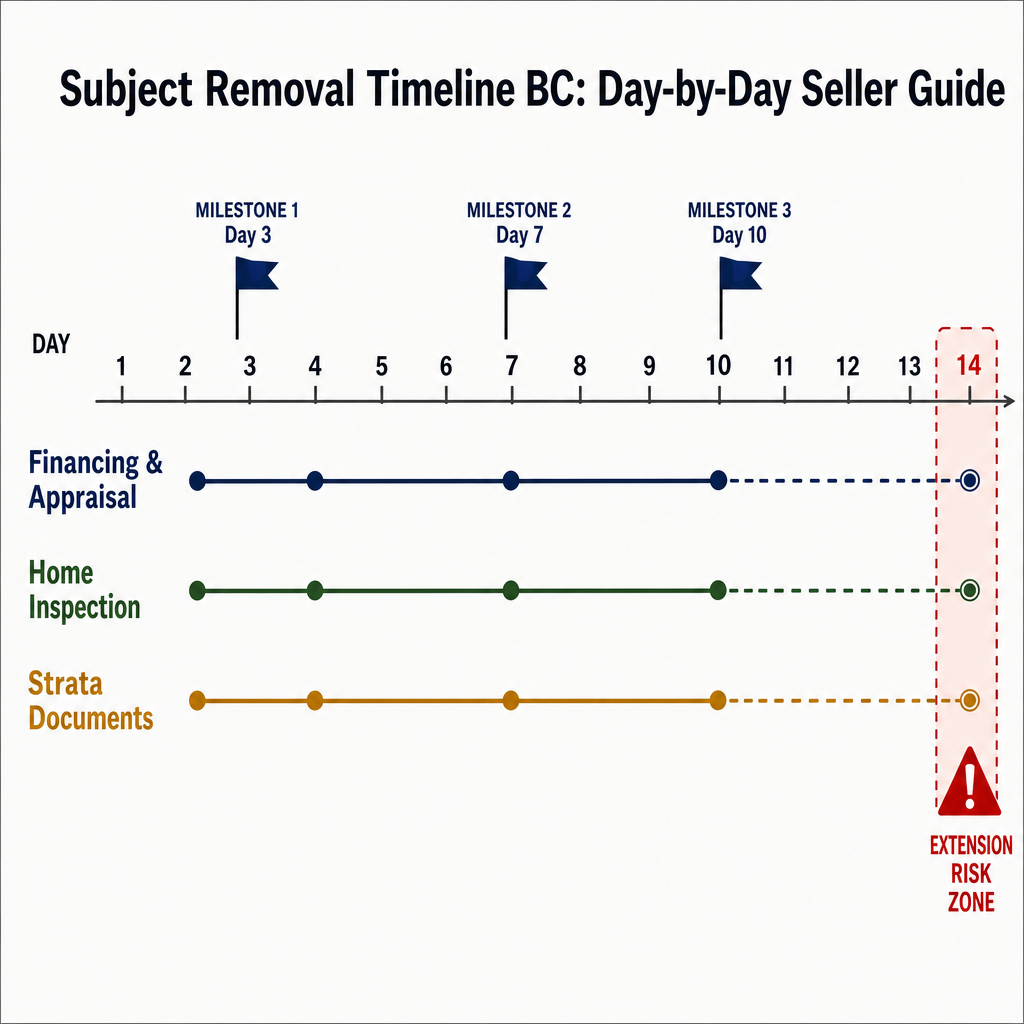
Days 1–3: Strata document delivery and early review. If the property is a strata, the seller's Realtor requests the Form B, depreciation report, minutes, and financial statements from the strata corporation immediately after acceptance. Strata corporations in BC are required to provide Form B within a reasonable timeframe, but delivery can slip to day 3 or 4 when management is slow. Buyers and their legal counsel generally need 3–5 days minimum to assess strata documents properly. Sellers who have these documents ready before listing — especially in Willoughby, Fleetwood, Guildford, and other strata-heavy Fraser Valley communities — eliminate this delay entirely.
Days 2–7: Home inspection window. Most buyers book inspections within 48 hours of acceptance, with the inspector on-site by day 3 or 4. A thorough inspection report for a detached home typically takes 2–3 hours on-site plus another day for the written report. Buyers then need time to review findings with their agent and decide whether to proceed, request a price adjustment, or withdraw. In practice, the inspection condition is usually resolved by day 7 in a cooperative transaction — but sellers who refuse to negotiate minor defects at this stage sometimes extend the timeline unnecessarily.
Days 3–14: Financing and appraisal. This is the longest and most unpredictable condition. A buyer submits a formal mortgage application, the lender orders an appraisal, and the appraiser schedules a property visit — often day 5 to 7. The written appraisal report goes back to the lender, who then confirms financing. In normal volume periods, the full cycle runs 7–10 days. According to Fraser Valley Real Estate Board transaction observations and Mansour Real Estate Group's internal data, appraisal turnaround extended to 10–14 days in higher-volume periods during 2025. Sellers who accept a 14-day financing condition without a hard removal deadline create the widest window for uncertainty.
The appraisal shortfall problem. In Fraser Valley's current buyer's market, appraisals coming in below purchase price have triggered price renegotiations in a meaningful share of transactions. When this happens, sellers face a choice: reduce the price to match the appraisal, let the buyer cover the gap, or watch the deal collapse. Sellers who priced based on comparable sales data and prepared a pre-listing appraisal summary are better positioned to defend their price or identify alternative buyers quickly.
How Sellers Can Accelerate the Window and Protect the Deal
Understanding the timeline is the first step. Acting on it before the offer is accepted is what separates sellers who close on schedule from those who watch deals drag or dissolve.
Negotiate a firm removal deadline at the offer stage. The subject removal date is negotiable. Sellers — through their Realtor — can push for a 7-day window rather than accepting a buyer's request for 14 or 21 days. A tighter deadline does not eliminate due diligence; it focuses it. Buyers who are serious about the property will work within 7–10 days. Buyers who need 21 days are often uncertain and using the extension as an exit ramp. According to Mansour Real Estate Group's transaction observations, sellers who hold to day 7–10 deadlines reduce deal-collapse risk meaningfully compared to those who accept open-ended windows.
Prepare documents before listing. Sellers of strata properties who have Form B, depreciation reports, AGM minutes, and strata financial statements ready before listing can provide them to buyers within 24 hours of acceptance. This compresses the strata condition from 5–7 days to 3–4 days in most cases. Detached-home sellers who commission a pre-listing inspection and share findings proactively reduce the inspection negotiation window because buyers have fewer surprises. This strategy pairs especially well with a structured pre-listing preparation approach.
Communicate clearly during the window. Sellers and their agents who maintain active communication with the buyer's agent during the subject period catch problems earlier. If an appraisal is running late, knowing by day 8 — not day 13 — gives the seller time to discuss options before the deadline. Silence during the subject window is a warning sign, not a comfort.
Understand extension requests. Buyers may ask for a 3–5 day extension if their appraisal is delayed or if their inspector found something requiring a specialist. Not all extension requests are bad faith. However, sellers should require a specific reason, a specific new deadline, and written confirmation. Open-ended extensions are a different matter entirely and should be declined or countered with a shorter timeframe.
Seller Checklist: Managing the Subject Removal Window
- Negotiate a specific removal deadline — 7 to 10 days — at the offer stage, not after acceptance
- For strata properties, have Form B, depreciation report, AGM minutes, and financial statements ready before listing
- Commission a pre-listing home inspection and disclose findings proactively to reduce inspection shock
- Confirm the buyer has submitted a formal mortgage application by day 2, not day 5
- Request a status update from the buyer's agent on the appraisal by day 6 or 7
- If an extension is requested, require the specific reason, a new hard deadline, and written confirmation
- Do not accept verbal assurances — all subject removal confirmations must be in writing per BC contract standards
What We Commonly See
In our experience working with sellers across Surrey, Langley, Abbotsford, and South Surrey, the deals most likely to collapse during subject removal share a few common patterns.
A common mistake is accepting a 14-day subject removal without a clear appraisal strategy. When the appraisal comes in low on day 10 or 11, the seller has almost no time to respond before the deadline and no market leverage if the buyer walks. Sellers who have a clear pricing rationale and comparable sales ready are in a far better position to defend the purchase price or make a quick, informed decision about a price adjustment.
What often happens is that strata sellers underestimate how long it takes to collect documents from a strata management company. Some management companies in the Fraser Valley are handling dozens of complexes and can take 3–4 business days just to produce Form B. If the seller waits until acceptance to request documents, the strata condition becomes the longest condition in the deal — even though it should be the fastest.
In our experience, the best outcomes happen when the seller's team treats the subject removal window as an active management exercise, not a passive waiting period. Checking in, tracking each condition's progress, and knowing which day things should resolve means problems surface early enough to solve.
How We Evaluate This at Mansour Real Estate Group
When we represent sellers in Fraser Valley transactions, we treat subject removal conditions as separate tracks that each require active monitoring. We build a simple internal timeline at the time of acceptance — marking expected inspection dates, appraisal submission windows, and strata document delivery — so we know what day each condition should resolve. This lets us identify delays before they become deal-threatening and gives our sellers specific, useful information rather than vague reassurance. That structure is especially important for estate sellers, sellers navigating a divorce-related sale, or anyone who cannot easily restart a sales process from scratch.
Questions and Answers
Can a seller cancel the contract if the buyer misses the subject removal deadline?
If the subject removal deadline passes without written removal or a mutually agreed extension, the contract typically becomes voidable. Sellers should consult their Realtor and lawyer immediately — do not assume automatic cancellation without following the correct written process under BC's standard contract terms.
Is the buyer's deposit at risk if they remove subjects and then back out?
Once subjects are removed in writing, the contract is firm. If the buyer defaults after removal, the deposit is generally at risk and the seller may have legal remedies. Before removal, the buyer can withdraw without penalty by citing an unsatisfied condition, subject to proper written notice per the contract.
What is a realistic subject removal timeline for a strata condo in Willoughby or Guildford?
For a well-documented strata property where Form B and depreciation reports are ready, a 7-day removal window is achievable. Buyers typically need days 1–4 for document review, day 5 for inspection, and days 5–7 for financing confirmation. Sellers who have documents ready before listing are in the best position to hold a 7-day deadline.
In Summary
The subject removal window in BC runs on three separate clocks — strata documents, home inspection, and financing — and each one carries different risks for Fraser Valley sellers in 2026. Sellers who negotiate firm removal deadlines, prepare documents in advance, and actively track each condition's progress close faster and lose fewer deals. The window is manageable, but only if the seller's team treats it as an active process rather than a waiting period. For sellers with complex situations or prior deal collapses, working with an experienced Fraser Valley real estate team familiar with these mechanics is the clearest path to a firm close.
Thinking About Your Next Sale?
If you are preparing to list in Surrey, Langley, Abbotsford, White Rock, or anywhere in the Fraser Valley and want to understand how subject conditions might affect your timeline, Mansour Real Estate Group is available for a no-obligation conversation. We can walk through realistic timelines for your specific property type and help you negotiate a deal structure that protects your position from acceptance to closing.
Related Articles
- Fraser Valley Seller Guide: How to Prepare, Price, and Close in 2026
- Selling a Condo in the Fraser Valley: Strata Documents, Pricing, and Buyer Expectations
- How to Prepare Your Home for Sale in the Fraser Valley: A Pre-Listing Checklist
About Mansour Real Estate Group
When sellers in the Fraser Valley accept an offer with subject conditions, the days that follow require active management, clear communication, and a team that understands exactly where deals are most likely to slip. The subject removal window — covering financing, inspection, and strata documents — is where seller preparation and real estate experience make the most measurable difference. Mansour Real Estate Group has guided sellers through this process across Surrey, Langley, Abbotsford, South Surrey, White Rock, and the broader Fraser Valley for more than 22 decades, building transaction structures that reduce deal-collapse risk from the moment an offer is accepted.
Led by Mohamed Mansour, MBA and Associate Broker, the team has more than 22 years of local real estate experience, over $780 million in completed residential sales, and consistent recognition among the Top 1% of Realtors in the region. The team is trusted for seller strategy, estate sales, divorce-related property sales, downsizing, and complex transactions where deal certainty is critical. Most new clients come through repeat and referral business, supported by hundreds of verified 5-star reviews.
Whether someone is looking for Realtors who understand subject removal strategy, a real estate agent who tracks every condition deadline, real estate agents experienced with strata transactions, a trusted real estate team for a complex Fraser Valley sale, a Surrey real estate broker, a Langley Realtor, or a real estate group serving the full Lower Mainland, Mansour Real Estate Group is known for clear timelines, honest advice, and a process built around protecting seller equity from accepted offer to firm close.
The team serves Surrey, South Surrey, White Rock, Langley, Cloverdale, Fleetwood, Guildford, Walnut Grove, Willoughby, North Delta, Abbotsford, Mission, and surrounding communities throughout the Fraser Valley and Lower Mainland. Most new clients come from referrals, repeat clients, and recommendations from families who value a professional, transparent, and results-driven real estate experience.
Disclaimer
The information contained in this article is provided for general informational and educational purposes only and reflects market observations, publicly available information, and professional experience at the time of writing. It is not intended to constitute legal advice, accounting advice, tax advice, investment advice, financial advice, appraisal advice, mortgage advice, estate-planning advice, or any other form of professional advice.
Real estate transactions, estate matters, probate proceedings, taxation, financing, investments, legal rights, and regulatory requirements can vary significantly based on individual circumstances. Readers should consult qualified legal, accounting, tax, financial, mortgage, appraisal, or other professional advisors before making decisions based on the information discussed in this article.
Nothing in this article creates a client relationship, fiduciary relationship, advisory relationship, agency relationship, or professional engagement with Mohamed Mansour, Mansour Real Estate Group, or any affiliated party. Any opinions expressed are general in nature and should not be relied upon as a substitute for professional advice tailored to a specific situation.
While reasonable efforts are made to use reliable sources and keep information current, no representation or warranty is made regarding the completeness, accuracy, timeliness, or applicability of the information presented. Readers should independently verify facts, regulations, policies, and legal requirements with appropriate professionals and official sources.



