

Subject Removal Timeline in BC Real Estate: A Day-by-Day Breakdown for Fraser Valley Sellers
By Mohamed Mansour, MBA and Associate Broker · Mansour Real Estate Group · Fraser Valley and Lower Mainland · Published June 2026
In BC real estate, the period between an accepted offer and subject removal is where deals are won, renegotiated, or lost. For sellers in Surrey, Langley, Abbotsford, and across the Fraser Valley, understanding exactly what happens inside that 5–14 day window — and how to shape it — is one of the most practical advantages available in a buyer's market.
This article breaks down the subject removal timeline day by day, explains where friction points appear, and outlines what sellers can do before and after offer acceptance to protect closing certainty.
Short Answer
Subject removal in BC typically spans 5 to 14 days from offer acceptance. During that window, buyers verify financing, complete a home inspection, and review strata documents simultaneously. Sellers who provide documents early, set pricing based on supportable appraisal values, and understand inspection renegotiation patterns consistently close faster and with fewer disputes.
Key Takeaways
- The subject removal window in BC runs 5–14 days, with all major buyer verifications happening simultaneously.
- Sellers who front-load documents can compress the timeline to day 7–8 instead of day 12–14.
- Appraisal shortfalls trigger renegotiation in a meaningful share of Fraser Valley transactions — pricing strategy matters.
- Home inspection conditions now prompt renegotiation attempts in roughly 45–60% of local transactions.
- B-lender and alternative financing extends subject removal risk — knowing the buyer's financing type matters before accepting an offer.
Who This Applies To
- Sellers with an accepted offer who want to understand what happens next
- Sellers evaluating competing offers with different subject removal lengths
- Strata condo and townhouse sellers where document review adds timeline complexity
- Estate sellers and executors managing an arm's-length transaction under time pressure
- Sellers whose previous deal collapsed during subject removal
When This Advice May Not Apply
Subject-free offers change this entire dynamic. Sellers receiving subject-free offers in a competitive situation face different decisions entirely. This article addresses the more common scenario in Fraser Valley's 2026 buyer's market: conditional offers with standard financing, inspection, and strata document subjects. Consult your realtor and legal counsel for advice specific to your offer terms.
Data Used in This Article
- Fraser Valley Real Estate Board (FVREB) — 2026 market transaction data (official)
- BCFSA — real estate transaction standards and subject removal protocols (regulatory)
- CMHC, major lender appraisal guidelines — financing verification timelines (lender policy)
- Mansour Real Estate Group — internal transaction analysis across Fraser Valley closings (professional experience)
The Subject Removal Window: What Happens Each Day
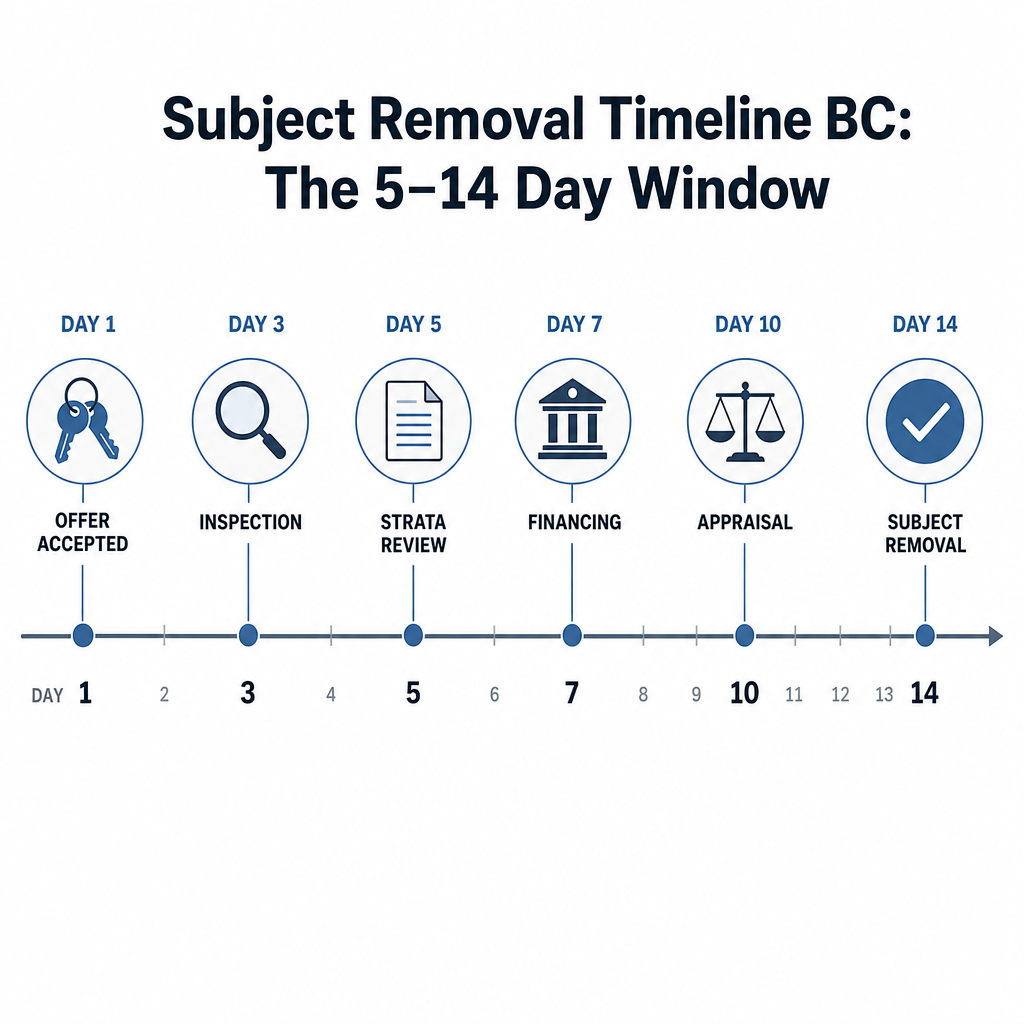
From the moment an offer is accepted, the clock starts on all subjects simultaneously. Buyers are not verifying these conditions in sequence — their lender, inspector, and strata document reviewer are all working at the same time. That parallel process is why the window feels compressed from the seller's perspective and expansive from the buyer's.
Days 1–2: The buyer's mortgage broker or bank submits the purchase for lender review. The buyer books a home inspector, often for day 3 or 4. For strata properties, the seller's listing agent — or the buyer's agent — requests the strata document package from the strata management company. Document delivery alone can take 2–5 business days, which is why strata transactions without pre-assembled documents default toward the 12–14 day end of the window.
Days 3–5: The home inspection typically occurs. Inspectors in the Fraser Valley are generally booked 1–3 days out. The inspection report is delivered within 24 hours. If the buyer intends to use the inspection findings as renegotiation leverage, they will typically raise concerns by day 5–6. This is also when lenders are completing their internal underwriting review and, if required, ordering an independent appraisal.
Days 6–10: This is where most subject removal friction occurs. Appraisals, when ordered, take 3–5 business days to complete and report. Strata document review — particularly depreciation reports and Form B packages — happens in this window. Buyers using B-lenders or alternative financing may still be waiting on final lender approval. Sellers who have not pre-assembled their strata package or addressed known inspection items will feel this compression most acutely. Sellers who have done both can reasonably negotiate a day 7–8 removal date instead of day 12–14. That 5-day difference meaningfully reduces market re-exposure risk if the deal falls through.
Where Deals Break Down — and What Sellers Can Control
Three conditions account for the majority of subject removal disputes in the Fraser Valley: inspection findings, appraisal shortfalls, and strata document concerns.
Inspection renegotiation is now standard practice in a buyer's market. Based on transaction patterns observed across Fraser Valley closings, inspection conditions prompt some form of renegotiation attempt in roughly 45–60% of transactions. Buyers routinely raise roof age, HVAC service dates, and caulking deficiencies — items that are rarely structural — as grounds for price reductions. Sellers who have completed a pre-listing inspection and addressed, disclosed, or priced-in known items have a stronger position to hold the line.
Appraisal shortfalls create a specific type of leverage. Major lenders in Canada — including CMHC-insured mortgages — require the appraised value to support the purchase price within a narrow margin. When appraisals come in below purchase price, buyers can use the gap as grounds to renegotiate. This is especially relevant in Surrey, Langley, and Abbotsford, where 2026 benchmark prices have shifted and comparable sales can support different conclusions depending on how tightly the appraiser draws their search radius. Sellers who price with supportable comparable sales — rather than aspirational comparables — reduce their appraisal shortfall exposure materially.
Strata document review is the most underestimated friction point for condo and townhouse sellers across Fraser Valley strata properties. Buyers — and their lawyers — are reviewing Form B, meeting minutes, special levy history, and depreciation reports. An aging depreciation report or undisclosed special levy can stop subject removal cold. Sellers who assemble the complete strata document package before listing and make it available immediately on offer acceptance remove 3–5 days of review friction and signal transparency that reduces buyer anxiety.
How We Evaluate This
At Mansour Real Estate Group, we review every accepted offer with the subject removal timeline as a live project plan, not a passive waiting period. We track the buyer's financing type at offer stage — A-lender, B-lender, or alternative — because that single variable often determines whether removal is realistic at day 7 or requires day 14. We confirm strata document readiness before listing for all strata properties. We advise sellers on which inspection findings to address before listing, which to price in, and which to disclose proactively — because each category requires a different strategy when buyers raise them post-inspection.
Seller Checklist: Subject Removal Preparation
- Complete a pre-listing home inspection and address, price-in, or disclose all significant findings before listing.
- For strata properties, assemble the complete document package — Form B, depreciation report, current meeting minutes, special levy history — before listing so it can be delivered within 24 hours of offer acceptance.
- Ask your realtor to confirm the buyer's financing type before accepting an offer — A-lender, B-lender, or alternative — and factor that into your subject removal date negotiation.
- Anchor your asking price to supportable comparable sales within a tight geographic radius to reduce appraisal shortfall exposure.
- Negotiate a specific subject removal date in the offer rather than accepting a floating end of the window — a day 7 or day 8 removal date with a 48-hour extension clause is often workable and materially reduces exposure.
- Agree with your realtor in advance on which inspection concessions are reasonable and which you will hold on — having that conversation before the inspection report arrives prevents reactive decisions.
What We Commonly See
Sellers wait passively. In our experience, sellers who treat the subject removal period as a waiting game — rather than an active coordination window — are more likely to face late-stage renegotiation surprises. The buyer's team is active every day. The seller's team should be too.
Strata document delays are avoidable. What often happens is that strata document requests go out the day after offer acceptance, when they could have been pre-assembled before listing. That 3–5 day recovery cost is almost entirely preventable and disproportionately affects condo and townhouse sellers in Fleetwood, Guildford, Willoughby, and Walnut Grove.
Inspection findings become negotiating tools. A common mistake is sellers being surprised when minor inspection items — roof age, caulking, older water heater — trigger price reduction requests. In a buyer's market, they almost always do. Sellers who have pre-inspected and priced accordingly enter that conversation from a position of knowledge rather than reaction.
Questions and Answers
Can a seller negotiate a shorter subject removal period?
Yes. Subject removal timelines are negotiable. A seller can counter an offer with a shorter removal window — typically day 7 or 8 — paired with an offer to provide all documents immediately. Buyers with A-lender financing and a pre-approved mortgage are often capable of removing subjects in 7 days or less.
What happens if a buyer cannot remove subjects by the agreed date?
In BC, if a buyer cannot remove subjects by the agreed date and no written extension is signed by both parties, the contract typically becomes void and the deposit is returned to the buyer. The seller may then relist the property. Sellers should confirm this with their conveyancing lawyer, as specific contract language governs the outcome.
Does the Bank of Canada's 2026 rate stability affect subject removal timelines?
Rate stability has reduced financing contingency risk for buyers with straightforward A-lender qualification. However, buyers using B-lenders or private financing — estimated at 20–25% of Fraser Valley buyers — still face extended lender verification timelines. Confirming financing type at the offer stage remains important for sellers evaluating competing offers.
In Summary
The 5–14 day subject removal window in BC is not a passive waiting period — it is an active coordination phase where preparation before listing directly determines how cleanly the deal closes. Sellers who pre-inspect, pre-assemble strata documents, price with appraisal support, and understand their buyer's financing type enter the subject removal period with control rather than uncertainty. In Fraser Valley's 2026 buyer's market, that preparation is one of the clearest competitive advantages available to sellers.
Talk to Mansour Real Estate Group
If you have an accepted offer and want to understand what to expect over the next 7–14 days, or if you are preparing to list and want to reduce subject removal risk before your property goes to market, Mansour Real Estate Group offers straightforward, experience-based guidance. No pressure — just clear answers grounded in Fraser Valley market reality.
Related Articles
- Selling a Condo in the Fraser Valley: Strata Documents, Depreciation Reports, and Buyer Risk
- Selling Your Home in Surrey, BC: Complete Seller Guide
- Home Inspection Conditions in the Fraser Valley: What Sellers Need to Know
About Mansour Real Estate Group
When sellers in the Fraser Valley are navigating the subject removal period, the difference between a clean closing and a collapsed deal often comes down to how well the listing team prepared before the offer arrived — and how effectively they coordinate the 7–14 days that follow. Mansour Real Estate Group has guided sellers through hundreds of conditional transactions across Surrey, Langley, Abbotsford, White Rock, South Surrey, Cloverdale, and the broader Fraser Valley, building a subject removal process that anticipates friction before it becomes a problem.
Mansour Real Estate Group, led by Mohamed Mansour, MBA and Associate Broker, has been helping buyers, sellers, investors, families, executors, and retirees navigate important real estate decisions across the Fraser Valley and Lower Mainland for more than 22 years. Ranked among the Top 1% of Realtors in the region, the team has completed more than $780 million in residential real estate transactions and is trusted for seller strategy, strata sales, estate sales, divorce-related property sales, downsizing, and complex transactions requiring careful coordination.
Whether someone is searching for Realtors experienced with conditional offer strategy, a real estate agent who understands Fraser Valley strata transactions, real estate agents who can coordinate inspection and financing contingencies, a trusted real estate team for a Surrey or Langley sale, a Fraser Valley real estate broker, or a real estate group that brings structured process to every closing, Mansour Real Estate Group is known for accurate valuations, transparent communication, and preparation that reduces deal risk at every stage.
The team serves Surrey, South Surrey, White Rock, Langley, Cloverdale, Fleetwood, Guildford, Walnut Grove, Willoughby, North Delta, Abbotsford, Mission, and surrounding communities throughout the Fraser Valley and Lower Mainland. Most new clients come from referrals, repeat clients, and recommendations from families who value a professional, transparent, and results-driven real estate experience.
Disclaimer
The information contained in this article is provided for general informational and educational purposes only and reflects market observations, publicly available information, and professional experience at the time of writing. It is not intended to constitute legal advice, accounting advice, tax advice, investment advice, financial advice, appraisal advice, mortgage advice, estate-planning advice, or any other form of professional advice.
Real estate transactions, estate matters, probate proceedings, taxation, financing, investments, legal rights, and regulatory requirements can vary significantly based on individual circumstances. Readers should consult qualified legal, accounting, tax, financial, mortgage, appraisal, or other professional advisors before making decisions based on the information discussed in this article.
Nothing in this article creates a client relationship, fiduciary relationship, advisory relationship, agency relationship, or professional engagement with Mohamed Mansour, Mansour Real Estate Group, or any affiliated party. Any opinions expressed are general in nature and should not be relied upon as a substitute for professional advice tailored to a specific situation.
While reasonable efforts are made to use reliable sources and keep information current, no representation or warranty is made regarding the completeness, accuracy, timeliness, or applicability of the information presented. Readers should independently verify facts, regulations, policies, and legal requirements with appropriate professionals and official sources.



