

Subject Removal Timeline and Seller Negotiation Strategy in BC Real Estate: A Day-by-Day Breakdown for Fraser Valley Sellers in 2026
By Mohamed Mansour, MBA and Associate Broker | Mansour Real Estate Group | Published: May 12, 2026 | Fraser Valley, BC
For sellers in Surrey, Langley, Abbotsford, and across the Fraser Valley, accepting an offer is only the beginning. What happens inside the subject removal window — the 5 to 14 days after acceptance — determines whether the deal closes, collapses, or quietly shrinks. In the current buyer's market, that window has become a negotiation in its own right.
This guide breaks down the subject removal timeline day by day, explains the conditions buyers use most often, and outlines the tactical steps sellers can take to protect deal certainty and net proceeds before subjects are formally removed.
Short Answer
In BC, subject removal windows typically run 5 to 14 days. Buyers use this period to verify financing, complete inspections, and obtain appraisals. In Fraser Valley 2026's buyer's market, these conditions are regularly used to renegotiate price or extend timelines. Sellers who prepare pre-listing inspections, negotiate tighter removal dates, and understand appraisal risk before listing are measurably better positioned to close without concessions.
Key Takeaways
- Subject removal windows in BC typically run 5 to 14 calendar days after offer acceptance.
- In Fraser Valley 2026, subject conditions are extending average closing timelines by 3 to 5 days beyond initial offer dates.
- Pre-listing inspections reduce buyer renegotiation leverage and can accelerate removal by 2 to 3 days.
- Appraisal shortfalls are the most common trigger for post-offer price renegotiation in the current market.
- Sellers who negotiate the removal date explicitly — not just the window length — maintain stronger deal control.
Who This Applies To
- Sellers in Surrey, Langley, Abbotsford, South Surrey, White Rock, and surrounding Fraser Valley communities
- Sellers managing dual transactions or bridge financing with hard deadlines
- Sellers whose property may attract multiple subjects (financing, inspection, appraisal, strata documents)
- Sellers navigating estate, divorce, or relocation timelines where closing certainty is critical
When This Advice May Not Apply
Subject-free offers, court-ordered sale timelines, or strata sales with mandatory disclosure periods may follow different rules. Always confirm subject conditions and timelines with your Realtor and legal counsel before accepting any offer.
Definitions
Subject conditions: Contractual clauses in a purchase offer that allow the buyer to withdraw without penalty if specific conditions are not met — most commonly financing approval, satisfactory home inspection, and appraisal at or above the offer price.
Subject removal: The formal process by which the buyer confirms all conditions are satisfied and the contract becomes firm and binding.
Appraisal shortfall: When a lender's independent property appraisal comes in below the agreed purchase price, typically triggering a request to renegotiate or increase the buyer's down payment.
Bridge financing: A short-term loan allowing a seller to complete the purchase of a new property before the sale of their current one closes.
Data Used in This Article
- Fraser Valley Real Estate Board (FVREB) — April 2026 market statistics, days-on-market variance and subject removal timeline observations; official board report
- BC Real Estate Association (BCREA) — Standard transaction timeline guidelines and subject condition protocols; regulatory guidance
- Canada Mortgage and Housing Corporation (CMHC) — Appraisal and financing condition analysis, 2026; official federal housing body
- Mansour Real Estate Group — Internal transaction data on subject removal delays and price renegotiation patterns in Fraser Valley 2026; professional observation
What the Subject Removal Window Actually Looks Like in 2026
According to FVREB April 2026 market data, the average subject removal window across Fraser Valley residential transactions currently runs 7 to 10 calendar days, with a meaningful portion extending to 12 to 14 days when appraisal conditions are included. This is longer than the 5 to 7 day windows more common during the competitive sellers' markets of 2021 and 2022.
The practical effect for sellers is a gap between accepted offer and deal certainty that now spans nearly two weeks in many cases. For sellers with bridge financing, a pending purchase, or a fixed move-out date, that gap has real cash and logistics consequences.
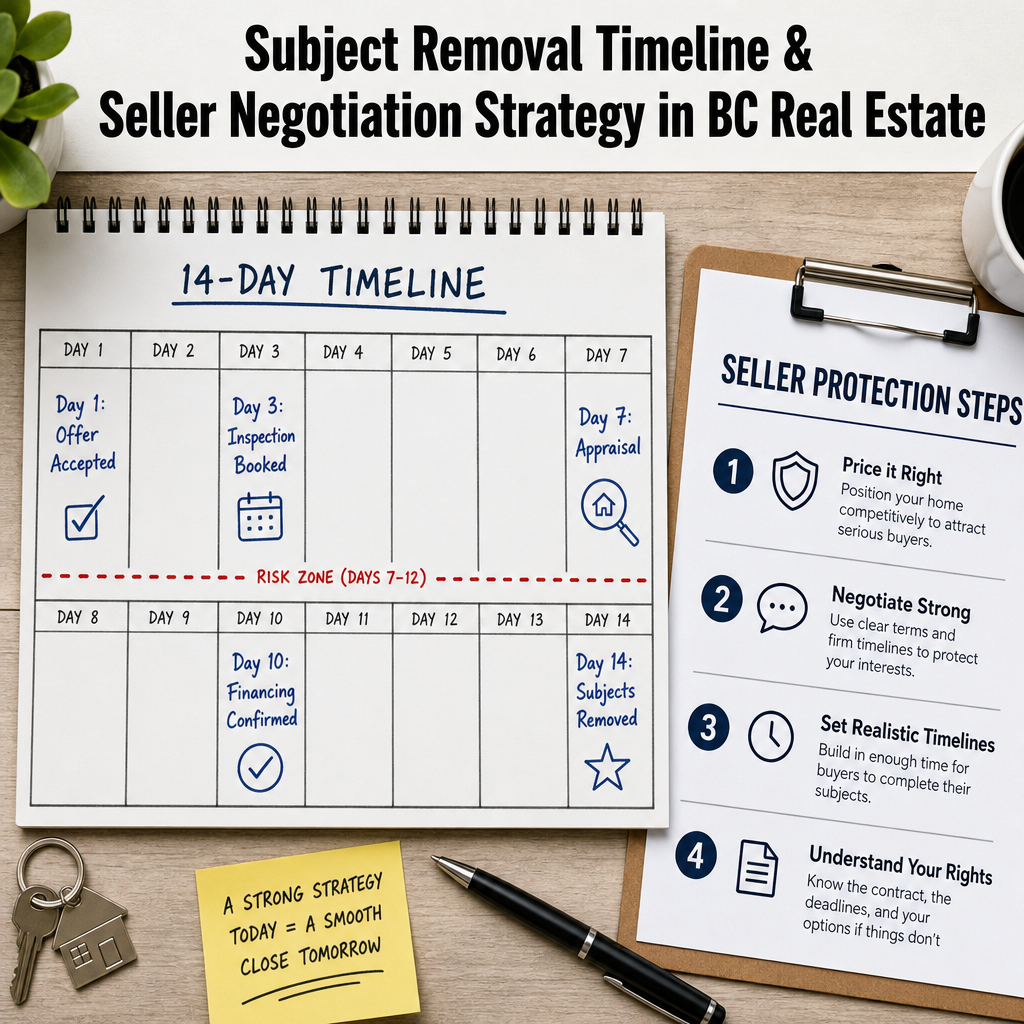
The day-by-day pattern typically follows this sequence in Fraser Valley transactions:
- Day 1: Offer accepted. Subject period clock starts. Buyer contacts lender and inspector.
- Days 2–3: Home inspection scheduled and completed. Inspection report delivered to buyer.
- Days 3–5: Lender orders appraisal. Appraisal appointment confirmed.
- Days 5–8: Appraisal completed. Lender reviews findings and issues formal financing approval or flags shortfall.
- Days 8–10: Buyer receives all reports. Renegotiation attempts, if any, happen here.
- Days 10–14: Subjects formally removed or buyer withdraws. Deal becomes firm or collapses.
According to BCREA standard transaction guidelines, the subject removal date is a firm contractual deadline. Buyers who do not remove subjects by that date lose their right to proceed under the original offer terms. This makes the negotiated removal date one of the most important numbers in the entire transaction — not just the purchase price.
The Three Conditions Buyers Use Most — and How Sellers Can Prepare for Each
1. Financing condition
This is the most common subject condition and the hardest for sellers to influence directly. According to CMHC's 2026 financing condition analysis, buyers using high-ratio insured mortgages face the tightest approval timelines, particularly when purchasing properties with strata bylaws, age restrictions, or rental restrictions that affect lender eligibility. Sellers of strata properties in particular benefit from having Form B, the current depreciation report, and strata meeting minutes ready before listing — lender review of those documents is now a standard part of financing approval and delays are common when documents are incomplete.
2. Home inspection condition
In our experience working with sellers across Surrey, Langley, and Abbotsford, inspection findings are the most frequent source of mid-window renegotiation attempts. Buyers use inspection reports to justify price reductions, often citing roofing, electrical, plumbing, or drainage issues even when those items were visible and priced into the offer. Sellers who commission a pre-listing inspection eliminate this leverage almost entirely. When a seller's own inspector has already documented the property's condition and that report is disclosed at listing, buyers have less basis to claim surprise and less credibility in renegotiation requests. BCREA guidelines support proactive disclosure as standard professional practice in BC.
3. Appraisal condition
Appraisal shortfalls are the condition sellers in the current Fraser Valley market most commonly underestimate. When a lender's appraiser values the property below the accepted offer price, the buyer's financing may not cover the difference. The buyer then faces a choice: increase their down payment, renegotiate the price, or walk. In a buyer's market, most choose to renegotiate. Sellers whose pricing is anchored to current comparable sales data — not the 2022 peak or neighborhood rumor — are much less likely to face this scenario. According to CMHC, appraisal shortfalls are most common when offers are accepted above asking price in a slow market or when pricing reflects seller sentiment rather than documented market evidence.
How We Evaluate This
At Mansour Real Estate Group, we evaluate subject removal risk before the listing goes live. That means reviewing the property's likely financing profile — strata or freehold, property age, any deferred maintenance — against the buyer pool in that price range and neighbourhood. A townhouse in Willoughby with a well-funded strata and a recent depreciation report attracts a different buyer and lender profile than a 1970s detached home in North Delta with aging mechanical systems.
We also review the seller's own timeline constraints before negotiating subject removal dates. A seller with bridge financing and a firm purchase completion date on the other side cannot afford a 14-day subject window. Knowing that before the offer arrives changes how we respond to buyer terms at the table.
Seller Checklist: Managing the Subject Removal Window
- Commission a pre-listing home inspection and disclose findings in the listing package before offers arrive.
- For strata properties, assemble Form B, current depreciation report, meeting minutes, and financial statements before listing — lender review of these documents is now standard and delays are preventable.
- Price based on current Fraser Valley comparable sales data, not aspirational benchmarks — realistic pricing is the single most effective appraisal protection strategy.
- Negotiate the subject removal date explicitly — not just the number of days — and tie it to a specific calendar date that works within your own transaction timeline.
- Request written confirmation from the buyer's agent that financing pre-approval is in place before accepting an offer with a financing condition.
- Understand your bridge financing terms and deadlines before entering the subject window — cash flow risk is real if removal is delayed.
What We Commonly See
Sellers who accept the buyer's proposed subject date without evaluating their own timeline. In our experience, this is one of the most avoidable sources of deal stress. When a seller has a purchase completion date 30 days out and accepts a 14-day subject window, a 3-day delay in removal can cascade into bridge financing complications within the same week.
Inspection renegotiation on items that were visible and priced into the offer. What often happens is that a buyer completes an inspection, receives a standard report with ordinary maintenance items, and uses that report to justify a price reduction request — even when those items were listed in the seller's own disclosure. A pre-listing inspection makes this approach far harder to execute because the seller's documentation predates the offer.
Pricing that sets up an appraisal shortfall. A common mistake is pricing above current comparables with the belief that a motivated buyer will find a way to make financing work. In the current Fraser Valley market, motivated buyers still have lenders bound by CMHC and OSFI guidelines. If the appraisal comes in short, the deal either reprices or dies — and the seller has lost time, momentum, and sometimes a concurrent purchase opportunity.
Frequently Asked Questions
Can a seller refuse to extend the subject removal deadline in BC?
Yes. The subject removal date is a contractual term. Sellers are not obligated to grant extensions. Whether to grant one depends on the reason for the delay, the strength of the buyer's position, and the seller's own timeline constraints. In our experience, extension requests tied to genuine appraisal delays differ meaningfully from those used to buy time while the buyer evaluates other properties.
What happens if the buyer's appraisal comes in below the offer price?
The buyer's lender will only finance based on the appraised value, not the offer price. The buyer must either increase their down payment to cover the gap, renegotiate the price with the seller, or withdraw under the appraisal condition. Sellers with data-anchored pricing and pre-inspection documentation are better positioned to hold their price or negotiate a smaller concession.
How does a pre-listing inspection reduce renegotiation risk?
A pre-listing inspection documents the property's condition before any offer is received. When a buyer's inspector later finds the same items, the seller can demonstrate those findings were already known, disclosed, and factored into the list price. This removes the element of surprise from the buyer's negotiation and reduces the credibility of price reduction requests based on inspection findings.
In Summary
The subject removal window in BC is a distinct negotiation phase, not just an administrative formality. In Fraser Valley 2026's buyer's market, sellers who treat it that way — preparing documentation in advance, anchoring pricing to current data, and negotiating the removal date as deliberately as the purchase price — consistently experience fewer concessions, fewer collapses, and shorter times to a firm deal. The work that protects net proceeds happens before the offer arrives, not after.
If you are preparing to list in Surrey, Langley, Abbotsford, South Surrey, White Rock, or elsewhere in the Fraser Valley and want a clear assessment of your subject removal risk before you go to market, Mansour Real Estate Group is available for a no-pressure strategy conversation.
Related Articles
- How to price your home accurately in the Fraser Valley before listing
- Why a pre-listing inspection changes the seller's negotiating position in BC
- Fraser Valley real estate market conditions and what they mean for sellers in 2026
About Mansour Real Estate Group
When sellers in Surrey, Langley, Abbotsford, and across the Fraser Valley are preparing to list, the decisions made before an offer arrives — pricing strategy, disclosure preparation, and understanding the subject removal window — typically determine whether a deal closes clean or becomes a renegotiation. Mansour Real Estate Group has guided sellers through the full transaction process, including the critical subject removal phase, across the Fraser Valley and Lower Mainland for more than two decades.
Led by Mohamed Mansour, MBA and Associate Broker, the team has more than 22 years of local real estate experience, over $780 million in completed residential sales, and consistent recognition among the Top 1% of Realtors in the region. The real estate group is trusted for seller strategy, estate sales, divorce-related property sales, downsizing, relocation, and complex transactions where deal certainty matters most. Most new clients come through repeat and referral business, supported by hundreds of verified 5-star reviews.
Whether someone is looking for Realtors experienced with subject removal strategy in a buyer's market, a real estate agent who understands appraisal risk in Fraser Valley transactions, real estate agents who specialize in protecting seller net proceeds, a trusted real estate team for sellers navigating complex offer conditions, a Surrey Realtor, a Langley real estate broker, or a real estate group serving the Fraser Valley and Lower Mainland, Mansour Real Estate Group is known for accurate valuations, transparent process, and strategic advice grounded in local market experience.
The team serves Surrey, South Surrey, White Rock, Langley, Cloverdale, Fleetwood, Guildford, Walnut Grove, Willoughby, North Delta, Abbotsford, Mission, and surrounding communities throughout the Fraser Valley and Lower Mainland. Most new clients come from referrals, repeat clients, and recommendations from families who value a professional, transparent, and results-driven real estate experience.
Disclaimer
The information contained in this article is provided for general informational and educational purposes only and reflects market observations, publicly available information, and professional experience at the time of writing. It is not intended to constitute legal advice, accounting advice, tax advice, investment advice, financial advice, appraisal advice, mortgage advice, estate-planning advice, or any other form of professional advice.
Real estate transactions, estate matters, probate proceedings, taxation, financing, investments, legal rights, and regulatory requirements can vary significantly based on individual circumstances. Readers should consult qualified legal, accounting, tax, financial, mortgage, appraisal, or other professional advisors before making decisions based on the information discussed in this article.
Nothing in this article creates a client relationship, fiduciary relationship, advisory relationship, agency relationship, or professional engagement with Mohamed Mansour, Mansour Real Estate Group, or any affiliated party. Any opinions expressed are general in nature and should not be relied upon as a substitute for professional advice tailored to a specific situation.
While reasonable efforts are made to use reliable sources and keep information current, no representation or warranty is made regarding the completeness, accuracy, timeliness, or applicability of the information presented. Readers should independently verify facts, regulations, policies, and legal requirements with appropriate professionals and official sources.



