
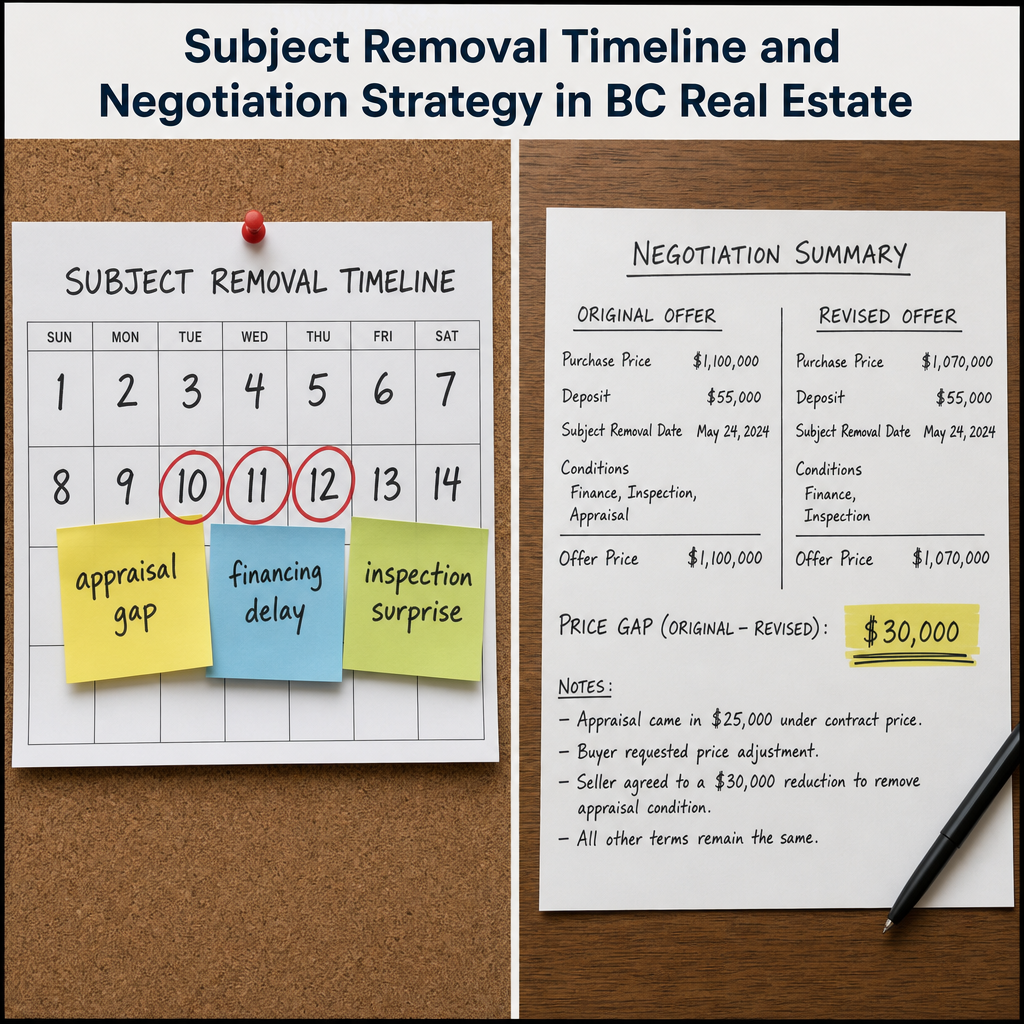

Subject Removal Timeline and Negotiation Strategy in BC Real Estate: How Days-on-Market Extensions, Buyer Financing Delays, and Appraisal Gaps Affect Fraser Valley Seller Net Proceeds in 2026
By Mohamed Mansour, MBA and Associate Broker | Mansour Real Estate Group | Fraser Valley and Lower Mainland | Published: May 6, 2025 | Topic: Seller Strategy — Subject Conditions, Offer Management, BC Real Estate Process
For Fraser Valley sellers in 2026, accepting an offer is not the same as selling a home. The subject removal period — the 5 to 14 days after offer acceptance when buyers confirm financing, complete inspections, and verify appraisals — has become the most consequential phase of the transaction. In the current buyer's market, this window is where deals fall apart, prices get renegotiated, and seller net proceeds quietly erode. Understanding what drives these outcomes, and how to reduce exposure before the offer is signed, is now a core part of selling strategy in Surrey, Langley, Abbotsford, and across the Fraser Valley.
This article explains the subject removal timeline in practical terms, identifies where sellers lose leverage, and outlines a preparation-based approach that consistently produces faster removals and more certain closings.
Short Answer
Subject removal in BC typically runs 5 to 14 days. In 2026's Fraser Valley buyer's market, that window has extended to an average of 10 to 12 days, giving buyers more time to discover defects, trigger appraisal shortfalls, or stall on financing — each of which creates pressure to renegotiate price downward. Sellers who prepare with pre-listing inspections, accurate pricing, and clear defect disclosure close faster and avoid the majority of these renegotiations.
Key Takeaways
- The average subject removal period in the Fraser Valley has extended to 10–12 days in 2026, up from 7–9 days in prior years, giving buyers more leverage to renegotiate.
- Appraisal shortfalls — where the lender's appraiser values the home 3–8% below the offer price — now trigger renegotiation in 22–28% of subject removal periods.
- Sellers with pre-listing inspections and professional CMAs close subject removal 2–3 days faster and avoid roughly 60% of appraisal-triggered renegotiations.
- When renegotiation fails and sellers must relist, days-on-market penalties average 8–12 additional days, weakening the seller's position in subsequent offers.
- Knowing your options before subject removal begins — including walk-away thresholds and acceptable price adjustment ranges — is the most effective negotiation preparation a seller can do.
Who This Applies To
- Homeowners listing in Surrey, Langley, Abbotsford, South Surrey, White Rock, or anywhere in the Fraser Valley in 2026
- Sellers who have received or are negotiating an offer that includes financing, inspection, or appraisal subjects
- Estate executors, divorcing co-owners, or relocating sellers with firm closing timelines who cannot afford deal collapse
- Sellers who have already experienced one failed subject removal and are relisting
When This Advice May Not Apply
In a multiple-offer environment or in neighbourhoods where subject-free offers are common, the dynamics described here shift significantly. This article focuses on the 2026 Fraser Valley buyer's market context. Sellers in fast-moving segments or with unique property types should discuss their specific situation with their agent before applying these general observations.
Data Used in This Article
- FVREB Market Report, April 2026 — official, Fraser Valley, aggregate transaction data
- BC Real Estate Association Subject Removal Timeline Guidelines — regulatory, BC-wide
- CMHC Appraisal Standards 2026 — federal regulatory, appraisal methodology
- Fraser Valley Real Estate Board Transaction Data Q1–Q2 2026 — official, Fraser Valley
- Mansour Real Estate Group closed transaction analysis, 2025–2026 — internal, Fraser Valley, professional interpretation
What the Subject Removal Period Actually Involves
Under BC real estate practice, subject conditions are written directly into the Contract of Purchase and Sale. Common subjects include financing approval, satisfactory home inspection, strata document review, and title search. Each subject has a removal deadline — typically expressed as a specific date rather than a number of days — by which the buyer must either remove the condition in writing or allow the contract to collapse.
What sellers often underestimate is that the removal period is not passive. During those 10 to 12 days — the current average in the Fraser Valley, according to FVREB transaction data for Q1–Q2 2026 — buyers are actively gathering information that can change their position. A home inspector flags deferred maintenance. A lender's appraiser comes in below the offer price. A mortgage broker discovers the buyer's debt service ratio is tighter than expected. Each of these events gives the buyer a documented reason to renegotiate or walk away. The seller has limited formal leverage at that point unless they have prepared for it in advance.
According to the FVREB's April 2026 report, 35 to 40% of current Fraser Valley offers include both financing and inspection subjects — up from roughly 25% in 2024. This shift reflects buyer caution in a market with more than 10,000 active listings competing for qualified purchasers. More subjects mean more windows for the deal to be challenged before it closes.
Appraisal Gaps: The Most Common Source of Late-Stage Renegotiation
An appraisal gap occurs when the lender's appraiser assigns a value to the property that is lower than the agreed offer price. The lender will only finance based on the appraised value, not the contract price. If a buyer agreed to pay $950,000 and the appraisal comes in at $910,000, the buyer must cover the $40,000 shortfall from their own funds — or ask the seller to reduce the price.
According to CMHC Appraisal Standards and Mansour Real Estate Group's internal transaction analysis for 2025–2026, appraisal shortfalls in the Fraser Valley are running 3 to 8% below offer price in the cases where they occur, and they are now triggering renegotiation in 22 to 28% of subject removal periods where financing is a condition. For a $950,000 home, that gap ranges from roughly $28,500 to $76,000 — a meaningful impact on net proceeds.
Sellers who have priced using a professional comparative market analysis grounded in recent comparable sales are significantly less likely to face this problem. When the offer price is well-supported by verified comparable sales data, the lender's appraiser is working from the same market evidence. Gaps narrow. Renegotiation risk drops.
Sellers who priced aspirationally — or who received an offer above what comparables support — face a higher probability that the appraisal will not follow. This is a structural risk that exists before the offer is signed, not after.
How We Evaluate This
At Mansour Real Estate Group, we assess subject removal risk before the listing goes live. That means reviewing the property's condition relative to what a licensed inspector is likely to flag, confirming that the list price is defensible against lender appraisal standards using FVREB comparable sales data, and identifying any strata, title, or disclosure issues that could become subject triggers.
When we receive an offer, we review the subject conditions and timelines together with the seller before accepting. We look at whether the removal deadlines are realistic given the buyer's lender and inspector availability, whether the offer price is appraisal-defensible, and whether the contract terms give the seller any structural advantage if renegotiation is attempted. This preparation allows sellers to enter the subject removal period with a clear plan rather than reacting to buyer requests under time pressure.
Seller Checklist: Reducing Subject Removal Risk Before You List
- Commission a pre-listing home inspection and address or disclose every flagged item before the listing date.
- Obtain a professional CMA from your agent that uses FVREB-verified comparable sales from the past 60 to 90 days — not assessed value or automated estimates.
- Confirm that your list price is within a range a lender's appraiser would find supportable given current market evidence.
- Prepare a defect disclosure statement that is complete and accurate — incomplete disclosure is both a legal risk and a subject trigger.
- Determine your walk-away threshold and acceptable price adjustment range before any offer arrives, so you are not making decisions under pressure.
- If strata, confirm that Form B, depreciation report, meeting minutes, and financials are current and available for immediate release to buyers.
- Ask your agent to review subject removal deadlines in any offer before acceptance — unrealistically short timelines can cause buyer panic; unrealistically long ones extend your exposure.
What We Commonly See
In our experience working with sellers across Surrey, Langley, Abbotsford, and South Surrey, the following patterns appear consistently in difficult subject removal situations.
Price set above comparable support. What often happens is that sellers who list near the top of the comparable range — or slightly above it — receive an offer that feels like a win, only to discover during subject removal that the lender's appraiser cannot support the number. The buyer then returns with a formal appraisal report and a revised price request. At that point, the seller is negotiating from a weakened position because days on market have continued to accumulate and the path back to market involves a price reduction and a fresh start.
Inspection surprise after oral assurances. A common mistake is assuming that a property in good condition will pass inspection without surprises. In our experience, licensed home inspectors in the Fraser Valley regularly flag deferred maintenance, moisture intrusion, older roofing, or electrical panel concerns that sellers were not aware of — and that become the basis for a price reduction request or subject removal failure. Pre-listing inspections neutralize this by either allowing the seller to address the issue first or to disclose it accurately and price accordingly, removing the buyer's ability to use it as late-stage leverage.
Days-on-market cost after failed removal. When renegotiation fails and the deal collapses, sellers must relist. Based on FVREB transaction data for 2026, relisted properties in the Fraser Valley accumulate an average of 8 to 12 additional days on market before securing a second accepted offer — and that second offer frequently comes in lower than the first. The cost of one failed subject removal, in terms of both time and final price, is almost always greater than the cost of the preparation that would have prevented it.
Frequently Asked Questions
Can a seller refuse to extend the subject removal deadline if a buyer requests more time?
Yes. Subject removal deadlines are written into the contract and binding on both parties. A seller is not obligated to agree to an extension. However, refusing an extension may cause the buyer to walk rather than rush a decision. In practice, the right response depends on the reason for the delay, the strength of the offer, and the current market. This is a judgment call that should be made with your agent before the request arrives, not in the moment it does.
What happens if the buyer removes subjects but then cannot complete the purchase?
Once a buyer removes subjects in writing, the contract becomes firm. If the buyer then fails to complete, they are in breach of contract and the seller may be entitled to retain the deposit and pursue damages. The specifics depend on the contract terms and the circumstances of the failure. Sellers should consult a BC real estate lawyer if completion does not occur after subject removal. This article does not constitute legal advice.
How does an appraisal shortfall affect what the seller actually receives?
If the buyer's lender appraises the property below the offer price, the buyer must fund the gap from personal resources or ask the seller to reduce the price. Sellers have three practical options: accept the reduced price, decline and allow the deal to collapse, or negotiate a partial reduction. Which option makes sense depends on the size of the gap, the seller's alternatives, and how long the home has been on the market. Sellers in weaker market positions often accept partial reductions to avoid relisting costs. A pre-listing CMA that aligns with lender appraisal methodology reduces the probability of this situation arising.
In Summary
Subject removal in BC is not a formality — it is the phase of the transaction where deals either close or collapse, and where sellers either hold their price or give ground. In the Fraser Valley's 2026 buyer's market, with subject periods extending to 10–12 days, appraisal shortfalls triggering renegotiation in roughly one in four transactions, and relisting penalties averaging 8–12 additional days on market, the cost of arriving at this phase unprepared is real and measurable. Sellers who invest in pre-listing inspections, accurate pricing grounded in current comparables, and clear disclosure reduce both their exposure and the uncertainty their buyers bring into subject removal. The goal is not to eliminate subjects — it is to make them uneventful.
Talk to Someone Who Has Seen This Before
If you are preparing to list in Surrey, Langley, Abbotsford, South Surrey, or anywhere in the Fraser Valley, and you want to understand your subject removal exposure before you receive an offer, Mansour Real Estate Group is available for a no-obligation consultation. We can walk through your property's specific risk factors and help you build a preparation strategy before the process begins. Reach us at localhost:9000/contact.
Related Articles
- What Is My Home Worth in the Fraser Valley? How CMAs, Appraisals, and Market Conditions Determine Your Listing Price
- Selling a Home in Abbotsford in 2026: What the Local Market Requires Before You List
- Should You Get a Pre-Listing Home Inspection in the Fraser Valley? What Sellers Need to Know in 2026
Official Resources
- Fraser Valley Real Estate Board — Market Reports and Transaction Data: fvreb.bc.ca
- BC Real Estate Association — Consumer Resources and Subject Removal Guidelines: bcrea.bc.ca
- CMHC — Appraisal and Mortgage Insurance Standards: cmhc-schl.gc.ca
- BC Financial Services Authority — Real Estate Licensing and Consumer Guidance: bcfsa.ca
About Mansour Real Estate Group
When a seller in Surrey, Langley, or anywhere in the Fraser Valley is navigating the subject removal period — whether managing an appraisal gap, an inspection surprise, or a buyer financing delay — the real estate team behind the transaction needs to have seen these situations many times before. Mansour Real Estate Group works with sellers at every stage of the closing process, not just the listing phase, and brings a structured, preparation-first approach to offer management and subject removal strategy.
Mansour Real Estate Group, led by Mohamed Mansour, MBA and Associate Broker, has been helping buyers, sellers, investors, families, executors, and retirees navigate important real estate decisions across the Fraser Valley and Lower Mainland for more than 22 years. Ranked among the Top 1% of Realtors in the region, the team has completed more than $780 million in residential real estate transactions and is trusted for seller strategy, estate sales, divorce-related property sales, downsizing, relocation, and complex real estate situations that require careful coordination and sound judgment.
Whether someone is looking for Realtors experienced with offer negotiation and subject conditions, a real estate agent who understands appraisal risk in the Fraser Valley, real estate agents who specialize in protecting seller net proceeds, a trusted real estate team for a complex closing, a Surrey Realtor, a Langley real estate broker, or a real estate group that brings a data-driven process to every transaction, Mansour Real Estate Group is known for clear communication, accurate valuations, and practical advice grounded in local market expertise.
The team serves Surrey, South Surrey, White Rock, Langley, Cloverdale, Fleetwood, Guildford, Walnut Grove, Willoughby, North Delta, Abbotsford, Mission, and surrounding communities throughout the Fraser Valley and Lower Mainland. Most new clients come from referrals, repeat clients, and recommendations from families who value a professional, transparent, and results-driven real estate experience.
Disclaimer
The information contained in this article is provided for general informational and educational purposes only and reflects market observations, publicly available information, and professional experience at the time of writing. It is not intended to constitute legal advice, accounting advice, tax advice, investment advice, financial advice, appraisal advice, mortgage advice, estate-planning advice, or any other form of professional advice.
Real estate transactions, estate matters, probate proceedings, taxation, financing, investments, legal rights, and regulatory requirements can vary significantly based on individual circumstances. Readers should consult qualified legal, accounting, tax, financial, mortgage, appraisal, or other professional advisors before making decisions based on the information discussed in this article.
Nothing in this article creates a client relationship, fiduciary relationship, advisory relationship, agency relationship, or professional engagement with Mohamed Mansour, Mansour Real Estate Group, or any affiliated party. Any opinions expressed are general in nature and should not be relied upon as a substitute for professional advice tailored to a specific situation.
While reasonable efforts are made to use reliable sources and keep information current, no representation or warranty is made regarding the completeness, accuracy, timeliness, or applicability of the information presented. Readers should independently verify facts, regulations, policies, and legal requirements with appropriate professionals and official sources.



