
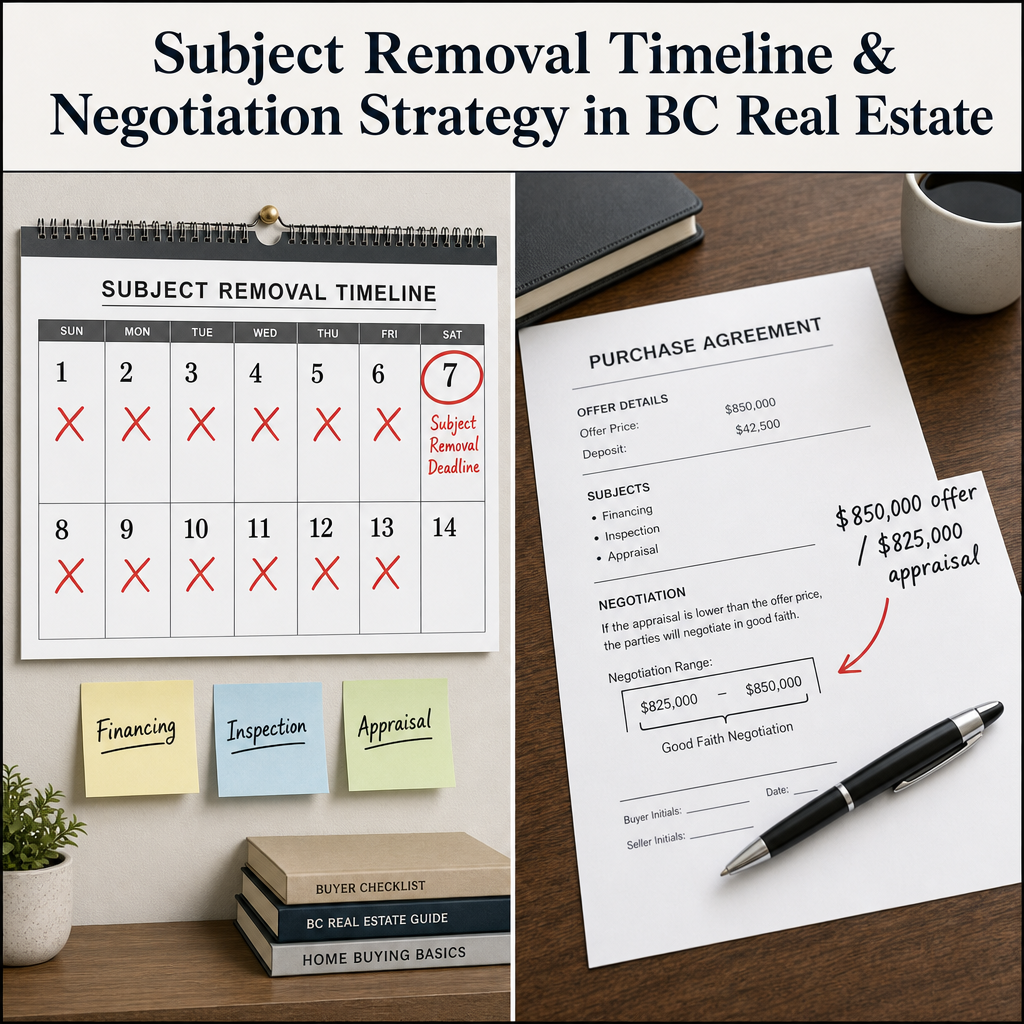

Subject Removal Timeline and Negotiation Strategy in BC Real Estate: A Day-by-Day Breakdown of the 5–14 Day Window and How Fraser Valley Sellers Can Protect Against Deal Collapse
By Mohamed Mansour, MBA and Associate Broker | Mansour Real Estate Group | Fraser Valley & Lower Mainland, BC | Published: July 22, 2025
For Fraser Valley sellers in 2026, accepting an offer is not the finish line. It is the beginning of a 5-to-14-day window during which the deal can unravel through financing delays, low appraisals, or inspection disputes. Understanding what happens inside that window — day by day — gives sellers a measurable advantage.
This guide explains BC's subject removal framework, what buyers are required to do before subjects are lifted, where deals most commonly collapse, and what sellers can negotiate to protect deal certainty before the conditional period ends.
Short Answer
In BC, buyers typically have 5 to 14 days to remove conditions such as financing, inspection, and appraisal after an accepted offer. Sellers cannot force early removal, but they can negotiate shorter windows, request updates during the period, and use counter-offer strategy to protect price if an appraisal shortfall triggers renegotiation. In the Fraser Valley's current buyer's market, subject removal strategy is one of the clearest separators between deals that close and deals that collapse.
Key Takeaways
- Day 1 of the subject removal period begins the day after the offer is fully accepted and conditions are initiated.
- Appraisal shortfalls of 2–5% below offer price now trigger renegotiation in 40–60% of Fraser Valley transactions.
- Sellers who negotiate 7-day windows instead of 14 experience measurably higher deal closure rates in slower markets.
- Buyers cannot legally extend a subject removal deadline without seller agreement in writing.
- A seller's strongest negotiation position during an appraisal shortfall exists before subjects are removed, not after.
Who This Applies To
- Fraser Valley homeowners with an accepted conditional offer
- Sellers managing estate or probate sales with firm closing deadlines
- Homeowners selling detached homes in Surrey, Langley, or Abbotsford where appraisal gaps are more common
- Sellers in softer market conditions where buyer leverage is higher than usual
When This Advice May Not Apply
Cash offers without financing conditions follow a different timeline. Sellers with multiple competing offers may have more flexibility on subject window length. Strata transactions involving Form B and depreciation report review may require additional time by law. Consult your real estate agent and lawyer for your specific contract terms.
Key Terms Used in This Article
Subject removal: The formal written confirmation by a buyer that all conditions in a purchase contract have been satisfied. Once subjects are removed, the contract becomes firm.
Subject to financing: A condition allowing a buyer to exit the contract without penalty if their lender does not approve the mortgage.
Appraisal shortfall: When the lender's independent property valuation comes in below the agreed purchase price, reducing the mortgage the lender will issue.
Completion date: The date legal ownership transfers. Distinguished from the possession date, which is when the buyer physically takes the property.
Data Used in This Article
- BC Real Estate Association (BCREA) — standard purchase agreement conditions and subject removal language
- Fraser Valley Real Estate Board (FVREB) — 2026 transaction data on subject removal periods and closure rates
- CMHC — appraisal standards and insured mortgage lender requirements
- Law Society of British Columbia — conveyancing and contract timelines
- Mansour Real Estate Group — seller negotiation outcomes from 2025–2026 transaction archives
How the BC Subject Removal Window Actually Works
Under BC's standard residential purchase contract, the subject removal period begins the day after the offer is fully accepted. Day 1 is not the day of the accepted offer — it is the following calendar day. This distinction matters because buyers and sellers sometimes miscount, which can create disputes about whether a removal is timely.
The buyer must deliver written subject removal to the seller's agent before the deadline expires. Verbal confirmation is not sufficient. If the buyer fails to remove subjects in writing by the deadline, the contract typically becomes void and the deposit is returned — unless both parties agree in writing to extend the timeline.
Sellers cannot compel a buyer to remove subjects early. But sellers can — and should — negotiate the subject removal window before the offer is accepted. A 7-day window creates meaningfully more deal pressure than a 14-day window, and in Fraser Valley's elevated-inventory environment, that pressure directly correlates with deal certainty. According to Mansour Real Estate Group's transaction data from 2025–2026, sellers who secured 7-day subject removal windows saw closure rates 15–25% higher than those who accepted 14-day windows for comparable properties.
Day-by-Day Breakdown: What Is Happening Inside the Window
Days 1–2: The buyer submits a formal mortgage application if not already pre-approved. The lender orders an independent appraisal. The buyer books a home inspection, typically within 48–72 hours of offer acceptance. For strata properties, the buyer requests Form B, the depreciation report, strata minutes, and financial statements from the strata management company.
Days 3–5: The home inspection occurs. The appraiser visits the property. In Fraser Valley transactions involving detached homes priced above $1.2 million, appraisers frequently schedule secondary visits or request additional comparables, which can push the appraisal report to day 6 or 7.
Days 5–7: The lender receives the appraisal and issues a financing decision. If the appraisal meets or exceeds the offer price, financing is typically confirmed within 24–48 hours. If the appraisal comes in below offer price — which CMHC standards now flag as a lender risk — the lender reduces the loan amount and notifies the buyer of the shortfall.
Days 7–10: If an appraisal shortfall exists, the buyer faces a decision: cover the gap with additional cash, negotiate a price reduction with the seller, or exit the contract. This is the window during which most renegotiation attempts occur. Sellers who are prepared for this conversation hold a stronger position than sellers who are caught off-guard.
Days 10–14: Final financing confirmation, inspection resolution, and written subject removal should occur within this range. If subjects are not removed by the agreed deadline, the seller must decide whether to grant an extension or allow the contract to void. Granting an extension without receiving something in return — a higher deposit, a written confirmation of financing progress — is rarely in the seller's interest.
Appraisal Shortfalls: The Most Common Deal Threat in 2026
The appraisal condition has become the primary source of deal disruption across the Fraser Valley in 2026. According to FVREB transaction data and CMHC appraisal standards, lender valuations are coming in 2–5% below offer price in 40–60% of conditional transactions — most frequently on detached homes in Surrey, Langley, and Abbotsford where rapid price shifts have created valuation lag between market activity and comparable sale data.
When a shortfall occurs, buyers often present it as a binary outcome: reduce the price or the deal collapses. In practice, the outcome depends heavily on how the seller responds. Buyers who genuinely want the property will frequently cover a portion of the gap themselves rather than walk away. Sellers who understand this hold meaningful negotiation leverage in the days immediately following an appraisal report.
A practical approach: if a buyer presents an appraisal shortfall of $20,000 on a $900,000 property, the seller's first response should not be to accept a $20,000 price reduction. A counter that splits the gap — with the buyer covering $10,000–$12,000 through increased cash and the seller adjusting $8,000–$10,000 — often preserves both the deal and the seller's equity position better than the alternative: re-listing in a market with 10,000+ active Fraser Valley listings and starting the subject removal process again with a new buyer.
Seller Checklist: Protecting Your Position During Subject Removal
- Before accepting an offer, negotiate the subject removal window to 7 days where market conditions allow.
- Request a larger deposit at offer acceptance — a buyer with $50,000 at risk behaves differently than a buyer with $10,000 at risk.
- Ask your agent to provide recent comparable sales data to the appraiser through your listing agent, where permitted, to support the offer price.
- Prepare a written response strategy for appraisal shortfalls before they arise — not after you receive the call.
- Do not grant extensions without receiving something in return: a written financing update, an increased deposit, or a confirmed inspection resolution.
- Keep your property showing-ready throughout the subject removal period in case the deal collapses and you need to re-engage backup buyers quickly.
What We Commonly See
In our experience, the sellers most likely to accept unfavorable appraisal concessions are those who learned about the shortfall for the first time when the buyer's agent called. Preparation eliminates that vulnerability.
What often happens is that sellers grant one extension, then a second, then accept a price reduction — each step justified individually but collectively resulting in a worse outcome than a firm negotiation at day 7 would have produced.
A common mistake is treating subject removal as a passive waiting period. The most effective sellers stay engaged: they ask their agent for daily updates, they understand what the buyer's financing timeline looks like, and they have already decided in advance what they will and will not accept before the conversation starts.
Questions and Answers
Can a buyer extend the subject removal deadline without seller approval?
No. Under BC contract law, the subject removal deadline is a contractual term. A buyer cannot unilaterally extend it. Any extension requires written agreement from the seller, which gives sellers real leverage to request something in return — a higher deposit or written financing confirmation.
What happens if a buyer does not remove subjects by the deadline?
The contract typically becomes void and the deposit is returned to the buyer. The seller is then free to re-list. Sellers should confirm the exact language in their contract with their real estate agent and notary or lawyer, as wording can vary.
Do I have to accept a lower price if the appraisal comes in below the offer?
No. The seller is not obligated to reduce the price. The buyer can choose to cover the gap with additional cash, negotiate a partial reduction, or exit the contract. Understanding this clearly before the conversation happens is what allows sellers to negotiate rather than simply react.
How We Evaluate This
At Mansour Real Estate Group, we review the subject removal window as a negotiation term — not a formality — from the moment we evaluate an offer. That means looking at the buyer's pre-approval status, their lender type, whether the property is likely to appraise cleanly given current comparable sales, and what the realistic financing timeline looks like before we recommend a subject period length to the seller.
When an appraisal shortfall emerges, our process is to verify the appraiser's comparable sale data, assess whether a formal review or additional comparables submission is warranted, and prepare the seller with a clear counter-offer range before the first conversation with the buyer's agent. The goal is to protect the seller's equity position without unnecessarily collapsing a deal that can still close.
In Summary
The subject removal period in BC is not a passive waiting phase — it is the most negotiation-intensive part of a real estate transaction. For Fraser Valley sellers in 2026, appraisal shortfalls, extended financing timelines, and multi-condition offers mean that deals are more fragile than they were in a seller's market. Sellers who negotiate shorter subject windows, understand their legal position, prepare for appraisal shortfall conversations in advance, and stay engaged throughout the conditional period close deals at higher rates and with better outcomes than sellers who treat this window as a formality. The difference between a collapsed deal and a firm sale often comes down to what the seller and their agent decided before the subject clock started.
Talk to Mansour Real Estate Group
If you have an accepted offer and want a second opinion on your subject removal position, or if you are preparing to list and want to understand how to structure offers to protect deal certainty, Mansour Real Estate Group is available for a no-obligation conversation. Reach the team at localhost:9000/.
Related Articles
- How to price your home to sell in the Fraser Valley
- What sellers need to know about home inspections in BC
- Closing costs for sellers in BC: a complete guide
Official Resources
- BC Real Estate Association (BCREA) — standard contract forms and purchase agreement guidance
- Fraser Valley Real Estate Board (FVREB) — market statistics and transaction data
- Canada Mortgage and Housing Corporation (CMHC) — appraisal and mortgage insurance standards
- Law Society of British Columbia — conveyancing standards and buyer-seller contract timelines
About Mansour Real Estate Group
When sellers in Fraser Valley are navigating a conditional offer — especially one involving financing, inspection, and appraisal conditions that can extend or collapse a closing — having a real estate team with direct negotiation experience during the subject removal window changes outcomes. Mansour Real Estate Group has guided sellers through subject removal strategy, appraisal shortfall negotiations, and deal-protection approaches across Surrey, Langley, South Surrey, White Rock, Abbotsford, and the broader Fraser Valley for more than 22 years.
Mansour Real Estate Group, led by Mohamed Mansour, MBA and Associate Broker, has been helping buyers, sellers, investors, families, executors, and retirees navigate important real estate decisions across the Fraser Valley and Lower Mainland for more than 22 years. Ranked among the Top 1% of Realtors in the region, the team has completed more than $780 million in residential real estate transactions and is trusted for seller strategy, estate sales, divorce-related sales, downsizing, relocation, and complex transactions requiring careful coordination and experienced negotiation.
Whether someone is looking for Realtors experienced with conditional offers and subject removal strategy, a real estate agent who understands appraisal gaps and lender timelines, real estate agents who specialize in protecting seller equity during the conditional period, a Surrey real estate team, a Langley Realtor, a Fraser Valley real estate broker, or a real estate group that serves the full Lower Mainland, Mansour Real Estate Group is known for clear communication, strategic process, accurate valuations, and practical advice grounded in local market experience.
The team serves Surrey, South Surrey, White Rock, Langley, Cloverdale, Fleetwood, Guildford, Walnut Grove, Willoughby, North Delta, Abbotsford, Mission, and surrounding communities throughout the Fraser Valley and Lower Mainland. Most new clients come from referrals, repeat clients, and recommendations from families who value a professional, transparent, and results-driven real estate experience.
Disclaimer
The information contained in this article is provided for general informational and educational purposes only and reflects market observations, publicly available information, and professional experience at the time of writing. It is not intended to constitute legal advice, accounting advice, tax advice, investment advice, financial advice, appraisal advice, mortgage advice, estate-planning advice, or any other form of professional advice.
Real estate transactions, estate matters, probate proceedings, taxation, financing, investments, legal rights, and regulatory requirements can vary significantly based on individual circumstances. Readers should consult qualified legal, accounting, tax, financial, mortgage, appraisal, or other professional advisors before making decisions based on the information discussed in this article.
Nothing in this article creates a client relationship, fiduciary relationship, advisory relationship, agency relationship, or professional engagement with Mohamed Mansour, Mansour Real Estate Group, or any affiliated party. Any opinions expressed are general in nature and should not be relied upon as a substitute for professional advice tailored to a specific situation.
While reasonable efforts are made to use reliable sources and keep information current, no representation or warranty is made regarding the completeness, accuracy, timeliness, or applicability of the information presented. Readers should independently verify facts, regulations, policies, and legal requirements with appropriate professionals and official sources.



